Type
Crochet
Difficulty
beginner
Category
dishcloth
AI Thinking Process
Planning
Verification
Pattern
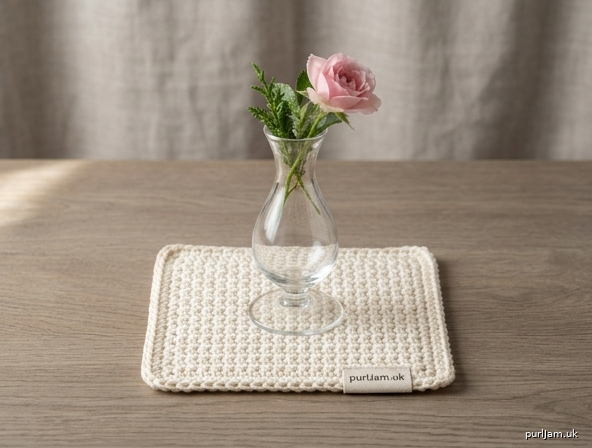
Small Vase Coaster
A small, firm cotton square that gives a little vase a steady base and protects the table from scratches and light condensation. It is worked in single crochet — the first stitch most beginners learn — and finished with an optional border that keeps the edges from curling.
This is a coaster, not a waterproof tray. It will handle a cool, dry vase and light condensation. Do not stand the vase in a puddle of water.
Skill Level
Beginner. You should know how to chain, single crochet, and slip stitch. Every count is written out. The border repeat is spelled out so you do not have to guess how many stitches to put along the sides.
Sizes
Instructions are written for Small, with Medium in parentheses. If only one number is given, it applies to both sizes.
- Small — for a vase base up to 3 inches (7.5 cm) wide. A bud vase or a small bottle.
- Medium — for a vase base up to 4 inches (10 cm) wide.
Measure the foot of the vase — the part that actually sits on the coaster — not the widest part of the glass. After the border, you want at least 1/2 inch (1.3 cm) of coaster showing on every side. If the foot is wider than 4 inches (10 cm), this small coaster will not cover it with a margin.
Finished Measurements
| Small | Medium | |
|---|---|---|
| Body, before border | 4 × 4 inches (10 × 10 cm) | 5 × 5 inches (12.5 × 12.5 cm) |
| After Border Round 1 | about 4.5 × 4.5 inches (11.5 × 11.5 cm) | about 5.5 × 5.5 inches (14 × 14 cm) |
| After optional Round 2 | about 5 × 5 inches (12.5 × 12.5 cm) | about 6 × 6 inches (15 × 15 cm) |
        16 (20) sc  =  4 (5) inches
      ┌─────────────────────┐
      │                     │
      │      20 (25) rows   │  =  4 (5) inches
      │                     │
      └─────────────────────┘
Yarn
Worsted weight cotton, Medium / 4. A dishcloth cotton such as Lily Sugar’n Cream or a similar smooth cotton is a good choice. Cotton holds its shape, washes clean, and will not stretch the way many acrylics do.
- Small: 30 yards (27 m) / about 0.6 oz (18 g)
- Medium: 45 yards (41 m) / about 1 oz (28 g)
One color is all you need. A contrasting color for the border is optional; join the new color at the start of the border.
Hook and Notions
- Crochet hook: US G/6 (4 mm), or the size that gives you gauge
- Yarn needle
- Scissors
- One stitch marker, or a short scrap of contrasting yarn, to mark the right side
The suggested hook is smaller than many worsted labels recommend. That is intentional. A firm fabric keeps the vase from stretching the coaster. Gauge matters more than the hook name printed here.
Gauge
16 single crochet and 20 rows = 4 inches (10 cm). That is 4 sc and 5 rows = 1 inch (2.5 cm).
Gauge swatch: Chain 18. Row 1: Sc in the 2nd chain from the hook and in each chain across — 17 sc. Rows 2–10: Ch 1, turn, sc in each sc across. Lay the swatch flat and do not stretch it. Four sc should measure 1 inch (2.5 cm) across, and 5 rows should measure 1 inch (2.5 cm) tall.
- More than 4 sc per inch: your stitches are tight. Use a larger hook.
- Fewer than 4 sc per inch: your stitches are loose. Use a smaller hook.
- Rows too short or too tall: change hook size and check again. Both numbers matter. If the row gauge is off, the coaster will not be square and the border will not lie flat.
You may instead measure the coaster itself after Row 10. If the gauge is off, unravel and start again with a different hook. A small piece is quicker to redo than to block into the wrong size.
Abbreviations (US terms)
- ch — chain
- sc — single crochet
- sl st — slip stitch
- st(s) — stitch(es)
- RS — right side
- WS — wrong side
This pattern uses US stitch names. US single crochet (sc) is the same stitch as UK double crochet.
Notes
- Chain 1 at the start of a row does not count as a stitch. Do not skip the first sc of the row. Work a sc into it.
- The right side is the side facing you while you work Row 1. Mark it.
- Count your stitches at the end of every row. Every body row has 16 (20) sc.
- A row-end is the stitch at the end of a row, seen from the side edge. Each row has one row-end on each side. Do not work an extra stitch into the turning chain.
- Crochet firmly enough that you cannot see large holes, but not so tightly that the hook will not go in. If the fabric is rigid and unpleasant to work, go up to a US 7 (4.5 mm) hook and check gauge again.
- The coaster protects against scratches and minor dampness. Empty a vase before you move it, and wipe spills rather than letting water sit.
Instructions
Chain 17 (21).
You will work into 16 (20) of these chains. The chain you skip at the start is only there to lift the first stitch. (17 − 1 = 16 ✓; 21 − 1 = 20 ✓)
Row 1 (RS): Sc in the 2nd ch from the hook and in each ch across. Turn. — 16 (20) sc
Mark this side as the right side.
Rows 2–20 (2–25): Ch 1, turn, sc in each sc across. — 16 (20) sc
Work the first sc of each row into the first sc, not into the chain-1. Work the last sc into the last sc.
Row check, Small: Row 1 plus Rows 2–20 is 20 rows. (1 + 19 = 20 ✓) Row check, Medium: Row 1 plus Rows 2–25 is 25 rows. (1 + 24 = 25 ✓)
Size check: 16 sc ÷ 4 sc per inch = 4 inches wide ✓. 20 rows ÷ 5 rows per inch = 4 inches tall ✓. Medium: 20 ÷ 4 = 5 inches wide ✓. 25 ÷ 5 = 5 inches tall ✓.
Fasten off. Weave in this end later, on the wrong side.
The body is complete. If you are skipping the border, go to Finishing. The border is recommended: a plain single-crochet edge can curl, and a vase needs a flat base.
Border (optional, recommended)
The border is worked on the right side. Round 1 adds about 1/2 inch (1.3 cm) to both the width and the height. The skip repeat on the sides is required. Single crochet rows are shorter than single crochet stitches are wide, so a stitch in every row-end would make the sides wavy.
Hold the coaster with the right side facing you and the final row at the top. Join yarn with a sl st in the first stitch of the final row (either end of that row).
Round 1: Ch 1. Sc in the same stitch and in each stitch across the top. — 16 (20) sc. This is one sc in every top stitch, including the stitch you joined into. Do not add an extra stitch at the join.
Ch 2 for the corner. The chain-2 is the corner. Do not also skip a stitch.
Along the first side, work (sc in the next 4 row-ends, skip the next row-end) 4 (5) times. — 16 (20) sc.
Side check, Small: 4 repeats × (4 sc + 1 skip) = 16 sc and 4 skips. 16 + 4 = 20 row-ends, which is every row ✓. Side check, Medium: 5 × (4 + 1) = 20 sc and 5 skips. 20 + 5 = 25 row-ends ✓.
Ch 2 for the corner.
Sc in each free loop of the foundation chain across the bottom. — 16 (20) sc. There is one free loop for each sc of Row 1.
Ch 2 for the corner.
Along the remaining side, work (sc in the next 4 row-ends, skip the next row-end) 4 (5) times. — 16 (20) sc.
Ch 2 for the last corner. Join with a sl st to the first sc of the round.
Round 1 count: 4 edges × 16 sc = 64 sc and 4 ch-2 spaces for Small ✓. 4 × 20 = 80 sc and 4 ch-2 spaces for Medium ✓.
Fasten off here if you are not working Round 2.
Round 2 (optional): Ch 1. Sc in each sc around, and work (sc, ch 2, sc) in each ch-2 corner space. Join with a sl st to the first sc. — 72 (88) sc and 4 ch-2 spaces.
Round 2 check: each corner adds 2 sc, and there are 4 corners. Small: 64 + 8 = 72 ✓. Medium: 80 + 8 = 88 ✓. The 16 (20) sc already on each side are worked once each, so the sides stay the same length as the top and bottom.
Fasten off.
Finishing
- Weave in every end on the wrong side. Run each end under several stitches, then back in the other direction for an inch or so, so a heavy vase cannot pull it out.
- Block the coaster to a square. Pin the corners, mist or steam it, and let it dry completely before you set a vase on it. Block the Small body to 4 inches (10 cm), or the bordered piece to about 4.5 inches (11.5 cm). Block the Medium body to 5 inches (12.5 cm), or the bordered piece to about 5.5 inches (14 cm).
- Set the vase in the center. You should see at least 1/2 inch (1.3 cm) of coaster beyond the foot on every side.
- Optional, if the vase slides: cut a piece of non-slip shelf liner slightly smaller than the coaster and stitch or glue it to the wrong side. Keep it inside the edge so it does not show from the top.
Care
Machine wash cool on a gentle cycle, or hand wash. Reshape to the measurements while damp and lay flat to dry. Do not tumble dry on high heat; cotton can shrink. If it does shrink, wet it again and block it back to size.
Troubleshooting
- The stitch count drops. The chain-1 was mistaken for a stitch, or the first or last sc was skipped. Unravel that row. Chain 1, then sc in the first sc and in each sc across, and recount. You need 16 (20) sc.
- The border waves. A stitch was worked into every row-end. Unravel the border and use the skip repeat: sc in 4 row-ends, skip 1.
- The corners curl. Add Border Round 1, then block. Round 2 will firm the edge further if it still lifts.
- The piece is not square. Stitch gauge and row gauge do not both match. Check the gauge section and change hook size. Blocking can neaten a small difference; it cannot turn a loose rectangle into the stated size.
- The vase wobbles. The fabric is looser than gauge, or the coaster was not blocked flat. Recheck gauge and block again. Center the foot on the coaster.
Disclaimer: This pattern was generated by AI and should be reviewed for accuracy before use. While we strive for quality, AI-generated content may contain errors. Please verify measurements, stitch counts, charts, and instructions before beginning your project. Generated by purlJam.uk
Love this pattern?
Save this pattern to your free PurlJam libraryAccess your pattern anytime
Bookmark this page to access your pattern anytime