Type
Knitting
Difficulty
beginner
Category
scarf
AI Thinking Process
Planning
Verification
Pattern
Snowy Valley Double-Knit Scarf
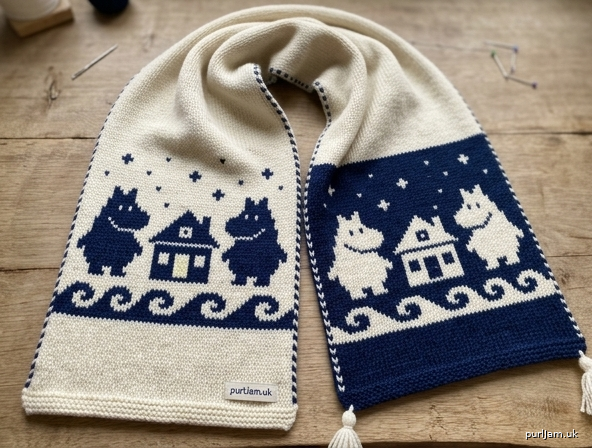
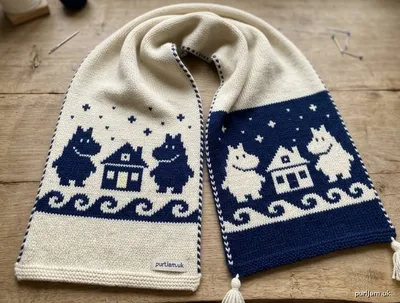
A thick, reversible rectangular scarf in two-color double knitting, inspired by round-snouted valley trolls, snowy cottages, and starry Nordic nights. One side is cream with navy motifs; the other is navy with cream motifs — the same picture, swapped. This is written as a first double-knit project: the fabric is simple (a straight rectangle), and the colorwork is described in words so you can keep it graphic and bold.
Double knitting is a step up from garter stitch, but you only need knit and purl, plus the habit of moving both yarns together. Read the primer before you cast on.
Materials
Yarn: Worsted weight wool or wool-blend, 2 colors.
- Color A (snow / troll): Cream or off-white — 320 yards (293 m). A 100 g / 220 yd (201 m) skein is not quite enough; plan on about 150 g, or two 100 g skeins.
- Color B (night / sea): Deep navy — 320 yards (293 m), same amount as Color A.
Both colors are used on every row, so you need roughly twice the yarn of a single-layer scarf. Extra yarn is better than running short on one color.
Needles: US 8 / 5 mm, straight or a 24" (60 cm) circular. If your swatch is tight and smaller than gauge, go up to US 9 / 5.5 mm.
Notions:
- Tapestry needle
- 4 stitch markers (optional, to mark pair groups)
- Scissors
- Blocking mats and pins
Gauge
In two-color double knitting, blocked:
18 visible stitches and 24 visible rows = 4" (10 cm)
A visible stitch is one knit/purl pair (the stitch you see on one face of the scarf). That means 36 working stitches = 4" (10 cm) on the needle.
Swatch at least 20 visible stitches / 40 working stitches and 28 visible rows. Measure the public side only. If you have more than 18 visible stitches in 4" (10 cm), the scarf will be narrow; go up a needle size. If you have fewer, go down a size.
Finished Size
8" (20.5 cm) wide × 60" (152.5 cm) long, blocked.
- Width: 36 visible sts ÷ 18 sts × 4" = 8" ✓
- Length: 360 visible rows ÷ 24 rows × 4" = 60" ✓
The fabric is two layers thick and will feel closer to a small wrap than a skinny winter scarf. For a narrower scarf, cast on 64 sts (32 pairs) for about 7" (18 cm). For a wider scarf, cast on 80 sts (40 pairs) for about 9" (23 cm). Always cast on an even number.
Abbreviations
- BO — bind off
- CO — cast on
- k — knit
- p — purl
- rep — repeat
- st(s) — stitch(es)
- wyib — with yarn in back
- wyif — with yarn in front
- pair — one Front knit stitch + one Back purl stitch (2 working sts = 1 visible st)
Pattern
Double-knitting primer (read this first)
Stitches are worked in pairs. On every row:
- Odd stitches (1, 3, 5, …) are Front / Side 1. Always knit these.
- Even stitches (2, 4, 6, …) are Back / Side 2. Always purl these.
Both yarns travel as a pair:
- To knit a Front stitch: move both yarns to the back, then knit with only the color that should show on Side 1.
- To purl a Back stitch: move both yarns to the front, then purl with only the color that should show on Side 2.
Background pair (Side 1 cream, Side 2 navy): k1 with A, p1 with B.
Motif pair (Side 1 navy, Side 2 cream): k1 with B, p1 with A.
Never knit and purl the same pair with one color only — that leaves a slit between the layers. The two faces of a pair must be opposite colors.
Edge seal: At the start of every row, twist Color A and Color B around each other once. This closes the long sides so the scarf is a sealed tube.
Tension: Do not tug the second yarn. The fabric should be a little looser than ordinary stockinette. If the scarf pulls in, drop down to a firmer hold on the unused yarn, not a smaller needle, until your swatch matches gauge.
Turning: Both balls stay on the same side of the work. Turn as usual; twist the yarns once, then begin the next row in pairs.
Cast on
With Color A and US 8 / 5 mm needles, long-tail CO 72 sts.
(36 visible sts × 2 = 72 working sts ✓)
(8" × 18 sts ÷ 4" = 36 visible sts ✓)
Place optional markers every 18 working sts (every 9 pairs) to make counting easier.
Setup row
Join Color B, leaving a 6" (15 cm) tail.
Twist the yarns once. Work all 36 pairs as background:
*With both yarns wyib, k1 A; with both yarns wyif, p1 B; rep from * to end.
You now have 36 cream knit stitches facing you and 36 navy purl stitches behind them. Count: 72 working sts still on the needle ✓.
Body
The scarf is worked in visible rows. Every row uses the same pair rhythm; you only change which color is knitted and which is purled.
Solid beginning — 4" (10 cm)
Work 24 visible rows in background pairs (k1 A, p1 B on every pair).
(4" × 24 rows ÷ 4" = 24 rows ✓)
Pattern field — 52" (132 cm)
Work 312 visible rows in the motif sequence below.
(52" × 24 rows ÷ 4" = 312 rows ✓)
(24 + 312 + 24 = 360 visible rows ✓)
Repeat the four bands in order until those 312 rows are complete. If you land in the middle of a band at row 312, finish the current band only if you have yarn and do not mind a slightly longer scarf; otherwise, stop on a background row so the two ends match.
Solid ending — 4" (10 cm)
Work 24 visible rows in background pairs, same as the beginning.
Motif sequence (worked in the 312-row field)
No stitch grid is required. Treat Side 1 (the cream side facing you on odd-numbered visible rows) as the “picture” side when you place motifs. Side 2 will automatically show the same shapes in opposite colors.
Keep unworked pairs as background (k1 A, p1 B). Change a pair to a motif pair (k1 B, p1 A) only where the picture needs navy on Side 1.
Band 1 — Quiet snow (about 2" / 5 cm, 12 visible rows)
All background pairs. This rest band keeps the scarf readable and beginner-friendly.
Band 2 — Round-snouted trolls (about 5" / 12.5 cm, 30 visible rows)
Place three plump troll silhouettes, evenly spaced across the 36 visible stitches, with a little background at each edge so the figures do not run into the seam.
Each figure, in words:
- A wide oval body, roughly a quarter of the scarf width and a little taller than it is wide.
- A smaller round head sitting on the body, slightly toward one side.
- A short rounded snout bumping out to the right on Side 1 (it will point left on Side 2).
- Two tiny ear bumps on top of the head.
- Optional: two small eye dots near the snout, each a single motif pair for 2–3 rows.
Keep the outlines chunky — two visible stitches thick is easier than a one-stitch line. Start and end the band with 2–3 all-background rows so the trolls sit on snow.
Band 3 — Starry night (about 3" / 7.5 cm, 18 visible rows)
On a cream Side 1, scatter small navy stars and dots:
- Single dots: 1 motif pair for 2 visible rows.
- Small stars: a plus sign — one pair for 4 rows, with one motif pair on each side for the middle 2 of those rows.
Space them irregularly so they feel like a night sky, not a grid. Leave at least two background pairs between any two marks.
Band 4 — Cottage and waves (about 5" / 12.5 cm, 30 visible rows)
Center one simple cottage on Side 1:
- A square or slightly wide rectangle for the house.
- A triangle roof sitting on the square, two visible stitches wider than the walls at the eaves.
- A 2-pair door in background color (so it shows as a cream doorway in the navy house on Side 1).
- One small square window.
Under the cottage, work 6–8 visible rows of waves: staggered 2- and 3-pair dashes of motif color, each dash 2 rows tall, offset on the next wave row, like gentle water. Then 2–3 all-background rows.
Work Bands 1–4 in order. A full pass is 12 + 30 + 18 + 30 = 90 visible rows (15" / 38 cm) ✓. Three full passes = 270 rows; then work Band 1, Band 2, and the first 12 rows of Band 3 (12 + 30 + 12 = 54) to reach 324… that overshoots. Instead: three full passes = 270 rows, then Band 1 (12) + Band 2 (30) = 312 rows exactly ✓. You will end the pattern field on trolls, then the solid cream/navy ending, which looks balanced with the solid beginning.
If you prefer fewer pictures, replace any band with Band 1 (plain snow). The scarf stays reversible and on gauge.
Working from a motif chart (optional)
If you use a separate colorwork chart, each chart square is one visible stitch (one pair). Read every row from right to left on Side 1 if that is your habit for flat knitting, but always knit the Front stitch and purl the Back stitch of the pair. A filled square = motif pair (B on Side 1); an empty square = background pair (A on Side 1). Center the chart on the 36 visible stitches and work uncharted pairs as background. Do not add extra working stitches for the chart — the 72 stitches on the needle already include both layers.
Bind off
Close the tube as you bind off:
- *K2tog (the knit stitch of the pair together with the purl stitch of the pair); rep from * across. 36 sts remain (72 ÷ 2 = 36 ✓).
- Bind off those 36 sts knitwise with both yarns held together.
- Cut both yarns, leaving 8" (20 cm) tails.
Finishing
- Close the cast-on edge. The long-tail CO in Color A is slightly open. Thread a tapestry needle with Color A and take small stitches through both layers along the cast-on, matching the twist you used on the long edges. Do not pull tight or the end will cup.
- Weave in ends between the layers. Split the scarf mouth at each end just enough to hide tails inside the tube. Weave each color along the inside of its own layer for at least 2" (5 cm), then snip. Do not weave across both colors on the same path or a shadow will show.
- Wet block. Soak in lukewarm water with a drop of wool wash for 15 minutes. Squeeze (do not wring). Roll in a towel. Pin to 8" × 60" (20.5 × 152.5 cm). The double fabric is dense; leave it until fully dry, often overnight.
- No fringe. Fringe hides the reversible edges. If you want tassels later, add them only after blocking, in matched pairs of A and B.
The finished scarf is cream with navy valley pictures on one face, navy with cream pictures on the other. Wear either side out.
Disclaimer: This pattern was generated by AI and should be reviewed for accuracy before use. While we strive for quality, AI-generated content may contain errors. Please verify measurements, stitch counts, charts, and instructions before beginning your project. Generated by purlJam.uk
Love this pattern?
Save this pattern to your free PurlJam libraryAccess your pattern anytime
Bookmark this page to access your pattern anytime