Type
Knitting
Difficulty
beginner
Category
scarf
Pattern
# Cosy Garter-Stitch Scarf — A Confident Second Project

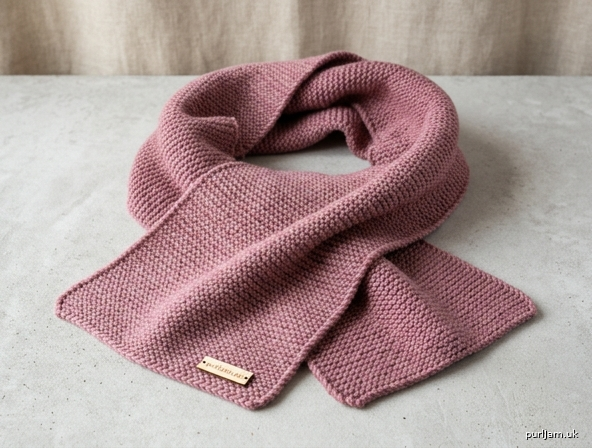
A relaxing, no-fuss rectangular scarf worked entirely in garter stitch. Because every row is knitted, there's nothing to count or chart — perfect for building confidence on your second knitting project. The garter fabric lies completely flat (no curling) and is reversible, so both sides look lovely.

---

## MATERIALS

- **Yarn:** Worsted-weight yarn (aran/medium, #4), approximately **250–300 g** (roughly 460–550 m / 500–600 yds) in the colour of your choice.
- **Needles:** A pair of **4.5 mm (UK size 7)** straight or circular knitting needles.
  - *If your tension is loose, try 4.0 mm; if tight, try 5.0 mm (UK size 6).*
- **Notions:** Tapestry/darning needle for weaving in ends; scissors.
- *(Optional)* A tape measure and a couple of stitch markers — not essential for this project.

---

## GAUGE (TENSION)

**18 sts and 36 rows = 10 cm (4")** over garter stitch on 4.5 mm needles, after gentle blocking.

> **Tension check:** Garter stitch is forgiving, but a quick swatch is wise. Cast on 22 sts, knit every row for about 12 cm, then measure 10 cm across the centre — you should count 18 stitches. If you have **more** stitches, go up a needle size; if **fewer**, go down a size.

---

## FINISHED SIZE

- **Width:** approximately **20 cm (8")**
- **Length:** approximately **152 cm (60")**

Both dimensions are easy to adjust — see the notes in the PATTERN section.

---

## ABBREVIATIONS

| Abbreviation | Meaning |
|---|---|
| **k** | knit |
| **st(s)** | stitch(es) |
| **cm** | centimetre(s) |
| **RS / WS** | right side / wrong side (in garter stitch both sides look the same) |

---

## PATTERN

**Cast on 36 sts.**

> **Maths check:** 18 sts per 10 cm × 20 cm desired width = 36 sts. ✓ (Within the recommended 32–42 cast-on range for worsted weight.)

**Every row:** k all sts (knit to end).

Repeat this single row until the scarf measures approximately **152 cm (60")** from the cast-on edge, or your desired length. Lay the work flat to measure, without stretching.

> **Length maths check:** At a tension of 36 rows = 10 cm, 152 cm ≈ **547 rows**. You do not need to count rows — simply knit until the tape measure says 152 cm.

**Bind off (cast off):** Knit 2 sts, then lift the first st over the second and off the needle; *knit 1 more st, lift the previous st over and off*; repeat from * until 1 st remains. Cut the yarn leaving a 15 cm tail and pull it through the last loop to fasten.

> **Tip — keep edges tidy:** Knit the first and last stitch of every row at your normal tension (not too tight). For an extra-neat edge, you may slip the first stitch of each row purlwise with the yarn at the back, then knit to the end — entirely optional.

### Adjusting your scarf
- **Narrower / wider:** Change the cast-on in multiples that suit you. Each extra **2 sts ≈ 1.1 cm** of width. For example, 40 sts ≈ 22 cm (8¾").
- **Shorter / longer:** Simply knit to a different length. A child's scarf might be 120 cm; an extra-long wrap could be 180 cm. Remember a longer scarf uses more yarn.

---

## FINISHING

1. **Weave in ends:** Thread each yarn tail onto the tapestry needle and weave it through several stitches along an edge on the wrong side. Trim closely.
2. **Block (recommended):** Gently wet the scarf or steam it, pat it out to **20 cm × 152 cm**, and leave it flat to dry. Blocking evens out the stitches and helps the scarf hang beautifully.
3. *(Optional)* **Add fringe:** Cut 30 cm lengths of yarn. Fold a small bundle (3–4 strands) in half, use a crochet hook to pull the folded loop through a stitch at one short end, then thread the tails through the loop and tighten. Repeat evenly across both ends and trim level.

Enjoy your beautifully finished second scarf — you've now mastered casting on, garter stitch, casting off, and finishing! 🧶
Disclaimer: This pattern was generated by AI and should be reviewed for accuracy before use. While we strive for quality, AI-generated content may contain errors. Please verify measurements, stitch counts, and instructions before beginning your project. Generated by purlJam.uk
Access your pattern anytime
Bookmark this page to access your pattern anytime