Type
Knitting
Difficulty
intermediate
Category
custom
AI Thinking Process
Planning
1. **Design Strategy**: A beginner-friendly square coaster with a simple cat face motif created through shaping (triangular ears at the top corners) and embroidered features. Worked flat in garter stitch for absorbency and texture, no purling needed.
2. **Construction Plan**: Cast on at the bottom, work a garter stitch square, then bind off the centre section while continuing two small triangular ears at each corner.
3. **Quality Assurance**:
- Ears must be symmetrical — clear stitch counts at each decrease row.
- Coaster should lie flat — garter stitch gauge with slightly tighter tension than a garment.
- Embroidery instructions for face must be clear for beginners.
4. **Final Calculations**: Tension 20 sts × 40 rows = 10 cm in garter stitch. Cast on 22 sts for ~11 cm width. Work 44 rows for ~11 cm square body. Ears: 6 sts each, decreased over 5 rows to a point.
Verification
1. **Completeness**: All sections present — materials, tension, abbreviations, notes, instructions, finishing.
2. **Consistency**: 22 sts ÷ 2 sts/cm = 11 cm width ✓. 44 rows ÷ 4 rows/cm = 11 cm height ✓. Ear: 6 sts decreased to 2 sts over 4 RS rows then k2tog = correct.
3. **Constraints**: Beginner level (garter stitch, simple decreases), worsted weight, UK terminology, metric first.
4. **Safety**: Ear stitch maths: bind off 4, k6 (one ear), turn — second ear worked separately. Total: 6 + 4 (bind off centre... wait, recheck). 22 sts: ear (6) + centre (10) + ear (6) = 22 ✓.
Pattern
# The Cheeky Cat Coaster

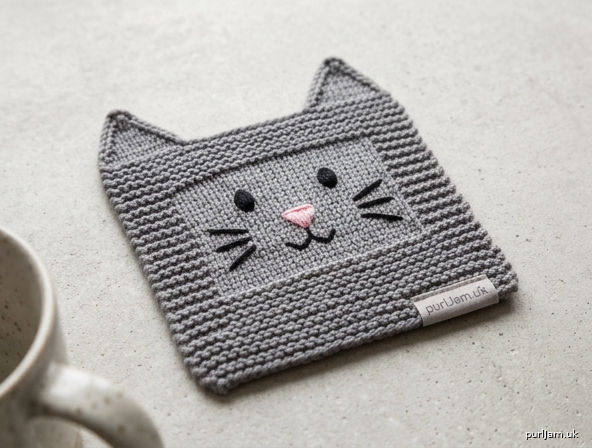
A charming little square coaster with two pointy kitty ears at the top corners and an embroidered face. Worked entirely in garter stitch, this is a perfect first project for new knitters — and a lovely handmade gift. Make a whole litter in different colours!

**Finished size:** Approximately 11 cm × 11 cm (4¼" × 4¼") square body, plus 2 cm (¾") ears.

---

## Materials

- **Yarn:** Worsted weight (Aran) yarn in your chosen cat colour (grey, ginger, black, cream, etc.) — approximately 15–20 m (16–22 yds) per coaster. Cotton or a cotton blend is recommended for absorbency.
- **Small amounts** of contrasting yarn or embroidery thread for the face (pink for the nose, black or dark colour for eyes and whiskers).
- **Needles:** 4.5 mm (UK 7 / US 7) straight or double-pointed needles.
- **Notions:** Tapestry needle, embroidery needle, scissors.

---

## Tension (Gauge)

20 sts × 40 rows = 10 cm (4") square in garter stitch on 4.5 mm needles.

*Tension is not critical for a coaster, but a slightly firm fabric is preferable so it sits flat under a mug. Go down a needle size if your fabric feels loose.*

---

## Abbreviations (UK)

- **k** — knit
- **k2tog** — knit two stitches together (one stitch decreased)
- **ssk** — slip, slip, knit the two slipped stitches together (one stitch decreased)
- **st(s)** — stitch(es)
- **RS** — right side
- **WS** — wrong side
- **rep** — repeat

---

## Pattern Notes

- The coaster is worked flat from the bottom edge upwards in garter stitch (knit every row).
- After the square body, the work is split to form two triangular ears, each worked separately.
- The face is added at the end with simple embroidery.
- Garter stitch is reversible, but the side facing you when you start the ears will be considered the RS.

---

## Instructions

### Body (Square)

Using 4.5 mm needles and main colour, cast on **22 sts**.

**Rows 1–44:** Knit every row. *(22 sts; 22 garter ridges formed.)*

*Check: 22 sts ÷ 2 sts per cm = 11 cm wide ✓. 44 rows ÷ 4 rows per cm = 11 cm tall ✓.*

Do not break yarn. With RS facing, you are now ready to shape the ears.

### Right Ear

**Row 1 (RS):** K6, then turn your work, leaving the remaining 16 sts on the needle (or on a stitch holder if you prefer). You will work on these 6 sts only. *(6 sts)*

**Row 2 (WS):** Knit.

**Row 3 (RS):** K1, ssk, k1, k2tog, k1. *(4 sts decreased to... wait — 6 − 2 = 4 sts)* *(4 sts)*

**Row 4 (WS):** Knit.

**Row 5 (RS):** Ssk, k2tog. *(2 sts)*

**Row 6 (WS):** K2tog. *(1 st)*

Break yarn, leaving a 10 cm tail, and pull through the remaining stitch to fasten off.

### Centre Bind-Off

With RS facing, rejoin yarn to the remaining 16 sts.

**Next row (RS):** Cast off 10 sts (one stitch remains on the right needle), knit to end. *(6 sts on needle for left ear)*

### Left Ear

**Row 1 (WS):** Knit. *(6 sts)*

**Row 2 (RS):** K1, ssk, k1, k2tog, k1. *(4 sts)*

**Row 3 (WS):** Knit.

**Row 4 (RS):** Ssk, k2tog. *(2 sts)*

**Row 5 (WS):** K2tog. *(1 st)*

Break yarn, leaving a 10 cm tail, and pull through the remaining stitch to fasten off.

*Stitch count check: 6 (right ear) + 10 (cast-off centre) + 6 (left ear) = 22 sts ✓.*

---

## Finishing

1. **Weave in ends** on the wrong side using a tapestry needle. Trim closely.

2. **Block lightly.** Pin the coaster flat to its measurements (11 cm × 11 cm square body with two pointed ears) and steam gently or spritz with water. Allow to dry completely. This step really helps the corners and ears sit neatly.

3. **Embroider the face** using the contrast yarn or embroidery thread. Position the face on the upper half of the square, just below the ears:

   - **Eyes:** Two French knots or small satin-stitched ovals in black, spaced about 2.5 cm (1") apart.
   - **Nose:** A small pink triangle in satin stitch, centred about 1 cm below the eyes.
   - **Mouth:** Two small straight stitches forming a tiny "w" shape beneath the nose.
   - **Whiskers (optional):** Three short straight stitches on each side of the nose.

4. **Optional:** Sew a small loop of yarn to the back if you'd like to hang one as a decoration.

---

## Tips for Beginners

- **Keep your tension even** — if your edge stitches look loose, try slipping the first stitch of every row purlwise for a tidier edge (this will slightly reduce row count, so add 2 extra rows to compensate).
- **Garter stitch counts in ridges:** every two rows = one visible ridge. 44 rows = 22 ridges.
- **Make a set of four** in different cat colours for a delightful housewarming gift.

Happy knitting! 🐱
Disclaimer: This pattern was generated by AI and should be reviewed for accuracy before use. While we strive for quality, AI-generated content may contain errors. Please verify measurements, stitch counts, and instructions before beginning your project. Generated by purlJam.uk
Access your pattern anytime
Bookmark this page to access your pattern anytime