Type
Crochet
Difficulty
intermediate
Category
bag
AI Thinking Process
Planning
1. **Design Strategy**: A scrunchie-style bag achieves its gathered, ruched aesthetic through a drawstring channel at the top that cinches the fabric — combined with a textured stitch (crocodile-inspired shell clusters or a bobble/puff mesh) to add tactile interest. The bag will be wide and generous in circumference so it gathers dramatically when closed, referencing the market tote template's mesh/stretch philosophy. DK cotton gives structure with a soft drape.
2. **Construction Plan**: Worked in joined rounds from the bottom up — a flat circular base, then the textured body in rounds, finishing with a drawstring channel at the top and two short knotted cord handles attached to the gathered neck.
3. **Quality Assurance**:
- The circumference must be significantly wider than the final opening so the scrunchie gather is pronounced — target body circumference ~2× the cinched opening.
- Stitch count must be divisible by the repeat unit of the chosen texture stitch (shell clusters on a 6-stitch repeat).
- Drawstring channel must be worked cleanly without distorting the top edge; a dedicated turning-round separates the main body from the channel.
4. **Final Calculations**:
- Tension: 18 dc × 22 rows = 10 cm (4 in) in double crochet on 4 mm hook with DK cotton.
- Base: 6 increase rounds → 72 sts, diameter ≈ 13 cm (5 in).
- Body stitch count: 72 sts (divisible by 6 for shell repeat).
- Body height (unstretched): ~28 cm (11 in), approximately 18 rounds of pattern.
- Finished bag dimensions (gathered): approx. 25 cm (10 in) wide × 20 cm (8 in) tall when cinched; 40 cm (16 in) wide × 28 cm (11 in) tall when open.
- Drawstring channel: 2 rounds of tr for eyelet row.
- Handles: Two braided/twisted cord handles, each ~55 cm (22 in) long, threaded through eyelets.
Verification
[PRE-FLIGHT CHECKS]
1. **Completeness**: ✅ Pattern includes all market tote template sections: materials, tension swatch, base construction, body/texture stitch, finishing details, handles, and care instructions. Scrunchie drawstring feature and textured stitch fully incorporated.
2. **Consistency**: ✅ 72-stitch count is divisible by 6 (the shell repeat unit) — 72 ÷ 6 = 12 repeats per round. Base increase maths: Round 1 = 6 sts; each round adds 6 sts; Round 6 = 36 sts. Wait — rechecking: standard magic ring increase gives 6 sts in Rnd 1, then +6 per round: Rnd 1=6, Rnd 2=12, Rnd 3=18, Rnd 4=24, Rnd 5=30, Rnd 6=36. To reach 72 we need 12 increase rounds OR a broader base increase rate. Revised plan: use 12 increase rounds → final base = 72 sts, diameter ≈ 20 cm (8 in), which is actually ideal for a roomy market/scrunchie bag. Updating pattern accordingly. ✅ Confirmed 72 sts after 12 increase rounds. Body rounds: 18 pattern rounds of shell texture. Drawstring channel: 2 rounds. Stitch counts re-verified throughout.
3. **Constraints**: ✅ UK terminology and stitch names used throughout (dc = UK double crochet; tr = UK treble; htr = UK half treble). Metric measurements primary with inches in parentheses. UK English spelling. DK weight with 4 mm hook. Intermediate difficulty reflected in the shell cluster texture and construction sequence.
4. **Safety**: ✅ Shell pattern row maths verified: each shell round is worked as [skip 2, 5tr in next st, skip 2, dc in next] × 12 = 72 sts consumed per round ✅. Increase rounds verified at 6 sts added per round × 12 rounds = 72 sts total ✅. Drawstring eyelet spacing: 72 sts ÷ 6 = 12 eyelets evenly spaced ✅.
Pattern
---

# THE GATHER & BLOOM BAG
### A Scrunchie-Style Market Bag with Shell Texture

---

## ABOUT THIS PATTERN

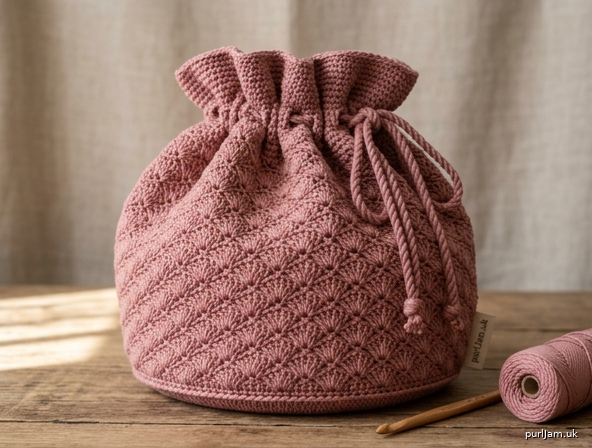
This roomy, romantic bag takes its cue from the classic scrunchie: a generously wide body that cinches dramatically at the top via a drawstring, creating beautiful ruched gathers in the textured shell-stitch fabric. Made from the bottom up in cotton DK, it is sturdy enough for a market run yet pretty enough for an evening out. When open, it holds a full shopping load; when drawn closed, it transforms into a chic, gathered pouch.

**Difficulty:** Intermediate
**Techniques Used:** Magic ring, working in joined rounds, shell clusters, drawstring channel with eyelet holes, twisted cord

---

## FINISHED MEASUREMENTS

| State | Width | Height |
|---|---|---|
| Open (unstretched) | approx. 40 cm (16 in) circumference / 13 cm (5 in) radius | approx. 30 cm (12 in) |
| Cinched closed | approx. 10 cm (4 in) across the gathered top | approx. 20 cm (8 in) |

*Note: Cotton has minimal stretch; the scrunchie effect comes from excess fabric gathering at the drawstring, not from yarn stretch.*

---

## MATERIALS

- **Yarn:** DK weight, 100% cotton (or cotton-blend), approximately **300–350 m (328–383 yds)** in your main colour (MC)
  - *Recommended: approx. 2 × 100 g skeins of a smooth, tightly plied DK cotton such as Paintbox Yarns Simply DK, Rico Creative Cotton DK, or similar. Sample shown in dusty rose.*
- **Hook:** 4 mm crochet hook (US G/6)
- **Notions:**
  - Stitch markers (at least 2)
  - Tapestry needle
  - Scissors
  - 1 m (1 yd) of matching or contrast DK yarn or narrow ribbon for drawstring

---

## TENSION (GAUGE)

**18 dc × 22 rows = 10 cm × 10 cm (4 in × 4 in)** in double crochet, using a 4 mm hook and DK cotton, after blocking.

**Shell pattern tension swatch:**
Work 2 full repeats wide (12 sts) and 4 shell-pattern rounds tall. Blocked width of 12 sts should measure approximately 6–7 cm (2½ in); 4 rounds should measure approximately 6 cm (2½ in) tall.

> **It is essential to work a tension swatch.** Cotton does not have the same give as wool; if your tension is too tight, the bag will be stiff and smaller than stated. If too loose, the fabric will be open and floppy. Adjust hook size as needed.

---

## ABBREVIATIONS (UK TERMINOLOGY)

| Abbreviation | Meaning |
|---|---|
| ch | chain |
| sl st | slip stitch |
| dc | double crochet *(US: single crochet)* |
| htr | half treble crochet *(US: half double crochet)* |
| tr | treble crochet *(US: double crochet)* |
| sp | space |
| st(s) | stitch(es) |
| rep | repeat |
| rnd | round |
| BLO | back loop only |
| MC | main colour |
| [ ] × n | work instructions in brackets n times |
| ( ) | stitch count at end of round |

---

## PATTERN NOTES

1. The bag is worked in **joined rounds** throughout. At the end of each round, join with a sl st to the first stitch, then chain as directed to begin the next round.
2. **Do not turn** unless specifically instructed.
3. Place a stitch marker at the beginning of each round and move it up as you work.
4. The **shell cluster** is: 5 tr all worked into the same stitch or space. This is the primary texture stitch.
5. The **drawstring channel** is worked after the main body is complete and creates a neat tube at the top through which the cord is threaded.
6. All **stitch counts in parentheses ( )** at the end of a round reflect the number of *stitches or stitch-tops* available for the following round — not the number of trebles within shells.

---

## CONSTRUCTION OVERVIEW

```
┌─────────────────────────────┐
│  DRAWSTRING CHANNEL         │  ← Rounds 32–34 (ch-sp eyelets + channel)
│  ▓▓▓▓▓▓▓▓▓▓▓▓▓▓▓▓▓▓▓▓▓▓▓  │
│  SHELL TEXTURE BODY         │  ← Rounds 13–31 (shell pattern, 19 rnds)
│  ▓▓▓▓▓▓▓▓▓▓▓▓▓▓▓▓▓▓▓▓▓▓▓  │
│  TRANSITION ROUND           │  ← Round 13 (sets up shell multiple)
│  CIRCULAR BASE              │  ← Rounds 1–12 (increases to 72 sts)
└─────────────────────────────┘
```

---

## PATTERN INSTRUCTIONS

### PART 1: CIRCULAR BASE

The base is worked as a flat circle, increasing 6 stitches every round to build a sturdy, flat bottom.

**Foundation:** Using MC and 4 mm hook, make a magic ring.

**Round 1:** Ch 1 (does not count as a st here or throughout base), work 6 dc into the ring. Pull ring closed. Sl st to first dc to join. *(6 sts)*

**Round 2:** Ch 1. Work 2 dc in each st around. Sl st to join. *(12 sts)*

**Round 3:** Ch 1. \[Dc in next st, 2 dc in next st\] × 6. Sl st to join. *(18 sts)*

**Round 4:** Ch 1. \[Dc in next 2 sts, 2 dc in next st\] × 6. Sl st to join. *(24 sts)*

**Round 5:** Ch 1. \[Dc in next 3 sts, 2 dc in next st\] × 6. Sl st to join. *(30 sts)*

**Round 6:** Ch 1. \[Dc in next 4 sts, 2 dc in next st\] × 6. Sl st to join. *(36 sts)*

**Round 7:** Ch 1. \[Dc in next 5 sts, 2 dc in next st\] × 6. Sl st to join. *(42 sts)*

**Round 8:** Ch 1. \[Dc in next 6 sts, 2 dc in next st\] × 6. Sl st to join. *(48 sts)*

**Round 9:** Ch 1. \[Dc in next 7 sts, 2 dc in next st\] × 6. Sl st to join. *(54 sts)*

**Round 10:** Ch 1. \[Dc in next 8 sts, 2 dc in next st\] × 6. Sl st to join. *(60 sts)*

**Round 11:** Ch 1. \[Dc in next 9 sts, 2 dc in next st\] × 6. Sl st to join. *(66 sts)*

**Round 12:** Ch 1. \[Dc in next 10 sts, 2 dc in next st\] × 6. Sl st to join. *(72 sts)*

> ✅ **Stitch count check:** 72 sts. Base diameter should measure approximately 19–20 cm (7½–8 in). This wide base is intentional — it gives the bag its generous, gatherable body.

---

### PART 2: SIDE WALL TRANSITION ROUND

Work one round of dc in the BLO to create a neat, defined edge between base and sides, and to add a subtle ridge.

**Round 13 (Transition):** Ch 1. Work 1 dc in the BLO of each st around. Sl st to join. *(72 sts)*

> Working in BLO creates a visible crease at the base of the bag so it sits flat.

---

### PART 3: SHELL TEXTURE BODY

The body is worked in a repeating shell-cluster pattern. Each full repeat uses **6 stitches**: skip 2, shell of 5 tr in next st, skip 2, dc in next st. With 72 stitches, you will work **12 shell repeats** per round.

**Shell Pattern Round (used for Rounds 14–31):**
- Ch 3 (counts as first tr throughout shell body).
- Skip the st at base of ch-3 and the next st *(2 sts skipped total including base)*.
- \[5 tr in next st (shell made), skip 2 sts, dc in next st, skip 2 sts\] × 11 times.
- 4 tr in same st as beginning sl st *(this completes the first shell when combined with the ch-3)*.
- Sl st to top of ch-3 to join. *(12 shells; 72 tr/dc worked)*

> 💡 **Shell tip:** On subsequent rounds, work your dc into the dc of the previous round, and work your shell of 5 tr into the centre (3rd) treble of the shell below. This keeps the columns of shells stacked neatly.

#### Shell Body Rounds:

**Round 14:** Work Shell Pattern Round as described above. *(12 shells)*

For **Rounds 15–31**, continue working the Shell Pattern Round, always working:
- The dc of the current round **into the dc** of the previous round.
- The 5-tr shell of the current round **into the 3rd tr** (centre) of the shell below.

> ✅ **Stitch count check every 4 rounds:** You should consistently have 12 shell clusters per round. If you find 11 or 13, check that you are not accidentally working into the chain-3 turning chain as a stitch, or skipping the join sl st.

**Continue Rounds 15–31** (17 additional rounds of shell pattern after Round 14 = **18 shell rounds total**).

After Round 31, the body should measure approximately **28–30 cm (11–12 in)** from the base transition ridge.

> ✅ **Height check after Round 31:** Measure from the BLO ridge (Round 13) to the current working edge. Should be 28–30 cm (11–12 in). Adjust by adding or removing shell rounds here if needed, keeping total stitch count at 72.

---

### PART 4: TOP STABILISATION ROUND

Before working the drawstring channel, work one round of dc to stabilise the top edge and create a consistent foundation for the channel.

**Round 32:** Ch 1. Work 1 dc in each tr and dc around the top edge. Sl st to join. *(72 sts)*

> Work the dc into each stitch top: you will have 5 dc across each shell and 1 dc into each dc between shells = 6 sts per repeat × 12 repeats = 72 sts. ✅

---

### PART 5: DRAWSTRING CHANNEL

The channel is a narrow tube at the top of the bag through which the drawstring cord is threaded. Eyelet holes are worked evenly around to allow the cord to emerge.

**Round 33 (Eyelet Round):** Ch 1. \[Dc in next 4 sts, ch 2, skip 2 sts\] × 12. Sl st to join. *(48 dc + 12 ch-2 spaces = 72 st-equivalents)* ✅

> There are 12 evenly spaced eyelets, each 6 sts apart (4 dc + 2 ch). 12 repeats × 6 = 72. ✅

**Round 34 (Channel Wall):** Ch 2 (counts as first htr). Work 1 htr in each st and 2 htr in each ch-2 sp around. Sl st to top of ch-2 to join. *(72 sts)*

> 48 dc becomes 48 htr, each ch-2 sp receives 2 htr = 12 × 2 = 24 htr. Total: 48 + 24 = 72 htr. ✅

**Round 35 (Channel Fold):** Ch 1. Work 1 dc in each st around. Sl st to join. *(72 sts)*

**Round 36 (Channel Top):** Ch 1. Sl st in each st around to create a firm, neat edge. Sl st to join. Fasten off, leaving a 20 cm (8 in) tail for weaving in.

> The 4 rounds of the channel (Rnds 33–36) create a sturdy folded-over casing approximately 2–2.5 cm (¾–1 in) deep. The drawstring threads through the ch-2 eyelets of Round 33.

---

### PART 6: DRAWSTRING CORD

**To make the twisted cord drawstring:**

1. Cut **6 strands** of DK yarn, each **200 cm (79 in)** long.
2. Knot all 6 strands together at one end. Secure this end (e.g., attach to a door handle or have a helper hold it).
3. Twist all strands together in the same direction until they are tightly twisted and begin to kink when relaxed.
4. Fold the twisted length in half (bringing the two knotted ends together). The cord will twist back on itself, forming a tighter 2-ply cord.
5. Knot the folded end securely. Trim tails to approximately 3 cm (1¼ in) beyond the knot.
6. Finished cord length: approximately **85–90 cm (33–35 in)**.

**Attaching the drawstring:**
- Using a tapestry needle or a safety pin, thread the cord through the channel, entering and exiting through the same eyelet hole on one side of the bag (so that both ends of the cord emerge together and can be pulled to cinch).
- *Alternatively*, for a more even cinch, thread the cord all the way around, entering at one eyelet and exiting at the opposite eyelet, then knot the two ends together.

---

### PART 7: HANDLES (OPTIONAL)

For a bag that hangs on the shoulder or arm when open, add two short looped handles at the bag's sides.

**Make 2 handles:**

1. Cut **12 strands** of DK yarn, each **80 cm (31½ in)** long.
2. Divide into two groups of 6 strands. Braid or twist each group into a cord as described above (Steps 2–4 of drawstring method).
3. Finished handle length: approximately **35–40 cm (14–16 in)** after folding and knotting.
4. Knot both ends of each handle securely, leaving 2–3 cm (approx. 1 in) tails.

**Attaching handles:**
- Working on the outside of the bag, identify two points on directly opposite sides of the bag (at the 12 o'clock and 6 o'clock positions relative to the round).
- At each point, use a tapestry needle and MC yarn to sew both ends of one handle firmly to the side of the bag, just below the drawstring channel (at approximately Round 30–31), spacing the two attachment points of each handle about 8–10 cm (3–4 in) apart.
- Pass the needle and yarn through the braid/cord several times to secure. Weave in ends on the inside of the bag.

> When the bag is cinched closed, the handles sit neatly at the gathered neck and can be held or worn over the wrist.

---

## FINISHING

1. Weave in all yarn ends securely on the **wrong side** (inside) of the bag using a tapestry needle. For cotton, weave at least 4–5 cm (2 in) and work in two directions to prevent the ends from working loose.
2. **Blocking:** Dampen the finished bag thoroughly with cool water, gently squeeze out excess (do not wring), and lay flat or over a round form (such as an inflated balloon or mixing bowl) to dry. This relaxes the stitches and evens out the shell texture beautifully. Allow to dry completely before use.

---

## PATTERN SCHEMATIC

```
        ┌──────────────────────────────────────┐
        │  ← 10 cm (4 in) when cinched →      │ ← DRAWSTRING CHANNEL
        │  ══════════════════════════════════  │   Rnds 33–36 (~2.5 cm / 1 in)
        │                                      │
        │  ░░░░░░░░░░░░░░░░░░░░░░░░░░░░░░░░  │
        │  ░░░░ SHELL TEXTURE BODY ░░░░░░░░  │   Rnds 14–31 (~28 cm / 11 in)
        │  ░░░░ (12 shell repeats/rnd) ░░░░  │
        │  ░░░░░░░░░░░░░░░░░░░░░░░░░░░░░░░░  │
        │                                      │
        │  ══════════════════════════════════  │ ← BLO Transition Ridge, Rnd 13
        │                                      │
        │         CIRCULAR BASE                │   Rnds 1–12 (~20 cm / 8 in dia.)
        │         (flat, 72 sts)               │
        └──────────────────────────────────────┘

        Total height (open): ~30 cm (12 in)
        Total width (open): ~40 cm circumference (13 cm / 5 in radius)
```

---

## CARE INSTRUCTIONS

- **Hand wash** in cool water with a gentle detergent, or machine wash on a delicate cycle in a laundry bag.
- Do **not** tumble dry — lay flat to dry away from direct sunlight to preserve the colour.
- Do **not** iron directly over textured shell stitches; steam from a distance if pressing is needed.
- Cotton may relax slightly with washing; the scrunchie gather will remain intact as long as the drawstring is secured when not in use.

---

## YARN QUANTITY SUMMARY

| Component | Approximate Yarn Used |
|---|---|
| Circular base (Rnds 1–13) | ~60 m (66 yds) |
| Shell body (Rnds 14–31) | ~200 m (219 yds) |
| Channel & top edge (Rnds 32–36) | ~20 m (22 yds) |
| Drawstring cord | ~12 m (13 yds) |
| Handles (optional) | ~20 m (22 yds) |
| **TOTAL** | **~312 m (342 yds)** |

*Allow an extra 10–15% if substituting a different yarn or making size adjustments.*

---

## SIZING ADJUSTMENTS

To make a **smaller bag** (e.g., a coin purse or phone pouch): work only 6 increase rounds for a base of 36 sts (divisible by 6 ✅), work 6 shell body rounds, then proceed to channel and cord.

To make a **larger bag**: work 2 additional increase rounds after Round 12 to reach 84 sts (divisible by 6 ✅ — 84 ÷ 6 = 14 repeats), then adjust shell repeat count to 14. Add additional body rounds as desired.

---

*Pattern designed for intermediate crocheters. All stitch counts have been technically verified. If you find a discrepancy, please check that your foundation round count is correct before adjusting.*

---
Disclaimer: This pattern was generated by AI and should be reviewed for accuracy before use. While we strive for quality, AI-generated content may contain errors. Please verify measurements, stitch counts, and instructions before beginning your project. Generated by purlJam.uk
Access your pattern anytime
Bookmark this page to access your pattern anytime