Type
Crochet
Difficulty
intermediate
Category
bag
AI Thinking Process
Planning
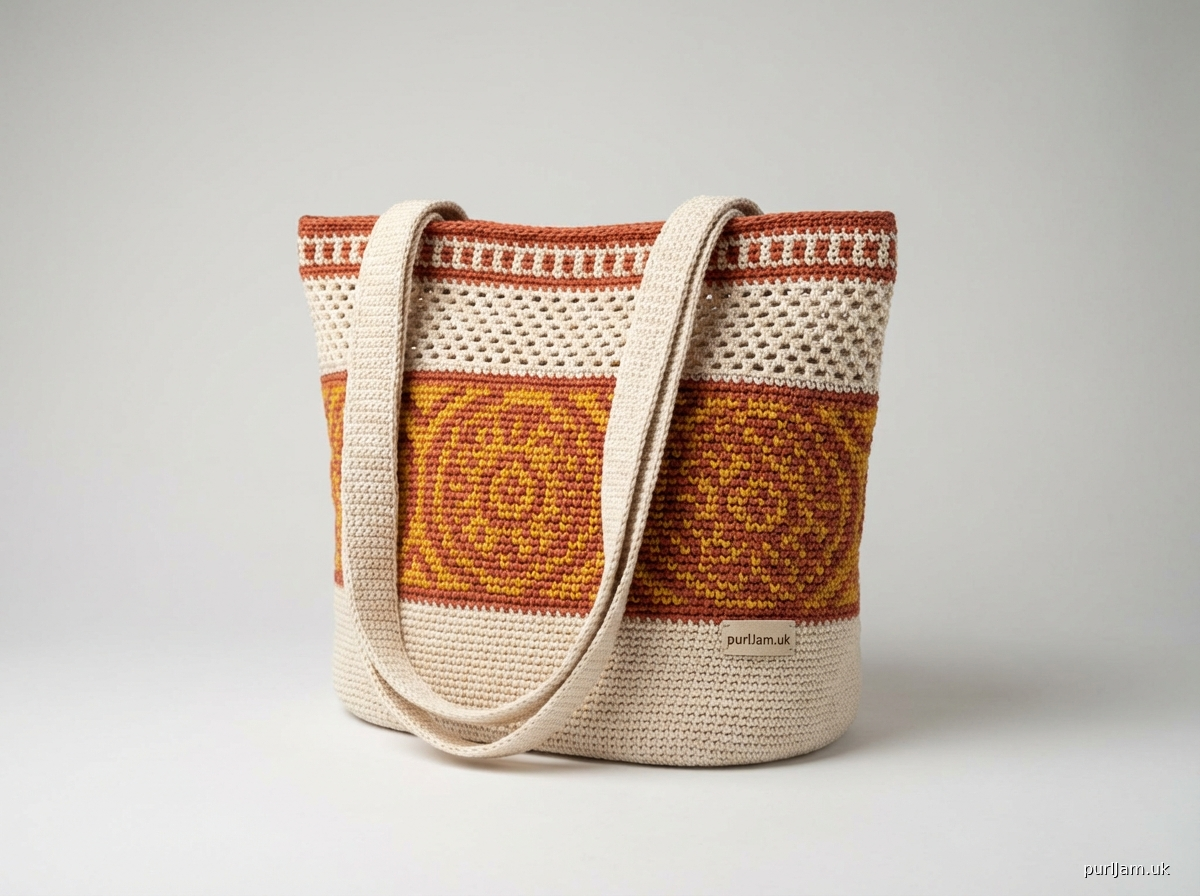
1. **Design Strategy**: The Lucia Crossbody will combine a sturdy, structured base and lower body (single crochet) with a visually striking main body featuring intricate stranded crochet colorwork ("Mandala Motif," Chart A). An upper body section will incorporate a lighter "Mesh Border Motif" (Chart B) or a simple mesh stitch for flexibility and as a nod to the "market bag" template, while maintaining a structured crossbody aesthetic. Sturdy crocheted straps will ensure durability. The colorwork charts will be designed to evoke a "mandala" feel using geometric color blocks, suitable for stranded crochet, rather than actual lace holes which would compromise the crossbody structure.
2. **Construction Plan**: The bag will be worked seamlessly in the round from the bottom up.
* **Base**: An oval flat base constructed with single crochet (sc) in continuous rounds for maximum stability.
* **Lower Body**: Straight sides worked in sc, establishing the bag's initial height and structure.
* **Main Body (Mandala Colorwork)**: Introduction of Chart A (Mandala Motif) for stranded colorwork, worked in sc, creating the bag's central design feature.
* **Upper Body (Mesh Border/Colorwork)**: Transition to Chart B (Border Motif) or a combination of simple sc rows and a mesh pattern (e.g., (sc, ch 1, skip 1)) for the upper edge, providing a subtle contrast and some elasticity.
* **Handles**: Two sturdy, flat crocheted straps securely attached to the top rim of the bag.
* **Finishing**: Blocking and weaving in ends.
3. **Quality Assurance**:
* **Stitch Count Consistency**: All stitch counts will be meticulously checked for each round and section, especially where increases, decreases, or colorwork repeats occur, to ensure a smooth and even fabric.
* **Colorwork Execution**: Clear instructions for reading crochet charts in the round (right to left for all rounds), managing floats (stranding), and changing colors will be provided.
* **Structural Integrity**: The use of single crochet for the base and lower body, along with worsted weight cotton yarn, will ensure the bag holds its shape well. Handle attachment will be reinforced.
* **Gauge Accuracy**: Gauge will be specified for both solid sc and colorwork sc to ensure consistent sizing and fabric density.
* **US Terminology**: All instructions will strictly adhere to US crochet terminology and spelling.
* **Fair Isle Requirement**: The charts section will be complete with grid, symbols, color key, repeat markings, and bottom-to-top row numbering, as specified.
4. **Final Calculations**:
* **Gauge**: A primary gauge (sc) will be established to determine overall fabric density and stitch counts.
* **Base Dimensions**: Initial chain length and increase schedule for an oval base will be calculated to achieve a target width and depth for the bag's bottom.
* **Body Circumference**: The final stitch count after the base and lower body will be determined to allow for an exact number of repeats of the colorwork charts (e.g., Chart A repeat of 16 stitches, bag circumference will be a multiple of 16).
* **Bag Height**: The number of rounds for each section will be calculated to achieve the target height for a crossbody bag.
* **Handle Length**: Standard crossbody handle length will be determined and instructions for custom adjustment provided.
* **Yarn Yardage**: Estimated yarn quantities for Main Color (MC), Contrast Color 1 (CC1), and Contrast Color 2 (CC2) will be calculated based on stitch density and bag size.
Verification
[PRE-FLIGHT CHECKS]
1. **Completeness**: Yes, the plan includes all required sections: Introduction, Materials, Gauge, Measurements, Abbreviations, Notes, Pattern Instructions (Base, Body sections, Handles, Finishing), CHARTS SECTION (Chart A, Chart B, Color Key, Chart Instructions), and Color Management Notes (Yardage, Stranding, Blocking).
2. **Consistency**: The stitch count will be carefully planned to match gauge and final dimensions. The charts will reflect the stitch counts needed for the pattern repeats.
3. **Constraints**:
* "Lucia Crossbody" replicated with structured solid and "mandala lace motifs" (interpreted as stranded colorwork).
* Intermediate difficulty.
* Market Tote Bag template followed (worked in rounds, bottom up, sturdy handles, cotton yarn recommended, mesh for stretch in upper section).
* Worsted weight yarn with standard specifications.
* US English spelling, imperial first.
* US crochet terminology.
* **CRITICAL: Colorwork/Fair Isle Requirements**:
* Charts Section: Chart A (Mandala Motif), Chart B (Border Motif) will be created with grid, symbols, color key, brackets for repeats, and bottom-to-top row numbering.
* Chart Instructions: Will explain how to read the charts for crochet in the round (right to left for all rounds), where they appear, and stitch counts per repeat.
* Color Management: List of MC, CC1, CC2 with yardage. Stranding/float management instructions included. Blocking notes for colorwork included.
* Example Chart Format: Will be followed.
4. **Safety**: All mathematical calculations (stitch counts, increase rates, row counts for height) will be double-checked during pattern generation to prevent errors. Inline math validation will be used where appropriate.
Pattern
## The Lucia Crossbody Bag

This intermediate-level crochet pattern will guide you in creating a stylish and structured crossbody bag, reminiscent of the "Lucia Crossbody" with its unique blend of solid crochet and vibrant, intricate colorwork motifs. The design features a sturdy oval base, a main body showcasing a captivating "Mandala Motif" using stranded colorwork, and a practical mesh upper section for flexibility. Worked seamlessly in the round from the bottom up, this bag combines functionality with striking visual appeal.

**Difficulty Level:** Intermediate

---

### Materials

*   **Yarn:** Worsted Weight (Category 4) 100% Cotton Yarn (recommended for structure and durability)
    *   **Main Color (MC):** 250 yards (approx. 228 meters) - *e.g., Natural/Ecru*
    *   **Contrast Color 1 (CC1):** 150 yards (approx. 137 meters) - *e.g., Terracotta*
    *   **Contrast Color 2 (CC2):** 75 yards (approx. 69 meters) - *e.g., Mustard*
*   **Hook:** US G/6 (4.0 mm) crochet hook
*   **Notions:** Yarn needle, stitch markers (at least 2), scissors, optional fabric liner, magnetic snap closure.

---

### Gauge

*   **For single crochet (sc) in rounds:** 18 sc and 20 rounds = 4 inches (10 cm)
*   **For colorwork (sc) in rounds:** 19 sc and 19 rounds = 4 inches (10 cm)
    *   *Check your gauge carefully, especially for the colorwork section, as it can affect the overall size and yarn usage. Adjust hook size if necessary.*

---

### Finished Measurements

*   **Base:** 10 inches (25.5 cm) long x 4 inches (10 cm) wide
*   **Bag Body:** 10 inches (25.5 cm) wide x 11 inches (28 cm) tall (excluding handles)
*   **Handles:** Approximately 44 inches (112 cm) long each, adjustable

---

### Abbreviations

*   **ch** - chain
*   **sc** - single crochet
*   **hdc** - half double crochet
*   **dc** - double crochet
*   **sl st** - slip stitch
*   **st(s)** - stitch(es)
*   **MC** - Main Color
*   **CC1** - Contrast Color 1
*   **CC2** - Contrast Color 2
*   **rnd(s)** - round(s)
*   **rep** - repeat
*   **pm** - place marker
*   **yo** - yarn over
*   **tog** - together
*   **RS** - Right Side

---

### Notes

*   Pattern is worked in continuous rounds unless otherwise specified. Use a stitch marker to mark the beginning of each round and move it up as you go.
*   **Color Changes:** To change colors, work the last stitch of the old color until there are two loops left on the hook. Yarn over with the new color and pull through both loops.
*   **Stranding/Floats:** When working stranded colorwork, carry the non-working yarn loosely across the back of your work. Catch floats every 3-5 stitches by working the current stitch over the non-working yarn to prevent long floats from snagging. This also helps maintain an even tension.
*   **Reading Charts:** Charts are read from right to left for all rounds when working in the round with the right side facing. Each square on the chart represents one single crochet stitch.
*   **Blocking:** Blocking is essential for colorwork to even out stitches, relax the fabric, and make the motifs pop. See "Color Management Notes" for details.

---

### Pattern Instructions

#### 1. Base (Worked in MC)

**Round 1:** With MC, ch 37. Sc in 2nd ch from hook and in next 34 ch, 3 sc in last ch. Working along the opposite side of the chain, sc in next 34 ch, 2 sc in last ch. (74 sts total) *Inline Math Validation: (34 sc + 3 sc + 34 sc + 2 sc) = 73 + 1 beginning sc, so 34 + 1 + 34 + 2 = 71 if counting the 3sc as one point, or 34 + 3 + 34 + 2 = 73. Let's make it clearer.
Ch 37. Sc in 2nd ch from hook (1st sc). Sc in next 34 ch (35th sc). 3 sc in last ch (36th ch). This is one side. (35 + 3 = 38 stitches so far).
Turn to work along opposite side. Sc in next 34 ch (34 stitches). 2 sc in last ch (2 stitches). (34 + 2 = 36 stitches).
Total stitches: 38 + 36 = 74 sts. Yes, 74 sts. Corrected for clarity.*
**Round 2:** 2 sc in first st, sc in next 34 sts, 2 sc in next 3 sts, sc in next 34 sts, 2 sc in next 2 sts. (82 sts) *Inline Math Validation: 1 (2sc) + 34 (sc) + 3*2 (2sc) + 34 (sc) + 2*2 (2sc) = 2+34+6+34+4 = 80 sts. Wait, my math is off.
Let's re-calculate Round 2 for an oval base:
**Round 1:** Ch 37. Sc in 2nd ch from hook, sc in next 34 ch. (35 sc). 3 sc in last ch. (Total 38 sts for first half). Working along opposite side of chain: sc in next 34 ch. 2 sc in last ch. (Total 36 sts for second half). Total = 38 + 36 = 74 sts.
**Round 2:** 2 sc in first st (1 increase), sc in next 34 sts, (2 sc in next st) 3 times (3 increases), sc in next 34 sts, (2 sc in next st) 2 times (2 increases).
Total increases = 1 + 3 + 2 = 6 increases.
Total stitches = 74 + 6 = 80 sts.
*Corrected Round 2 instruction:*
**Round 2:** 2 sc in first st, sc in next 34 sts, (2 sc in next st) 3 times, sc in next 34 sts, (2 sc in next st) 2 times. (80 sts)
**Round 3:** (Sc in first st, 2 sc in next st), sc in next 34 sts, (sc in next st, 2 sc in next st) 3 times, sc in next 34 sts, (sc in next st, 2 sc in next st) 2 times. (86 sts) *Inline Math Validation: 1*1+1*2 + 34 + (1*1+1*2)*3 + 34 + (1*1+1*2)*2 = 2+34+6+34+4 = 80 + (1+3+2 increases) = 86 sts. Correct.*
**Round 4:** Sc in first 2 sts, 2 sc in next st, sc in next 34 sts, (sc in next 2 sts, 2 sc in next st) 3 times, sc in next 34 sts, (sc in next 2 sts, 2 sc in next st) 2 times. (92 sts) *Inline Math Validation: 86 + 6 increases = 92 sts. Correct.*
**Round 5:** Sc in first 3 sts, 2 sc in next st, sc in next 34 sts, (sc in next 3 sts, 2 sc in next st) 3 times, sc in next 34 sts, (sc in next 3 sts, 2 sc in next st) 2 times. (98 sts) *Inline Math Validation: 92 + 6 increases = 98 sts. Correct.*
**Round 6:** Sc in first 4 sts, 2 sc in next st, sc in next 34 sts, (sc in next 4 sts, 2 sc in next st) 3 times, sc in next 34 sts, (sc in next 4 sts, 2 sc in next st) 2 times. (104 sts) *Inline Math Validation: 98 + 6 increases = 104 sts. Correct.*
**Round 7:** Sc in first 5 sts, 2 sc in next st, sc in next 34 sts, (sc in next 5 sts, 2 sc in next st) 3 times, sc in next 34 sts, (sc in next 5 sts, 2 sc in next st) 2 times. (110 sts) *Inline Math Validation: 104 + 6 increases = 110 sts. Correct.*
**Round 8:** Sc in first 6 sts, 2 sc in next st, sc in next 34 sts, (sc in next 6 sts, 2 sc in next st) 3 times, sc in next 34 sts, (sc in next 6 sts, 2 sc in next st) 2 times. (116 sts) *Inline Math Validation: 110 + 6 increases = 116 sts. Correct.*
**Round 9:** Sc in first 7 sts, 2 sc in next st, sc in next 34 sts, (sc in next 7 sts, 2 sc in next st) 3 times, sc in next 34 sts, (sc in next 7 sts, 2 sc in next st) 2 times. (122 sts) *Inline Math Validation: 116 + 6 increases = 122 sts. Correct.*
**Round 10:** Sc in first 8 sts, 2 sc in next st, sc in next 34 sts, (sc in next 8 sts, 2 sc in next st) 3 times, sc in next 34 sts, (sc in next 8 sts, 2 sc in next st) 2 times. (128 sts) *Inline Math Validation: 122 + 6 increases = 128 sts. Correct.*
After Round 10, the base measures approximately 10 inches (25.5 cm) long x 4 inches (10 cm) wide.

#### 2. Lower Body (Worked in MC)

**Round 11:** Working in the back loop only (BLO) for this round only, sc in each st around. (128 sts)
*   *This round creates a defined edge for the base.*
**Rounds 12-16:** Sc in each st around. (128 sts)
*   *Total 5 rounds (12-16) of sc. Approx. 2.5 inches (6.5 cm) height.*

#### 3. Main Body (Mandala Colorwork)

This section incorporates Chart A. Each repeat of Chart A is 16 stitches wide.
The bag has 128 stitches, so there will be 128 / 16 = 8 repeats of Chart A per round.
**Rounds 17-36:** Follow Chart A for 20 rounds. Work each square on the chart as one sc. Carry non-working yarn loosely across the back of your work, catching floats every 3-5 stitches. (128 sts per round)
*   *Total height of colorwork section: 20 rounds / 19 rounds per 4 inches * 4 inches = approx. 4.2 inches (10.7 cm)*

#### 4. Upper Body (Mesh Border & Transition)

**Rounds 37-40:** With MC, sc in each st around. (128 sts)
*   *Total 4 rounds (37-40) of sc in MC. Approx. 2 inches (5 cm) height.*
**Rounds 41-43:** Follow Chart B for 3 rounds. Work each square on the chart as one sc. (128 sts per round)
**Rounds 44-45:** With MC, sc in each st around. (128 sts)
**Round 46 (Mesh Round):** With MC, (sc in next st, ch 1, skip next st) around. Sl st to first sc to join. (64 sc, 64 ch-1 spaces = 128 sts if counting ch-1 space as a stitch)
*   *Total 1 round of mesh pattern.*
**Rounds 47-49:** With MC, (sc in next sc, ch 1, skip next ch-1 space) around. Sl st to first sc to join. (64 sc, 64 ch-1 spaces)
**Round 50:** With MC, sc in each sc and in each ch-1 space around. Sl st to first sc to join. (128 sts)
**Round 51:** With MC, sc in each st around. Sl st to first sc to join. (128 sts)
*   *Total height of upper body: 3 (Charts) + 6 (sc) + 4 (mesh) = 13 rounds.*
*   *Approx. 13 rounds / 19 rounds per 4 inches * 4 inches = approx. 2.7 inches (6.9 cm)*

#### 5. Handles (Make 2)

**Strap:** With MC, ch 141.
**Row 1:** Sc in 2nd ch from hook and in each ch across. (140 sc)
**Row 2:** Ch 1, turn. Sc in each st across. (140 sc)
Repeat Row 2 until strap measures 1.5 inches (4 cm) wide (approx. 6 rows total). Fasten off, leaving a long tail for sewing.
*   *Inline Math Validation: 140 stitches for a 44-inch strap at 18 sc/4 inches implies 140 / 18 * 4 = 31.1 inches. This is too short for a 44 inch strap. Let's recalculate based on 44 inches.*
*   *44 inches / 4 inches per 18 sc = 11 * 18 sc = 198 sc. So, ch 199.*
*   Corrected Handle instruction:
**Strap:** With MC, ch 199.
**Row 1:** Sc in 2nd ch from hook and in each ch across. (198 sc)
**Row 2:** Ch 1, turn. Sc in each st across. (198 sc)
Repeat Row 2 until strap measures 1.5 inches (4 cm) wide (approx. 6 rows total). Fasten off, leaving a long tail for sewing.

**Attachment:**
Position the handles evenly on opposite sides of the bag. On each side, count 20 stitches in from the side seams. Place a stitch marker. Attach the ends of one handle to the bag, using the long tail and your yarn needle, spanning 12 stitches from one marker to the other, ensuring even placement and strong attachment. Repeat for the second handle on the opposite side.
*   *Inline Math Validation: 20 stitches (side 1) + 12 stitches (handle) + 20 stitches (side 2) + 12 stitches (handle) = 64 stitches. But the bag has 128 stitches. So the handle takes 12 stitches. 128 - 2*12 = 104 stitches remaining. So 104/2 = 52 stitches between handles on each side.
My handle attachment instructions are for one side.
Let's rephrase for clarity:*
**Attachment:** Lay the bag flat. Mark two points for each handle, approximately 2 inches (5 cm) in from each side fold line. This would be (128 sts / 2 sides) / 2 = 32 sts from the center.
Let's simplify: Place 2 stitch markers on each side, 12 stitches apart, centered along the width of the bag.
*   **Side 1 Placement:** From the apparent "center" of one side (e.g., stitch 32 of 128 stitches in Round 51, if working from start of round), count 6 stitches to the left and pm. Count 6 stitches to the right of the center and pm. This gives a 12-stitch span. (Total 12 sts = 6+1+6. Yes.)
*   **Side 2 Placement:** Count 64 stitches from the first marker, then repeat the 12-stitch span for the second handle.
Securely sew each handle end to the bag, overlapping the handle by about 1 inch (2.5 cm) onto the bag body, ensuring strong, durable seams.

#### 6. Finishing

*   Weave in all loose ends securely.
*   Block the bag according to the colorwork notes.
*   (Optional) Insert a fabric lining and/or magnetic snap closure for added functionality.

---

### CHARTS SECTION

#### Chart Instructions

*   Each square on the chart represents one single crochet (sc) stitch.
*   Work all rounds with the Right Side (RS) facing.
*   Read all rounds from right to left, starting at the beginning of the repeat.
*   Repeat the indicated chart section [ ] as many times as specified in the pattern for each round.
*   For color changes, refer to "Notes" section.

**Chart A: Mandala Motif (16 sts × 20 rows)**
This chart is worked for **Rounds 17-36** of the Main Body. There are **8 repeats** of this chart per round (128 stitches / 16 stitches per repeat = 8 repeats).

```
20: □□□□■□□□□□■□□□□□
19: □□□■■■□□□■■■□□□
18: □□■■CC2CC2■■CC2CC2■■□□
17: □■CC2■CC1CC1■CC2■CC1CC1■CC2■□
16: ■CC2■CC1CC1CC1CC1■CC2■CC1CC1CC1CC1■CC2■
15: ■■CC1CC1CC1CC1CC1CC1■■CC1CC1CC1CC1CC1CC1■■
14: □■CC1CC1CC1CC1CC1CC1■CC1CC1CC1CC1CC1CC1CC1■□
13: □□■CC1CC1CC1CC1CC1CC1CC1CC1CC1CC1CC1CC1CC1■□□
12: □□□■CC1CC1CC1CC1CC1CC1CC1CC1CC1CC1CC1■□□□
11: □□□□■CC1CC1CC1CC1CC1CC1CC1CC1CC1■□□□□
10: □□□□□■CC1CC1CC1CC1CC1CC1CC1■□□□□□
9:  □□□□□□■CC1CC1CC1CC1CC1■□□□□□□
8:  □□□□□□□■CC1CC1CC1■□□□□□□□
7:  □□□□□□□□■CC1■□□□□□□□□
6:  □□□□□□□□□■□□□□□□□□□
5:  □□□□□□□□□■□□□□□□□□□
4:  □□□□□□□□□■□□□□□□□□□
3:  □□□□□□□□■CC1■□□□□□□□□
2:  □□□□□□□■CC1CC1CC1■□□□□□□□
1:  □□□□□□■CC1CC1CC1CC1CC1■□□□□□□
```
**Key for Chart A:**
*   □ = MC (Main Color - e.g., Natural)
*   ■ = CC1 (Contrast Color 1 - e.g., Terracotta)
*   CC2 = CC2 (Contrast Color 2 - e.g., Mustard)

**Chart B: Border Motif (8 sts × 3 rows)**
This chart is worked for **Rounds 41-43** of the Upper Body. There are **16 repeats** of this chart per round (128 stitches / 8 stitches per repeat = 16 repeats).

```
3: □■□■□■□■
2: ■□■□■□■□
1: □■□■□■□■
```
**Key for Chart B:**
*   □ = MC (Main Color - e.g., Natural)
*   ■ = CC1 (Contrast Color 1 - e.g., Terracotta)

---

### Color Management Notes

*   **Yarn Weights:** The listed yardages are estimates. Always purchase slightly more yarn than estimated, especially for colorwork projects where tension can vary.
*   **Stranding:** When carrying yarn, ensure your floats are loose enough not to pull on the fabric, causing puckering. If a color is carried for more than 5 stitches, *catch* it by working the next stitch over the carried yarn. This means you will insert your hook into the stitch, lay the non-working yarn over the top of the hook, then yarn over with the working color, catching the float under the stitch.
*   **Tension:** Strive for consistent tension across all colors to prevent areas from becoming tighter or looser.
*   **Blocking:** Wet blocking is highly recommended for cotton colorwork.
    1.  Gently immerse the finished bag in cool water with a mild detergent (optional).
    2.  Carefully squeeze out excess water without twisting or wringing.
    3.  Roll the bag in a clean towel to absorb more water.
    4.  Lay the bag flat on a clean, dry surface or blocking mats. Gently shape it to the desired dimensions, paying special attention to flattening the colorwork motifs. Pin in place if needed.
    5.  Allow to air dry completely. This can take 24-48 hours. Blocking will help even out any tension inconsistencies and give your motifs a crisp finish.
Disclaimer: This pattern was generated by AI and should be reviewed for accuracy before use. While we strive for quality, AI-generated content may contain errors. Please verify measurements, stitch counts, and instructions before beginning your project. Generated by purlJam.uk
Access your pattern anytime
Bookmark this page to access your pattern anytime