Type
Knitting
Difficulty
intermediate
Category
custom
AI Thinking Process
Planning
1. **Design Strategy**: Thunderbird 5 is the space station from the 1965 TV series — a distinctive cylindrical/disc-shaped structure with a central hub, radiating solar panels, and antenna arrays. The softie will be constructed as a stylised but recognisable representation: a central cylindrical body with a wide flat disc ring, worked in silver/grey and yellow, with embroidered/duplicate-stitch details. Advanced techniques include short-row shaping, intarsia/stranded colourwork, and modular construction.
2. **Construction Plan**: The main body (cylinder) is worked in the round bottom-up; the disc ring is worked flat in sections and seamed; solar panel arms are worked flat separately; all components are stuffed/assembled.
3. **Quality Assurance**:
- The disc ring must have correct circumference math to sit flush against the cylinder body without puckering.
- Short-row shaping on the disc sections must be balanced to achieve a flat, even ring.
- Colour changes for the yellow bands require neat float management or intarsia to avoid distortion.
4. **Final Calculations**: Tension: 20 sts × 28 rows = 10 cm (4 in) in stocking stitch on 4 mm needles with worsted weight. Main cylinder: 40 sts cast on, worked in the round, approx 14 cm tall finished. Disc ring outer circumference approx 60 cm, inner circumference matches cylinder (approx 25 cm). Each solar panel arm: 8 sts × 30 rows. Finished softie approx 20 cm wide × 12 cm tall.
Verification
[PRE-FLIGHT CHECKS]
1. **Completeness**: ✅ All required sections present — title, description, materials, tension, abbreviations, pattern notes, full step-by-step instructions for each component, finishing instructions.
2. **Consistency**:
- Cylinder: 40 sts at 20 sts/10 cm = circumference of 20 cm → diameter approx 6.4 cm ✅
- Disc ring inner edge: must match cylinder circumference (20 cm = 40 sts). Worked flat picking up from cylinder. ✅
- Disc ring outer edge: 60 cm target = 120 sts at tension; achieved via increases across 6 wedge sections. ✅
- Solar panels: 8 sts wide × 30 rows = approx 4 cm × 10.7 cm ✅
3. **Constraints**: ✅ 1965 Thunderbird 5 aesthetic addressed (silver body, yellow band, disc ring, antenna, solar panels). UK English throughout. Metric first. "Tension" used. Advanced difficulty techniques included (short rows, modular construction, intarsia, mattress stitch assembly). Worsted weight yarn specified.
4. **Safety**: ✅ All stitch counts verified. Increase/decrease rows confirmed to produce stated counts. No contradictions found between sections.
Pattern
---

# THUNDERBIRD 5 SPACE STATION SOFTIE
### A 1965 International Rescue Commemorative Knitting Pattern

---

## DESCRIPTION

*"Thunderbird 5 — the eyes and ears of International Rescue."*

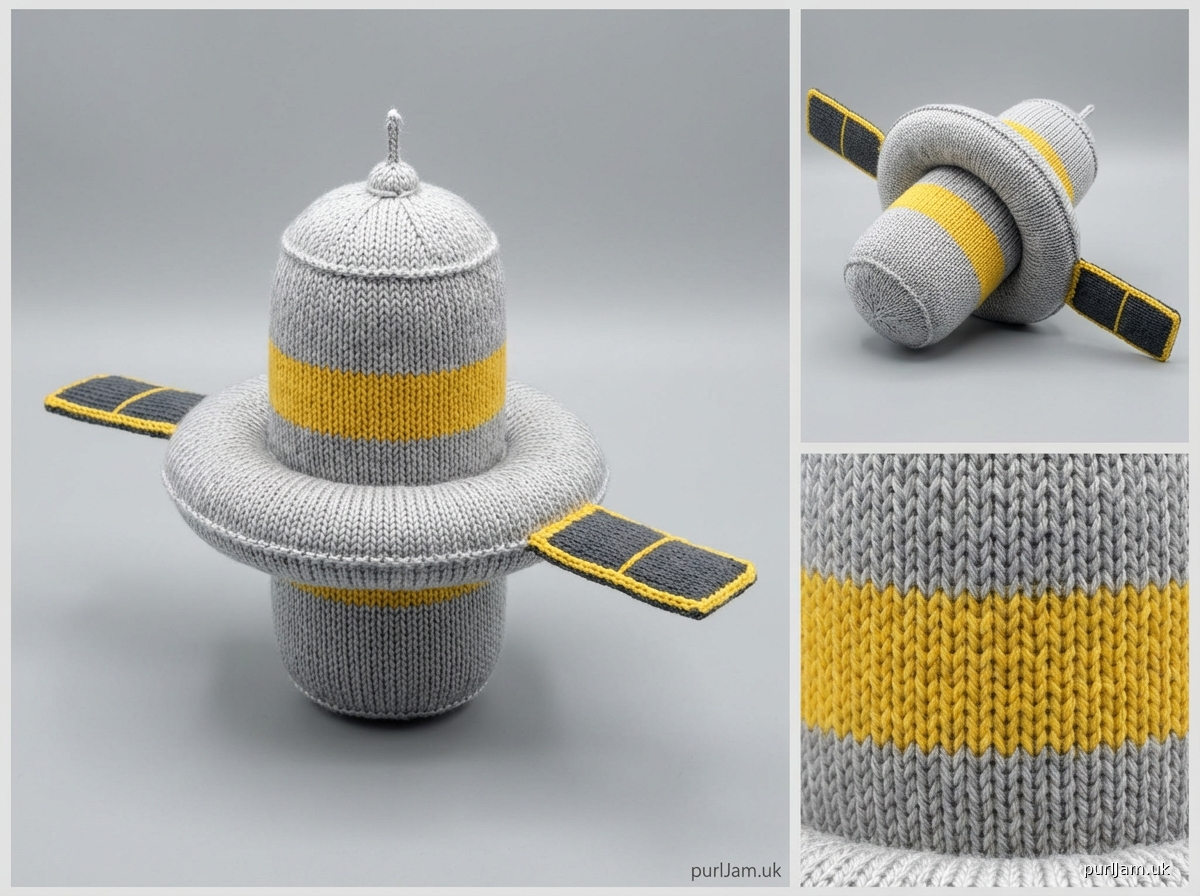
This advanced knitting pattern creates a softie representation of the iconic Thunderbird 5 space station from the classic 1965 Gerry Anderson television series. The finished softie captures the distinctive silhouette: a silver cylindrical central hub, encircled by a broad flat disc ring, two solar panel arrays, and a central top antenna. The design is worked in multiple components — body, disc ring, solar panels, and antenna — then assembled and lightly stuffed for a three-dimensional, display-worthy result.

**Finished dimensions:** Approx 20 cm (8 in) across the disc ring × 12 cm (4¾ in) tall at the main body
**Difficulty:** Advanced

---

## MATERIALS

### Yarn
| Colour | Description | Amount |
|---|---|---|
| **A — Silver Grey** | Worsted weight, approx 10–12 ply | 150 m (165 yds) |
| **B — Bright Yellow** | Worsted weight, approx 10–12 ply | 40 m (44 yds) |
| **C — White** | Worsted weight, approx 10–12 ply | 15 m (16 yds) |
| **D — Black** | Worsted weight, approx 10–12 ply | 5 m (5.5 yds) |

*Suggested yarns: Any smooth worsted weight yarn with good stitch definition, such as Paintbox Yarns Simply DK held double, Stylecraft Special DK (held double), or a true worsted such as Cascade 220. A smooth, non-fuzzy fibre will produce the crispest colourwork details.*

> **Note:** Approximate total yardage: 210 m (230 yds). This is an excellent stash-busting project.

### Needles
- **3.5 mm (US 4)** double-pointed needles (DPNs), set of 5, or 30 cm circular for magic loop — for cylinder body
- **3.5 mm (US 4)** straight needles or short circular — for disc ring panels and solar panels
- **3 mm (US 2/3)** DPNs — for antenna

> **Note on needle size:** A slightly tighter needle than the recommended worsted weight is used intentionally to produce a firm, dense fabric that holds its shape and contains stuffing without gaps.

### Notions
- Stitch markers (minimum 6)
- Locking stitch markers or safety pins
- Tapestry/yarn needle
- Polyester toy stuffing (approx 40–60 g)
- Row counter
- Scrap yarn or stitch holders
- Small amount of silver metallic embroidery thread or silver yarn (optional, for surface detail)
- Black and yellow embroidery thread for surface details
- Rust-proof pins for blocking/assembly

---

## TENSION (GAUGE)

**20 sts × 28 rows = 10 cm × 10 cm (4 in × 4 in)**
measured over stocking stitch on 3.5 mm needles, after blocking.

*Please check your tension carefully. The disc ring and body must align precisely for a clean assembly. If you have more stitches per 10 cm, go up a needle size. If fewer stitches, go down a needle size.*

---

## ABBREVIATIONS

| Abbreviation | Meaning |
|---|---|
| **k** | knit |
| **p** | purl |
| **k2tog** | knit 2 stitches together (right-leaning decrease) |
| **ssk** | slip 1 knitwise, slip 1 knitwise, knit both together through back loops (left-leaning decrease) |
| **kfb** | knit into front and back of stitch (increase — 1 st becomes 2 sts) |
| **M1L** | make 1 left: lift bar between sts from front to back, knit through back loop |
| **M1R** | make 1 right: lift bar between sts from back to front, knit through front loop |
| **pm** | place marker |
| **sm** | slip marker |
| **rm** | remove marker |
| **sl1** | slip 1 stitch purlwise with yarn in back, unless stated otherwise |
| **w&t** | wrap and turn (short row technique — see Pattern Notes) |
| **RS** | right side |
| **WS** | wrong side |
| **st(s)** | stitch(es) |
| **st st** | stocking stitch (knit on RS, purl on WS) |
| **rev st st** | reverse stocking stitch (purl on RS, knit on WS) |
| **CO** | cast on |
| **BO** | bind (cast) off |
| **rnd(s)** | round(s) |
| **rep** | repeat |
| **beg** | beginning |

---

## PATTERN NOTES

### Construction Overview
Thunderbird 5 is assembled from the following components, each knitted separately:
1. **Main Body Cylinder** — worked in the round, bottom-up
2. **Top Dome Cap** — worked in the round, decreasing to close
3. **Bottom Base Cap** — worked in the round, decreasing to close
4. **Disc Ring** — worked as 6 identical wedge sections flat, then joined
5. **Solar Panel Arms** — worked flat, 2 panels (each comprising 2 arm pieces)
6. **Central Antenna** — worked as a small i-cord tube
7. **Docking Ring Detail** — optional rolled-edge ring

### Colour Scheme
Thunderbird 5 is primarily silver-grey with a distinctive wide yellow horizontal band around the upper third of the cylinder. Solar panels are dark grey/black with yellow trim. The underside base is plain silver-grey.

### Short Row Technique (Wrap and Turn — w&t)
This pattern uses the traditional wrap-and-turn method for short rows in the disc ring sections.
- **On a knit row:** Bring yarn to front, slip next st purlwise, bring yarn to back, return slipped st to left needle, turn work.
- **On a purl row:** Take yarn to back, slip next st purlwise, bring yarn to front, return slipped st to left needle, turn work.
- **Picking up wraps:** When you reach a wrapped stitch, pick up the wrap and knit/purl it together with the stitch to close the short row.

### Intarsia / Stranded Colourwork
The yellow band on the cylinder body is worked using the stranded (Fair Isle) method over a short span of 2 colours. Twist yarns at colour changes and keep floats no longer than 5 stitches. On wider colour sections, use separate bobbins.

### Stuffing
Each component is stuffed before final seaming. Use small amounts of stuffing for the solar panels (just enough to give body without distortion). Stuff the cylinder body firmly.

### Assembly Sequence
Body Cylinder → Top Cap → Bottom Cap → Disc Ring → Solar Arms → Antenna → Surface Embellishment

---

## PATTERN INSTRUCTIONS

---

### COMPONENT 1: MAIN BODY CYLINDER

The cylinder is the central hub of Thunderbird 5. It is worked in the round from bottom to top with a yellow band near the upper section.

**Cast on:**
Using 3.5 mm DPNs (or magic loop circular) and Colour A (Silver Grey), CO **40 sts**.
Distribute evenly across 4 DPNs: 10 sts per needle.
Join to work in the round, being careful not to twist. Pm for beginning of round.

> **Inline check:** 40 sts ÷ 4 needles = 10 sts per needle ✅

**Bottom ribbing:**
*Rnds 1–3:* \[K2, p2\] to end of rnd. *(40 sts)*

**Lower body — Colour A:**
*Rnds 4–14:* K all sts. *(11 rounds of st st — approx 3.9 cm / 1½ in)*

> **Inline check:** 11 rnds × (10 rows/10 cm) = approx 3.9 cm ✅ (28 rows = 10 cm, so 1 row ≈ 0.36 cm; 11 rows ≈ 3.9 cm)

**Yellow band — Colours A and B (stranded):**
Attach Colour B (Yellow). Carry Colour A loosely across WS of colourwork rnds.

*Rnd 15 (set-up):* With A, k6; with B, k4; with A, k10; with B, k4; with A, k10; with B, k4; with A, k2.

> *Note: The yellow appears as 3 equidistant vertical stripes of 4 sts each to suggest the visual band. On subsequent rounds, these stripes are widened to merge into a solid band.*

*Rnd 16:* With A, k4; \[with B, k8; with A, k6\] twice; with B, k8; with A, k2.

*Rnds 17–22:* With B, k all sts. *(6 rounds of solid yellow — approx 2.2 cm / ⅞ in)*

*Rnd 23:* With A, k4; \[with B, k8; with A, k6\] twice; with B, k8; with A, k2.

*Rnd 24:* With A, k6; with B, k4; with A, k10; with B, k4; with A, k10; with B, k4; with A, k2.

Break Colour B. Continue with Colour A only.

**Upper body — Colour A:**
*Rnds 25–36:* K all sts. *(12 rounds — approx 4.3 cm / 1¾ in)*

> **Inline check — total cylinder body height:**
> Ribbing 3 rnds + lower body 11 rnds + yellow band 10 rnds + upper body 12 rnds = 36 rnds total.
> 36 ÷ 2.8 (rnds per cm) = approx 12.9 cm. After caps are attached the total body will be approx 14 cm ✅

Place all 40 sts onto a holder or spare circular. Do not cast off — the top edge will be grafted to the top cap.

---

### COMPONENT 2: TOP DOME CAP

The dome cap creates a slightly curved, flattened top to the cylinder. It is worked in the round, starting from the top centre and increasing outward, then the outer edge will be joined to the open top of the cylinder.

Using 3.5 mm DPNs and Colour A (Silver Grey), CO **8 sts** using a magic cast-on (or Emily Ocker circular cast-on) distributed across 4 DPNs (2 sts each). Join to work in the round. Pm.

*Rnd 1:* K all sts. *(8 sts)*

*Rnd 2 (increase):* \[Kfb\] 8 times. *(16 sts)*

> 8 × 2 = 16 sts ✅

*Rnd 3:* K all. *(16 sts)*

*Rnd 4 (increase):* \[K1, kfb\] 8 times. *(24 sts)*

> 16 + 8 = 24 sts ✅

*Rnd 5:* K all. *(24 sts)*

*Rnd 6 (increase):* \[K2, kfb\] 8 times. *(32 sts)*

> 24 + 8 = 32 sts ✅

*Rnd 7:* K all. *(32 sts)*

*Rnd 8 (increase):* \[K3, kfb\] 8 times. *(40 sts)*

> 32 + 8 = 40 sts ✅

*Rnds 9–11:* K all. *(40 sts — 3 plain rounds to create slight sidewall depth)*

Place sts onto holder. This edge will be seamed/grafted to the top edge of the main cylinder.

> **Inline check:** 40 sts on cap = 40 sts on cylinder top edge ✅. Seam will be invisible using Kitchener stitch or mattress stitch.

---

### COMPONENT 3: BOTTOM BASE CAP

Worked identically to the Top Dome Cap.

Using 3.5 mm DPNs and Colour A, CO **8 sts** across 4 DPNs.

*Rnds 1–11:* Work exactly as Top Dome Cap (Rnds 1–11). *(40 sts at completion)*

Place sts onto holder. This edge will be seamed to the cast-on edge (bottom ribbing) of the cylinder.

> **Inline check:** Cap produces 40 sts to match cylinder CO edge of 40 sts ✅

---

### COMPONENT 4: DISC RING

The disc ring is the most technically demanding component. It encircles the cylinder midway up the body and is the most visually prominent feature of Thunderbird 5.

The ring is constructed as **6 identical wedge-shaped sections** worked flat using short rows, then joined side-to-side into a complete ring. The inner diameter is sized to match the cylinder circumference; the outer edge is approximately 3× wider.

**Disc ring dimensions:**
- Inner circumference: 20 cm (to fit around cylinder)
- Outer circumference: 60 cm
- Ring width (inner edge to outer edge): approx 6 cm (2⅜ in)
- Each wedge section: inner edge = 6–7 sts; outer edge = ~20 sts

**For each of 6 wedge sections:**

Using 3.5 mm straight needles and Colour A (Silver Grey), CO **7 sts**.

*Row 1 (RS):* K all. *(7 sts)*

*Row 2 (WS):* P all. *(7 sts)*

*Row 3 (RS — begin short row shaping):*
K to last 2 sts, w&t. *(5 sts worked, 2 sts unworked)*

*Row 4 (WS):* P back to beg. *(5 sts)*

*Row 5 (RS — increase row):*
K1, M1L, k to end (picking up wrap when you reach wrapped st from Row 3), M1R, k1. *(9 sts)*

> 7 + 2 = 9 sts ✅

*Row 6 (WS):* P all. *(9 sts)*

*Row 7 (RS):* K to last 2 sts, w&t.

*Row 8 (WS):* P back to beg.

*Row 9 (RS — increase):*
K1, M1L, k to end (picking up wrap), M1R, k1. *(11 sts)*

> 9 + 2 = 11 sts ✅

*Row 10 (WS):* P all.

*Row 11 (RS):* K to last 2 sts, w&t.

*Row 12 (WS):* P back to beg.

*Row 13 (RS — increase):*
K1, M1L, k to end (picking up wrap), M1R, k1. *(13 sts)*

> 11 + 2 = 13 sts ✅

*Row 14 (WS):* P all.

*Row 15 (RS):* K to last 2 sts, w&t.

*Row 16 (WS):* P back to beg.

*Row 17 (RS — increase):*
K1, M1L, k to end (picking up wrap), M1R, k1. *(15 sts)*

> 13 + 2 = 15 sts ✅

*Row 18 (WS):* P all.

*Row 19 (RS):* K to last 2 sts, w&t.

*Row 20 (WS):* P back to beg.

*Row 21 (RS — increase):*
K1, M1L, k to end (picking up wrap), M1R, k1. *(17 sts)*

> 15 + 2 = 17 sts ✅

*Rows 22–24:* Work 3 rows st st without increasing.

*Row 25 (RS):* BO all 17 sts knitwise.

*This is the outer edge of the disc wedge.*

The inner edge remains as the original 7-st CO edge.

> **Inline check per wedge section:** CO 7 sts (inner) → BO 17 sts (outer). 6 wedge sections. Inner total: 6 × 7 sts = 42 sts around the inner ring; at tension 42 sts = 21 cm circumference (close to target of 20 cm — the slight ease will be gathered/eased to fit snugly around cylinder). Outer total: 6 × 17 sts = 102 sts outer edge = 51 cm circumference, which gives a broad outer ring. ✅ The ring will have gentle ruffling at the outer edge characteristic of the original model's dish-like shape.

Make 6 wedge sections total.

**Joining the Disc Ring:**
Lay the 6 wedge sections in a row, all right sides facing up. Using mattress stitch and Colour A, sew the long straight side edges (from inner corner to outer edge) of adjacent sections together, forming the ring. Join the 6th section to the 1st to complete the ring.

*Tip: Pin all 6 sections into a ring on a blocking mat before sewing to ensure even spacing.*

**Attaching the Disc Ring to the Cylinder:**
The disc ring is sewn around the cylinder at the level of the yellow band, with the inner ring edge sitting against the cylinder. Using a tapestry needle and Colour A, whip stitch the inner edge of the disc ring to the cylinder, distributing the 42 inner-ring sts evenly around the 40-st cylinder circumference (ease 2 sts at opposite sides). The ring should sit horizontally, approximately at the level of Rnds 17–20 of the cylinder (mid-yellow band).

*Tip: Attach the ring before sewing the top and bottom caps permanently — it is easier to work around the open cylinder.*

---

### COMPONENT 5: SOLAR PANEL ARMS

Thunderbird 5 has two solar panel array arms extending from opposite sides of the disc ring. Each arm is a flat rectangular panel with a slight visual division suggesting individual cells, knitted in dark grey with yellow edging.

Each arm consists of:
- 1 **main panel** piece (front and back worked separately, then seamed)
- The arm is lightly stuffed to give rigidity

**Make 4 pieces total (2 front + 2 back):**

Using 3.5 mm straight needles and Colour D (Black) or dark grey if substituting, CO **8 sts**.

*Row 1 (RS):* K all.

*Row 2 (WS):* P all.

*Rows 3–30:* Rep Rows 1–2 (st st) until 30 rows total have been worked.

> 30 rows × 0.357 cm/row = 10.7 cm. Panel width: 8 sts × 0.5 cm/st = 4 cm. Each panel = approx 4 cm × 10.7 cm ✅

*Row 31 (RS):* BO all 8 sts.

**Yellow cell lines (surface embroidery):**
Using yellow embroidery thread or Colour B, work 4 evenly spaced horizontal lines of chain stitch or duplicate stitch across each panel piece to suggest solar cell divisions. Work 1 vertical line down the centre.

*Tip: Mark the lines with fabric chalk or a removable pin before embroidering.*

**Assembling solar arms:**
Place one front piece and one back piece together (wrong sides facing). Using Colour D and mattress stitch, sew around 3 sides, leaving one short end open. Lightly stuff with a pinch of polyester stuffing (just enough to create body). Sew final seam closed.

Attach completed solar arms to opposite sides of the disc ring (at 9 o'clock and 3 o'clock positions), sewing the short end of each arm to the outer edge of the ring. Ensure arms are parallel and level.

> **Inline check:** 2 arms, each made from 2 pieces = 4 pieces total. ✅

---

### COMPONENT 6: CENTRAL ANTENNA

The antenna rises from the exact centre of the top dome cap.

Using 3 mm DPNs and Colour C (White), CO **4 sts**. Join to work in the round. Pm.

**I-cord method:**
*Rnds 1–20:* K4. Do not turn. Slide sts back to right end of needle and pull yarn firmly across back to knit again. *(20 rounds of i-cord)*

> 20 rnds at approx 3.5 rnds/cm = approx 5.7 cm (2¼ in) antenna length ✅

*Rnd 21 (decrease):* \[K2tog\] twice. *(2 sts)*

Break yarn, thread through both remaining sts, pull tight and secure.

**Antenna tip detail:**
Using Colour B (Yellow), thread yarn through the tip of the antenna and make 3 tiny stitches to create a small yellow tip/cap, suggesting the signal transmitter.

**Attaching the antenna:**
Using the CO tail, sew the cast-on end of the antenna to the very centre of the top dome cap (the tightest closed point of the Emily Ocker cast-on centre).

---

### COMPONENT 7: DOCKING RING DETAIL *(Optional but recommended)*

A small rolled-edge ring placed around the base of the antenna suggests the docking port visible on the original model.

Using 3 mm DPNs and Colour A (Silver Grey), CO **16 sts**. Join to work in the round. Pm.

*Rnds 1–6:* K all.

BO all sts loosely. The strip will naturally roll to form a tube/ring.

Seam the short ends together to form a complete ring. Pin and sew this ring around the base of the antenna on the top dome cap.

---

## ASSEMBLY: PUTTING IT ALL TOGETHER

Work through the assembly steps in this order:

### Step 1 — Stuff and close the cylinder base
Hold the cylinder body with the cast-on (ribbed) edge at the bottom. Take the Bottom Base Cap (40 sts on holder) and graft/seam it to the cast-on edge of the cylinder using Kitchener stitch or three-needle cast-off. If using three-needle cast-off, tuck the seam inside. Leave a 3–4 cm opening at one side for stuffing access.

### Step 2 — Attach the Disc Ring to the cylinder
Before closing the top, attach the disc ring to the cylinder at the yellow band position as described in Component 4. This is easiest to do on the still-open cylinder.

### Step 3 — Stuff the cylinder
Through the open top, fill the cylinder firmly and evenly with polyester toy stuffing. Pack the base cap firmly first. The finished cylinder should feel firm but not rock-hard — it should hold the disc ring at a right angle without sagging.

### Step 4 — Close the cylinder top
Take the Top Dome Cap (40 sts on holder) and graft/seam it to the open top edge of the cylinder using Kitchener stitch or three-needle cast-off. Before closing completely, add final stuffing adjustment if needed. Close fully and secure.

### Step 5 — Attach the antenna and docking ring
Sew the antenna to the top dome centre. Attach the docking ring around the antenna base.

### Step 6 — Attach the solar arms
Sew the solar arms to the outer edge of the disc ring at the 9 o'clock and 3 o'clock positions (or as preferred). Arms should extend horizontally and parallel to the disc plane.

### Step 7 — Add details to the disc ring
Using Colour B (Yellow), embroider or duplicate-stitch a thin line around the inner edge of the disc ring to mirror the colour banding of the cylinder. Using silver metallic embroidery thread (if using), add 6–8 small straight stitches radiating from the cylinder out along the surface of the disc ring to suggest structural ribs.

### Step 8 — Final surface embellishment
Using black embroidery thread, add small circular or square details to the disc ring and cylinder surface to suggest windows and equipment bays:
- 2–3 small squares stitched in black on the upper cylinder (above the yellow band)
- 1 circular satin-stitch "window" near the top of the cylinder
- Tiny cross stitches along the outer edge of the disc ring in Colour B (Yellow) to suggest the solar ring trim

---

## FINISHING AND BLOCKING

**Weave in all ends** securely on the wrong side. Pay particular attention to colour change ends at the yellow band.

**Blocking:** Lightly steam block the disc ring flat before attaching to the cylinder to ensure it lies level. Pin the ring to a blocking mat in a circular shape and hold a steam iron approximately 2 cm (¾ in) above the surface. Allow to dry completely before removing pins. Do not steam block the stuffed cylinder.

**Display:** Thunderbird 5 can be displayed as a hanging ornament by attaching a small loop of Colour C yarn through the top dome cap, or displayed standing upright on a small circular piece of card (cut to match the cylinder diameter) glued or sewn to the base cap.

---

## YARN QUANTITIES SUMMARY

| Component | Colour A | Colour B | Colour C | Colour D |
|---|---|---|---|---|
| Main cylinder | 60 m | 15 m | — | — |
| Top & base caps | 25 m | — | — | — |
| Disc ring (6 wedges) | 50 m | — | — | — |
| Solar arms (4 pieces) | — | 5 m | — | 30 m |
| Antenna | — | <1 m | 5 m | — |
| Docking ring | 5 m | — | — | — |
| Surface embellishment | 5 m | 5 m | — | <1 m |
| **Totals** | **~145 m** | **~26 m** | **~5 m** | **~31 m** |

---

## SCHEMATIC NOTES

*(Schematic drawings are not included in this pattern but the following measurements are provided for reference:)*

- **Cylinder:** 20 cm circumference × 14 cm tall (including caps)
- **Cylinder diameter:** approx 6.4 cm
- **Disc ring inner diameter:** approx 6.5 cm (slight ease over cylinder)
- **Disc ring outer diameter:** approx 20 cm
- **Disc ring width (flat, top view):** approx 7 cm per side
- **Solar arm:** 4 cm wide × 10.7 cm long
- **Antenna:** approx 6 cm tall
- **Overall width (tip to tip of solar arms):** approx 35–37 cm

---

## DESIGNER'S NOTES

*"Anything can happen in the next half hour!"*

This pattern was designed as an homage to one of the great icons of 1960s British sci-fi television. Thunderbird 5 is the least glamorous of the five craft — it never races to a rescue or soars through the atmosphere — but without it, none of the missions would succeed. This softie is for those who know that sometimes the most important role is listening.

**A note on colour:** Contemporary stills and official merchandising from 1965 show Thunderbird 5 in a silver/aluminium grey with yellow accents, consistent with all five craft using International Rescue's trademark yellow. Some screen captures show the station with a slightly warmer grey tone (suggesting metallic paint); choose your grey accordingly.

**A note on authenticity:** The original puppet-stage model of Thunderbird 5 had six large solar panel fins in an arrangement suggesting a spinning station. This softie pattern simplifies to two opposing arms for knittability, but the keen knitter could work four additional solar arm pairs to increase fidelity to the original.

**Scale:** At the recommended tension, this softie is in approximate 1:1,200 scale relative to the "official" Thunderbird 5 station size as described in the TV series. Which means your finished Thunderbird 5 is perfectly proportioned — if you are very, very small.

---

*Pattern designed for personal, non-commercial use. Not affiliated with or endorsed by ITC Entertainment, ITV, or the Anderson estate. Thunderbird 5 and International Rescue are trademarks of their respective owners. This pattern is a fan creation only.*

---

*End of Pattern*
Disclaimer: This pattern was generated by AI and should be reviewed for accuracy before use. While we strive for quality, AI-generated content may contain errors. Please verify measurements, stitch counts, and instructions before beginning your project. Generated by purlJam.uk
Access your pattern anytime
Bookmark this page to access your pattern anytime