Type
Knitting
Difficulty
intermediate
Category
custom
AI Thinking Process
Planning
Verification
Pattern
Tiny Trainers
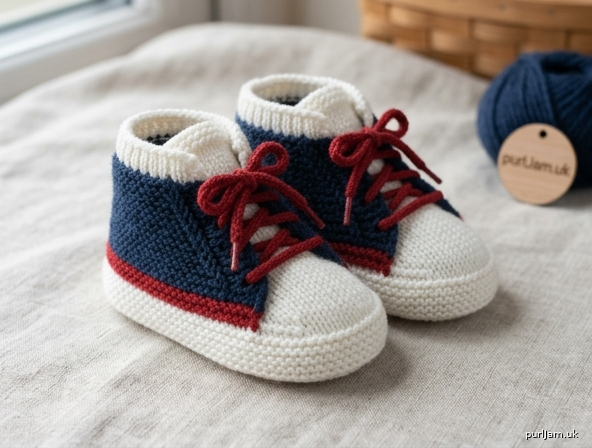
Knitted high-top baby sneakers
A sturdy pair of high-top trainers for a baby boy, worked in worsted-weight yarn. White garter soles and foxing, a contrast sport stripe, a coloured upper with lace-up eyelets, a white tongue and i-cord laces. The pair is identical (no left/right). Designed to stay on chubby ankles.
Skill level: Intermediate
Techniques: Garter-stitch sole shaping, picking up stitches, working in the round, dividing for a U-shaped upper, eyelets, ribbed collar, i-cord.
Sizes
Instructions are written for 0–3 months (3–6 months, 6–12 months).
When only one number is given, it applies to all sizes.
| Size | To fit age | Finished sole length | Finished sole width |
|---|---|---|---|
| 1 | 0–3 months | 9 cm (3½ in) | 5 cm (2 in) |
| 2 | 3–6 months | 10.5 cm (4¼ in) | 6 cm (2¼ in) |
| 3 | 6–12 months | 12 cm (4¾ in) | 7 cm (2¾ in) |
To choose a size, measure the baby’s foot from heel to longest toe and add about 1 cm (½ in) of growing room. Match that figure to the finished sole length.
Materials
Yarn — worsted weight (UK Aran / 10-ply); approx. 180 m / 100 g.
Firm, smooth wool or wool-blend recommended (cotton is cooler but stretches more).
- MC (upper): 50 g / 90 m (98 yd) — navy, charcoal or royal blue
- CA (sole, foxing, tongue): 25 g / 45 m (49 yd) — off-white or white
- CB (sport stripe and laces): 15 g / 27 m (30 yd) — red, electric blue or gold
Needles
- 4.5 mm double-pointed needles (set of 5), or a 60–80 cm circular for magic loop — main fabric
- 4 mm double-pointed needles — collar and i-cord laces
Notions
- 2 stitch markers
- Stitch holder or smooth waste yarn
- Tapestry needle
- Optional: suede sole patches or non-slip fabric paint
- Optional: small felt circles or contrasting yarn for a side badge
Tension (gauge)
20 sts and 28 rows = 10 cm (4 in) over stocking stitch on 4.5 mm needles, after a light steam.
20 sts and 40 rows (20 ridges) = 10 cm (4 in) over garter stitch on 4.5 mm needles.
Work to a firm tension — trainers need a dense fabric. If you have more than 20 sts to 10 cm, go down a needle size; if fewer, go up. A 10 cm tension swatch in stocking stitch is essential: 1 cm of error is a whole baby size.
Abbreviations
| Abbr. | Meaning |
|---|---|
| CA, CB, MC | Contrast A, Contrast B, Main Colour |
| cm | centimetre(s) |
| k | knit |
| kfb | knit into front and back of stitch (1 st increased) |
| k2tog | knit 2 together (right-leaning decrease) |
| p | purl |
| PM | place marker |
| rem | remain(ing) |
| rep | repeat |
| rnd(s) | round(s) |
| RS | right side |
| sl | slip stitch purlwise unless stated |
| ssk | slip, slip, knit (left-leaning decrease) |
| st(s) | stitch(es) |
| st st | stocking stitch (knit RS, purl WS; knit every rnd in the round) |
| WS | wrong side |
| wyib / wyif | with yarn in back / with yarn in front |
| yo | yarn over |
Cast off is used throughout (UK).
Pattern notes
- Instructions are for one shoe. Make two alike.
- Numbers are given as 0–3 months (3–6 months, 6–12 months).
- The sole is worked flat in garter stitch. The upper is picked up around the sole and joined in the round, then divided and worked flat.
- Slip the first stitch of every flat row (except eyelet rows) for a chain edge along the lace-up opening.
- Cast off the collar loosely so the shoe will stretch over the heel.
- Safety: Long cords are a hazard for infants. For babies under 12 months, thread the laces, tie a small bow and sew the laces in place so they cannot be pulled out or undone. Never leave loose ties. Check the fit often; discard if the fabric pills into a choking hazard or the sole becomes slippery.
Sole (make 2)
With 4.5 mm needles and CA, cast on 6 (8, 8) sts.
Working in garter stitch (knit every row):
Increase for toe
- Row 1 (RS): Kfb, k to last st, kfb. 8 (10, 10) sts (6+2=8 ✓ / 8+2=10 ✓).
- Row 2 (WS): Kfb, k to last st, kfb. 10 (12, 12) sts (8+2=10 ✓ / 10+2=12 ✓).
- Size 6–12 months only — Row 3: Kfb, k to last st, kfb. 14 sts (12+2=14 ✓).
10 (12, 14) sts.
Centre of sole
Knit 32 (38, 42) rows even on these sts.
Check: total rows so far = 2 (2, 3) increase rows + 32 (38, 42) even = 34 (40, 45) rows.
Decrease for heel
- Knit 2 together at each end of the next 2 (2, 3) rows.
- After first dec row: 8 (10, 12) sts (10−2=8 ✓ / 12−2=10 ✓ / 14−2=12 ✓).
- After second dec row: 6 (8, 10) sts (8−2=6 ✓ / 10−2=8 ✓ / 12−2=10 ✓).
- Size 6–12 months only — third dec row: 8 sts (10−2=8 ✓).
6 (8, 8) sts. Cast off knitwise. Fasten off, leaving a 20 cm tail.
Check — sole length: 2 (2, 3) + 32 (38, 42) + 2 (2, 3) = 36 (42, 48) rows. At 40 garter rows = 10 cm this is 9 (10.5, 12) cm ✓.
Check — sole width: 10 (12, 14) sts at 20 sts = 10 cm is 5 (6, 7) cm ✓.
The cast-on edge is the toe; the cast-off edge is the heel.
Upper — pick up and foxing
With RS of sole facing, 4.5 mm needles and CA, beginning at the centre of the heel (mid-point of the cast-off edge):
- Pick up and knit 3 (4, 4) sts along the first half of the heel, PM for beginning of round, pick up and knit 3 (4, 4) sts along the second half of the heel. 6 (8, 8) heel sts ✓.
- Pick up and knit 18 (20, 24) sts along the first long side (about 1 st per garter ridge; skip a ridge if needed on size 2).
- Pick up and knit 6 (8, 8) sts along the cast-on (toe) edge.
- Pick up and knit 18 (20, 24) sts along the second long side.
48 (56, 64) sts. Join to work in the round. PM at beginning of round (centre heel). Place a second marker at centre toe (after 24 (28, 32) sts) to help you find the instep later.
Foxing (white rim)
- Rnds 1–3: Knit.
- Rnd 4: Purl (turning ridge).
Sport stripe and toe-box
Join CB.
- Knit 2 rounds.
Join MC.
- Knit 2 (2, 4) rounds.
48 (56, 64) sts.
Divide for lace-up opening
The 12 (14, 16) sts centred on the toe marker are the instep (start of the tongue).
Break MC, leaving a 15 cm tail.
With RS facing, slip the 12 (14, 16) centre-front sts onto a holder or waste yarn.
Rejoin MC at the right-hand edge of this opening (the stitch immediately after the held sts). You will now work back and forth on the remaining stitches (right quarter + heel + left quarter).
36 (42, 48) sts on the needles (48−12=36 ✓ / 56−14=42 ✓ / 64−16=48 ✓).
Quarters and heel (U-shape, with eyelets)
Work flat in stocking stitch. Slip the first stitch of every row except eyelet rows.
Row 1 (RS): Sl 1 wyib, k to end.
Row 2 (WS): Sl 1 wyif, p to end.
Eyelet row (RS): K1, yo, k2tog, k to last 3 sts, ssk, yo, k1.
(Stitch count is unchanged: yo + k2tog = 0 net; ssk + yo = 0 net ✓.)
Row 4 and every WS row: Sl 1 wyif, p to end.
Continue in st st, working an eyelet row on rows 3, 7 and 11.
Size 6–12 months only: also work an eyelet row on row 15.
Work until 12 (14, 16) rows have been completed, ending with a WS row.
You now have 3 (3, 4) pairs of eyelets along the opening. 36 (42, 48) sts.
Collar
Change to 4 mm needles.
Rib row: *K1, p1; rep from * to end.
Rep this row 7 more times (8 rows of 1×1 rib).
The even stitch count 36 (42, 48) means every row starts with k1 and ends with p1, and the rib nests correctly on the WS ✓.
Cast off loosely in rib (use 4.5 mm for the cast-off row if needed so the ankle will stretch over the heel). Fasten off.
Tongue
Return the 12 (14, 16) held instep sts to 4.5 mm needles. With RS facing, join CA at the right-hand edge of the held sts.
Rows 1–4: Beg with a RS knit row, work in st st, slipping the first st of every row (sl 1 wyib on RS, sl 1 wyif on WS).
Row 5 (RS, increase): Kfb, k to last st, kfb. 14 (16, 18) sts (12+2=14 ✓ / 14+2=16 ✓ / 16+2=18 ✓).
Row 6: Sl 1 wyif, p to end.
Continue in st st with slipped edges until the tongue measures 5 (6, 7) cm from the divide, ending with a WS row.
Next 2 rows: *K1, p1; rep from * to end (1×1 rib).
Cast off in rib. Fasten off, leaving a 20 cm tail.
The extra width after row 5 lets the tongue sit neatly under the laces.
Laces (make 2)
With 4 mm needles and CB, cast on 3 sts. Work 3-stitch i-cord:
*Knit 3, do not turn, slide sts back to the right-hand end of the needle, pull yarn firmly across the back; rep from * until the cord measures 40 (45, 50) cm.
Cast off. Weave the tail into the cord. Make a second lace for the second shoe.
Finishing
- Close gaps. At each corner where the tongue meets the foxing, use the yarn tails to close any small hole. Do not pull tight enough to pucker the sole.
- Tack the tongue. With CA, sew the lower 1.5 cm of each tongue side to the matching edge of the opening so the tongue stays centred. Leave the rest of the tongue free.
- Weave in ends on the WS. On the sole, run tails along garter ridges so they do not show on the walking surface.
- Steam. Lightly steam the uppers (avoid flattening the garter sole ridges). Do not press ribbing.
- Laces. Thread each lace criss-cross through the eyelets, starting at the bottom pair, as on a fabric trainer. Tie a small bow. For under-12-months: sew the laced bow and the lace ends to the shoe so they cannot be pulled free.
- Optional side badge. With CB, duplicate-stitch a 6-st × 6-row square or a small star on the outer side of each shoe, centred between stripe and collar.
- Optional non-slip sole. Stitch suede patches to the walking surface, or apply non-slip fabric paint in several dots and allow to cure fully before wear.
- Pair. Confirm both shoes match in stripe height, eyelet count and tongue length.
Fit notes
- The ribbed collar should hug the ankle without leaving red marks. If it is tight, re-cast-off more loosely or add 2 extra rib rows and fold them to the inside.
- If the sole is short, the baby will outgrow the shoe immediately — always measure against a foot tracing.
- If the upper pulls inward over the sole, too few stitches were picked up along the sides; if it frills, too many were picked up. Aim for one stitch per garter ridge.
Wear with pride — first trainers, first adventures.
Disclaimer: This pattern was generated by AI and should be reviewed for accuracy before use. While we strive for quality, AI-generated content may contain errors. Please verify measurements, stitch counts, charts, and instructions before beginning your project. Generated by purlJam.uk
Love this pattern?
Save this pattern to your free PurlJam libraryAccess your pattern anytime
Bookmark this page to access your pattern anytime