Type
Knitting
Difficulty
advanced
Category
blanket
AI Thinking Process
Planning
Verification
Pattern
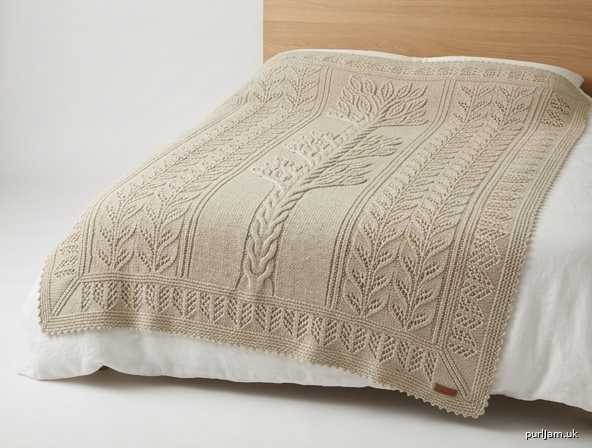
Tree of Life Ajour Bedspread
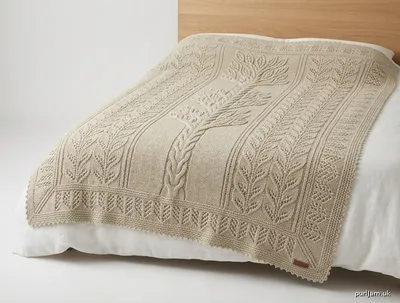
An advanced knitted coverlet: a column of cable-trunk Trees of Life set between climbing ajour-leaf panels, finished with a mitred openwork border.
MATERIALS
Yarn: Worsted-weight wool or wool-mix (10-ply) with crisp stitch definition and good memory for blocking (non-superwash wool is ideal).
Meterage: 3200 m (3500 yds) — 16 × 100 g balls at 200 m / 218 yds per ball. Purchase one extra ball if your tension is dense or you lengthen the piece.
Suggested colour: Natural cream, undyed, stone, or a mid forest green — pale or mid tones show the ajour best.
Needles:
- 5 mm circular needle, 150 cm long, for the main fabric
- 4.5 mm circular needle, 150 cm long, for the border
- A second 4.5 mm circular (or one 200 cm circular) to hold the border stitches comfortably
- Cable needle
Notions: 8 stitch markers (4 of a contrast colour for corners), row counter, tapestry needle, blocking wires, T-pins.
Note: A 5 mm, 150 cm circular is essential from the cast-on; 313 sts of worsted will not sit on straight needles.
TENSION (GAUGE)
18 sts and 24 rows = 10 cm over Ajour Leaf (Chart A), using 5 mm needles, after wet blocking.
Work a tension square of at least 24 sts × 32 rows (2 leaf repeats plus 6 garter edge sts). Block it exactly as you will block the bedspread, then measure in the centre.
Lace opens with blocking; cables draw in. If you have more than 18 sts to 10 cm, switch to 5.5 mm for a more open ajour. If you have fewer, try 4.5 mm. Changing needle size will change the finished measurements and the yarn required.
FINISHED SIZE
After blocking, including border:
194 cm (76½ in) wide × 240 cm (94½ in) long.
Main fabric (before border): 174 cm × 220 cm.
Border depth: approximately 10 cm all round.
This is a generous double-bed coverlet (modest drop on a 135 cm double; decorative cover on a larger mattress). To widen by about 13 cm, add one 12-st Ajour Leaf repeat to each side panel (+24 sts). Recalculate yarn before you do so.
ABBREVIATIONS
C6F — cable 6 forward: slip 3 sts to cn, hold at front, k3, k3 from cn
cn — cable needle
k — knit
k2tog — knit 2 together (right-leaning decrease)
p — purl
pm — place marker
rep — repeat
RS — right side
s2kp — slip 2 sts together knitwise, k1, pass the 2 slipped sts over (centred double decrease; 3 sts to 1)
sl — slip
sm — slip marker
ssk — slip, slip, knit (left-leaning decrease): slip 1 knitwise, slip 1 knitwise, insert left needle into the fronts and knit together
st(s) — stitch(es)
WS — wrong side
yo — yarn over (bring yarn forward and over the needle)
NOTES
- UK English; centimetres first. Tension is given in pattern stitch after blocking.
- Ajour = openwork. Every yarn over is paired with a decrease on the same row so the stitch count never changes on the main fabric.
- Charts are drawn as you knit them: every row left to right. Odd rows are RS.
- Read Chart A and Chart B on the same RS row; they share a 48-row rhythm (3 × 16 = 48).
- The 6 sts at each end are garter stitch (k every row) and form a firm pick-up edge.
- The 6-st gutters are reverse stocking stitch (p on RS, k on WS) so the tree and leaves stand forward.
- Use a row counter. Mark every 16th row (end of Chart A) and every 48th row (end of one tree).
- Join new balls in the garter edges or gutters, never in the tree trunk.
- Blocking is not optional. The leaves and mitred border only reveal themselves when wet-blocked to size.
Panel map (313 sts):
6 garter | 120 Ajour Leaf (10 × 12) | 6 gutter | 49 Tree of Life | 6 gutter | 120 Ajour Leaf | 6 garter
(6 + 120 + 6 + 49 + 6 + 120 + 6 = 313 ✓)
CHARTS
Symbol key
| Symbol | RS (odd rows) | WS (even rows) |
|---|---|---|
. |
purl | knit |
| |
knit | purl |
o |
yo | purl the yo |
/ |
k2tog | — |
\ |
ssk | — |
A |
s2kp | — |
C |
C6F (work 6 consecutive C as one C6F) |
purl |
No-stitch symbols are not used; every chart row contains the stated stitch count.
Chart A: Ajour Leaves
12 sts × 16 rows. Repeat 10 times across each side panel.
Row 16 (WS): p11, k1
Row 15 (RS): . / o | | | | | | | o \
Row 14 (WS): p11, k1
Row 13 (RS): . | / o | | | | | o \ |
Row 12 (WS): p11, k1
Row 11 (RS): . | | / o | | | o \ | |
Row 10 (WS): p11, k1
Row  9 (RS): . | | | / o | o \ | | |
Row  8 (WS): p11, k1
Row  7 (RS): . | | | | o A o | | | |
Row  6 (WS): p11, k1
Row  5 (RS): . | | | o | A | o | | |
Row  4 (WS): p11, k1
Row  3 (RS): . | | o | | A | | o | |
Row  2 (WS): p11, k1
Row  1 (RS): . | o | | | A | | | o |
Each RS row: 2 yos + one double decrease (or k2tog + ssk) = 12 sts ✓
Written (one 12-st repeat):
- Row 1 (RS): p1, k1, yo, k3, s2kp, k3, yo, k1.
- Row 2 and all WS rows: p11, k1.
- Row 3: p1, k2, yo, k2, s2kp, k2, yo, k2.
- Row 5: p1, k3, yo, k1, s2kp, k1, yo, k3.
- Row 7: p1, k4, yo, s2kp, yo, k4.
- Row 9: p1, k3, k2tog, yo, k1, yo, ssk, k3.
- Row 11: p1, k2, k2tog, yo, k3, yo, ssk, k2.
- Row 13: p1, k1, k2tog, yo, k5, yo, ssk, k1.
- Row 15: p1, k2tog, yo, k7, yo, ssk.
Chart B: Tree of Life
49 sts × 48 rows (19-st left wing, 11-st trunk, 19-st right wing).
Leaf unit (7 sts), used in the wings:
- L1: k1, yo, k1, s2kp, k1, yo, k1
- L3: k2, yo, s2kp, yo, k2
- L5: k1, k2tog, yo, k1, yo, ssk, k1
- L7: k2tog, yo, k3, yo, ssk
Each L row = 7 sts (2 yos balanced by s2kp, or by k2tog + ssk) ✓
Leaves are palindromes: the same unit is used on both wings.
Trunk (11 sts):
- TN (plain): p2, k7, p2
- TC (cable, RS rows 7, 15, 23, 31, 39, 47): p2, C6F, k1, p2
(2 + 6 + 1 + 2 = 11 ✓)
WS of Chart B (all even rows): Work sts as they present (k the purls, p the knits and yos). Trunk: k2, p7, k2.
Tier map (one 48-row tree):
| Rows | Wings | Silhouette |
|---|---|---|
| 1–8 | all purl | bare trunk |
| 9–16 | inner leaf only | lower branches |
| 17–32 | outer + inner leaves | full canopy |
| 33–40 | inner leaf only | upper branches |
| 41–48 | all purl | trunk / sky |
Stacked trees therefore have 16 rows of continuous cable trunk between canopies.
RS rows — full 49 sts (p12 + 7 + 11 + 7 + 12 = 49; or 7+5+7+11+7+5+7 = 49 ✓):
- Row 1: p19, TN, p19.
- Row 3: p19, TN, p19.
- Row 5: p19, TN, p19.
- Row 7: p19, TC, p19.
- Row 9: p12, L1, TN, L1, p12.
- Row 11: p12, L3, TN, L3, p12.
- Row 13: p12, L5, TN, L5, p12.
- Row 15: p12, L7, TC, L7, p12.
- Row 17: L1, p5, L1, TN, L1, p5, L1.
- Row 19: L3, p5, L3, TN, L3, p5, L3.
- Row 21: L5, p5, L5, TN, L5, p5, L5.
- Row 23: L7, p5, L7, TC, L7, p5, L7.
- Rows 25, 27, 29, 31: as Rows 17, 19, 21, 23 (Row 31 uses TC).
- Rows 33, 35, 37, 39: as Rows 9, 11, 13, 15 (Row 39 uses TC).
- Rows 41, 43, 45, 47: as Rows 1, 3, 5, 7 (Row 47 uses TC).
ASCII (RS rows only; 49 sts; . = p, | = k):
Bare trunk (Rows 1, 3, 5) — 21 purl, 7 knit, 21 purl:
.....................|||||||.....................
Cable trunk (Rows 7, 47) — C6F on the first 6 of the 7 knit sts:
.....................CCCCCC|.....................
Inner-leaf RS (Row 9 example; L1 against the trunk):
............|o|A|o|..|||||||..|o|A|o|............
Full-canopy RS (Row 17 example; outer leaf, 5 purl, inner leaf):
|o|A|o|.....|o|A|o|..|||||||..|o|A|o|.....|o|A|o|
(Place L3 / L5 / L7 in the same 7-st slots on the following RS rows of each tier.)
Chart C: Border Leaf
12-st repeat × 8 rows. Worked in the round on the picked-up border; odd rounds facing RS. Even rounds: purl. Do not work Chart C into the corner stitch — corners are worked as given in Border.
Row 8: p12
Row 7: | | | | o A o | | | |
Row 6: p12
Row 5: | | | o | A | o | | |
Row 4: p12
Row 3: | | o | | A | | o | |
Row 2: p12
Row 1: | o | | | A | | | o |
Written (12-st repeat, odd rounds):
- Round 1: *k1, yo, k3, s2kp, k3, yo, k1; rep from * to corner marker.
- Round 3: *k2, yo, k2, s2kp, k2, yo, k2; rep from * to corner marker.
- Round 5: *k3, yo, k1, s2kp, k1, yo, k3; rep from * to corner marker.
- Round 7: *k4, yo, s2kp, yo, k4; rep from * to corner marker.
- Even rounds: purl to corner marker.
Each repeat remains 12 sts (2 yos + s2kp) ✓
PATTERN
Set-up
With 5 mm circular needle and a long-tail (or cable) cast-on, cast on 313 sts. Do not join; the main fabric is worked flat.
Place markers:
- After st 6 (left garter)
- After st 126 (end of left leaves: 6 + 120 = 126 ✓)
- After st 132 (end of left gutter: 126 + 6 = 132 ✓)
- After st 181 (end of tree: 132 + 49 = 181 ✓)
- After st 187 (end of right gutter: 181 + 6 = 187 ✓)
- After st 307 (end of right leaves: 187 + 120 = 307 ✓)
- 6 garter sts remain (307 + 6 = 313 ✓)
Body
Work 11 full repeats of Chart B (48 rows) = 528 rows, keeping the side panels in Chart A throughout.
Every RS row (odd rows 1–527):
- K6 (garter).
- Work Chart A 10 times (120 sts ✓).
- P6 (gutter).
- Work Chart B over 49 sts.
- P6 (gutter).
- Work Chart A 10 times (120 sts ✓).
- K6 (garter).
(6 + 120 + 6 + 49 + 6 + 120 + 6 = 313 sts ✓)
Every WS row (even rows 2–528):
- K6 (garter).
- Work Chart A WS 10 times (*p11, k1; rep from * 10 times).
- K6 (gutter: reverse stocking).
- Work Chart B WS over 49 sts (sts as they present; trunk k2, p7, k2).
- K6 (gutter).
- Work Chart A WS 10 times.
- K6 (garter).
(313 sts ✓)
Row-counter checkpoints
- End of each Ajour Leaf: every 16 rows (33 leaf repeats in 528 rows: 33 × 16 = 528 ✓).
- End of each tree: every 48 rows. After Row 48, 96, 144, 192, 240, 288, 336, 384, 432, 480, 528 you have completed 1–11 trees (11 × 48 = 528 ✓).
- Cable the trunk on RS rows 7, 15, 23, 31, 39, 47 of every Chart B repeat.
After Row 528 (WS), cast off loosely knitwise on the RS, keeping the last loop only long enough to fasten off. Do not cast off tightly — this edge is picked up for the border.
BORDER
Change to 4.5 mm. With RS facing, pick up and knit around the entire coverlet, placing 4 contrast markers in the 4 corner stitches:
| Edge | How to pick up | Sts between corner markers |
|---|---|---|
| Cast-off (top) | 1 for 1, skipping 1 st once | 312 (26 × 12 = 312 ✓) |
| Left side | 3 sts from 4 rows; 132 times | 396 (528 × 3/4 = 396; 33 × 12 = 396 ✓) |
| Cast-on (bottom) | 1 for 1, skipping 1 st once | 312 |
| Right side | 3 sts from 4 rows; 132 times | 396 |
Pick up 1 extra stitch at each corner and mark it.
Total: 312 + 396 + 312 + 396 + 4 corner sts = 1420 sts ✓
Join to work in the round. The start of round is the first corner stitch of the top-right corner (or any corner; keep it consistent).
Corner rule (every odd round): work to the corner marker, yo, sm, k1 (corner st), yo.
That is +2 sts at each corner, +8 sts per odd round. Even rounds: purl the yos; knit the marked corner st so it remains easy to see.
Garter frame (rounds 1–4)
- Round 1 (odd): Knit, working the corner rule at each of the 4 corners.
- Round 2: Purl, knitting each marked corner st.
- Round 3: As Round 1.
- Round 4: As Round 2.
Leaf lace (rounds 5–20)
Work Chart C twice (16 rounds).
- Odd rounds (5, 7, 9, 11, 13, 15, 17, 19): Chart C across each side between the yo-increases; corner rule at each marker. On the first lace round use Chart C Row 1; then 3, 5, 7, then repeat 1, 3, 5, 7.
- Even rounds: Purl, knitting each marked corner st.
Each side remains a multiple of 12 between the corner yos, because increases sit outside the repeat ✓
Garter frame (rounds 21–24)
- Rounds 21 and 23: Knit, with corner rule.
- Rounds 22 and 24: Purl, knitting each marked corner st.
12 odd rounds × 8 sts = 96 sts increased. 1420 + 96 = 1516 sts at cast-off ✓
Border depth: 24 rounds ≈ 10 cm.
Picot cast-off
Using 4.5 mm, *cast off 3 sts, slip the remaining st on the right needle back to the left needle, cable-cast-on 3 sts; rep from * around. When 3 or fewer sts remain, cast them off plainly. Fasten off and join the picot ridge invisibly to the start.
(If you prefer a quieter edge, substitute a very loose knitted cast-off in place of the picots.)
FINISHING
-
Weave in all ends on the WS, preferably along garter edges or gutters. Do not weave through lace holes or the cable trunk.
-
Wet block. Soak in lukewarm water with a little wool wash for 20 minutes. Support the fabric as you lift it (it is heavy when wet). Roll in towels and press out water — do not wring.
-
Spread on blocking mats. Run blocking wires through the picot edge along all four sides. Pin the wires to:
194 cm (76½ in) wide × 240 cm (94½ in) long.
Square the corners with a right-angle. Open the ajour leaves so each yo is a clear eyelet; do not stretch the cable trunk so hard that it looks like stocking stitch. Let dry completely before removing pins (24–48 hours).
-
Once dry, steam the reverse-stocking gutters very lightly if they still curl, holding the iron above the fabric — do not press the lace flat.
-
Optional: sew a cotton backing to the WS if you want a lined bedspread. This hides the reverse of the cables and reduces the stained-glass quality of the ajour; most heirloom coverlets are left unlined.
No fringe. The picot border is the finished edge.
Skill notes. You should be comfortable reading lace and cable charts, counting a 49-st panel without losing the trunk, and managing 1400+ border sts on a circular needle. A single missed yo in Chart A will throw the 12-st repeat; stop and check stitch count at each marker every 16 rows until the rhythm is automatic.
Disclaimer: This pattern was generated by AI and should be reviewed for accuracy before use. While we strive for quality, AI-generated content may contain errors. Please verify measurements, stitch counts, charts, and instructions before beginning your project. Generated by purlJam.uk
Love this pattern?
Save this pattern to your free PurlJam libraryAccess your pattern anytime
Bookmark this page to access your pattern anytime