Type
Crochet
Difficulty
beginner
Category
hat
AI Thinking Process
Planning
Verification
Pattern
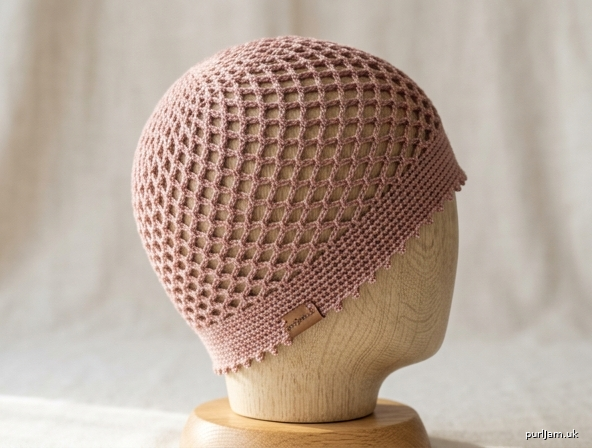
Trellis Mesh Lace Beanie
Skill level: Intermediate
Construction: Top-down, seamless, joined rounds
Style: Close-fitting lace beanie with open trellis mesh and a picot edge. Lightweight and breathable — a fashion/spring–fall hat, not a dense winter cap.
Sizes
Baby (Toddler, Child, Teen/Small Adult, Adult Medium, Adult Large)
Instructions are written for Baby with larger sizes in parentheses. When only one number is given, it applies to all sizes.
To choose a size, measure the head and pick the size whose to-fit range matches. Mesh fabric stretches; the blocked hat should measure a little smaller than the head.
Finished measurements (blocked, unstretched)
| Baby | Toddler | Child | Teen/Small Adult | Adult Medium | Adult Large | |
|---|---|---|---|---|---|---|
| To fit head | 16–18" (40.5–45.5 cm) | 18–19" (45.5–48.5 cm) | 19–20" (48.5–51 cm) | 20–21" (51–53.5 cm) | 21–22" (53.5–56 cm) | 23–24" (58.5–61 cm) |
| Hat circumference | 15" (38 cm) | 18" (45.5 cm) | 18" (45.5 cm) | 21" (53.5 cm) | 21" (53.5 cm) | 24" (61 cm) |
| Height (crown to brim) | 6" (15 cm) | 7" (18 cm) | 7½" (19 cm) | 7¾" (19.5 cm) | 8¼" (21 cm) | 8¾" (22 cm) |
| Body mesh count | 30 | 36 | 36 | 42 | 42 | 48 |
Ease: about 1–2" (2.5–5 cm) negative ease on Baby through Adult Medium; Adult Large is a relaxed mesh fit (0–1" / 0–2.5 cm ease).
Materials
Yarn: Lace weight (size 0), smooth yarn (wool, cotton, or wool-silk). Avoid fuzzy mohair; halo hides the mesh.
Yardage: 210 (260, 300, 340, 370, 430) yd / 190 (240, 275, 310, 340, 395) m
Approx. 25 (30, 35, 40, 45, 55) g, depending on the yarn’s yardage per gram.
Hook: US E-4 (3.5 mm), or size needed to obtain gauge.
A larger hook than traditional lace knitting/crochet is intentional — it opens the trellis.
Notions:
- Stitch marker
- Yarn needle
- Scissors
- Blocking supplies (pins, mat, or a bowl/balloon in the target circumference)
Gauge
Blocked trellis mesh:
- 8 mesh repeats = 4" (10 cm)
- 9 mesh rounds = 4" (10 cm)
1 mesh repeat = (1 dc, ch 2).
Work a swatch of at least 12 meshes × 12 rnds in the round, wet-block, dry fully, then measure the center 4" (10 cm). Unblocked lace will read tight and the hat will come out small.
If you have too few meshes per 4" (10 cm), go down a hook size.
If you have too many, go up a hook size.
Abbreviations (US)
- beg — beginning
- ch — chain
- dc — double crochet
- MR — magic ring (magic loop)
- rep — repeat
- rnd(s) — round(s)
- RS — right side
- sc — single crochet
- sk — skip
- sl st — slip stitch
- sp(s) — space(s)
- st(s) — stitch(es)
- yo — yarn over
Special stitches
Trellis mesh (mesh): (dc, ch 2) in the indicated ch-2 space. One mesh is produced from one space.
Increase (inc): (dc, ch 2, dc, ch 2) in the same ch-2 space. Two meshes are produced from one space.
Beg mesh: After joining, sl st into the first ch-2 sp, ch 5 (counts as 1 dc + ch 2). This is the first mesh of the round.
Picot: Ch 3, sl st in the sc just made.
Notes
- US crochet terms throughout (sc, dc). Do not substitute UK treble for dc.
- Hat is worked RS facing at all times. Do not turn at the end of a round.
- Join every mesh round with a sl st in the 3rd ch of beg ch-5. The remaining 2 ch of that ch-5 are the first ch-2 sp of the next round.
- Ch-5 at the start of a mesh round always counts as (dc, ch 2).
- Count ch-2 spaces, not just dc, at the end of every round. The space count must match the mesh count given in brackets.
- Pull the magic ring firmly after Rnd 1 so the crown hole closes.
- A faint join line is normal; wet-blocking relaxes it.
- Mesh is stretchy. Stop increasing when the crown matches the listed circumference, even if a later size’s round looks tempting.
Pattern
Crown
Rnd 1: Make a MR, ch 5 (counts as dc + ch 2), (dc, ch 2) 5 times in the ring, join with sl st in 3rd ch of beg ch-5. Pull ring firmly closed.
[6 meshes — 6 dc + 6 ch-2 sps ✓]
Rnd 2 (inc in every sp): Sl st in first ch-2 sp, ch 5, dc in same sp, ch 2, *(dc, ch 2, dc, ch 2) in next ch-2 sp; rep from * around, join with sl st in 3rd ch of beg ch-5.
[12 meshes — 6 sps × 2 meshes each = 12 ✓]
Rnd 3: Sl st in first ch-2 sp, ch 5, (dc, ch 2, dc, ch 2) in next ch-2 sp, [(dc, ch 2) in next ch-2 sp, (dc, ch 2, dc, ch 2) in next ch-2 sp] 5 times, join.
[18 meshes — (1 even + 1 inc) × 6 = 6 + 12 = 18 ✓]
Rnd 4: Sl st in first ch-2 sp, ch 5, (dc, ch 2) in next ch-2 sp, (dc, ch 2, dc, ch 2) in next ch-2 sp, [(dc, ch 2) in each of next 2 ch-2 sps, (dc, ch 2, dc, ch 2) in next ch-2 sp] 5 times, join.
[24 meshes — (2 even + 1 inc) × 6 = 12 + 12 = 24 ✓]
Rnd 5: Sl st in first ch-2 sp, ch 5, (dc, ch 2) in each of next 2 ch-2 sps, (dc, ch 2, dc, ch 2) in next ch-2 sp, [(dc, ch 2) in each of next 3 ch-2 sps, (dc, ch 2, dc, ch 2) in next ch-2 sp] 5 times, join.
[30 meshes — (3 even + 1 inc) × 6 = 18 + 12 = 30 ✓]
Baby size only: Skip to Body. Circumference at this point: 30 meshes ÷ 8 meshes per 4" × 4" = 15" (38 cm) ✓
Rnd 6 (Toddler, Child, Teen/Small Adult, Adult Medium, Adult Large): Sl st in first ch-2 sp, ch 5, (dc, ch 2) in each of next 3 ch-2 sps, (dc, ch 2, dc, ch 2) in next ch-2 sp, [(dc, ch 2) in each of next 4 ch-2 sps, (dc, ch 2, dc, ch 2) in next ch-2 sp] 5 times, join.
[36 meshes — (4 even + 1 inc) × 6 = 24 + 12 = 36 ✓]
Toddler and Child only: Skip to Body. Circumference: 36 ÷ 8 × 4" = 18" (45.5 cm) ✓
Rnd 7 (Teen/Small Adult, Adult Medium, Adult Large): Sl st in first ch-2 sp, ch 5, (dc, ch 2) in each of next 4 ch-2 sps, (dc, ch 2, dc, ch 2) in next ch-2 sp, [(dc, ch 2) in each of next 5 ch-2 sps, (dc, ch 2, dc, ch 2) in next ch-2 sp] 5 times, join.
[42 meshes — (5 even + 1 inc) × 6 = 30 + 12 = 42 ✓]
Teen/Small Adult and Adult Medium only: Skip to Body. Circumference: 42 ÷ 8 × 4" = 21" (53.5 cm) ✓
Rnd 8 (Adult Large only): Sl st in first ch-2 sp, ch 5, (dc, ch 2) in each of next 5 ch-2 sps, (dc, ch 2, dc, ch 2) in next ch-2 sp, [(dc, ch 2) in each of next 6 ch-2 sps, (dc, ch 2, dc, ch 2) in next ch-2 sp] 5 times, join.
[48 meshes — (6 even + 1 inc) × 6 = 36 + 12 = 48 ✓]
Circumference: 48 ÷ 8 × 4" = 24" (61 cm) ✓
Crown mesh count now: 30 (36, 36, 42, 42, 48)
Body
Work even in trellis mesh on the established spaces. Do not increase.
Body rnd: Sl st in first ch-2 sp, ch 5, (dc, ch 2) in each remaining ch-2 sp around, join with sl st in 3rd ch of beg ch-5.
[30 (36, 36, 42, 42, 48) meshes ✓]
Rep the Body rnd until you have worked 7 (8, 9, 9, 10, 10) even body rounds.
Total mesh rounds from Rnd 1: 12 (14, 15, 16, 17, 18)
Mesh fabric height: 12 (14, 15, 16, 17, 18) × 4" ÷ 9 rnds = 5⅓ (6¼, 6⅔, 7⅛, 7½, 8)" / 13.5 (16, 17, 18, 19, 20.5) cm ✓
Brim
The brim converts each mesh into 3 sc so the edge matches gauge and will not flare.
Brim Rnd 1: Ch 1 (does not count as a st), *sc in next dc, 2 sc in next ch-2 sp; rep from * around, join with sl st in first sc.
[90 (108, 108, 126, 126, 144) sc — 30 (36, 36, 42, 42, 48) × 3 = 90 (108, 108, 126, 126, 144) ✓]
Brim Rnds 2–3: Ch 1, sc in each sc around, join.
[90 (108, 108, 126, 126, 144) sc ✓]
Brim Rnd 4 (picot edge): Ch 1, *sc in next 2 sc, sc in next sc, picot; rep from * around, join with sl st in first sc.
[90 (108, 108, 126, 126, 144) sc and 30 (36, 36, 42, 42, 48) picots — 90 (108, 108, 126, 126, 144) ÷ 3 = 30 (36, 36, 42, 42, 48) ✓]
Fasten off.
Brim adds about ¾" (2 cm).
Total height: mesh height + brim = 6 (7, 7½, 7¾, 8¼, 8¾)" / 15 (18, 19, 19.5, 21, 22) cm ✓
Finishing
- Weave in ends on the WS with a yarn needle, following the mesh paths so tails do not show through the openwork.
- Block. For lace this is not optional — the trellis will not open to gauge until it is wet-blocked.
- Soak in lukewarm water (with a drop of wool wash if using protein fiber) for 15–20 minutes.
- Roll in a towel to remove excess water. Do not wring.
- Stretch over a balloon, bowl, or hat form that matches the finished circumference, or pin the hat on a blocking mat to the measurements in the table, coaxing the mesh into even diamonds.
- Pin the picots out so they sit in a clean ring.
- Dry fully before removing (often overnight).
- Optional: add a small sewn-on tag at the WS of the brim.
Variations
Simple edge (no picot): Work Brim Rnd 4 as a plain sc round, then fasten off. Same stitch count.
Slouchy mesh beanie: Work 4 extra even body rounds before the brim (+ about 1¾" / 4.5 cm). Extra fabric pools at the back.
Denser brim: Work 6 sc rounds total instead of 4 before the picot round for a 1–1¼" (2.5–3 cm) band.
Stripes: Change color every 2 mesh rounds. Join the new color at the sl st join; weave old tails along the WS of the join.
Cotton summer version: Use cotton or bamboo lace at the same gauge. Expect slightly less stretch than wool; if the swatch has little give, make the next size up.
Fit checks (before fastening off)
- Crown should be a shallow bowl, not a point and not a ruffle. If it cups tightly, your gauge is tight — go up a hook. If it ripples, your gauge is loose — go down a hook.
- Body circumference should match the table after a light stretch. If it is more than 1" (2.5 cm) off, change hook size and redo rather than adding random increases.
- Brim should sit at or just over the ears on a classic fit. Add or subtract even mesh rounds in 1-round steps (about ½" / 1 cm each) to shorten or lengthen.
Disclaimer: This pattern was generated by AI and should be reviewed for accuracy before use. While we strive for quality, AI-generated content may contain errors. Please verify measurements, stitch counts, charts, and instructions before beginning your project. Generated by purlJam.uk
Love this pattern?
Save this pattern to your free PurlJam libraryAccess your pattern anytime
Bookmark this page to access your pattern anytime