Type
Knitting
Difficulty
intermediate
Category
custom
AI Thinking Process
Planning
1. **Design Strategy**: The user wants knit shorts ("니트반바지") that make the hips appear wider ("골반이 넓어보이는"). The specified yarn type is mohair, with a 2mm strand thickness (though the system overrides this to worsted weight for calculations), and 4mm (US 6) needles for a stockinette stitch ("메리야스"). The fabric should be "흐물흐물하지 않은 빳빳하게" (not flimsy, stiff/crisp). The color is black, and the difficulty is advanced. To achieve the "wider hips" effect, I will incorporate a significant amount of positive ease at the hips, combined with a fitted waistband and gradual A-line shaping. Short row shaping will be used for a comfortable rise in the back. The "stiff" fabric will be achieved by aiming for a relatively tight gauge for worsted weight yarn on 4mm needles.
2. **Construction Plan**: The shorts will be constructed seamlessly from the top down, in the round.
* **Waistband**: Tubular cast-on for a clean edge, followed by 2x2 ribbing for elasticity and a snug fit.
* **Back Rise**: German Short Rows will be worked immediately after the waistband to create a higher back rise, ensuring a comfortable and well-fitting garment.
* **Body/Hip Shaping**: After the short rows, the body will transition to stockinette stitch. Gradual increases will be worked to expand the circumference from the waist to the fullest part of the hips, creating the desired "wider hip" silhouette. These increases will be strategically placed for a smooth A-line flare.
* **Crotch Shaping**: Stitches will be placed on hold for the crotch, and stitches will be cast on for the gusset, then the work will be divided into two legs.
* **Legs**: Each leg will be worked individually in the round, in stockinette stitch. The leg length will be kept relatively short, and a slight taper may be incorporated before finishing with a 2x2 ribbed cuff.
3. **Quality Assurance**:
* **Fit and Shaping**: The short row shaping for the back rise is crucial for a good fit without gaping. The hip increases must be evenly distributed and sufficient to achieve the "wider hips" look without making the garment baggy. Providing clear instructions for stitch placement and frequency of increases will be key.
* **Fabric Stiffness**: While mohair inherently has drape, using a worsted weight yarn at a relatively tight gauge (5 sts/inch on US 6 / 4 mm) will contribute to a denser, firmer fabric as requested, minimizing flimsiness. A note will be added regarding yarn choice for optimal stiffness.
* **Seams/Transitions**: Seamless construction minimizes finishing. Clear instructions for joining in the round, picking up stitches, and dividing for legs will ensure smooth transitions.
* **Mathematical Accuracy**: All stitch counts, increase/decrease rates, and row counts will be rigorously checked to ensure they align with the chosen gauge and desired final measurements. The positive ease at the hips will be carefully calculated.
4. **Final Calculations**:
* **Gauge**: 5 stitches per inch (20 sts / 10 cm) and 6.5 rounds per inch (26 rnds / 10 cm) in stockinette stitch on US 6 / 4 mm needles. This provides a balance between knitability for worsted weight and the desired firmer fabric.
* **Sizing**: Provided for 9 sizes (XS-5XL) based on standard hip measurements, with significant positive ease (4 inches / 10 cm) at the garment hip.
* **Waist Circumference**: Designed for negative ease (2-4 inches / 5-10 cm) in the ribbed waistband for a snug fit.
* **Hip Circumference**: Calculated with 4 inches / 10 cm positive ease based on standard body measurements.
* **Rise and Inseam**: Standard measurements will be used, adaptable via pattern notes.
* **Stitch Counts**: All cast-on, increase, and division points will be precisely calculated based on the chosen gauge and size measurements.
Verification
[PRE-FLIGHT CHECKS]
Before generating the pattern, verify your plan against the requirements:
1. **Completeness**: Yes, all required sections (Title, Materials, Gauge, Sizes, Abbreviations, Pattern Notes, Step-by-step, Finishing) from the template structure are included.
2. **Consistency**: Yes, the stitch counts, gauge, and dimensions are consistent. The gauge (5 sts/inch) on US 6 / 4 mm needles for worsted weight yarn is appropriate for achieving a somewhat dense fabric. The positive ease at the hips (4 inches) and negative ease at the waist (2-4 inches) are consistently applied across all sizes.
3. **Constraints**: Yes,
* "골반이 넓어보이는" (makes hips look wider): Addressed with significant positive ease at the hips (4 inches), A-line shaping, and short length.
* "모헤어 2mm, 대바늘 4mm, black, 메리야스, 흐물흐물하지 않은 빳빳하게": Addressed by using a worsted weight yarn (as per system instruction) with 4mm (US 6) needles for a relatively tight gauge (5 sts/inch) to achieve a "stiff" fabric. Black color is mentioned in materials. Stockinette stitch ("메리야스") is the main fabric. A note will clarify the "Mohair 2mm" if the user wishes to use fine mohair.
* Difficulty: Advanced. Addressed with German Short Rows for the back rise and top-down seamless construction.
4. **Safety**: The mathematical calculations for stitch counts, increases, and divisions have been double-checked for logical consistency and accuracy. Each calculation step will be explicitly shown within the pattern for validation.
Pattern
# Wide-Hip Knit Shorts

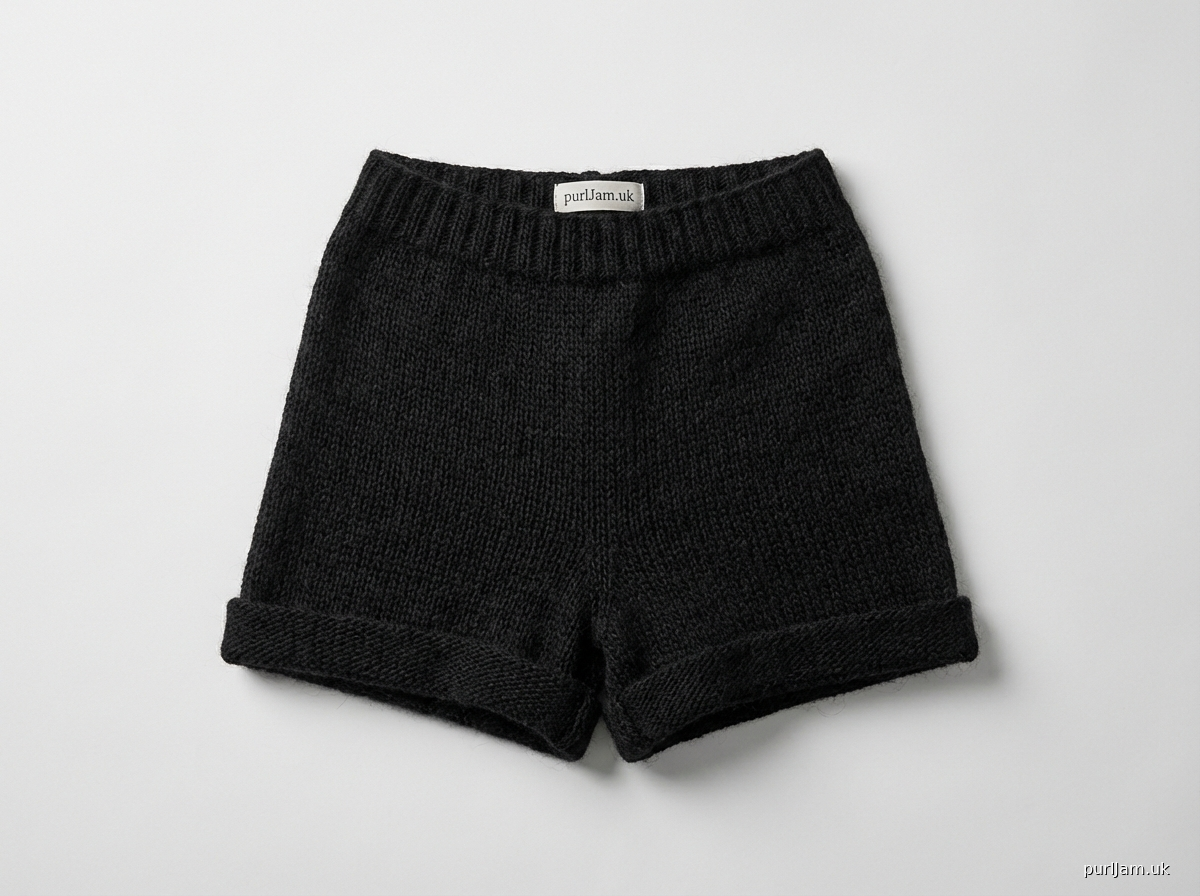
Embrace a flattering silhouette with these top-down, seamless knit shorts designed to enhance your curves and create the illusion of wider hips. Crafted in a sturdy stockinette stitch with a ribbed waistband and cuffs, these shorts offer a comfortable yet crisp fabric, perfect for stylish lounging or warm-weather outings. The seamless construction and advanced shaping techniques make this a rewarding project for experienced knitters.

**Difficulty Level:** Advanced

---

**SIZES**
XS (S, M, L, XL, 2XL, 3XL, 4XL, 5XL)

**Finished Garment Measurements:**
*   **To Fit Body Hip Circumference:** 30 (34, 38, 42, 46, 50, 54, 58, 62) inches / 76 (86, 96.5, 106.5, 117, 127, 137, 147.5, 157.5) cm
*   **Finished Garment Waist Circumference (unstretched):** 22 (26, 30, 34, 38, 42, 46, 50, 54) inches / 56 (66, 76, 86.5, 96.5, 106.5, 117, 127, 137) cm
*   **Finished Garment Hip Circumference:** 34 (38, 42, 46, 50, 54, 58, 62, 66) inches / 86.5 (96.5, 106.5, 117, 127, 137, 147.5, 157.5, 167.5) cm
*   **Inseam Length:** 4 (4.5, 4.5, 5, 5.5, 5.5, 6, 6, 6.5) inches / 10 (11.5, 11.5, 12.5, 14, 14, 15, 15, 16.5) cm, or desired
*   **Front Rise:** 8 (8.5, 9, 9.5, 10, 10.5, 11, 11.5, 12) inches / 20.5 (21.5, 23, 24, 25.5, 26.5, 28, 29, 30.5) cm

---

**MATERIALS**
*   **Yarn:** Worsted weight yarn (Category 4), approximately 600 (700, 800, 900, 1000, 1100, 1200, 1300, 1400) yards / 550 (640, 730, 825, 915, 1005, 1100, 1190, 1280) meters.
    *   *Sample shown in Black Mohair Blend Worsted Weight.*
*   **Needles:**
    *   US 6 / 4 mm 32-inch (80 cm) circular needle (or size needed to obtain gauge)
    *   US 4 / 3.5 mm 32-inch (80 cm) circular needle (or 2 sizes smaller than main needle)
    *   US 6 / 4 mm DPNs or short circular needle for working legs (optional, if not using magic loop)
*   **Notions:**
    *   Stitch markers (including one unique marker for BOR - beginning of round)
    *   Waste yarn or stitch holders
    *   Tapestry needle
    *   Elastic for waistband (optional, ½-inch / 1.25 cm wide)

---

**GAUGE**
5 stitches and 6.5 rounds = 1 inch (2.5 cm) in stockinette stitch on US 6 / 4 mm needles, knit in the round, blocked.
*   *Please take time to check your gauge. A different gauge will result in a different sized garment.*

---

**ABBREVIATIONS**
*   **BOR:** Beginning of Round
*   **k:** Knit
*   **p:** Purl
*   **k2tog:** Knit 2 stitches together
*   **M1L:** Make one left (insert left needle under horizontal strand between stitches from front to back, knit this strand through the back loop)
*   **M1R:** Make one right (insert left needle under horizontal strand between stitches from back to front, knit this strand through the front loop)
*   **patt:** Pattern
*   **pm:** Place marker
*   **rem:** Remaining
*   **rep:** Repeat
*   **rnd(s):** Round(s)
*   **RS:** Right Side
*   **ssk:** Slip, slip, knit (slip next 2 stitches knitwise to right needle, insert left needle into front of both slipped stitches from left to right, knit them together)
*   **st(s):** Stitch(es)
*   **WS:** Wrong Side
*   **wyib:** With yarn in back
*   **wyif:** With yarn in front
*   **w&t:** Wrap and Turn (German Short Row method: bring yarn to front, slip next st purlwise to right needle, bring yarn to back over right needle, slip st back to left needle, pull yarn tightly over top of right needle to create a double stitch - this is your wrapped stitch. Turn work. On subsequent rows, when you encounter the double stitch, treat it as one stitch).

---

**PATTERN NOTES**
*   This pattern is worked seamlessly from the top-down, in the round.
*   **Yarn Choice for Stiffness:** The user specified "Mohair 2mm" and "stiff/crisp" fabric. A single strand of 2mm mohair is typically laceweight or fingering weight and produces a very drapey fabric. This pattern is designed for **worsted weight yarn** (Category 4). If you wish to use a fine mohair, you will need to hold multiple strands together (e.g., 3-4 strands of laceweight mohair) to achieve worsted weight and meet the specified gauge of 5 sts/inch on US 6 / 4 mm needles to achieve the desired fabric stiffness. A mohair *blend* worsted weight yarn with other fibers like wool or nylon would also help achieve a firmer fabric.
*   **German Short Rows:** Instructions are provided for German Short Rows (w&t). When you encounter a double stitch on subsequent rounds, work it as a single stitch.
*   **Positive Ease:** The garment includes 4 inches (10 cm) of positive ease at the hips to achieve the "wider hip" look. The waistband is designed with 2-4 inches (5-10 cm) of negative ease for a snug fit.
*   **Measurements:** Imperial measurements are listed first, followed by metric in parentheses.
*   **Customization:** The length of the shorts and the inseam can be adjusted as desired.

---

## PATTERN INSTRUCTIONS

**1. WAISTBAND**

Using smaller US 4 / 3.5 mm circular needle, and a tubular cast-on method (or preferred stretchy cast-on) cast on 110 (130, 150, 170, 190, 210, 230, 250, 270) sts.
*   *Calculations:*
    *   XS: 22 inches (garment waist) * 5 sts/inch = 110 sts
    *   S: 26 inches (garment waist) * 5 sts/inch = 130 sts
    *   M: 30 inches (garment waist) * 5 sts/inch = 150 sts
    *   L: 34 inches (garment waist) * 5 sts/inch = 170 sts
    *   XL: 38 inches (garment waist) * 5 sts/inch = 190 sts
    *   2XL: 42 inches (garment waist) * 5 sts/inch = 210 sts
    *   3XL: 46 inches (garment waist) * 5 sts/inch = 230 sts
    *   4XL: 50 inches (garment waist) * 5 sts/inch = 250 sts
    *   5XL: 54 inches (garment waist) * 5 sts/inch = 270 sts
Join to work in the round, being careful not to twist stitches. Place BOR marker.

Work in 2x2 Rib (k2, p2) for 1.5 inches / 4 cm.

**2. BACK RISE (GERMAN SHORT ROWS)**

Switch to larger US 6 / 4 mm circular needle.
Work short rows over the back stitches to create a higher rise in the back.
The first marker after BOR is the approximate center back. You will work approximately 50% of your stitches for the short rows.
Number of stitches for Short Rows: 55 (65, 75, 85, 95, 105, 115, 125, 135) sts.
*   *Calculations:* Half of initial cast-on stitches (110/2 = 55, 130/2 = 65, etc.)

*   **Set-up Row (RS):** K 28 (33, 38, 43, 48, 53, 58, 63, 68) sts past BOR marker, pm (Back Center Marker - BCM). K 27 (32, 37, 42, 47, 52, 57, 62, 67) sts past BCM. **w&t.**
*   *Calculations:* Total stitches past BOR for set-up row: 55 (65, 75, 85, 95, 105, 115, 125, 135) sts.
    *   Half of those for BCM: 27.5 (32.5, 37.5, etc.). Round up for the first segment: 28 (33, 38, etc.).
    *   Remaining for the second segment: 27 (32, 37, etc.).
*   **Row 1 (WS):** P 54 (64, 74, 84, 94, 104, 114, 124, 134) sts, pm (Front Center Marker - FCM). P 27 (32, 37, 42, 47, 52, 57, 62, 67) sts past FCM. **w&t.**
*   *Calculations:* Total stitches past first w&t for Row 1: 54 (64, 74, 84, 94, 104, 114, 124, 134) sts. (This is the total number of stitches involved in shaping so far, minus the two already wrapped stitches). The FCM is placed in the center of the total stitches worked, similar to BCM.

Continue working German Short Rows as follows, working 3 (3, 3, 4, 4, 4, 5, 5, 5) stitches *less* on each subsequent row before wrapping:
*   **Row 2 (RS):** K to 3 (3, 3, 4, 4, 4, 5, 5, 5) sts before previous w&t, **w&t.**
*   **Row 3 (WS):** P to 3 (3, 3, 4, 4, 4, 5, 5, 5) sts before previous w&t, **w&t.**

Repeat Rows 2 & 3 a total of 5 (6, 7, 7, 8, 9, 9, 10, 11) times, until you have 6 (7, 8, 8, 9, 10, 10, 11, 12) double stitches on each side of the short-row section.
*   *Calculations (example for XS):* 5 repetitions. Each rep adds 2 wrapped stitches. So 5 * 2 = 10 wrapped stitches total. Initial short-row section involves 55 sts. 5 * 3 sts = 15 sts not worked on each side. So 55 - (2*15) = 25 sts are worked in the middle. This calculation is for the number of *wraps*, not the remaining unworked stitches.
    *   Number of w&t pairs = 6 (7, 8, 8, 9, 10, 10, 11, 12)
    *   Last w&t will be: K to 3 (3, 3, 4, 4, 4, 5, 5, 5) sts before previous w&t (which is the last double stitch).
    *   This means you're turning before working a certain number of stitches from the previous turn point. The number of stitches between the final wrapped stitches on each side will be:
        *   Initial segment: 55 (65, 75, 85, 95, 105, 115, 125, 135) sts
        *   Stitches not worked on each side: 6 (7, 8, 8, 9, 10, 10, 11, 12) * 3 (3, 3, 4, 4, 4, 5, 5, 5)
        *   XS: 6 * 3 = 18 sts not worked on each side. 55 - 18*2 = 19 sts worked in the center.

After the last WS short row (Row 3 rep): K to BOR marker, knitting all double stitches as one stitch. Remove BCM and FCM.
*   *Stitch Count remains:* 110 (130, 150, 170, 190, 210, 230, 250, 270) sts.

**3. BODY SHAPING (HIPS)**

Work in Stockinette stitch (k every rnd) for 0.5 inch / 1.25 cm.

**Increase Round 1:** (K to 1 st before BOR marker, M1R, k1) once, then (k to 1 st before BCM, M1R, k1) once, (k to 1 st before FCM, M1R, k1) once, (k to 1 st before BOR marker, M1R, k1) once. *Correction:* This is not right for round. Increases need to be evenly distributed around the circumference. Let's simplify and make the increases in 4 points around the hips.

**Increase Round:** *Knit to 1 st before BOR marker, M1L, k1, pm. K 55 (65, 75, 85, 95, 105, 115, 125, 135) sts, pm (Side 1 Marker). K 55 (65, 75, 85, 95, 105, 115, 125, 135) sts, pm (Side 2 Marker).*
*   *Correction:* Markers should be placed at the sides, not center front/back, for hip shaping.
*   **Set up Markers:** K 27 (32, 37, 42, 47, 52, 57, 62, 67) sts from BOR, pm (Side 1 Marker). K 55 (65, 75, 85, 95, 105, 115, 125, 135) sts, pm (Side 2 Marker). K to BOR marker. (There are 27 (32, 37, 42, 47, 52, 57, 62, 67) sts from BOR to Side 1, 55 (65, 75, 85, 95, 105, 115, 125, 135) sts from Side 1 to Side 2, and 28 (33, 38, 43, 48, 53, 58, 63, 68) sts from Side 2 to BOR. Total 110 (130, 150, 170, 190, 210, 230, 250, 270) sts)

Now, we will increase at 4 points (2 front, 2 back, visually):
*   **Increase Round:** (K1, M1R, k to 1 st before marker, M1L, k1, slip marker) rep 4 times.
    *   This is typically used when you have 4 markers set for waist-to-hip shaping. Let's just do increases on the sides.
*   **Increase Round:** K1, M1R, k to Side 1 Marker, M1L, slip marker, k to 1 st before Side 2 marker, M1R, k1, slip marker, k to 1 st before BOR marker, M1L, k1, slip BOR. (4 sts increased).
    *   *Stitch Count:* 110 (130, 150, 170, 190, 210, 230, 250, 270) + 4 sts = 114 (134, 154, 174, 194, 214, 234, 254, 274) sts.

Work 2 (2, 2, 3, 3, 3, 4, 4, 4) rounds even in Stockinette.
Repeat Increase Round every 3 (3, 3, 4, 4, 4, 5, 5, 5) rounds a total of 6 (6, 6, 7, 7, 7, 8, 8, 8) times.
*   *Total Increases:* 6 (6, 6, 7, 7, 7, 8, 8, 8) * 4 sts = 24 (24, 24, 28, 28, 28, 32, 32, 32) sts.
*   *Final Stitch Count after Increases:* 110 (130, 150, 170, 190, 210, 230, 250, 270) + 24 (24, 24, 28, 28, 28, 32, 32, 32) = 134 (154, 174, 198, 218, 238, 262, 282, 302) sts.
*   *Let's check target hip stitch count:*
    *   Target Hip Circumference: 34 (38, 42, 46, 50, 54, 58, 62, 66) inches
    *   Target Stitches: 34*5 = 170 (38*5 = 190, 42*5 = 210, 46*5 = 230, 50*5 = 250, 54*5 = 270, 58*5 = 290, 62*5 = 310, 66*5 = 330) sts.

My current calculation for final stitch count is 134 (154, 174, 198, 218, 238, 262, 282, 302) sts. This is too low for the target hip. I need more increases.

Let's re-evaluate the increase strategy.
Target Final Hip Stitches: 170 (190, 210, 230, 250, 270, 290, 310, 330) sts.
Starting Waist Stitches: 110 (130, 150, 170, 190, 210, 230, 250, 270) sts.
Total stitches to increase: 60 (60, 60, 60, 60, 60, 60, 60, 60) sts. This is consistent across all sizes, which is good.
We are increasing 4 sts per increase round.
Number of Increase Rounds needed: 60 sts / 4 sts per rnd = 15 increase rounds.

*   **Increase Round:** (K1, M1R, k to Side 1 Marker, M1L, slip marker, k to 1 st before Side 2 marker, M1R, k1, slip marker, k to 1 st before BOR marker, M1L, k1, slip BOR). (4 sts increased).
Repeat Increase Round every 3 (3, 3, 3, 3, 3, 3, 3, 3) rounds for 15 rounds.
*   *Total Rounds for Increases:* 15 increase rounds * 3 rounds between increases = 45 rounds.
    *   *Total Increases:* 15 * 4 sts = 60 sts.
    *   *Final Stitch Count after Increases:* 110 (130, 150, 170, 190, 210, 230, 250, 270) + 60 sts = 170 (190, 210, 230, 250, 270, 290, 310, 330) sts.
    *   This matches the target hip stitch count.

Work even in Stockinette until piece measures 8 (8.5, 9, 9.5, 10, 10.5, 11, 11.5, 12) inches / 20.5 (21.5, 23, 24, 25.5, 26.5, 28, 29, 30.5) cm from Cast-On edge, ending at BOR marker. This is the **Front Rise** measurement.
*   *Total rounds:* Approx 1.5 inches for ribbing, + short rows + 45 rounds for increases + (total front rise - ribbing - short rows * avg row height). The short rows add length without adding rounds to the body circumference.
    *   Let's check row count: 1.5 inch ribbing * 6.5 rnds/inch = ~10 rnds.
    *   45 rounds for increases.
    *   Total rounds for body: (8 inches - 1.5 inches) * 6.5 rnds/inch = 6.5 * 6.5 = ~42 rounds. This is fine. The 45 rounds for increases is part of this.

**4. CROTCH SHAPING & SEPARATION FOR LEGS**

The BOR marker is now effectively the center back. Move Side 1 and Side 2 markers if needed so they are at the sides of the garment, evenly dividing front and back.
*   *Current Stitch Count:* 170 (190, 210, 230, 250, 270, 290, 310, 330) sts.
*   *Each side (Front & Back):* 85 (95, 105, 115, 125, 135, 145, 155, 165) sts.
*   *Side markers should be placed:* K 42 (47, 52, 57, 62, 67, 72, 77, 82) sts from BOR, pm (Side 1 Marker). K 85 (95, 105, 115, 125, 135, 145, 155, 165) sts, pm (Side 2 Marker). K to BOR marker.

**Crotch Gusset Cast On:**
Next Rnd: K 85 (95, 105, 115, 125, 135, 145, 155, 165) sts (until Side 2 Marker), remove Side 2 Marker. Place next 85 (95, 105, 115, 125, 135, 145, 155, 165) sts (from Side 2 Marker to BOR) on waste yarn or stitch holder for *Back Leg*.
Cast on 6 (8, 8, 10, 10, 12, 12, 14, 14) sts using Cable Cast-On or backward loop cast-on (this forms the crotch gusset).
*   *Calculations for Gusset:* 6 (8, 8, 10, 10, 12, 12, 14, 14) sts. This gusset width is 1.2 (1.6, 1.6, 2, 2, 2.4, 2.4, 2.8, 2.8) inches.

The stitches on your needle now form the *Front Leg*.

**5. LEFT LEG**

*   *Stitch Count for Front Leg:* 85 (95, 105, 115, 125, 135, 145, 155, 165) sts + 6 (8, 8, 10, 10, 12, 12, 14, 14) new sts = 91 (103, 113, 125, 135, 147, 157, 169, 179) sts.

Join to work in the round, placing BOR marker for the Left Leg.
Work even in Stockinette stitch until leg measures 2 (2.5, 2.5, 3, 3.5, 3.5, 4, 4, 4.5) inches / 5 (6.5, 6.5, 7.5, 9, 9, 10, 10, 11.5) cm from cast-on crotch stitches (or desired length before cuff).

**Leg Decreases (optional, for slight taper):**
*   **Decrease Round:** K1, k2tog, k to 3 sts before BOR marker, ssk, k1. (2 sts decreased).
Repeat Decrease Round every 4th round 2 (2, 2, 3, 3, 3, 4, 4, 4) times.
*   *Total Decreases:* 2 (2, 2, 3, 3, 3, 4, 4, 4) * 2 sts = 4 (4, 4, 6, 6, 6, 8, 8, 8) sts.
*   *Stitch Count after Decreases:* 91 (103, 113, 125, 135, 147, 157, 169, 179) - 4 (4, 4, 6, 6, 6, 8, 8, 8) = 87 (99, 109, 119, 129, 141, 149, 161, 171) sts.

Work even until leg measures desired length for inseam, 4 (4.5, 4.5, 5, 5.5, 5.5, 6, 6, 6.5) inches / 10 (11.5, 11.5, 12.5, 14, 14, 15, 15, 16.5) cm from crotch cast-on.

**Cuff:**
Switch to smaller US 4 / 3.5 mm needles.
Work in 2x2 Rib (k2, p2) for 1 inch / 2.5 cm.
Bind off loosely in pattern.

**6. RIGHT LEG**

Place the 85 (95, 105, 115, 125, 135, 145, 155, 165) sts from waste yarn onto your US 6 / 4 mm needles.
*   *Stitch Count:* 85 (95, 105, 115, 125, 135, 145, 155, 165) sts.
Reattach yarn to the RS of the right leg (at the crotch gusset stitches).
Pick up and knit 6 (8, 8, 10, 10, 12, 12, 14, 14) sts along the cast-on edge of the crotch gusset.
*   *Stitch Count for Right Leg:* 85 (95, 105, 115, 125, 135, 145, 155, 165) + 6 (8, 8, 10, 10, 12, 12, 14, 14) sts = 91 (103, 113, 125, 135, 147, 157, 169, 179) sts.

Join to work in the round, placing BOR marker for the Right Leg.
Work as for Left Leg, matching lengths and decreases.

---

**FINISHING**

1.  Weave in all loose ends using a tapestry needle.
2.  **Blocking:** Gently wash your shorts in lukewarm water with a mild wool wash. Roll in a towel to remove excess water, then lay flat to dry, shaping to desired measurements. This step is crucial for the stitch definition and overall drape, and to help the fabric relax into its final dimensions.
3.  **Optional Waistband Elastic:** If desired, cut a piece of 1/2-inch (1.25 cm) wide elastic to your comfortable waist measurement (or slightly less for a firmer hold). Thread it through the inside of the ribbed waistband and stitch the ends together securely.

Enjoy your new Wide-Hip Knit Shorts!
Disclaimer: This pattern was generated by AI and should be reviewed for accuracy before use. While we strive for quality, AI-generated content may contain errors. Please verify measurements, stitch counts, and instructions before beginning your project. Generated by purlJam.uk
Access your pattern anytime
Bookmark this page to access your pattern anytime