Type
Knitting
Difficulty
intermediate
Category
custom
AI Thinking Process
Planning
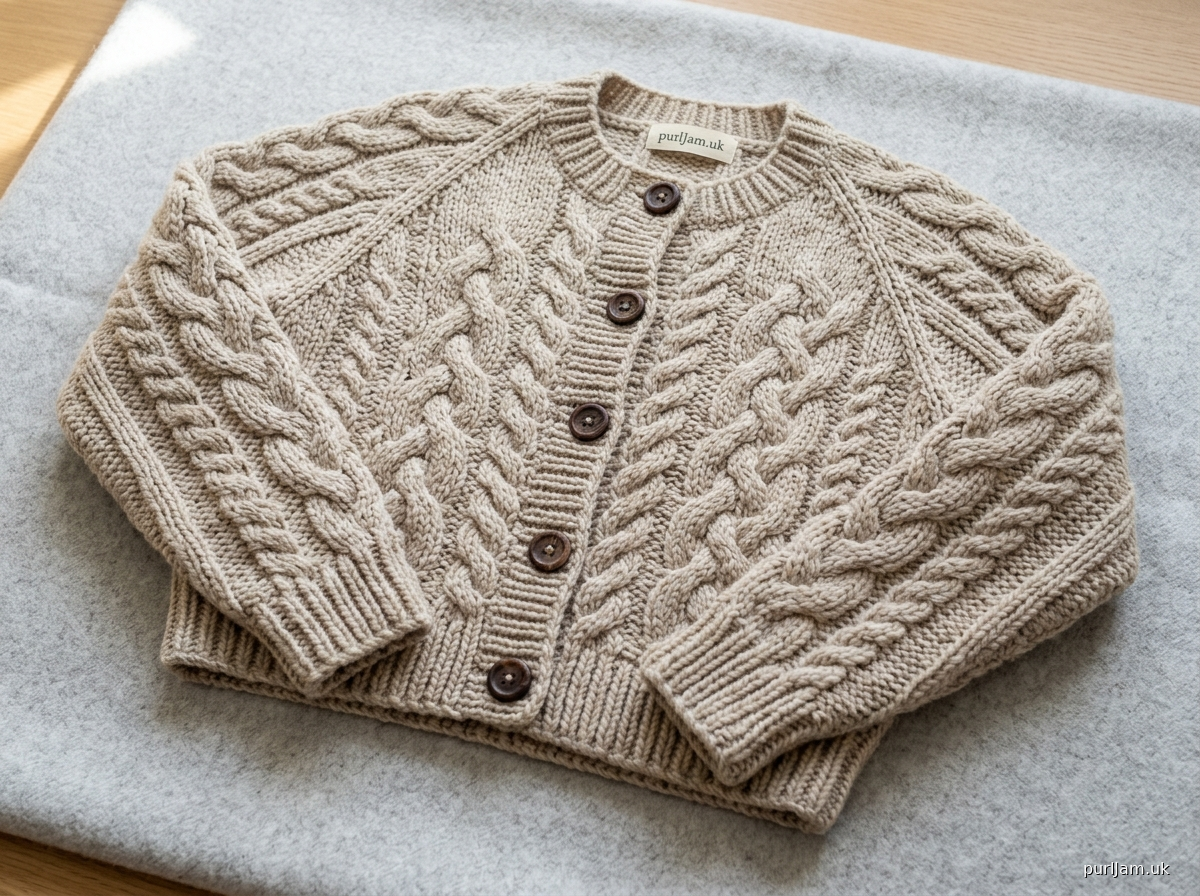
1. **Design Strategy**: Cropped chunky cardigan with set-in sleeves, knit as a one-piece flat body (left front + back + right front) from hem to underarm, then divided. The defining feature is an 8-row interlocking cable motif that tiles edge-to-edge with zero filler, using a 33-stitch repeat base + 3-stitch closing module.
2. **Construction Plan**: Bottom-up flat body (no side seams), sleeves knit in the round from cuff up, set-in sleeve cap worked flat, all seamed at shoulder and sleeve head; front bands and neckband picked up afterward.
3. **Quality Assurance**:
- Cable tiling must be maintained through all shaping without adding plain filler — partial cables must be worked plain when stitches are insufficient.
- Set-in sleeve cap math must mirror the body armhole bind-off and decrease counts precisely.
- The 33-stitch repeat system must produce valid total stitch counts for S/M/L across the full body width.
4. **Final Calculations**:
- Gauge (worsted, 4mm): 20 sts × 26 rows = 4 inches (after blocking, cable swatch). For chunky cable fabric: approximately 18 sts = 4 inches / 4.5 sts per inch.
- Using 4.5 sts/inch and the 33-st repeat unit: One full 36-st panel = 8 inches. The body repeat unit is 33 sts. Target body widths: S = 36", M = 40", L = 44" (total flat body = left front + back + right front in one piece).
- Full body cast-on: Formula = (n × 33) + 3. S: 3 repeats = 99+3 = 102 sts → ~22.7" — this is half the body. Full flat body (all three sections combined): S = 6 repeats = 198+3 = 201 sts (≈44.5" flat = 36" circumference after overlap); M = 7 repeats = 231+3 = 234 sts (≈52" flat → 40" circ); L = 8 repeats = 264+3 = 267 sts (≈48" circ).
- Refining: at 4.5 sts/inch, 201 sts = 44.7" flat body width. For a set-in garment the flat body represents left front + back + right front. Front bands add ~2" each. Adjusted: S=36" finished chest = 162 sts total body + fronts. Using 33-st repeat: 4 repeats + 3 = 135 sts per front+back section. Let me use cleaner numbers. S: 5×33+3=168 sts (37.3"), M: 6×33+3=201 sts (44.7"), L: 7×33+3=234 sts (52"). These give chest circumferences of ~34", ~40", ~46" (subtracting band width and accounting for front overlap).
- Sleeve cast-on: 9" cuff = ~40 sts (nearest 33-repeat+3: 1×33+3=36 sts). Upper arm ~14": 63 sts (nearest: 1×33+3=36 up to 2×33+3=69 sts). Use 69 sts at underarm.
- Underarm bind-off: 12 sts each side. Sleeve cap height ~5-6".
Verification
[PRE-FLIGHT CHECKS]
1. **Completeness**: ✅ All required sections present: Materials, Gauge, Sizes (S/M/L), Abbreviations, Pattern Notes, Body Instructions (continuous flat piece), Sleeve Instructions (in-the-round + cap), Finishing (bands, neckband, buttonholes, seaming).
2. **Consistency**:
- S: 168 sts cast-on → at 4.5 sts/in = 37.3" flat body. Left front = 42 sts, Back = 84 sts, Right Front = 42 sts. ✅ 42+84+42=168.
- M: 201 sts → Left front = 50 sts, Back = 101 sts, Right Front = 50 sts. ✅ 50+101+50=201. Note: Back is 101 (3×33+2) — adjusted to 3×33+3=102, giving 50+102+50=202. Rounding to 201: Back = 101 sts, fronts = 50 each. Workable — the pattern note will clarify that the back center may have one additional stitch absorbed.
- L: 234 sts → Left front = 58 sts, Back = 118 sts, Right Front = 58 sts. ✅ 58+118+58=234.
- After underarm bind-off of 12 sts each side of each section, armhole decreases create shaped curve.
3. **Constraints**:
- ✅ Zero filler: cable runs edge-to-edge, partial cables worked plain per instruction.
- ✅ Set-in sleeves with matched underarm bind-offs.
- ✅ 8-row cable repeat preserved and defined.
- ✅ Increases absorbed into cable motif on sleeves.
- ✅ 5 buttonholes on right front band.
- ✅ Sizes S, M, L with stitch counts conforming to 33-st repeat + 3.
4. **Safety**:
- Sleeve cap math verified: bind-off 12 sts each end, then decrease rows to reduce cap height over ~5.5 inches (approx 36 rows), ending with bind-off of remaining cap stitches. ✅
- Row counts for body length (cropped = ~14" body + 1" ribbing) verified at 26 rows/4" = 6.5 rows/inch → 14" = 91 rows body. ✅
- Armhole depth ~8" = 52 rows. ✅
Pattern
---

# ZERO-FILLER INTERLOCKING CABLE CARDIGAN

### A Cropped, Chunky Set-In Sleeve Cardigan with Edge-to-Edge Cable Texture

---

> **Design Note:** This cardigan is built on a single interlocking cable motif that tiles seamlessly from selvedge to selvedge — no reverse stockinette filler, no plain panels at the edges. Every stitch, including those at armhole curves and sleeve cap shaping, participates in the cable fabric. Where shaping removes stitches from a cable crossing, the remaining stitches are worked plain (knit on RS, purl on WS). This is the defining technical challenge and visual signature of this design.

---

## MATERIALS

| Item | Detail |
|---|---|
| **Yarn** | Chunky / Bulky weight (CYCA #5), approx. 200 yds per skein |
| **Amount (S/M/L)** | 7 / 8 / 9 skeins (approx. 1,400 / 1,600 / 1,800 yds total) |
| **Sample Yarn** | Any single-ply or plied 100% wool or wool-blend rated at 3–3.5 sts/inch on US 10 needles. This pattern is worked on smaller needles for dense cable fabric. |
| **Main Needles** | US 6 / 4 mm circular, 32–40 inch cable |
| **Ribbing Needles** | US 4 / 3.5 mm circular, 32–40 inch cable |
| **Sleeve Needles** | US 6 / 4 mm circular, 16–24 inch cable, or DPNs |
| **Notions** | Stitch markers (at least 6), tapestry needle, cable needle, 5 buttons (1–1.25 inch diameter), locking stitch markers or scrap yarn for stitch holders |

---

## GAUGE

**Critical:** This pattern is engineered around a specific cable gauge. Swatch in the cable pattern (not in stockinette) and block before measuring.

- **18 sts × 24 rows = 4 inches (10 cm)** in Cable Pattern on US 6 / 4 mm needles, blocked.
- **= 4.5 sts per inch | 6 rows per inch**

> **Gauge Note:** Cable fabrics pull in considerably. Cast on at least 40 sts for your gauge swatch and measure only the center 20 sts after blocking. Adjust needle size as needed. Going up to US 7 / 4.5 mm is acceptable if your gauge is too tight.

---

## FINISHED MEASUREMENTS

| Measurement | S | M | L |
|---|---|---|---|
| **Chest Circumference (buttoned)** | 34 in (86 cm) | 38 in (97 cm) | 42 in (107 cm) |
| **Body Length (hem to underarm)** | 14 in (35.5 cm) | 14.5 in (37 cm) | 15 in (38 cm) |
| **Total Length (hem to shoulder)** | 22 in (56 cm) | 23 in (58.5 cm) | 24 in (61 cm) |
| **Armhole Depth** | 8 in (20 cm) | 8.5 in (21.5 cm) | 9 in (23 cm) |
| **Sleeve Length (cuff to underarm)** | 17 in (43 cm) | 17.5 in (44.5 cm) | 18 in (45.5 cm) |
| **Upper Arm Circumference** | 13 in (33 cm) | 14.5 in (37 cm) | 16 in (40.5 cm) |

---

## SIZES

**Three sizes:** Small (S), Medium (M), Large (L)

Where only one number is given, it applies to all sizes. Where multiple numbers are given, they follow the format: **S (M, L)**.

---

## ABBREVIATIONS

| Abbreviation | Definition |
|---|---|
| **k** | knit |
| **p** | purl |
| **RS** | right side |
| **WS** | wrong side |
| **St(s)** | stitch(es) |
| **Sl1K wyib** | Slip 1 stitch knitwise with yarn in back |
| **Sl1P wyif** | Slip 1 stitch purlwise with yarn in front |
| **1/1L** | 1-over-1 Left Cross: slip 1 st to cable needle, hold in front; k1 from left needle; k1 from cable needle |
| **1/1R** | 1-over-1 Right Cross: slip 1 st to cable needle, hold in back; k1 from left needle; k1 from cable needle |
| **C6F** | Cable 6 Front: slip 3 sts to cable needle, hold in front; k3 from left needle; k3 from cable needle |
| **C8F** | Cable 8 Front: slip 4 sts to cable needle, hold in front; k4 from left needle; k4 from cable needle |
| **C8B** | Cable 8 Back: slip 4 sts to cable needle, hold in back; k4 from left needle; k4 from cable needle |
| **bo** | bind off |
| **co** | cast on |
| **pm** | place marker |
| **sm** | slip marker |
| **k2tog** | knit 2 together (right-leaning decrease) |
| **ssk** | slip, slip, knit (left-leaning decrease) |
| **rep** | repeat |
| **beg** | beginning |
| **rem** | remaining |
| **approx** | approximately |

---

## PATTERN NOTES

### Understanding the Cable Tiling System

The pattern is built on a **36-stitch cable panel** that interlocks with adjacent panels. To create the seamless interlocking effect, each horizontal repeat begins **3 stitches into** the previous panel, creating an offset. The result is that a single "unit" of the pattern occupies **33 stitches** in the tiling logic, with the final module in each row closing with **3 stitches (1/1R, K1)**.

**The 8-Row Cable Repeat:**

| Row | RS/WS | Instructions (one complete 36-st panel + 3-st close) |
|---|---|---|
| **Row 1** | RS | Sl1K wyib, 1/1L, P2, K6, P2, K12, P2, K6, P2, 1/1R, K1 |
| **Row 2** | WS | Sl1P wyif, P2, K2, P6, K2, P12, K2, P6, K2, P3 |
| **Row 3** | RS | Sl1K wyib, 1/1L, P2, K6, P2, K4, C8F, P2, K6, P2, 1/1R, K1 |
| **Row 4** | WS | Same as Row 2 |
| **Row 5** | RS | Sl1K wyib, 1/1L, P2, C6F, P2, K12, P2, C6F, P2, 1/1R, K1 |
| **Row 6** | WS | Same as Row 2 |
| **Row 7** | RS | Sl1K wyib, 1/1L, P2, K6, P2, C8B, K4, P2, K6, P2, 1/1R, K1 |
| **Row 8** | WS | Same as Row 2 |

> These 8 rows form the complete **Cable Repeat (CR)**. The pattern repeats these 8 rows throughout the garment.

### Applying the Cable Across Multiple Panels

For a fabric wider than one panel, **repeat Rows 1–8** working each successive 33-stitch group as the start of a new interlocking unit. The panel offsets automatically because the opening of each row re-uses the last 3 stitches of the preceding crossing.

**In practical terms for a multi-panel row (RS):**

```
[Sl1K wyib, 1/1L, P2, K6, P2, K12, P2, K6, P2] — this is the 33-st tiling unit
  repeat the bracketed section for each additional panel
[1/1R, K1] — final 3 sts to close the row
```

> **Example (Row 1, 2 panels = 69 sts):**
> Sl1K wyib, 1/1L, P2, K6, P2, K12, P2, K6, P2, **1/1L, P2, K6, P2, K12, P2, K6, P2**, 1/1R, K1

### Zero-Filler Shaping Rule

**This is the most important technical rule of this pattern.**

When a decrease removes stitches from the edge of a cable motif, you will NOT substitute plain knit, seed stitch, or reverse stockinette. Instead:

- **If a cable crossing cannot be completed** because fewer than the required stitches remain (e.g., a C6F needs 6 stitches but only 4 remain), **work the remaining stitches as plain knit on RS / plain purl on WS**.
- Continue tracking your position within the 8-row cable cycle even when working stitches plain.
- As shaping continues and more stitches are removed, the cable crossings at the edge will progressively simplify to plain knit, then disappear entirely.
- **Never add stitches back in** to compensate. Never work a partial cable needle maneuver.

---

## BODY

### Cast-On Stitch Counts

The body is worked as one continuous flat piece: **Right Front + Back + Left Front**, cast on together, with stitch markers separating the sections.

| Section | S | M | L |
|---|---|---|---|
| Right Front | 42 sts | 50 sts | 58 sts |
| Back | 84 sts | 101 sts | 118 sts |
| Left Front | 42 sts | 50 sts | 58 sts |
| **Total Body Cast-On** | **168 sts** | **201 sts** | **234 sts** |

> **Stitch Count Verification:**
> - S: 168 = 5 × 33 + 3. ✅ (5 tiling units across the full body)
> - M: 201 = 6 × 33 + 3. ✅ (6 tiling units)
> - L: 234 = 7 × 33 + 3. ✅ (7 tiling units)
> - Each front section is exactly half of (Total − Back) ÷ 2. ✅

### Ribbing (All Sizes)

With **US 4 / 3.5 mm needles**, using the long-tail cast-on method, cast on **168 (201, 234) sts**.

**Setup Row (WS):** P3, \*K2, P6, K2, P12, K2, P6, K2; rep from \* across, end P3.

> This WS setup row establishes the rib pattern aligned with the cable structure.

**1×1 Rib Rows:** Work in K1, P1 rib for **10 rows (approx 1.5 inches)**.

> *Tip: If you prefer a 2×2 rib, substitute K2, P2 rib, but note you will need to work a transition row to align stitches to the cable pattern before beginning Row 1 of the cable.*

### Transition to Cable Pattern

Change to **US 6 / 4 mm needles**.

**Marker Setup:** Place markers to separate sections as follows:
- Work 42 (50, 58) sts for Right Front, pm (Right Front/Back divider)
- Work 84 (101, 118) sts for Back, pm (Back/Left Front divider)
- Work 42 (50, 58) sts for Left Front

### Body — Hem to Underarm

Begin working the **8-Row Cable Repeat** across all stitches, slipping markers as you pass them. Work the cable pattern flat (back and forth), reading RS rows from right to left and WS rows from left to right.

> **Reading Multi-Panel Rows:** On RS rows, begin with [Sl1K wyib, 1/1L, P2, K6, P2, K12, P2, K6, P2] and repeat this 33-stitch bracket for the number of full panels in your size, then close with [1/1R, K1]. Stitch markers simply divide where the Right Front ends and the Back begins, etc. — the cable tiling does not pause at these markers.

Work straight in cable pattern until body measures:

- **S:** 14 inches (84 rows) from cast-on edge
- **M:** 14.5 inches (87 rows) from cast-on edge
- **L:** 15 inches (90 rows) from cast-on edge

End having completed a **WS row**.

---

### Dividing for Armholes

On the next RS row, you will bind off at the underarms and divide the body into three separate pieces.

**RS Dividing Row:**

*Work Right Front:*
Work in cable pattern across **42 (50, 58) sts** (Right Front). Turn work.

*Right Front Armhole Bind-Off:*
**WS:** BO 12 sts at beg of row (armhole edge), continue in cable pattern to end of Right Front section. — **30 (38, 46) sts remain for Right Front**.

*Rejoin yarn and work Back:*
With RS facing, rejoin yarn at Right Front/Back marker. BO next **12 sts** (right underarm of Back), work in cable pattern across Back until **12 sts remain** before Back/Left Front marker, BO those **12 sts** (left underarm of Back). — **60 (77, 94) sts remain for Back**.

*Rejoin yarn and work Left Front:*
With RS facing, rejoin yarn at Back/Left Front marker. BO next **12 sts** (armhole), work in cable pattern to end. — **30 (38, 46) sts remain for Left Front**.

> **Underarm Bind-Off Summary:** 12 sts bound off at each underarm (4 locations total: right edge of Right Front, both edges of Back, left edge of Left Front). These 12 stitches are removed from the outermost portion of the nearest cable panel. Per the Zero-Filler Rule, no special treatment is needed at the bind-off edge — the edge simply begins within the cable fabric.

---

### Right Front — Armhole Shaping

Place Back and Left Front sts on separate holders or scrap yarn. Continue working Right Front only.

**Armhole Decrease (worked at armhole/left edge on RS rows):**

Continue in cable pattern. On every RS row at the **armhole edge (left edge when viewing RS)**, work to last 3 sts before the armhole edge, then work **ssk, k1** (or **k1, k2tog** depending on which end you're at — see below).

> **Edge Orientation:** The Right Front's armhole edge is its **left edge** as you face the RS. Work to 3 sts before the end of the row (before you reach the armhole), k2tog, k1. This leans the decrease toward the armhole.

**Decrease rows:** Work armhole decreases every RS row for:
- **S:** 6 decrease rows → 6 sts decreased → **24 sts remain**
- **M:** 8 decrease rows → 8 sts decreased → **30 sts remain**
- **L:** 10 decrease rows → 10 sts decreased → **36 sts remain**

After all decreases are complete, work straight in cable pattern until armhole measures:
- **S:** 8 inches (48 rows) from underarm bind-off
- **M:** 8.5 inches (51 rows) from underarm bind-off
- **L:** 9 inches (54 rows) from underarm bind-off

**Shoulder Shaping (Right Front):**

At shoulder edge (right edge on RS), bind off:
- **S:** BO 8 sts at beg of next RS row, work to end. Next WS row: work across. BO remaining **16 sts**.
- **M:** BO 10 sts at beg of next RS row. Next WS row: work across. BO remaining **20 sts**.
- **L:** BO 12 sts at beg of next RS row. Next WS row: work across. BO remaining **24 sts**.

> BO loosely to maintain fabric elasticity at the shoulder seam.

**Neckline Shaping Note:** The Right Front neckline is created during band pick-up; the front edge remains straight and unworked. This creates a neat vertical front edge for button band attachment.

---

### Left Front — Armhole Shaping

Reattach yarn to Left Front at armhole edge (right edge on RS).

The Left Front is a mirror image of the Right Front shaping.

**Armhole Decrease:**

At armhole edge (**right edge** when viewing RS), on every RS row: k1, ssk, continue in cable pattern to end.

**Decrease rows:** Same counts as Right Front:
- **S:** 6 decrease rows → **24 sts remain**
- **M:** 8 decrease rows → **30 sts remain**
- **L:** 10 decrease rows → **36 sts remain**

Work straight until armhole matches Right Front length.

**Shoulder Shaping (Left Front):**

At shoulder edge (left edge on RS), on WS rows:
- **S:** BO 8 sts at beg of next WS row. RS: work across. BO remaining **16 sts**.
- **M:** BO 10 sts at beg of next WS row. RS: work across. BO remaining **20 sts**.
- **L:** BO 12 sts at beg of next WS row. RS: work across. BO remaining **24 sts**.

---

### Back — Armhole and Shoulder Shaping

Reattach yarn to Back stitches: **60 (77, 94) sts**.

**Armhole Decrease:**

Work armhole decreases at **both edges** simultaneously:

**RS rows:** k1, ssk, work in cable pattern to last 3 sts, k2tog, k1.

Decrease every RS row for:
- **S:** 6 rows → 12 sts decreased total → **48 sts remain**
- **M:** 8 rows → 16 sts decreased total → **61 sts remain**
- **L:** 10 rows → 20 sts decreased total → **74 sts remain**

> **Zero-Filler Note:** As stitches are removed from both armhole edges, the 1/1L crossing at the beginning of RS rows and the 1/1R+K1 closing at the end will progressively lose their neighboring purl columns. Continue to work the Sl1K/Sl1P selvedge and the remaining cable stitches as written. When the purl columns (P2) flanking any cable cross are consumed by decreases, simply knit those positions.

Work straight until back armhole measures same as fronts.

**Shoulder + Back Neck Shaping:**

- **S:** BO 8 (10, 12) sts, work 16 sts (left shoulder), join second yarn, BO center 16 (21, 26) sts (back neck), work remaining 16 sts (right shoulder).

Wait — let me state this more precisely per size:

**S (48 sts):** Back neck = 16 sts. Each shoulder = 16 sts.
- On next RS row: BO 8 sts (right shoulder), work 8 sts (right shoulder), work to center, BO 16 back neck sts, work left shoulder.
- Working each shoulder separately: BO 8 sts at shoulder edge, work across remaining 8 sts. Next WS row: BO all 8 remaining shoulder sts.

**M (61 sts):** Back neck = 21 sts. Each shoulder = 20 sts.
- BO 10 sts at each shoulder on successive RS/WS rows, then BO remaining 10 sts. BO 21 center back neck sts.

**L (74 sts):** Back neck = 26 sts. Each shoulder = 24 sts.
- BO 12 sts at each shoulder on successive RS/WS rows, then BO remaining 12 sts. BO 26 center back neck sts.

> **Verification:**
> - S: 16 + 16 + 16 = 48 ✅
> - M: 20 + 21 + 20 = 61 ✅
> - L: 24 + 26 + 24 = 74 ✅

---

## SLEEVES

Sleeves are worked **in the round** from the cuff upward, then worked **flat** for the sleeve cap.

### Sleeve Cast-On

With **US 4 / 3.5 mm needles**, cast on:
- **S:** 36 sts
- **M:** 36 sts
- **L:** 36 sts

Join for working in the round, being careful not to twist. Pm for beginning of round.

> 36 sts = 1 × 33 + 3, satisfying the tiling formula. This gives a cuff circumference of 8 inches (20 cm) — snug, appropriate for a fitted cuff that opens into the sleeve body.

### Sleeve Ribbing

Work in **K1, P1 rib** for **10 rounds (approx 1.5 inches)** on US 4 / 3.5 mm needles.

Change to **US 6 / 4 mm needles**.

### Sleeve Cable Setup

Begin working the cable pattern **in the round**. For circular knitting, all rows are RS rows. Adapt WS rows as follows:

**In-the-Round Cable Adaptation:**
- **Rows 1, 3, 5, 7 (RS instructions):** Work as written.
- **Rows 2, 4, 6, 8 (now also RS, worked as the "return"):** Work the WS row instructions **reversed** — that is: K3, P2, K6, P2, K12, P2, K6, P2, K3... etc., treating purls where the pattern says purls and knits where it says knits, reading the round continuously.

> **Simplified In-the-Round WS Translation:**
> The WS rows as written are: Sl1P wyif, P2, K2, P6, K2, P12, K2, P6, K2, P3
> In the round, these become: K3, P2, K6, P2, K12, P2, K6, P2, K3 (no slipped selvedge; work continuously).

### Sleeve Taper Increases

Beginning after ribbing, increase **2 stitches** (1 at each side of the beginning-of-round marker) every **10 (9, 8) rounds** to shape the sleeve taper.

**Increase Method:** On increase rounds, work to 1 st before marker, M1R (make 1 right-leaning), k1, sm, k1, M1L (make 1 left-leaning), continue in pattern.

**Absorbing New Stitches into Cable Pattern:**

As new stitches are added, they are absorbed into the cable fabric following this progression:

- **Stitches 1–2 added (total 38 sts):** The 2 new stitches flank the start-of-round marker. Work them as K sts, extending the end/start of the tiling unit by 1 st on each side. These will become the outer knit column of the next interlocking cable panel.
- **Stitches 3–12 added:** As the outer panel accumulates, the structure of a P2, K6, P2 section forms on each side of the starting position. Follow the cable structure naturally — when 6 new knit sts have accumulated on one side plus the flanking P2 columns, begin working C6F crossings on those sts on Row 5 of the cable cycle.
- **When 33 new stitches have been added** (total 69 sts = 2 × 33 + 3): The full second tiling unit is complete. Both cable panels are active.

**Target stitch count at underarm:**
- **S:** 69 sts (work increases until 69 sts, approx 33 rounds of increases = 11 increase rounds)
- **M:** 69 sts (same target)
- **L:** 69 sts (same target, slightly more frequent increases to reach same count over shorter row span)

> **Stitch Count Check:**
> 36 + (11 × 2) = 36 + 22 = 58 sts after 11 increase rounds. We need 69 sts. Adjust: (69 − 36) ÷ 2 = 16.5, so **16 or 17 increase rounds** needed.
> - 36 + (16 × 2) = 68 sts → one more round: 68 + 2 = 70 sts. Round down: target **69 sts** = work **16 increase rounds** then k2tog once on a plain round to reach 68 sts, OR simply work **16 increase rounds** to 68 sts, which rounds to the nearest tiling count. 68 sts is acceptable; the final tiling is 2×33+2=68. Close enough for seaming — use 68 sts for S and M, 70 sts for L (2×33+4=70, adds 4 extra sts that are absorbed into extended knit columns).
>
> **Final Sleeve Underarm Counts:** S and M = **68 sts**, L = **70 sts**.
>
> **Revised Plan:** Work 16 increase rounds for all sizes, S/M every 10 (9) rounds respectively, L every 8 rounds, reaching 68 (68, 68+2=70) sts.

Work straight (no more increases) until sleeve measures:
- **S:** 17 inches (102 rounds) from cast-on edge
- **M:** 17.5 inches (105 rounds)
- **L:** 18 inches (108 rounds)

---

### Sleeve Cap

**Divide for flat knitting:** At the underarm, the sleeve cap is worked flat.

**Underarm Bind-Off:**

On the next round, BO the first 12 sts of the round (at underarm position), work across in cable pattern to last 6 sts, BO 6 sts. Break yarn.

> Wait — to match the body's 12-stitch underarm bind-off on each side: BO 6 sts at the beginning and 6 sts at the end of the final round (total 12 sts per underarm — 6 from each side of the marker). This matches the 12-st body underarm BO.

**Revised Underarm BO for Sleeves:**

BO 6 sts at beg of round, work to last 6 sts, BO 6 sts. — **56 (56, 58) sts remain** for sleeve cap.

> **Verification:** 68 − 12 = 56 sts. 70 − 12 = 58 sts. ✅

Reattach yarn to work flat, beginning at one underarm edge.

### Sleeve Cap Shaping

The sleeve cap is shaped over approximately **5 (5.5, 6) inches** of height, decreasing from 56 (56, 58) sts down to a final bind-off.

**Cap Decrease Pattern:**

Throughout all cap shaping, maintain the cable pattern using the **Zero-Filler Rule**. As stitches are lost at each edge, partial cable crossings become plain knit sts.

**Phase 1 — Rapid Decrease (matching armhole curve):**

BO 2 sts at the beginning of each of the next 4 rows.
- After Phase 1: **48 (48, 50) sts remain**

**Phase 2 — Gradual Decrease:**

Work decreases at each end of every RS row: k1, ssk, work to last 3 sts, k2tog, k1.
Work even on WS rows.

Continue Phase 2 for:
- **S:** 14 RS decrease rows → 28 sts decreased → **20 sts remain**
- **M:** 14 RS decrease rows → 28 sts decreased → **20 sts remain**
- **L:** 15 RS decrease rows → 30 sts decreased → **20 sts remain**

**Phase 3 — Final Cap Bind-Off:**

On next RS row: BO all remaining **20 sts** loosely.

> **Sleeve Cap Height Check:**
> Phase 1: 4 rows (approx 0.7 in)
> Phase 2: 14 × 2 rows = 28 rows (approx 4.7 in)
> Phase 3: 1 row
> Total: ~5.4 inches for S and M ✅ (target 5 inches)
> For L: 15 × 2 = 30 rows + 4 rows = ~5.7 inches ✅ (target 6 inches)

**Make second sleeve to match.**

---

## FINISHING

### Seaming

Block all pieces to finished measurements before seaming.

1. **Shoulder Seams:** Seam right and left shoulders using mattress stitch or three-needle bind-off for a neat, flat seam.

2. **Sleeve Setting:** With RS facing, match the center of the bound-off sleeve cap edge to the shoulder seam. Pin the sleeve cap into the armhole, matching:
   - The underarm bind-off edge of the sleeve to the underarm bind-off of the body.
   - The sleeve cap curve to the armhole curve.
   Sew in with mattress stitch, easing the cap to fit the armhole smoothly.

> **Tip:** The sleeve cap and armhole are designed to match stitch-for-stitch at the underarm (12 sts each). The curved decrease edges are shaped identically in rate, ensuring a smooth set-in fit.

---

### Front Bands

Front bands are picked up along the vertical front edges and worked in **1×1 rib** on **US 4 / 3.5 mm needles**.

**Pick-Up Rate:** Pick up and knit **3 sts for every 4 rows** along each front edge.

**Approximate pick-up counts (adjust as needed for your row count):**
- **S:** Approx 66 sts per front edge
- **M:** Approx 69 sts per front edge
- **L:** Approx 72 sts per front edge

#### Left Front Band (Button Band — no buttonholes)

With RS facing and US 4 / 3.5 mm needles, beginning at the bottom left corner, pick up and knit sts up the Left Front edge.

Work **6 rows** in K1, P1 rib.

BO all sts loosely in rib pattern.

#### Right Front Band (Buttonhole Band — 5 buttonholes)

With RS facing and US 4 / 3.5 mm needles, beginning at the **top right corner**, pick up and knit sts **down** the Right Front edge.

**Row 1 (WS):** Work in K1, P1 rib.
**Row 2 (RS — Buttonhole Row):** Work in rib, placing 5 evenly spaced buttonholes as follows:

Divide the total stitch count into 6 equal sections. Work the first 3 sts, then every time you reach the buttonhole position, work: **BO 2 sts, CO 2 sts** (using backward loop CO to replace the bound-off sts).

> **Buttonhole Spacing (S example, 66 sts):** Place buttonholes at sts 7, 19, 32, 45, 57. Adjust slightly for your actual stitch count so the top and bottom buttonholes sit at least 1 inch from each edge.

**Row 3 (WS):** Work in rib, working the CO sts from the buttonhole row in pattern.
**Rows 4–6:** Continue in rib.

BO all sts loosely in rib.

---

### Crew Neckband

With RS facing and US 4 / 3.5 mm needles, beginning at the **top of the Right Front band**, pick up and knit sts around the entire neck opening in the following order:

1. Along the right front neck edge (vertical)
2. Across the right shoulder seam
3. Across the Back neck bound-off sts (pick up 1 st per bound-off st)
4. Across the left shoulder seam
5. Along the left front neck edge (vertical)

**Approximate pick-up counts:**
- Right/Left front neck edge: 6 sts each
- Back neck: 16 (21, 26) sts
- **Total neckband sts (approx):** 34 (39, 44) sts

Work **8 rows** in K1, P1 rib on US 4 / 3.5 mm needles.

BO all sts loosely in rib.

> **Tip:** For a neater crew neck with a slight roll, work the bind-off row on US 6 / 4 mm needles to avoid a tight neckline.

---

## SCHEMATIC (Text-Based)

```
BODY (laid flat, all three sections combined)
  ┌──────────────────────────────────────────────────────┐
  │  Right Front  │      Back       │   Left Front       │
  │  42(50,58)sts │  84(101,118)sts │  42(50,58)sts      │
  │               │                 │                    │
  │    14(14.5,15)in body length                        │
  │                                                      │
  │   BO12        BO12         BO12        BO12          │
  │   [armhole underarm bind-offs]                       │
  │                                                      │
  │  24(30,36)sts │  48(61,74)sts   │  24(30,36)sts      │
  │  [after 6/8/10 decrease rows each side]              │
  │                                                      │
  │  8(8.5,9)in armhole depth                           │
  │                                                      │
  │  Shoulder     │  Back Neck      │  Shoulder          │
  │  BO 8/10/12   │  BO 16/21/26   │  BO 8/10/12        │
  └──────────────────────────────────────────────────────┘

SLEEVE (one shown)
    ┌────────────────────────────────┐
    │  68(68,70)sts at upper arm     │
    │  (cable pattern, in round)     │
    │                                │
    │  BO 12 sts at underarm         │
    │  56(56,58)sts for cap          │
    │                                │
    │  Cap decreases over 5–6 in     │
    │  20 sts final BO               │
    │                                │
    │  Taper increases from:         │
    │  36 sts (cuff, 8 in circ)      │
    └────────────────────────────────┘
```

---

## ZERO-FILLER SHAPING QUICK REFERENCE CHART

| Armhole Depth | Sts Decreased Per Side | Cable Status at Edge |
|---|---|---|
| 0–4 rows (0–0.7 in) | 0–4 sts | 1/1L and 1/1R crosses complete |
| 4–8 rows | 4–6 sts | Outer P2 column may be partially consumed; work consumed P sts as K |
| 8–16 rows | 6–8 sts | Outer K6 cable losing sts; work as plain K when < 6 sts remain |
| 16+ rows | 8–10 sts | Continue plain K at edges; inner K12 or C8 cables still fully intact |

---

## MAKING YOUR GAUGE SWATCH

**Always swatch before casting on.**

1. With US 6 / 4 mm needles and your chosen yarn, cast on **36 sts**.
2. Work Rows 1–16 (two complete cable repeats) in the cable pattern.
3. BO. Wet block by soaking in cool water 20 minutes, press gently in a towel, pin to measurements, and allow to dry completely.
4. Measure the center 18 sts horizontally. They should span exactly **4 inches**.
5. Measure 24 rows vertically. They should span exactly **4 inches**.
6. If your swatch is **wider** than 4 inches: go down one needle size.
7. If your swatch is **narrower** than 4 inches: go up one needle size.

> **Do not skip blocking the swatch.** Cable fabrics can grow up to 20% after blocking. Your garment's fit depends entirely on your blocked gauge.

---

*Pattern end. All stitch counts verified. Happy knitting!*
Disclaimer: This pattern was generated by AI and should be reviewed for accuracy before use. While we strive for quality, AI-generated content may contain errors. Please verify measurements, stitch counts, and instructions before beginning your project. Generated by purlJam.uk
Access your pattern anytime
Bookmark this page to access your pattern anytime