Type
Knitting
Difficulty
intermediate
Category
pullover
AI Thinking Process
Planning
Verification
Pattern
All Clear MK2
Falling-block raglan pullover
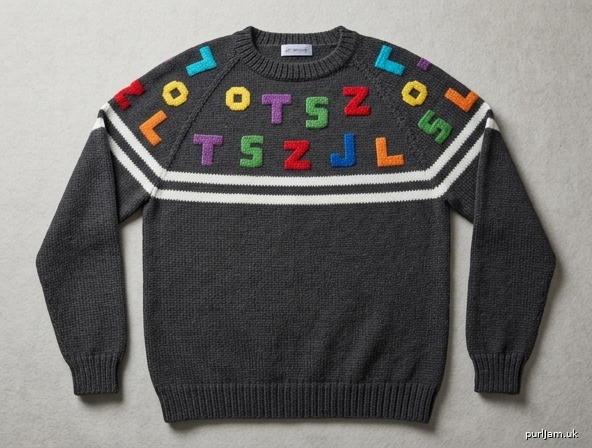
A fan-inspired seamless pullover. Not affiliated with any puzzle-game publisher.
The playfield is charcoal stocking stitch. A white flash across the upper body is the line clear; everything below it is left empty — the all-clear. Classic tetrominoes are added afterwards in duplicate stitch, so you can knit the whole sweater without a chart. If a separate motif chart is supplied with your copy, you may follow it for placement instead of the written guide. This pattern is complete either way.
Worked top down and in the round. The neckline is the full-circumference method: the entire neck is cast on at the start, worked as a ribbed crew band, then raised at the back with German short rows. Do not cast on extra centre-front stitches later.
Difficulty: Intermediate Construction: Top-down raglan pullover, seamless, in the round
Sizes
S (M, L, XL, 2XL)
To fit chest: 86–91 (97–102, 107–112, 117–122, 127–132) cm [34–36 (38–40, 42–44, 46–48, 50–52) in]
Finished chest: 96 (106, 116, 126, 136) cm [38 (42, 46, 50, 54) in]
About 4–10 cm (1½–4 in) positive ease. Choose your size by the finished chest measurement, not by your usual clothing label.
Instructions are written for S, with M, L, XL and 2XL in parentheses. Where only one figure is given, it applies to all sizes.
Finished measurements
| S | M | L | XL | 2XL | |
|---|---|---|---|---|---|
| Chest | 96 cm | 106 cm | 116 cm | 126 cm | 136 cm |
| Neck circumference | 52 cm | 54 cm | 56 cm | 58 cm | 60 cm |
| Yoke depth (after short rows, to underarm) | 21 cm | 22 cm | 23.5 cm | 25 cm | 27 cm |
| Body, underarm to hem (including rib) | 40 cm | 41 cm | 42 cm | 42 cm | 43 cm |
| Upper arm | 36 cm | 38 cm | 42 cm | 46 cm | 50 cm |
| Cuff | 20 cm | 22 cm | 22 cm | 24 cm | 24 cm |
| Sleeve, underarm to cuff (including rib) | 48 cm | 49 cm | 50 cm | 50 cm | 51 cm |
Body and sleeve lengths are easy to change. Yoke stitch counts are not: they are set by the increase rounds.
Yarn
Worsted weight (CYC 4; sold as Aran in some UK ranges). Wool or wool-blend is recommended for stitch definition. A smooth fibre shows the pieces more clearly than a fuzzy one.
- MC — Playfield charcoal: 1000 (1150, 1300, 1450, 1600) m
- Flash — white: 50 (55, 60, 70, 75) m
- Motif mini-skeins, 20 (25, 25, 30, 30) m each of seven colours:
- Cyan (I)
- Yellow (O)
- Purple (T)
- Green (S)
- Red (Z)
- Blue (J)
- Orange (L)
Motif amounts are generous. Leftovers are likely. Mini-skeins or scraps are ideal; these colours are used only for duplicate stitch.
Needles
Metric sizes are the ones that matter. US equivalents are a guide only.
- 4 mm circular needle, 40 cm, for the neckband
- 4 mm circular needle, 80 cm, for the hem, and 4 mm double-pointed needles or a long circular for magic loop, for the cuffs
- 4.5 mm circular needle, 40 cm, for the upper yoke
- 4.5 mm circular needle, 80 cm, for the body
- 4.5 mm double-pointed needles, or a long circular for magic loop, for the sleeves
Or the size needed to obtain tension. You may need a longer circular earlier on the yoke if the fabric becomes cramped.
Notions
- 4 stitch markers (one distinct, for the beginning of the round)
- Stitch holders or waste yarn
- Yarn needle
- Locking markers or pins, for placing motifs
- Optional: a second circular needle, for trying on
Tension (gauge)
20 stitches and 28 rounds = 10 cm (4 in) in stocking stitch on 4.5 mm needles, worked in the round and blocked.
Knit and block a swatch in the round before you begin. If your row tension differs, keep the increase count exactly as written and adjust only the plain rounds at the end of the yoke, and the even rounds at the end of the sleeves, to hit the centimetre measurements.
Abbreviations
| approx | approximately |
| BOR | beginning of round |
| cm | centimetre(s) |
| CO | cast on |
| dec | decrease |
| DS | double stitch (German short row) |
| inc | increase |
| k | knit |
| k2tog | knit 2 together |
| m | metre(s) |
| M1L | make 1 left: lift the bar between the stitches from front to back and knit it through the back loop |
| M1R | make 1 right: lift the bar between the stitches from back to front and knit it through the front loop |
| MC | main colour |
| mm | millimetre(s) |
| p | purl |
| pm | place marker |
| rem | remaining |
| rep | repeat |
| rnd(s) | round(s) |
| RS | right side |
| sm | slip marker |
| ssk | slip, slip, knit: slip 2 stitches knitwise one at a time, return them to the left needle and knit them together through the back loop |
| st(s) | stitch(es) |
| WS | wrong side |
Special techniques
German short-row double stitch (DS). Bring the yarn to the front, slip the next stitch purlwise, pull the yarn over the needle to the back so both legs of that stitch show, then continue. On a later row or round, work both legs of the DS together as one stitch. This keeps the stitch count unchanged.
Knitted cast-on is neat for the underarm. Backward-loop cast-on is acceptable if it is not pulled tight.
Duplicate stitch. Bring a blunt needle up through the base of a stitch, follow the path of that stitch under both legs of the stitch above, and go back down where you came up. The new colour should look knitted in. Keep the tension even with the fabric, not tighter.
Notes
- The raglan is four diagonal increase lines from the neck to the underarms, worked seamlessly. It is not a drop shoulder and not a set-in sleeve.
- There are four sections: Back, Right Sleeve, Front, Left Sleeve. Each increase round adds 2 stitches to every section (8 stitches in total).
- Short rows raise the back neck only. They do not add stitches. The full neck circumference is already on the needle.
- The Line Clear flash is ordinary stripes. It replaces plain rounds; it does not add stitches or extra length.
- Try the yoke on before you separate the sleeves. Length of the body and sleeves can still be changed after that.
- Colour names below are the usual falling-block colours, described in words. They are not tied to a chart cell.
Instructions
Neckband
With MC and 4 mm needle, cast on 104 (108, 112, 116, 120) sts with a stretchy long-tail cast-on. Join to work in the round, taking care not to twist. Pm for BOR.
Rib rnd: *K1, p1; rep from * to end.
Work in 1×1 rib until the band measures 3 cm.
Neck circumference at this stitch count is 52 (54, 56, 58, 60) cm before the rib draws in (104 ÷ 2 = 52 ✓). Do not add or remove stitches in the rib.
Set up the yoke
Change to 4.5 mm needle.
Set-up rnd: K38 (42, 44, 46, 48) for the Back, pm, k14 (12, 12, 12, 12) for the Right Sleeve, pm, k38 (42, 44, 46, 48) for the Front, pm, k14 (12, 12, 12, 12) for the Left Sleeve.
The existing BOR marker sits at the end of the Left Sleeve, at the start of the Back.
Count check: 38 + 14 + 38 + 14 = 104 ✓ (42 + 12 + 42 + 12 = 108; 44 + 12 + 44 + 12 = 112; 46 + 12 + 46 + 12 = 116; 48 + 12 + 48 + 12 = 120 ✓).
Back-neck short rows
The yarn is at the start of the Back, ready for a RS row. Short rows are worked flat over the Back only.
Short row 1 (RS): K to 3 sts before the first marker (end of Back), turn. Short row 2 (WS): Make DS, p to 3 sts before the BOR marker, turn. Short row 3 (RS): Make DS, k to 2 sts before the previous DS, turn. Short row 4 (WS): Make DS, p to 2 sts before the previous DS, turn. Short rows 5–6: Rep short rows 3–4 once more.
Next row (RS): Make DS, k to the BOR marker, working any DS you meet as one stitch.
You are back at the BOR. Resume working in the round. On the next round, work every remaining DS as one stitch.
Stitch count is still 104 (108, 112, 116, 120). Do not cast on centre-front stitches. The neck is already complete.
Yoke
Increase rnd: *K to 1 st before marker, M1R, k1, sm, k1, M1L; rep from * three more times.
Each section gains 1 stitch at each end. Four sections × 2 = 8 sts increased. Size S after the first increase rnd: 104 + 8 = 112 ✓.
Plain rnd: Knit, slipping markers.
Work an increase rnd followed by a plain rnd 25 (27, 31, 34, 38) times in total.
304 (324, 360, 388, 424) sts:
- Back and Front: 88 (96, 106, 114, 124) sts each
- Each sleeve: 64 (66, 74, 80, 88) sts
Checks:
- S: 104 + (8 × 25) = 304; 88 + 64 + 88 + 64 = 304 ✓
- M: 108 + (8 × 27) = 324; 96 + 66 + 96 + 66 = 324 ✓
- L: 112 + (8 × 31) = 360; 106 + 74 + 106 + 74 = 360 ✓
- XL: 116 + (8 × 34) = 388; 114 + 80 + 114 + 80 = 388 ✓
- 2XL: 120 + (8 × 38) = 424; 124 + 88 + 124 + 88 = 424 ✓
Section growth: start + (2 × increase rnds). Back, size S: 38 + (2 × 25) = 88 ✓. Sleeve, size S: 14 + 50 = 64 ✓. The same +2 per increase rnd produces the other sizes.
Knit 9 (8, 4, 2, 0) rnds even. Size 2XL: skip this step.
At the stated tension these rounds give a yoke depth of about 21 (22, 23.5, 25, 27) cm from the end of the short rows to the underarm:
- S: 25 pairs = 50 rnds, plus 9 = 59 rnds ✓
- M: 54 + 8 = 62 rnds ✓
- L: 62 + 4 = 66 rnds ✓
- XL: 68 + 2 = 70 rnds ✓
- 2XL: 76 + 0 = 76 rnds ✓
If your row tension differs, add or remove only these final plain rnds until the yoke depth matches the table. Do not work extra increase rnds.
The raglan lines should run cleanly from neck to underarm, leaning toward the markers. If a line looks twisted, check that M1R sits at the end of a section and M1L at the start of the next.
Divide for body and sleeves
The round still begins at the start of the Back.
Divide rnd:
- Knit the Back sts — 88 (96, 106, 114, 124). Remove marker.
- Slip the Right Sleeve sts — 64 (66, 74, 80, 88) — to a holder. Remove marker.
- Cast on 8 (10, 10, 12, 12) underarm sts.
- Knit the Front sts — 88 (96, 106, 114, 124). Remove marker.
- Slip the Left Sleeve sts — 64 (66, 74, 80, 88) — to a holder. Remove marker.
- Cast on 4 (5, 5, 6, 6), pm for the new BOR, cast on 4 (5, 5, 6, 6).
The new BOR is the centre of the left underarm. 192 (212, 232, 252, 272) body sts.
Checks: 88 + 8 + 88 + 8 = 192 ✓; 96 + 10 + 96 + 10 = 212 ✓; 106 + 10 + 106 + 10 = 232 ✓; 114 + 12 + 114 + 12 = 252 ✓; 124 + 12 + 124 + 12 = 272 ✓. At 20 sts per 10 cm that is 96 (106, 116, 126, 136) cm ✓.
On the next rnd, you may close any small gap at each end of the cast-on by picking up the bar between the cast-on and the body stitch and knitting it together with the neighbouring stitch. Do this so the stitch count does not change.
Body
Knit every rnd in MC until the body measures 8 cm from the underarm.
Line Clear — these 8 rnds replace plain rnds; they are part of the body length, not extra:
- Rnds 1–2: Knit in Flash.
- Rnds 3–4: Knit in MC.
- Rnds 5–6: Knit in Flash.
- Rnds 7–8: Knit in MC.
Carry the unused colour loosely up the wrong side over the 2-rnd gaps, or break it and weave it in later. Do not pull the carried yarn tight.
Continue in MC until the stocking-stitch portion measures 34 (35, 36, 36, 37) cm from the underarm, or 6 cm short of your desired length.
Change to 4 mm needle.
Rib rnd: *K2, p2; rep from * to end.
All body counts divide by 4 (192 ÷ 4 = 48; 212 ÷ 4 = 53; 232 ÷ 4 = 58; 252 ÷ 4 = 63; 272 ÷ 4 = 68 ✓).
Work in 2×2 rib for 6 cm. Cast off in rib.
Body from underarm to hem is 40 (41, 42, 42, 43) cm.
Sleeves
Work one sleeve at a time. Return 64 (66, 74, 80, 88) held sts to a 4.5 mm needle.
With RS facing and MC, starting at the centre of the underarm cast-on, pick up and knit 4 (5, 5, 6, 6) sts along the first half of the underarm, knit the held sleeve sts, pick up and knit 4 (5, 5, 6, 6) sts along the second half. Pm for BOR at the centre underarm.
72 (76, 84, 92, 100) sts. Checks: 4 + 64 + 4 = 72 ✓; 5 + 66 + 5 = 76 ✓; 5 + 74 + 5 = 84 ✓; 6 + 80 + 6 = 92 ✓; 6 + 88 + 6 = 100 ✓. Upper arm: 36 (38, 42, 46, 50) cm ✓.
Knit 4 rnds.
Line Clear: Work the same 8-rnd flash sequence as the body, beginning on the next rnd. If a decrease rnd falls during the flash, work that decrease in the colour of the current rnd.
At the same time, shape the sleeve as follows. Keep the decrease schedule even if it overlaps the flash.
Dec rnd: K1, k2tog, k to last 3 sts, ssk, k1. (2 sts decreased.)
- S: [K 6 rnds, work dec rnd] 16 times (112 rnds), then k 6 rnds. 16 × 2 = 32 sts decreased; 72 − 32 = 40 ✓.
- M: [K 6 rnds, work dec rnd] 16 times (112 rnds), then k 8 rnds. 76 − 32 = 44 ✓.
- L: [K 5 rnds, work dec rnd] 20 times (120 rnds), then k 3 rnds. 84 − 40 = 44 ✓.
- XL: [K 4 rnds, work dec rnd] 22 times (110 rnds), then k 13 rnds. 92 − 44 = 48 ✓.
- 2XL: [K 3 rnds, work dec rnd] 26 times (104 rnds), then k 22 rnds. 100 − 52 = 48 ✓.
At the stated tension the stocking-stitch sleeve is 118 (120, 123, 123, 126) rnds, about 42 (43, 44, 44, 45) cm. If your row tension differs, keep the decrease interval and change only the final even rnds until the sleeve measures 42 (43, 44, 44, 45) cm from the underarm before the cuff.
Change to 4 mm needles. 40 (44, 44, 48, 48) sts, all divisible by 4 ✓.
Rib rnd: *K2, p2; rep from * to end.
Work in 2×2 rib for 6 cm. Cast off in rib.
Sleeve from underarm to cuff edge is 48 (49, 50, 50, 51) cm.
Work the second sleeve the same way.
Finishing
Weave in ends on the wrong side. Wet-block to the measurements in the table and let the sweater dry fully before you place the motifs. Duplicate stitch sits more evenly on blocked fabric.
Lightly steam the motifs after they are worked. Do not press the rib flat.
Motifs — the pieces
Work these after blocking, in duplicate stitch, with the motif colours. Each piece is four squares joined edge to edge. Aim for each square to measure about 1.5 cm, covering the stitches that fall inside that area. Rotate pieces as you like.
If a separate motif chart is supplied with your pattern, follow that chart for placement and colour. Otherwise use this guide. Do not invent a tight grid across the raglan lines; keep every piece on one section of fabric.
Shapes
- I (cyan): four squares in a straight line, horizontal or vertical.
- O (yellow): four squares arranged as a larger square, two along each side.
- T (purple): a row of three squares, with the fourth centred on one long side.
- S (green): two squares side by side, with another two squares above them, shifted one square to the right.
- Z (red): two squares side by side, with another two squares above them, shifted one square to the left.
- J (blue): three squares in a column, with the fourth square to the left of the bottom square.
- L (orange): three squares in a column, with the fourth square to the right of the bottom square.
How many
| S | M | L | XL | 2XL | |
|---|---|---|---|---|---|
| On the yoke | 5 | 6 | 7 | 8 | 9 |
| On the body, above the flash only | 6 | 8 | 9 | 10 | 12 |
| On each sleeve, above the sleeve flash only | 1 | 1 | 2 | 2 | 3 |
Use a mix of shapes. On M and larger, include each of the seven shapes at least once somewhere on the sweater.
Placement
- Scatter them as if they are falling toward the flash, not in a rigid border.
- Leave at least 2 cm between pieces.
- Keep pieces at least 2 cm clear of the neckband, the raglan lines, the underarms, the cuffs, and the flash.
- Nothing goes below the Line Clear band on the body, and nothing goes below the sleeve flash. That empty charcoal is the all-clear. Do not fill it.
- Pin every piece with locking markers and look at the sweater on a table, or try it on, before you stitch. Move any piece that crowds a raglan line.
Weave motif ends in on the wrong side for about 3 cm, splitting the plies through the backs of stitches so they do not show on the right side or pull the fabric.
Care
Follow the ball band. For wool, hand-wash cool and dry flat, reshaping to the finished measurements. Do not hang the sweater while it is wet.
A note on fit
This is a standard raglan, not an oversized drop shoulder. If you want more ease, knit the next size up rather than adding stitches inside a size — the increase maths will not survive an ad-hoc stitch change. Length, from the underarm down, is yours to change.
Disclaimer: This pattern was generated by AI and should be reviewed for accuracy before use. While we strive for quality, AI-generated content may contain errors. Please verify measurements, stitch counts, charts, and instructions before beginning your project. Generated by purlJam.uk
Love this pattern?
Save this pattern to your free PurlJam libraryAccess your pattern anytime
Bookmark this page to access your pattern anytime