Type
Crochet
Difficulty
intermediate
Category
custom
AI Thinking Process
Planning
Verification
Pattern
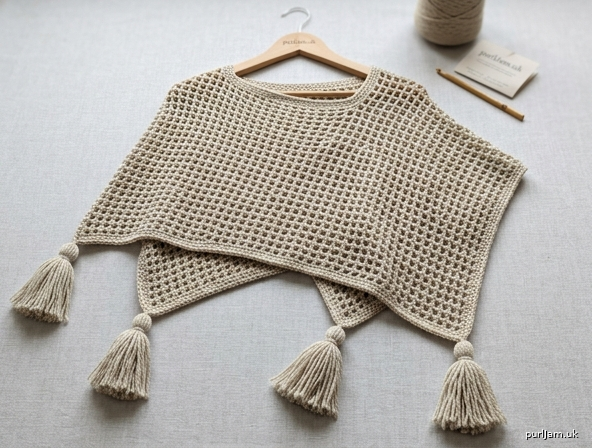
Asymmetrical Mesh Poncho with Tassels
An open filet-mesh poncho worked in one rectangle, with a centered neck opening set toward one short edge so the front sits cropped and the back falls long. Four tassels weight the corners. Worked flat in US terms; no seaming.
Skill level: Intermediate
Sizes
S/M (L/XL, 2X/3X)
To fit bust 32–38 (40–46, 48–54)" / 81–97 (102–117, 122–137) cm, with generous poncho drape.
Instructions are written for S/M; L/XL and 2X/3X appear in parentheses. When only one number is given, it applies to all sizes.
Finished measurements (after light blocking)
- Width (side to side, including arm drape): 42 (46, 50)" / 106.5 (117, 127) cm
- Total length (front hem to back hem): 30¼ (32½, 34¾)" / 77 (82.5, 88.5) cm
- Front drop from neck opening: 11½ (12½, 13¾)" / 29 (32, 35) cm
- Back drop from neck opening: 18¼ (19½, 20½)" / 46.5 (49.5, 52) cm
- Neck opening width: 14 (15¼, 16¾)" / 35.5 (39, 42.5) cm
Schematic (not to scale):
     |<----------- 42 (46, 50)" ----------->|
     +-------------------------------------+
     |                                     |  11½ (12½, 13¾)"  front
     |            ___________              |
     |           | neck 14     |           |
     |           | (15¼, 16¾)" |           |
     |            -----------              |
     |                                     |
     |                                     |  18¼ (19½, 20½)"  back
     +-------------------------------------+   tassels at all 4 corners
Materials
- Yarn: Worsted weight (category 4), 750 (900, 1100) yd / 685 (825, 1005) m. A wool or wool-blend with drape is ideal; acrylic is a good substitute. Sample uses a smooth worsted that blocks open. Extra yardage covers edging and four tassels.
- Hook: US J/10 (6 mm), or size needed to obtain gauge
- Notions: Tapestry needle; 4 stitch markers; 7" / 18 cm piece of cardboard (or a tassel maker); scissors; blocking pins and mats
Gauge
6 mesh repeats and 7 rows = 4" / 10 cm in Mesh Pattern, measured after light blocking.
One mesh repeat = 1 dc + 1 ch-1 space.
Gauge swatch: Ch 22. Work Row 1 of Mesh Pattern (9 dc), then work Row 2 until the swatch measures at least 5" tall. Block lightly. You should have 6 mesh repeats = 4" across the center, and 7 rows = 4" tall.
If you have too few repeats in 4", go down a hook size. If you have too many, go up a hook size. Mesh stretches; always measure after blocking.
Abbreviations (US)
- beg – beginning
- ch – chain
- dc – double crochet
- PM – place marker
- rep – repeat
- RS – right side
- sc – single crochet
- sk – skip
- sl st – slip stitch
- sp(s) – space(s)
- st(s) – stitch(es)
- WS – wrong side
- * – repeat instructions after asterisk as directed
Special stitch — Mesh Pattern
Worked flat over a foundation that is a multiple of 2 + 4.
Row 1 (RS): Dc in 6th ch from hook (5 skipped chs count as 1 dc + ch 1), *ch 1, sk next ch, dc in next ch; rep from * across, turn.
Row 2: Ch 4 (counts as dc + ch 1 here and throughout), sk first ch-1 sp, dc in next dc, *ch 1, sk next ch-1 sp, dc in next dc; rep from * across, working last dc in 3rd ch of beg ch-4, turn.
Repeat Row 2 for Mesh Pattern. Dc are always worked into dc (or into the 3rd ch of the turning ch, or into the neck chains as stated). Do not work into ch-1 spaces except on the neck restore row.
Pattern notes
- Ch 4 at the beginning of every mesh row counts as 1 dc + ch 1. The last dc of every row is worked into the 3rd ch of that turning ch. Tip: PM in the 3rd ch of every turning ch-4 as you make it, so it is easy to find on the next row.
- Stitch counts in parentheses at the end of a row are the number of dc. Chains between dc are not counted unless noted.
- The dc count is 63 (69, 75) on every row except the Neck Opening Row.
- Work in both loops throughout.
- The piece is a rectangle. Asymmetry comes from placing the neck closer to the front hem.
- Mesh fabric grows with blocking and wearing. The sc edging, especially around the neck, keeps the opening from stretching out of shape.
- Count dc posts, not chains, as you work.
Poncho
Back (long panel)
With J/10 (6 mm) hook, ch 130 (142, 154).
Row 1 (RS): Dc in 6th ch from hook (5 skipped chs count as dc + ch 1), *ch 1, sk next ch, dc in next ch; rep from * across, turn. (63 (69, 75) dc ✓) (Check: 130 − 6 = 124 remaining ch; 124 / 2 = 62 dc + first dc = 63. For L/XL: 142 − 6 = 136 / 2 = 68 + 1 = 69. For 2X/3X: 154 − 6 = 148 / 2 = 74 + 1 = 75 ✓)
Row 2: Ch 4 (counts as dc + ch 1), sk first ch-1 sp, dc in next dc, *ch 1, sk next ch-1 sp, dc in next dc; rep from * across, working last dc in 3rd ch of beg ch-4, turn. (63 (69, 75) dc ✓)
Rows 3–32 (34, 36): Repeat Row 2. (63 (69, 75) dc on every row ✓)
Piece measures approximately 18¼ (19½, 20½)" / 46.5 (49.5, 52) cm from the foundation chain. (32 (34, 36) rows × 4" / 7 rows = 18¼ (19½, 20½)" ✓)
Neck opening
Row 33 (35, 37) — Neck Opening Row (RS): Ch 4, sk first ch-1 sp, dc in next dc, *ch 1, sk next ch-1 sp, dc in next dc; rep from * until 21 (23, 25) dc have been worked in this row (turning dc counts as the first of these 21 (23, 25) dc). Ch 42 (46, 50), sk next 21 (23, 25) dc, dc in next dc, *ch 1, sk next ch-1 sp, dc in next dc; rep from * across, working last dc in 3rd ch of beg ch-4, turn.
(21 (23, 25) dc on each side of opening, plus ch 42 (46, 50) ✓) (21 + 21 skipped + 21 = 63. 23 + 23 + 23 = 69. 25 + 25 + 25 = 75 ✓) (Ch 42 (46, 50) is even so the next row can place exactly 21 (23, 25) dc in the chain ✓)
PM in the dc just before the ch-42 (46, 50) and in the dc just after it. These mark the two corners of the neck.
Row 34 (36, 38) — Restore Row: Ch 4, sk first ch-1 sp, dc in next dc, *ch 1, sk next ch-1 sp, dc in next dc; rep from * until 21 (23, 25) dc have been worked (turning dc counts as the first). Work across the neck chain as follows: *ch 1, sk next ch, dc in next ch; rep from * until 21 (23, 25) dc have been worked into the chain (this uses all 42 (46, 50) ch: 42 / 2 = 21, 46 / 2 = 23, 50 / 2 = 25 ✓). Ch 1, dc in next dc (the marked dc on the far side of the opening), *ch 1, sk next ch-1 sp, dc in next dc; rep from * across, working last dc in 3rd ch of beg ch-4, turn.
(21 + 21 + 21 = 63 (23 + 23 + 23 = 69, 25 + 25 + 25 = 75) dc ✓)
Remove neck markers. The dc count is restored and remains constant for the rest of the body.
Front (short panel)
Rows 35–53 (37–57, 39–61): Repeat Row 2. (63 (69, 75) dc on every row ✓)
You have now worked 20 (22, 24) rows after the Neck Opening Row, for a total of 53 (57, 61) rows from the beginning. (32 + 1 + 20 = 53. 34 + 1 + 22 = 57. 36 + 1 + 24 = 61 ✓) (53 (57, 61) rows × 4" / 7 = 30¼ (32½, 34¾)" total length ✓) (20 (22, 24) front rows × 4" / 7 = 11½ (12½, 13¾)" front drop ✓)
Fasten off.
Edging
Outer edging
With RS facing, join yarn with sl st in any corner.
Rnd 1: Ch 1, work sc evenly around the entire outer edge, working 3 sc in each of the 4 corners, 1 sc in each dc and each ch-1 sp across the foundation and the final row, and 2 sc in each row-end along both long sides. Join with sl st to first sc. Fasten off.
Do not work 2 sc per row-end so tightly that the long sides draw in, or so loosely that they ruffle. The long sides should lie flat at the same 30¼ (32½, 34¾)" as the body.
Neck edging
With RS facing, join yarn with sl st at one marked corner of the neck opening.
Rnd 1: Ch 1, sc evenly around the neck opening, working 1 sc in each dc, 1 sc in each ch, and 1 sc in each corner dc of the opening. Do not increase at the two neck corners — extra stitches here will stretch the opening. Join with sl st to first sc. Fasten off.
The neck should remain close to 14 (15¼, 16¾)" across. If it looks flared, work this round with a US H/8 (5 mm) hook instead.
Tassels (make 4)
Each tassel finishes about 6½–7" / 16.5–18 cm long.
- Cut a 12" / 30 cm length of yarn and set it aside as the tie.
- Wrap yarn around the 7" / 18 cm cardboard 25 times. Do not wrap so tightly that the cardboard bends.
- Slip the reserved 12" tie under the wraps at one edge of the cardboard and knot it firmly. This is the top of the tassel.
- Slide the wraps off the cardboard. Cut through the loops at the bottom (opposite the tie).
- Cut a 24" / 61 cm length of yarn. Wrap it tightly around the tassel about ½" / 1.5 cm below the top knot, 8–10 times, to form the neck. Tie securely and thread the ends down into the tassel body with the tapestry needle so they hide.
- Trim the bottom even.
Repeat for 4 tassels.
Attach: Using the two tails of each tassel’s top tie, sew one tassel securely to each of the four outer corners, going through the 3-sc corner of the edging. Knot on the WS and weave in.
Optional: for a heavier hem, make 3 extra tassels and space them evenly along the long (back) short edge only.
Finishing
- Weave in all remaining ends on the WS.
- Block. Pin the rectangle to 42 (46, 50)" × 30¼ (32½, 34¾)" / 106.5 (117, 127) × 77 (82.5, 88.5) cm, opening the mesh so the squares sit even. Spray-block or wet-block and let dry completely. Blocking is what gives the fabric its drape and the correct finished size.
- Recheck that the four tassels hang freely and are the same length.
To wear: Put your head through the neck opening with the shorter panel in front and the longer panel in back. The 42 (46, 50)" width drapes over the upper arms. Tassels hang at both hem corners and both side points. Reverse front and back if you want the long panel in front.
Stitch-count summary
| Section | Rows | Dc per row | Running total rows |
|---|---|---|---|
| Foundation | — | ch 130 (142, 154) | — |
| Back | 32 (34, 36) | 63 (69, 75) | 32 (34, 36) |
| Neck opening | 1 | 21 + ch-42 (46, 50) + 21 (23, 25) | 33 (35, 37) |
| Restore | 1 | 21 + 21 + 21 = 63 (69, 75) | 34 (36, 38) |
| Front (remaining) | 19 (21, 23) | 63 (69, 75) | 53 (57, 61) |
(Restore is the first of the 20 (22, 24) front rows. Front row total including restore = 20 (22, 24) ✓)
Disclaimer: This pattern was generated by AI and should be reviewed for accuracy before use. While we strive for quality, AI-generated content may contain errors. Please verify measurements, stitch counts, charts, and instructions before beginning your project. Generated by purlJam.uk
Love this pattern?
Save this pattern to your free PurlJam libraryAccess your pattern anytime
Bookmark this page to access your pattern anytime