Type
Knitting
Difficulty
beginner
Category
hat
AI Thinking Process
Planning
Verification
Pattern
Brimless Ribbed Beanie
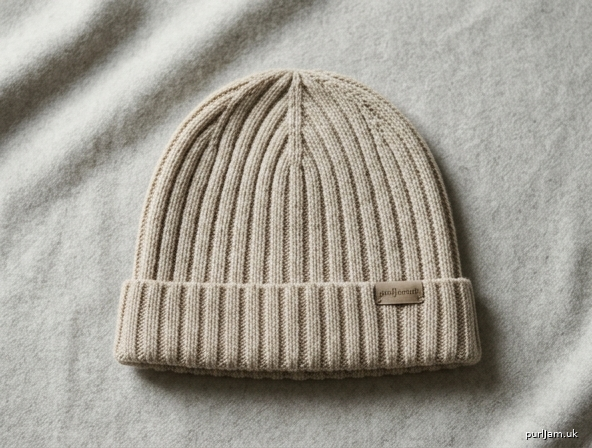
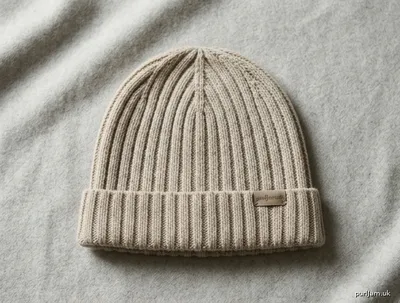
A close-fitting, brimless beanie in k2, p2 rib, worked in the round from the bottom up. There is no folded cuff — the rib starts at the cast-on edge and runs to the crown — so the hat sits neatly at the hairline. Crown shaping uses only knit-two-together and purl-two-together. Optional pompom.
Skill level: Beginner
Sizes
Baby (Toddler, Child, Adult Small, Adult Medium, Adult Large)
To fit head circumference: 40–45 (46–49, 50–53, 54–56, 57–59, 60–62) cm [15¾–17¾ (18–19¼, 19¾–21, 21¼–22, 22½–23¼, 23½–24½) in]
Choose the size closest to the wearer’s head measurement. Ribbing is very stretchy; if you are between sizes, choose the smaller one.
Instructions are written for the smallest size, with larger sizes in parentheses. When only one number is given, it applies to all sizes.
Finished measurements
Circumference (based on tension, unstretched equivalent): 36.5 (40, 43.5, 47.5, 51, 54.5) cm [14¼ (15¾, 17¼, 18¾, 20, 21½) in]
The k2, p2 fabric will measure less than this when relaxed and will stretch to fit the head circumference given above (about 5–10 cm negative ease).
Length (cast-on edge to crown, after gathering): 15 (17, 19, 20, 21, 22) cm [6 (6¾, 7½, 8, 8¼, 8¾) in]
This is a brimless, skull-cap length. For a slouchier hat, work extra rib before the crown (see Pattern notes).
Yarn
Naturally Big Natural DK / 8ply (or any DK / 8ply yarn that matches tension)
Typical ball: 50 g / approx. 100 m
Approx. metreage: 90 (110, 135, 155, 175, 200) m [100 (120, 150, 170, 190, 220) yd]
Balls (50 g / 100 m): 1 (2, 2, 2, 2, 2)
The Baby size is close to one 100 m ball — buy a second ball if your tension is loose or you add length. Sample shown in a solid wool DK; any fibre that meets tension will work. Cotton DK has less stretch than wool, so consider going up one size if substituting a plant fibre.
Needles
- 4 mm circular needle, 40 cm long, or set of 4 mm double-pointed needles, or 4 mm circular 80 cm long for magic loop
- Double-pointed needles in the same size for the crown if you started on a short circular
- The yarn band suggests 3.25–4 mm. Use 4 mm for the stated tension and a soft fabric. Use 3.25 mm only if you want a denser hat and you still match 22 sts = 10 cm slightly stretched over rib (or go down a size in the stitch table if the fabric comes out tighter)
Use whichever 4 mm method you prefer for knitting a small tube in the round.
Notions
- 1 stitch marker (beginning of round)
- Tapestry needle
- Optional: pompom maker or cardboard rings; extra yarn for a pompom
Tension (gauge)
22 sts and 28 rows = 10 cm (4 in) over stocking stitch on 4 mm needles, or over k2, p2 rib slightly stretched.
Always knit a swatch. Cast on 28 sts, work 8 cm in k2, p2 rib, and measure 22 sts across the centre with the rib gently stretched. If you have too many stitches to 10 cm, use a larger needle; if too few, use a smaller needle. Matching tension matters more than using the exact needle size.
Abbreviations
| Abbr. | Meaning |
|---|---|
| k | knit |
| p | purl |
| k2tog | knit 2 stitches together (1 stitch decreased) |
| p2tog | purl 2 stitches together (1 stitch decreased) |
| st(s) | stitch(es) |
| rnd(s) | round(s) |
| pm | place marker |
| rep | repeat |
| RS | right side |
Pattern notes
- Worked in the round; the right side is always facing you.
- Brimless: do not fold a cuff. The cast-on edge is the wearing edge.
- Rib pattern: every round is *k2, p2; rep from * to end, until the crown. The rib stacks vertically (knit stitches sit on knit stitches).
- Join to work in the round without twisting the cast-on edge. A twisted join cannot be fixed later.
- When the remaining stitches no longer reach comfortably around a 40 cm circular, switch to double-pointed needles or magic loop.
- Longer hat: work extra centimetres of rib before the crown. Each extra 1 cm of rib adds about 1 cm of depth. Do not add length for babies beyond the written size unless you are fitting a specific head.
- Pompoms are a choking hazard for babies and toddlers. Skip the pompom on those sizes, or sew it on so it cannot be pulled off.
Instructions
Cast on
Using 4 mm needles and a long-tail cast-on (stretchy), cast on 80 (88, 96, 104, 112, 120) sts.
(Multiple of 4 ✓ — 20 (22, 24, 26, 28, 30) repeats of k2, p2.)
Place marker for beginning of round and join to work in the round, taking care not to twist.
Body (all-over rib)
Rib round: *K2, p2; rep from * to end.
Repeat the rib round until the work measures 12 (14, 16, 17, 18, 19) cm [4¾ (5½, 6¼, 6¾, 7, 7½) in] from the cast-on edge.
Do not fold. This length is the wearing depth before the crown.
Shape crown
Change to double-pointed needles or magic loop when the stitches feel tight on the circular needle. Keep the beginning-of-round marker.
Rnd 1: *K2, p2tog; rep from * to end. 60 (66, 72, 78, 84, 90) sts (Each 4-st rib becomes 3 sts: 80 × ¾ = 60 ✓, 88 × ¾ = 66 ✓, 96 × ¾ = 72 ✓, 104 × ¾ = 78 ✓, 112 × ¾ = 84 ✓, 120 × ¾ = 90 ✓.)
Rnd 2: *K2, p1; rep from * to end.
Rnd 3: *K2tog, p1; rep from * to end. 40 (44, 48, 52, 56, 60) sts (Each 3-st unit becomes 2 sts: 60 × ⅔ = 40 ✓, 66 × ⅔ = 44 ✓, 72 × ⅔ = 48 ✓, 78 × ⅔ = 52 ✓, 84 × ⅔ = 56 ✓, 90 × ⅔ = 60 ✓.)
Rnd 4: *K1, p1; rep from * to end.
Rnd 5: *K2tog; rep from * to end. 20 (22, 24, 26, 28, 30) sts (40 ÷ 2 = 20 ✓, 44 ÷ 2 = 22 ✓, 48 ÷ 2 = 24 ✓, 52 ÷ 2 = 26 ✓, 56 ÷ 2 = 28 ✓, 60 ÷ 2 = 30 ✓.)
Rnd 6: Knit.
Rnd 7: *K2tog; rep from * to end. 10 (11, 12, 13, 14, 15) sts (20 ÷ 2 = 10 ✓, 22 ÷ 2 = 11 ✓, 24 ÷ 2 = 12 ✓, 26 ÷ 2 = 13 ✓, 28 ÷ 2 = 14 ✓, 30 ÷ 2 = 15 ✓.)
Rnd 8: *K2tog; rep from * to last 0 (1, 0, 1, 0, 1) st, k 0 (1, 0, 1, 0, 1). 5 (6, 6, 7, 7, 8) sts (10 ÷ 2 = 5 ✓; 5 × k2tog + k1 = 6 ✓; 12 ÷ 2 = 6 ✓; 6 × k2tog + k1 = 7 ✓; 14 ÷ 2 = 7 ✓; 7 × k2tog + k1 = 8 ✓.)
Cut the yarn, leaving a 20 cm [8 in] tail. Thread the tail onto a tapestry needle, pass it through the remaining 5 (6, 6, 7, 7, 8) sts, and pull firmly to close the hole. Pass the tail through the stitches a second time for security, then take it to the inside.
Finishing
Weave in the cast-on tail and the crown tail on the wrong side. If the centre of the crown has a tiny hole, use the crown tail to take one extra stitch across it before weaving in.
Blocking: Wet the hat, squeeze out water in a towel (do not wring), and lay it flat to dry. Shape it into a gentle circle but do not stretch the rib out to full width — you want to keep the spring. A brimless ribbed hat should cup the head, not sit like a plate.
Optional pompom: Make a pompom 6–8 cm across and sew it firmly to the crown with the yarn tail, taking stitches through the gathered centre several times. Omit for babies and toddlers (see Pattern notes).
Fit check
The hat should need a gentle tug to go on and then sit just above the ears, with no rolled cuff. If it feels loose, the next size down, a 3.25 mm needle, or fewer body centimetres will tighten it. If it will not pass the ears, go up a size or add 1–2 cm of rib before the crown.
Disclaimer: This pattern was generated by AI and should be reviewed for accuracy before use. While we strive for quality, AI-generated content may contain errors. Please verify measurements, stitch counts, charts, and instructions before beginning your project. Generated by purlJam.uk
Love this pattern?
Save this pattern to your free PurlJam libraryAccess your pattern anytime
Bookmark this page to access your pattern anytime