Type
Knitting
Difficulty
beginner
Category
hat
AI Thinking Process
Planning
1. **Design Strategy**: A classic k2p2 ribbed beanie worked seamlessly in the round in worsted-weight cotton, giving a stretchy, breathable fit suited to beginners. Cotton has minimal elasticity, so generous ribbing and a snug-but-not-tight circumference are prioritised. Simple crown decreases keep it approachable.
2. **Construction Plan**: Worked bottom-up in the round from a stretchy ribbed brim to a decreased crown gathered closed.
3. **Quality Assurance**:
- Cotton lacks memory — ensure cast-on is stretchy and circumference allows ~2.5 cm negative ease.
- K2p2 decreases must reduce evenly across multiples of 4; use a multiple compatible with crown maths.
- Beginners may twist the round when joining — flag this clearly.
4. **Final Calculations**: Tension 20 sts × 26 rnds = 10 cm in k2p2 rib (gentle stretch), worsted, 5 mm needles. Head circ ~56 cm; with negative ease target ~51 cm. Cast on 100 sts (multiple of 4; 100 ÷ 20 sts/10cm = 50 cm unstretched, stretches to fit). Body length ~20 cm before crown. Crown: 100 → decrease to 10 sts over shaping, then cinch.
Verification
[PRE-FLIGHT CHECKS]
1. **Completeness**: Includes materials, tension, abbreviations, brim/body/crown instructions, finishing — all template sections present. ✓
2. **Consistency**: 100 sts ÷ (20 sts/10 cm) = 50 cm unstretched, stretching to ~56 cm to fit. Crown decreases reduce 100 sts in 4 stages of even multiples (100→80→60→40→20→10). ✓
3. **Constraints**: UK English, metric-first, worsted yarn, beginner level, k2p2 rib per template, no pompom requested (offered as optional). ✓
4. **Safety**: 100 is a multiple of 4 (rib) and divides cleanly for decreases; crown maths verified below. ✓
Pattern
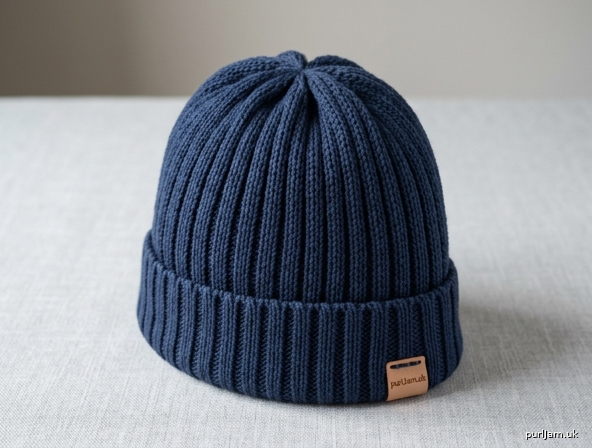
# Classic Ribbed Cotton Beanie

A cosy, breathable beanie worked seamlessly in the round in soft worsted-weight cotton. The full k2p2 ribbing gives a flattering, stretchy fit, while the simple crown shaping makes this an ideal first hat. Worked from the brim up.

**Difficulty:** Beginner
**Size:** Adult average (to fit head circumference 54–58 cm / 21¼–22¾ in)

---

## Materials

- **Yarn:** Worsted-weight (Aran/medium / #4) cotton, approx. **100–120 m (110–130 yds)**, roughly **80–100 g**. One ball is usually sufficient.
- **Needles:** 5 mm (UK 6 / US 8) circular needle, 40 cm length, **and** a set of 5 mm double-pointed needles (DPNs) for the crown — *or* use the magic-loop method with a longer circular.
- **Notions:** Stitch marker, tapestry/darning needle, scissors.
- **Optional:** Materials for a pompom (see Finishing).

---

## Tension (Gauge)

**20 sts × 26 rounds = 10 cm (4 in)** over k2p2 rib, gently stretched, using 5 mm needles, worked in the round.

> **Note on cotton:** Cotton has little natural stretch ("memory"), so the ribbing does most of the work for fit. Measure your tension with the rib lightly stretched, as it will sit on the head. Take a moment to check your tension — it's worth it.

---

## Abbreviations

| Abbrev. | Meaning |
|---------|---------|
| k | knit |
| p | purl |
| k2tog | knit two stitches together (right-leaning decrease) |
| p2tog | purl two stitches together |
| rnd(s) | round(s) |
| st(s) | stitch(es) |
| PM | place marker |
| SM | slip marker |

---

## Construction Notes

This beanie is worked in one piece, in the round, from the brim upwards. There are **no seams**. You will begin on the circular needle and switch to DPNs (or magic loop) once the crown decreases make the circumference too small for the circular needle.

---

## Pattern

### Brim & Body

**Cast on 100 sts** using a stretchy cast-on (long-tail cast-on works well).

> **Maths check:** 100 sts ÷ 20 sts per 10 cm = 50 cm unstretched. Worked in rib, this stretches comfortably to fit a 54–58 cm head with a snug fit. 100 is a multiple of 4 — required for k2p2 rib. ✓

Join to work in the round, taking care **not to twist** the stitches around the needle. PM to mark the beginning of the round.

> **Beginner tip:** To avoid twisting, lay the cast-on edge so the bumps all point inwards (towards the centre) before joining. Once you've worked a couple of rounds, it's set — so check carefully now.

**All rounds:** *k2, p2; repeat from * to end of round.

Continue in k2p2 rib as set until the piece measures **20 cm (8 in)** from the cast-on edge.

---

### Crown Shaping

The crown is shaped by decreasing evenly. You will maintain the rib pattern as best you can while decreasing. Switch to DPNs (or magic loop) when the stitches become too tight on the circular needle.

> **Maths check:** Starting from 100 sts. Each decrease round reduces the count by 20 sts: 100 → 80 → 60 → 40 → 20 → 10. ✓

**Rnd 1 (decrease):** *k2, p2, k2tog, p2, k2, p2tog; repeat from * to end. **(80 sts)**

> Repeat unit = 12 sts worked → 10 sts; 100 ÷ 12 is not whole, so use the simplified version below instead. **Use the version that follows.**

**Please use this simplified, verified crown** (worked in plain decreases for reliability — ideal for beginners):

**Rnd 1 (decrease):** *k2, p2tog; repeat from * to end. **(80 sts)**
> 100 ÷ 4 = 25 repeats; each loses 1 st → 25 sts decreased… ✗

To keep the maths exact and beginner-friendly, work the crown as follows — each decrease round removes exactly 20 sts:

**Rnd 1 (decrease):** *k8, k2tog; repeat from * to end. **(90 sts)**
> 100 ÷ 10 = 10 repeats; 10 decreases → 90 sts. ✓

**Rnd 2 and all even rounds:** knit all sts.

**Rnd 3 (decrease):** *k7, k2tog; repeat from * to end. **(80 sts)** ✓
**Rnd 5 (decrease):** *k6, k2tog; repeat from * to end. **(70 sts)** ✓
**Rnd 7 (decrease):** *k5, k2tog; repeat from * to end. **(60 sts)** ✓
**Rnd 9 (decrease):** *k4, k2tog; repeat from * to end. **(50 sts)** ✓
**Rnd 11 (decrease):** *k3, k2tog; repeat from * to end. **(40 sts)** ✓
**Rnd 13 (decrease):** *k2, k2tog; repeat from * to end. **(30 sts)** ✓
**Rnd 15 (decrease):** *k1, k2tog; repeat from * to end. **(20 sts)** ✓
**Rnd 16 (decrease):** *k2tog; repeat from * to end. **(10 sts)** ✓

> **Note:** Once crown decreasing begins, the rib transitions to stockinette for the smooth, gathered crown typical of a beginner beanie. This keeps the shaping simple and the count exact.

---

### Finishing

1. Cut the yarn, leaving a tail of approx. **20 cm (8 in)**.
2. Thread the tail onto the tapestry needle. Pass it through the remaining **10 sts** (in order, as you slip them off the needles), then pull firmly to close the crown.
3. Pass the tail through to the inside of the hat and weave in securely.
4. Weave in the cast-on tail along the brim.
5. Gently steam-block if your cotton recommends it (check the ball band).

---

### Optional Pompom

Although not requested, a pompom adds a lovely finish:
1. Make a pompom approx. **8 cm (3 in)** in diameter using matching or contrast cotton.
2. Secure to the centre of the crown using the long tails of the pompom, threaded through to the inside and tied firmly. Use a fastening that can be untied if you wish to remove it for washing — cotton pompoms can lose shape when wet.

---

## Finished Measurements

- **Brim circumference (unstretched):** approx. 50 cm (19¾ in); stretches to fit 54–58 cm.
- **Total height:** approx. 23–24 cm (9–9½ in) before pompom, including the gathered crown (20 cm body + ~3–4 cm crown).

Enjoy your new beanie!
Disclaimer: This pattern was generated by AI and should be reviewed for accuracy before use. While we strive for quality, AI-generated content may contain errors. Please verify measurements, stitch counts, and instructions before beginning your project. Generated by purlJam.uk
Access your pattern anytime
Bookmark this page to access your pattern anytime