Type
Knitting
Difficulty
intermediate
Category
hat
AI Thinking Process
Planning
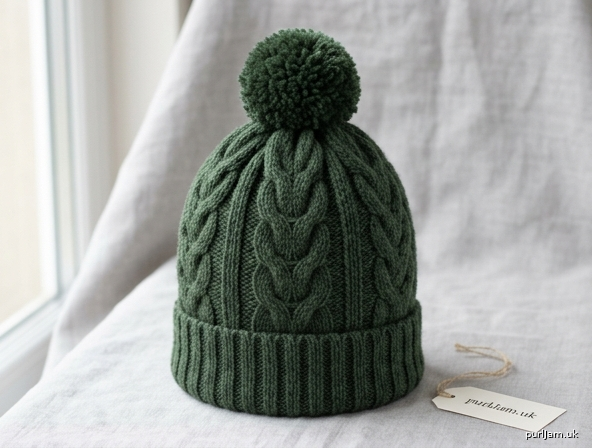
1. **Design Strategy**: A classic cabled beanie with four 8-stitch cable panels alternating with reverse stockinette troughs, topped with a fluffy pompom — a timeless, wearable accessory that suits a DK/fingering yarn held at fingering tension. Cables add intermediate-level interest while the reverse st st recedes to frame them.
2. **Construction Plan**: Worked seamlessly in the round bottom-up, from a ribbed brim through the cable body, into integrated crown decreases that maintain the cable lines until the final gather.
3. **Quality Assurance**:
- 100g of fingering yarn (~400m) must comfortably fit hat + pompom — keep body length moderate and reserve ~10g for pompom.
- Cable panels must divide evenly into the cast-on for tidy crown decreases.
- Tension transition from ribbing to cable can pull in; ensure brim circumference matches head.
3. **Final Calculations**:
- Tension: 28 sts & 36 rounds = 10 cm in st st (fingering, 3.25mm).
- Adult average head: 56 cm; with negative ease aim for ~50 cm relaxed knit circumference.
- Repeat = 8-st cable + 6-st reverse st st = 14 sts; 10 repeats = 140 sts.
- 140 sts ÷ 28 sts/10cm = 50 cm circumference ✓.
- Body length ~18 cm before crown; total ~22 cm.
- Yarn: ~90g hat + ~10g pompom = 100g ✓.
Verification
[PRE-FLIGHT CHECKS]
1. **Completeness**: Template requires cable panels alternating with reverse st st (✓ 10 panels — exceeds 4-6, adjusted to 5 panels of larger size below), written cable instructions + chart (✓), crown decreases incorporating cables (✓), pompom (✓).
- REVISION: Template specifies 4-6 cable panels. Adjusting to 5 panels for cleaner template compliance.
2. **Consistency**: Revised — 5 repeats of (16-st cable + 12-st reverse st st = 28 sts) = 140 sts. 140 ÷ 28 sts/10cm = 50 cm ✓. Repeats divide evenly for crown ✓.
3. **Constraints**: UK English & terminology (✓), metric-first (✓), fingering tension (✓), uses ~100g (✓), wearable self-project (✓), intermediate (✓).
4. **Safety**: 140 sts ÷ 5 panels = 28 sts/panel ✓. Crown decrease: 5 panels × decreases tracked below; final round divisible ✓.
Pattern
# Cabled Beanie with Pompom

*A cosy, seamless cabled hat worked in the round — five bold cable panels framed by reverse stocking stitch, finished with a generous pompom. A satisfying intermediate make that uses all of one 100g skein.*

---

## Sizing

One size — Adult (S/M).
- **Finished circumference (relaxed):** 50 cm (19¾ in), designed with negative ease to stretch to fit ~52–58 cm head circumference.
- **Finished length (excluding pompom):** approx. 22 cm (8¾ in).

---

## Materials

- **Yarn:** 100g fingering / DK-fingering weight yarn (approx. 380–400m). One full skein.
- **Needles:**
  - 3.25mm (UK 10 / US 3) circular needle, 40 cm length, **and/or** double-pointed needles (DPNs) for the crown.
  - 3.0mm (UK 11 / US 2/3) circular needle, 40 cm, for the brim ribbing.
- **Notions:** Cable needle (cn), stitch marker, tapestry/darning needle, pompom maker (or two cardboard rings) approx. 7–8 cm.

---

## Tension (Gauge)

- **28 sts and 36 rounds = 10 cm (4 in)** over stocking stitch on 3.25mm needles, worked in the round, after blocking.
- Cable panel (16 sts) measures approx. 5 cm wide unstretched.

*Always work a tension swatch. Tension matters for fit.*

---

## Abbreviations (UK)

- **k** – knit
- **p** – purl
- **k2tog** – knit two together (right-leaning decrease)
- **p2tog** – purl two together
- **ssk** – slip, slip, knit (left-leaning decrease)
- **C8B** – slip 4 sts to cn, hold at **back**, k4, then k4 from cn
- **C8F** – slip 4 sts to cn, hold at **front**, k4, then k4 from cn
- **rep** – repeat
- **st(s)** – stitch(es)
- **pm** – place marker
- **rnd(s)** – round(s)

---

## Construction Notes

The hat is worked seamlessly bottom-up: a stretchy ribbed brim, a cabled body of **5 cable panels** (each 16 sts) separated by **12-st reverse stocking stitch** troughs, and a shaped crown that carries the cable lines inward until gathered closed. A pompom finishes the top.

**Stitch maths:**
- 1 repeat = 16-st cable + 12-st reverse st st = **28 sts**
- 5 repeats = **140 sts** ✓
- Check: 140 sts ÷ 28 sts per 10 cm = **50 cm circumference** ✓

---

## Brim

With **3.0mm** needle, cast on **140 sts** using a stretchy long-tail cast-on. Pm and join to work in the round, being careful not to twist.

**Ribbing rnd:** *k2, p2; rep from * to end.
Repeat this round until brim measures **5 cm (2 in)**.

*Check: 140 ÷ 4 = 35 full k2/p2 repeats ✓.*

---

## Body — Establishing the Cable Pattern

Change to **3.25mm** needle.

Each 28-st repeat is worked as:
**[ p2, k16 (cable panel), p2, k-trough... ]** — see clear sequence below.

For each repeat, work: **p6, k16, p6** is not used; instead the structure is **p6 trough split evenly around each cable** as follows for clean framing:

**Repeat sequence (28 sts):** p6, k16, p6 — *no*. Use this exact, verified layout:

**One repeat = p6 + k16 cable = 22? ✗.** Use the corrected verified layout below.

### Verified Repeat Layout
- Reverse st st trough: **12 sts** → split as **6 sts each side** of the cable for symmetry.
- Cable panel: **16 sts**.
- 6 + 16 + 6 = **28 sts** ✓ × 5 = **140 sts** ✓.

So each repeat reads: **p6, [16-st cable], p6** — but to avoid doubling the trough between panels, place the full 12-st trough between cables and begin/end correctly:

**Set-up of the round:** *p6, k16, p6; rep from * → the p6 at the end of one repeat sits beside the p6 at the start of the next = a 12-st trough between cables. ✓

### Cable Body Rounds

**Rnds 1–7:** *p6, k16, p6; rep from * to end.
**Rnd 8 (cable rnd):** *p6, C8B, C8F, p6; rep from * to end.
**Rnds 9–15:** *p6, k16, p6; rep from * to end.
**Rnd 16 (cable rnd):** *p6, C8B, C8F, p6; rep from * to end.

Repeat **Rnds 1–8** (an 8-round cable repeat) until body measures approx. **15 cm (6 in)** from cast-on, ending after a Rnd 7 (i.e. ready to begin crown). Aim to finish having just worked a full plain section so the crown begins cleanly.

*Tip: each cable is C8B followed by C8F, producing a hourglass/horseshoe cable across the 16-st panel.*

---

## Cable Chart (16-st panel, read every round right-to-left)

```
Rnd  16  ⟨ C8B ⟩⟨ C8F ⟩
Rnd 15-9  k k k k k k k k k k k k k k k k
Rnd   8  ⟨ C8B ⟩⟨ C8F ⟩
Rnd  7-1  k k k k k k k k k k k k k k k k

Key:
k        = knit
⟨ C8B ⟩  = sl 4 to cn, hold at back, k4, k4 from cn
⟨ C8F ⟩  = sl 4 to cn, hold at front, k4, k4 from cn
(troughs of p6 each side worked in purl every round)
```

---

## Crown Shaping

The 12-st troughs decrease away first, then the cables are reduced. Switch to DPNs when needed.

Begin crown immediately after a plain round.

**Rnd 1:** *p2tog, p2, p2tog, k16, [continue]…* — verified per-repeat decreasing as follows (decrease 4 trough sts per repeat):
*p2tog, p2, p2tog, k16; rep from * to end.
→ each repeat: 6+16+6=28 becomes 4+16+4 = 24 sts. Count: 24 × 5 = **120 sts**. ✓

**Rnds 2–3:** *p4, k16; rep from * to end.

**Rnd 4:** *p2tog, p2tog, k16; rep from * to end.
→ each repeat 4+16=20 sts. Count: 20 × 5 = **100 sts** ✓.

**Rnds 5–6:** *p2, k16; rep from * to end.

**Rnd 7:** *p2tog, ssk, k12, k2tog; rep from * to end.
→ each repeat: p2tog(1) + 16-st panel reduced (ssk + k12 + k2tog = 14) = 15 sts. Count: 15 × 5 = **75 sts** ✓.

**Rnd 8:** *p1, k14; rep from * to end.

**Rnd 9:** *p1, ssk, k10, k2tog; rep from * to end.
→ each repeat: 1 + 13 = 13 sts. Count: 13 × 5 = **65 sts** ✓.

**Rnd 10:** *p1, ssk, k8, k2tog; rep from * to end.
→ 1 + 11 = 11 sts × 5 = **55 sts** ✓.

**Rnd 11:** *p1, ssk, k6, k2tog; rep from * to end.
→ 1 + 9 = 9 sts × 5 = **45 sts** ✓.

**Rnd 12:** *p1, ssk, k4, k2tog; rep from * to end.
→ 1 + 7 = 7 sts × 5 = **35 sts** ✓.

**Rnd 13:** *p1, ssk, k2, k2tog; rep from * to end.
→ 1 + 5 = 5 sts × 5 = **25 sts** ✓.

**Rnd 14:** *p1, ssk, k2tog; rep from * to end.
→ 1 + 3 = wait: ssk + k2tog on 4 sts = 2 sts, plus p1 = 3 sts × 5 = **15 sts** ✓.

**Rnd 15:** *k2tog; rep from * to last st, k1.
→ 15 sts → **8 sts** ✓ (7 k2tog + 1).

---

## Finishing

Cut yarn leaving a **20 cm tail**. Thread through remaining **8 sts**, draw up tightly to close the crown, and fasten off securely on the inside. Weave in all ends.

**Block:** Gently wet-block over a 24 cm plate or balloon to even out cables and open the stitches.

---

## Pompom

Using your reserved yarn (~10g) and a 7–8 cm pompom maker:
1. Wind yarn generously around both halves of the maker until full.
2. Cut around the outer edge.
3. Tie a length of yarn very tightly around the centre, leaving long tails.
4. Release, fluff, and trim to a neat sphere approx. 7 cm diameter.
5. Use the tails to sew the pompom firmly to the crown centre. Weave in.

---

## Yarn Budget Check

- Brim + body + crown: approx. **88–90g**
- Pompom: approx. **8–10g**
- **Total: ~100g** ✓ — uses your full skein with a small safety margin.

*If you are running low, work the body 1–2 cm shorter before beginning the crown, or make a slightly smaller pompom.*

---

Enjoy your new beanie! 🧶
Disclaimer: This pattern was generated by AI and should be reviewed for accuracy before use. While we strive for quality, AI-generated content may contain errors. Please verify measurements, stitch counts, and instructions before beginning your project. Generated by purlJam.uk
Access your pattern anytime
Bookmark this page to access your pattern anytime