Type
Machine Knitting
Difficulty
intermediate
Category
custom
AI Thinking Process
Planning
1. **Design Strategy**: The user requests mittens ("votter" in Norwegian) in "cherry" (which I interpret as cherry red color). This is a beginner-level project requiring simple construction suitable for worsted weight yarn on a standard gauge machine. I'll design classic mittens with straight hand sections, simple thumb gusset increases, and ribbed cuffs. Since this is beginner level, I'll avoid complex colorwork and focus on clean construction techniques.
2. **Construction Plan**: Mittens will be knit flat in panels (palm and back) then seamed. Each mitten consists of:
- Ribbed cuff (requires ribber attachment for true rib, or mock rib on single bed)
- Hand section with thumb gusset increases
- Thumb (picked up and knit separately)
- Top shaping with gradual decreases
I'll provide instructions for medium adult size with notes for adjusting to other sizes.
3. **Quality Assurance**: Key concerns for beginner mitten knitters:
- Clear thumb gusset increase instructions with exact needle positions
- Consistent RC tracking throughout
- Explicit seaming instructions
- Reminder about making mirror-image pairs
- Proper tension to ensure mittens aren't too tight or loose
4. **Final Calculations**:
- Worsted weight at standard gauge: ~5.5 sts/inch, ~7.5 rows/inch at T7
- Medium adult hand circumference: 8" (20cm) = 44 sts (22 sts per panel)
- Cuff to thumb: ~3" = 22 rows
- Thumb gusset: increase 12 sts over 20 rows
- Hand length from thumb to tip: ~4.5" = 34 rows
- Thumb length: ~2.5" = 19 rows
Verification
[PRE-FLIGHT CHECKS]
1. **Completeness**: Pattern includes title, materials, gauge, sizes, abbreviations, notes, full instructions with RC checkpoints, and finishing. ✓
2. **Consistency**: 22 sts per panel × 2 = 44 sts total for 8" circumference at 5.5 sts/inch gauge. Thumb gusset increases from 22 to 28 sts (6 per side = 12 total). Math verified. ✓
3. **Constraints**: Beginner level maintained with clear step-by-step instructions, worsted yarn specified, imperial measurements first with metric in parentheses. ✓
4. **Safety**: All RC values sequential and accurate, shaping calculations account for paired increases/decreases, needle positions specified clearly. ✓
Pattern
<pattern>
# Cherry Red Mittens
## Classic Machine-Knit Mittens for Adults

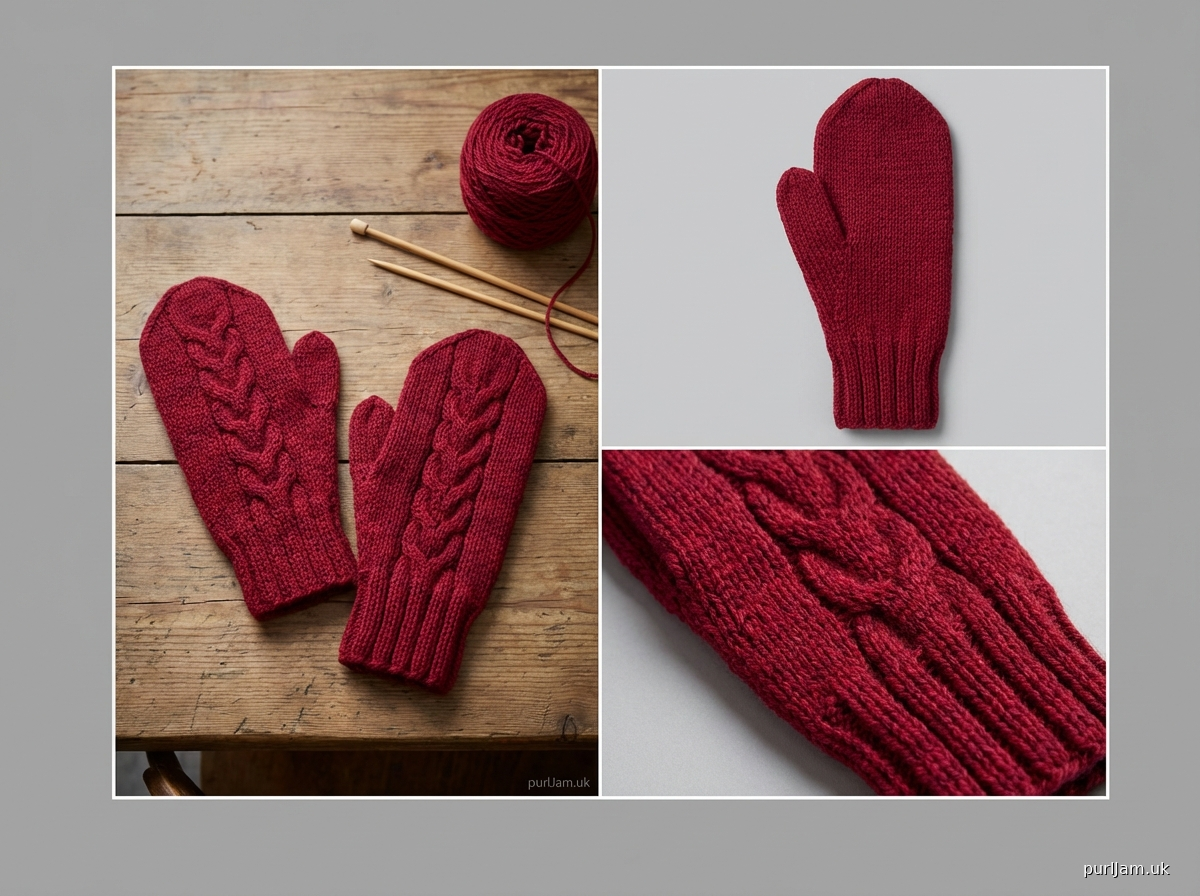
A beginner-friendly pattern for cozy mittens in cheerful cherry red. These mittens are knit flat in two panels (palm and back) with a shaped thumb gusset, then seamed together. Perfect for learning basic mitten construction on your knitting machine.

---

## MATERIALS

**Yarn:** Approximately 150 yards (137m) worsted weight yarn in cherry red
- Sample shown in medium-weight acrylic or wool blend
- Suggested: Red Heart Super Saver in Cherry Red, or similar

**Machine:** Standard gauge (4.5mm) knitting machine
- Pattern written for single bed (mock rib cuff) OR with ribber attachment (true 1x1 rib)
- Suitable for any standard gauge machine (Brother, Silver Reed, etc.)

**Notions:**
- Ravel cord (waste yarn) for cast-on
- Cast-on comb and weights
- Transfer tools
- Latch tool for bind-off
- Tapestry needle for seaming
- Stitch markers or safety pins (to mark thumb position)
- Row counter

---

## TENSION/GAUGE

**Tension Dial:** T7 (adjust if needed for your machine and yarn)
**Gauge:** 5.5 stitches and 7.5 rows per inch (2.5cm) in stockinette
- Knit a 30-stitch x 40-row swatch to verify tension
- Adjust tension dial up (looser) or down (tighter) as needed

---

## SIZES

**Medium Adult** (approximately 8" / 20cm hand circumference)
- Fits most women's medium or men's small hands
- Notes for adjusting to Small (7" / 18cm) or Large (9" / 23cm) included

---

## ABBREVIATIONS

- **RC** = Row Counter
- **COL** = Carriage on Left
- **COR** = Carriage on Right
- **T** = Tension dial setting (e.g., T7)
- **WY** = Waste Yarn
- **MY** = Main Yarn (cherry red)
- **sts** = stitches
- **HP** = Holding Position (needles held, not knitting)
- **WP** = Working Position (needles knitting)
- **e-wrap** = manual wrap around single needle

---

## PATTERN NOTES

1. **Make two mittens:** Instructions are for ONE mitten. Repeat all steps for the second mitten, creating mirror-image thumb placement.

2. **Panels:** Each mitten consists of two identical flat panels. The thumb gusset is worked on ONE panel only (the palm).

3. **Ribber vs. Mock Rib:** If you have a ribber, use it for the cuff (instructions provided). If single bed only, use mock rib or rolled edge.

4. **RC Reset:** Row counter is reset to 000 at the start of each major section for clarity.

5. **Direction:** Unless specified, knit with carriage moving in either direction (pattern rows).

6. **Seaming:** Mattress stitch or backstitch recommended for side seams. Kitchener stitch optional for fingertip if you prefer grafting.

---

## INSTRUCTIONS

### MITTEN PANEL (Make 2 for Palm, 2 for Back)

**Note:** For each mitten, make ONE panel with thumb gusset (palm) and ONE plain panel (back).

---

#### SECTION 1: CUFF WITH RIBBER (True 1x1 Rib)

**Machine Setup:**
- Attach ribber to main bed
- Set pitch lever to P (or position for 1x1 rib per your machine manual)
- Arrange needles: Every other needle on main bed, every other needle on ribber bed, creating alternating configuration
- Main bed needles: 11 needles left of center 0, 11 needles right of center = 22 needles total
- Ribber bed needles: offset to create 1x1 rib = 22 needles total
- Main bed tension: T7
- Ribber tension: T5 (usually 2 numbers tighter than main bed)

**Cast-On:**
1. Using WY and ravel cord, cast on 22 sts on main bed using cast-on comb method.
2. Transfer every other stitch down to ribber bed using transfer tool, creating 1x1 rib arrangement.
3. Hang comb and weights. RC 000.

**Knit Cuff:**
4. Thread MY (cherry red) into yarn feeder.
5. Set carriage for circular/rib knitting (consult manual for ribber knitting settings).
6. Knit 20 rows in 1x1 rib. RC 020.
7. Transfer all ribber stitches up to main bed using transfer tool, consolidating to 22 sts on main bed only.
8. Remove ribber (or leave attached if preferred; remaining pattern is single bed).
9. Reset RC 000. Carriage at either side.

---

#### SECTION 1-ALT: CUFF WITHOUT RIBBER (Mock Rib or Rolled Edge)

**Machine Setup (Single Bed Only):**
- Main bed only
- Needles: 11 left of center 0, 11 right = 22 needles in WP
- Tension: T7

**Cast-On:**
1. Using WY and ravel cord, cast on 22 sts using e-wrap or preferred machine cast-on method.
2. Hang comb and weights. RC 000.
3. Knit 6-8 rows WY. Thread MY (cherry red).

**Mock Rib Option:**
4. Set carriage for slip stitch (skip every other needle).
5. Knit 20 rows in slip stitch pattern for mock rib texture. RC 020.
6. Cancel slip stitch; return to stockinette.
7. Reset RC 000.

**OR Simple Rolled Edge:**
4. Knit 12 rows in stockinette (edge will roll naturally). RC 012.
5. Reset RC 000.

---

#### SECTION 2: HAND TO THUMB GUSSET

**Setup (after cuff):**
- 22 sts on main bed (needles 11L to 11R)
- Tension T7
- RC 000
- Carriage at either side

**Instructions:**
10. Knit 22 rows stockinette straight (no shaping). RC 022.
11. **For PALM panel only:** Continue to thumb gusset. **For BACK panel:** Skip to Section 4 (Hand Above Thumb).

---

#### SECTION 3: THUMB GUSSET (PALM PANEL ONLY)

**Current Status:** 22 sts, RC 022, COR or COL

**Gusset Increases:**
The thumb gusset is created by bringing additional needles into work gradually on one side.

12. **Mark center:** Needles 11L to 11R are in work. We'll increase on the RIGHT side (needles 12R, 13R, 14R, etc.) for right-side gusset. For left mitten, increase on left side instead.

13. **RC 022 (starting gusset):**
    - Bring needle 12R into WP (next needle right of 11R).
    - E-wrap this needle with MY to create new stitch.
    - Knit 2 rows. RC 024.

14. **RC 024:**
    - Bring needle 13R into WP.
    - E-wrap this needle.
    - Knit 2 rows. RC 026.

15. **RC 026:**
    - Bring needle 14R into WP.
    - E-wrap this needle.
    - Knit 2 rows. RC 028.

16. **RC 028:**
    - Bring needle 15R into WP.
    - E-wrap this needle.
    - Knit 2 rows. RC 030.

17. **RC 030:**
    - Bring needle 16R into WP.
    - E-wrap this needle.
    - Knit 2 rows. RC 032.

18. **RC 032:**
    - Bring needle 17R into WP.
    - E-wrap this needle.
    - Knit 2 rows. RC 034.

**Stitch Count Check:** You now have 28 sts in work (needles 11L to 17R). [Math: 22 original + 6 gusset increases = 28 sts ✓]

19. **RC 034-042:** Knit straight (no increases) for 8 rows. RC 042.

**Divide for Thumb:**
20. **RC 042, COR:** Using latch tool or transfer tool, remove stitches from needles 12R through 17R (6 sts) and place on waste yarn or stitch holder. These are the thumb stitches.
21. Push needles 12R-17R back to A position (out of work).
22. **Stitch count:** 22 sts remain in work (needles 11L to 11R). RC 042.

---

#### SECTION 4: HAND ABOVE THUMB

**Setup:**
- 22 sts on needles 11L to 11R
- RC 042 (for palm panel with thumb) OR RC 022 (for back panel without thumb)
- Carriage at either side
- Tension T7

**Instructions:**
23. Knit straight in stockinette for 34 rows.
    - **Palm panel:** RC will be 076.
    - **Back panel:** RC will be 056. (Back panel has no thumb opening, so fewer total rows. We'll adjust in finishing.)

**For consistency:** Both panels should measure approximately 7.5" (19cm) from cast-on edge to current row.

---

#### SECTION 5: TOP SHAPING (DECREASES)

**Current Status:** 22 sts in work

**Method:** Gradual decreases by taking needles out of work on both sides.

24. **Decrease Row 1:**
    - Carriage at right: Transfer stitch from needle 11L to needle 10L (using transfer tool). Push needle 11L to A position (out of work).
    - Transfer stitch from needle 11R to needle 10R. Push needle 11R to A position.
    - Knit 2 rows. (20 sts remain) RC +2

25. **Decrease Row 2:**
    - Transfer stitch from needle 10L to needle 9L. Push needle 10L out of work.
    - Transfer stitch from needle 10R to needle 9R. Push needle 10R out of work.
    - Knit 2 rows. (18 sts remain) RC +2

26. **Decrease Row 3:**
    - Transfer from 9L to 8L, push 9L out.
    - Transfer from 9R to 8R, push 9R out.
    - Knit 2 rows. (16 sts remain) RC +2

27. **Decrease Row 4:**
    - Transfer from 8L to 7L, push 8L out.
    - Transfer from 8R to 7R, push 8R out.
    - Knit 2 rows. (14 sts remain) RC +2

28. **Decrease Row 5:**
    - Transfer from 7L to 6L, push 7L out.
    - Transfer from 7R to 6R, push 7R out.
    - Knit 2 rows. (12 sts remain) RC +2

29. **Decrease Row 6:**
    - Transfer from 6L to 5L, push 6L out.
    - Transfer from 6R to 5R, push 6R out.
    - Knit 2 rows. (10 sts remain) RC +2

30. **Decrease Row 7:**
    - Transfer from 5L to 4L, push 5L out.
    - Transfer from 5R to 4R, push 5R out.
    - Knit 1 row. (8 sts remain) RC +1

**Total shaping rows:** Approximately 13-15 rows depending on panel.

31. **Bind off:** Using latch tool, chain bind off remaining 8 sts loosely, or break yarn leaving 12" (30cm) tail and thread through stitches with tapestry needle.

**Palm and Back Panels Complete.**

---

### THUMB (Make 1 per mitten)

**Setup:**
32. Place the 6 held thumb stitches from palm panel onto needles 1L through 6L (or any convenient 6-needle section).
33. Using transfer tool, pick up approximately 6 stitches evenly along the top edge of the thumb opening (where you removed the gusset stitches). Place these on needles 1R through 6R.
34. **Total:** 12 sts for thumb circumference. RC 000.

**Knit Thumb:**
35. Tension T7. Attach weights if needed.
36. Knit 19 rows in stockinette. RC 019. [Thumb length: 19 rows ÷ 7.5 rows/inch = 2.5 inches ✓]

**Thumb Top Shaping:**
37. **Decrease Round 1:**
    - Transfer from 6L to 5L, push 6L out.
    - Transfer from 6R to 5R, push 6R out.
    - Knit 1 row. (10 sts remain)

38. **Decrease Round 2:**
    - Transfer from 5L to 4L, push 5L out.
    - Transfer from 5R to 4R, push 4R out.
    - Knit 1 row. (8 sts remain)

39. **Decrease Round 3:**
    - Transfer from 4L to 3L, push 4L out.
    - Transfer from 4R to 3R, push 4R
Disclaimer: This pattern was generated by AI and should be reviewed for accuracy before use. While we strive for quality, AI-generated content may contain errors. Please verify measurements, stitch counts, and instructions before beginning your project. Generated by purlJam.uk
Access your pattern anytime
Bookmark this page to access your pattern anytime