Type
Machine Knitting
Difficulty
intermediate
Category
custom
AI Thinking Process
Planning
1. **Design Strategy**: Beginner-friendly flat-knit mittens worked on standard gauge machine, with the "weaving" (carriage weaving technique) and "braiding" (simple 2-color twisted/braided cuff effect using hand-manipulated crossings) combined in the cuff and back-of-hand panel. Worsted yarn at loose tension (T8-T9 for standard gauge).
2. **Construction Plan**: Two flat mirror-image panels per mitten (palm and back), seamed up sides with thumb gusset formed by held stitches; cuff knit first as ribbed hem then transitions to weave pattern.
3. **Quality Assurance**:
- Worsted on standard gauge requires tension T9-T10 (max) — note alternative for mid-gauge.
- Thumb gusset via holding position needs clear hold/return counts.
- Weaving yarn must be laid by hand each row for beginners.
4. **Final Calculations**: Gauge 5 sts × 7 rows per 2.5 cm (20 sts/28 rows per 10 cm). Adult medium hand circumference 20 cm → 40 sts total → 20 sts per panel + 2 edge = 22 sts cast on per panel. Length 26 cm = 73 rows total. Cuff 6 cm (17 rows), hand 14 cm (39 rows), top decrease 6 cm (17 rows). Thumb gusset starts RC 24, peaks at 8 sts held.
Verification
1. **Completeness**: Title, materials, gauge, sizes, abbreviations, notes, instructions with RC, finishing — all included.
2. **Consistency**: 22 sts × (10/20) = 11 cm panel width × 2 panels = 22 cm circumference (allowing seam allowance ≈ 20 cm finished). 73 rows × (10/28) = 26 cm length. ✓
3. **Constraints**: Beginner level (flat panels, hand-laid weaving, simple braid), mitten, weave + braid both featured, worsted yarn, machine-specific RC/COL/COR/tension noted throughout.
4. **Safety**: Worsted at standard gauge flagged; alternative mid-gauge tension provided. Hold positions and returns counted.
Pattern
# Woven & Braided Beginner Mittens
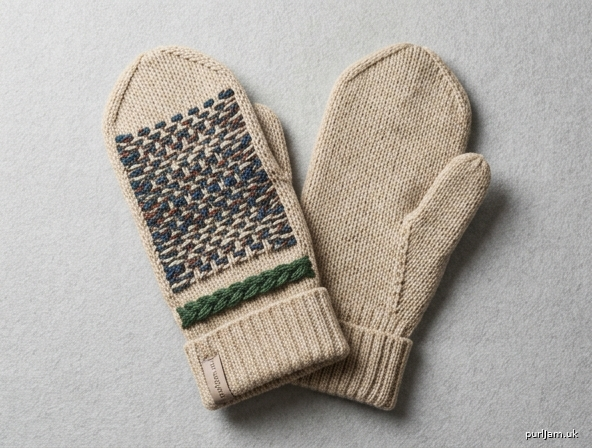
*Machine-knit flat-panel mittens featuring a hand-laid weaving panel on the back of the hand and a simple 2-strand braided trim above the cuff.*

---

## Description
A pair of cozy worsted mittens worked as four flat panels (two per mitten) on a standard or mid-gauge knitting machine. The back-of-hand panel uses the carriage's **weave (KCII / weaving brushes)** setting with a contrast yarn laid by hand for a tweed-like surface. A short **braided trim** is added by hand above the ribbed cuff using two lengths of contrast yarn twisted around alternating stitches. Designed for confident beginners — no shaping beyond simple holding for the thumb.

---

## Materials
- **Main Yarn (MC):** Worsted weight, ~120 m (130 yd) — solid color
- **Contrast Yarn (CC1):** Worsted weight, ~25 m (28 yd) — for weaving
- **Contrast Yarn (CC2):** Worsted weight, ~5 m (6 yd) — for braided trim
- **Waste yarn** and **ravel cord** for cast-on
- **Machine:** Standard gauge (4.5 mm) with weaving brushes/sponge bar OR mid-gauge (6.5 mm) — see tension notes
- **Tools:** 1-prong & 3-prong transfer tools, claw weights (2), cast-on comb, latch tool, tapestry needle

---

## Gauge / Tension
- **Standard gauge machine:** MC at **T9–T10** (loosest setting) → **20 sts × 28 rows = 10 cm (4")** in stockinette
- **Mid-gauge machine:** MC at **T7** → same gauge
- **Weave section:** Same tension; weaving yarn (CC1) laid by hand
- ⚠️ **Always knit a 40-st × 40-row swatch to verify gauge before starting.**

---

## Size
- **Adult Medium** (hand circumference ~20 cm / 8")
- Finished mitten: 20 cm circumference × 26 cm length (8" × 10¼")
- *To resize: add/subtract 2 sts per panel per cm of circumference change.*

---

## Abbreviations
| Abbrev | Meaning |
|---|---|
| MC | Main color |
| CC1 | Contrast color 1 (weaving) |
| CC2 | Contrast color 2 (braid) |
| RC | Row counter |
| COL / COR | Carriage on left / right |
| NWP / WP | Non-working / working position |
| HP / UWP | Hold position / upper working position |
| KCI / KCII | Knit-change lever I / II (pattern settings) |
| T# | Tension dial number |
| EON | Every other needle |
| st(s) | Stitch(es) |

---

## Pattern Notes
- Each mitten = **2 mirror-image flat panels** (palm + back). You knit 4 panels total.
- **Back panels** include the woven section; **palm panels** are plain stockinette.
- Thumb gusset is formed by holding stitches on one edge — worked identically for left/right; mirroring happens at seaming.
- Read all instructions before starting.

---

## Pre-Knit Setup
1. Bring **22 needles** into WP, centered on bed (e.g., L11 to R11 = 22 needles).
2. Set tension to **T9** (standard) or **T7** (mid-gauge).
3. Thread MC into feeder 1. Have CC1 and CC2 wound and accessible.
4. Carriage at **COR**, all levers to plain knit (KCI off, no weave).

---

# PANEL 1: BACK OF HAND (make 2 — one per mitten)

### Section A — Waste Yarn Cast-On & Cuff Hem
1. With **waste yarn**, e-wrap cast on 22 sts. Knit 8 rows ending **COR**. Insert ravel cord, knit 1 row to **COL**.
2. Change to **MC**, **RC = 000**. Knit 20 rows for folded hem. End **COL**. **RC = 020**.
3. **Pick up hem:** With a 3-prong transfer tool, pick up the first MC row loops and hang them back onto the corresponding needles. Hang claw weights.

✅ *Check: 22 sts on needles, hem folded, RC = 020.*

### Section B — Ribbed Cuff Look (mock rib via slip)
4. Set carriage to **slip ←→** (Part button both directions), KCII engaged, no card needed — manually push **every 3rd needle** (8 needles total: positions L9, L6, L3, R1, R4, R7, R10) to **HP**.
   - *Beginner alt: skip this and just knit 10 more plain rows for a rolled cuff.*
5. Knit **10 rows** at **T8**. End **COL**. **RC = 030**.
6. Return all needles to UWP. Cancel slip setting.

### Section C — Braided Trim (hand-manipulated, 1 row)
7. Cut a **40 cm length of CC2** and fold in half. You now have 2 strands.
8. With carriage at **COL** and knitting paused, take the doubled CC2 and thread the loop **between needles 1 and 2** from front to back. Pass the two tails alternately under-over each needle's stitch across the row (like a running braid), twisting the two strands once between each needle.
9. When you reach the right edge, tie tails on the wrong side. **Do not knit this row** — it sits as a decorative band.

✅ *Check: Braid visible across all 22 sts, RC still = 030.*

### Section D — Woven Section (back of hand)
10. Set carriage to **KCII** with **weaving brushes/levers down** (consult your machine manual — "weave" or "WV" setting). MC remains in main feeder at **T9**.
11. **RC = 030**, **COL**. For each row:
    - Lay a 35 cm strand of **CC1 by hand** across the needle bed, hooking under every 2nd needle's open hook (or use your machine's weaving yarn guide if equipped).
    - Knit 1 row. CC1 is woven into the back of the fabric.
12. Repeat for **14 rows** total of weaving. End **COL**. **RC = 044**.

### Section E — Plain Stockinette + Thumb Gusset Mirror (back panel has NO gusset shaping; the palm panel handles the thumb)
13. Cancel weave setting. Return to **plain knit, T9**.
14. Knit straight for **15 rows**. End **COR**. **RC = 059**.

### Section F — Mitten Top Decreases
15. Decrease both edges every other row using a **3-prong transfer tool** (full-fashion decrease, 2 sts in from edge):
    - **RC 059 (COR):** Decrease 1 st each end → 20 sts. Knit 2 rows. **RC = 061**.
    - **RC 061:** Dec 1 each end → 18 sts. Knit 2 rows. **RC = 063**.
    - **RC 063:** Dec 1 each end → 16 sts. Knit 2 rows. **RC = 065**.
    - **RC 065:** Dec 1 each end → 14 sts. Knit 2 rows. **RC = 067**.
    - **RC 067:** Dec 2 each end → 10 sts. Knit 2 rows. **RC = 069**.
    - **RC 069:** Dec 2 each end → 6 sts. Knit 1 row. **RC = 070**.
16. Break MC leaving 40 cm tail. Use **latch-tool bind-off** across remaining 6 sts, or thread tail through sts and pull tight.

✅ *Verification: 22 → 20 → 18 → 16 → 14 → 10 → 6 sts. Total rows worked in MC = 70. 70 ÷ 28 × 10 = 25 cm + hem fold (1 cm) = 26 cm. ✓*

---

# PANEL 2: PALM (make 2 — one per mitten)

Worked identically to Panel 1 **except**:
- **Skip Section C** (no braid on palm)
- **Skip Section D weave**; knit Section D as **14 plain rows in MC at T9** instead
- **Add thumb gusset** in Section E (see below)

### Section E (Palm) — Thumb Gusset via Holding
Setting: Carriage to **Hold (Part)** position both directions.

Starting **RC = 044**, **COL**:
1. **RC 044 (COL):** Push the **3 leftmost needles** to **HP**. Knit 1 row to COR. (Left needles held, knit only 19 sts.)
2. **RC 045 (COR):** Knit 1 row back to COL across the 19 active sts.
3. **RC 046:** Push **2 more left needles** to HP (5 held total). Knit 1 row → COR.
4. **RC 047:** Knit 1 row → COL.
5. **RC 048:** Push **2 more left needles** to HP (7 held total). Knit 1 row → COR.
6. **RC 049:** Knit 1 row → COL.
7. **RC 050:** Push **1 more left needle** to HP (8 held total). Knit 1 row → COR.
8. **RC 051–054:** Knit 4 plain rows on the 14 active sts.
9. **RC 055:** Wrap held-edge needle (e-wrap once around outermost held needle to prevent hole) then **return all 8 held needles to UWP**. Knit 1 row → COL.
10. **RC 056–059:** Knit 4 more rows on full 22 sts. End **COR**. **RC = 059**.

Then proceed with **Section F decreases** exactly as for the back panel.

> 💡 The held wedge forms a thumb opening. When seaming, the held edge becomes the side seam at the thumb base; the thumb itself is a small separate piece (below).

---

# THUMB (make 2)

1. Bring **12 needles** into WP. Waste yarn cast-on, knit 8 rows, ravel cord, knit 1 row.
2. Switch to **MC at T9**, **RC = 000**. Knit **24 rows**. End **COL**. **RC = 024**.
3. Decrease:
   - RC 024: Dec 1 each end → 10 sts. Knit 2 rows.
   - RC 026: Dec 2 each end → 6 sts. Knit 1 row.
4. Break yarn, thread tail through 6 sts, pull tight.

✅ *Thumb length ≈ 24 rows × 10/28 = 8.5 cm — appropriate for adult medium.*

---

## Finishing

1. **Remove waste yarn** from all panel cast-on edges by pulling the ravel cord.
2. **Block** all pieces flat to measurements, lightly steam (do not press the woven section flat — let it stay textured).
3. **Seam side opposite thumb gusset:** Use mattress stitch with MC to join palm and back panels along the straight (non-gusset) side, from cuff to top.
4. **Seam thumb-gusset side:** Match the held wedge on the palm panel to the corresponding section of the back panel. Sew from cuff up to the start of the gusset opening, leave the gusset open, then continue seaming from the top of the gusset to the mitten tip.
5. **Attach thumb:** Seam thumb's long edge into a tube, then sew its cast-on edge around the gusset opening. Weave in tail.
6. **Cuff hem:** The hem from Section A should already be folded; tack the live picked-up edge down if needed.
7. **Secure braid tails** (CC2) on inside.
8. **Weave in all ends.** Lightly steam again.
9. **Mirror the second mitten** — construction is identical; mirroring happens naturally at seaming since the gusset can be placed on either side.

---

## Quick Reference Math Check
| Measurement | Calculation | Result |
|---|---|---|
| Panel width | 22 sts × (10 cm / 20 sts) | 11 cm |
| Mitten circumference | 11 cm × 2 panels − 2 cm seam allowance | ≈ 20 cm ✓ |
| Mitten length | 70 rows × (10 cm / 28 rows) + 1 cm hem fold | ≈ 26 cm ✓ |
| Thumb length | 27 rows × (10/28) | ≈ 9.5 cm ✓ |

Happy knitting! 🧤
Disclaimer: This pattern was generated by AI and should be reviewed for accuracy before use. While we strive for quality, AI-generated content may contain errors. Please verify measurements, stitch counts, and instructions before beginning your project. Generated by purlJam.uk
Access your pattern anytime
Bookmark this page to access your pattern anytime