Type
Knitting
Difficulty
intermediate
Category
pullover
AI Thinking Process
Planning
Verification
Pattern
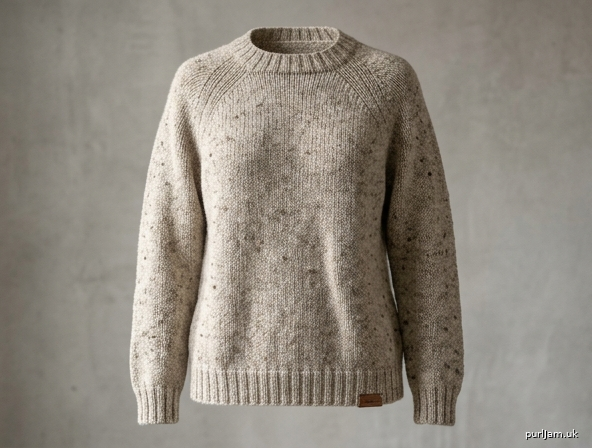
Chunky Tweed Raglan Jumper
A classic crew-neck jumper in chunky tweed, knitted seamlessly from the top down. The neckband is worked first on the full neckline circumference, German short rows lift the back neck, and raglan increases form diagonal lines from the neck to the underarm. Stocking stitch shows off the tweed fleck; 2×2 rib finishes the neck, cuffs and hem. There is no sewing.
Difficulty: Intermediate — working in the round, German short rows, raglan increases (M1L, M1R), separating sleeves, and regular sleeve decreases.
Fit: Comfortable standard fit, with about 6–14 cm (2½–5½ in) positive ease depending on where you sit in the size range. For a chunky layer, choose a finished bust at least 8 cm (3 in) larger than your bust.
Sizes
S (M, L, XL, 2XL)
To fit bust: 86–91 (97–102, 107–112, 117–122, 127–132) cm
[34–36 (38–40, 42–44, 46–48, 50–52) in]
Instructions are given for size S, with M, L, XL and 2XL in parentheses. Where only one figure is given, it applies to all sizes. Highlight your size before you begin.
Yarn
Chunky-weight tweed (bulky), wool or wool-blend with a visible fleck or nep. A springy wool tweed holds the rib and the raglan line best.
Tension basis: 14 stitches and 20 rounds = 10 cm.
Amount: 700 (800, 900, 1000, 1150) metres [765 (875, 985, 1095, 1258) yd]
If your yarn is about 100 m per 100 g, that is roughly 7 (8, 9, 10, 12) balls. Amounts are generous; buy an extra ball if you plan to lengthen the body or sleeves. Check the ball band and buy all of one dye lot.
Suggested palette: one colourway — oatmeal, moss, herringbone brown or heather grey. The pattern is worked in a single colour.
Needles
- 5.5 mm (UK 5 / US 9) circular needle, 40 cm, for the neckband; a longer 5.5 mm circular, or double-pointed needles, for the hem and cuffs
- 6.5 mm (UK 3 / US 10.5) circular needle, 40–60 cm, for the start of the yoke
- 6.5 mm circular needle, 80–100 cm, for the lower yoke and body
- 6.5 mm double-pointed needles, or a long circular for magic loop, for the sleeves
Use whichever needle type you prefer for small circumferences. Match tension, not the needle size printed on the band: move up or down a size if needed.
Notions
- 4 stitch markers, one distinct (beginning of round)
- Stitch holders or smooth waste yarn
- Tapestry needle
- Optional: row counter
Tension
14 stitches and 20 rounds = 10 cm (4 in) in stocking stitch on 6.5 mm needles, after blocking.
Knit a square of at least 15 cm: cast on 24 stitches and work stocking stitch for 28 rows, block as you will block the jumper, and measure 10 cm in the centre. Both stitch and row tension matter. Stitch tension sets the bust and sleeves; row tension sets yoke depth and length.
If you have too many stitches to 10 cm, use a larger needle. If you have too few, use a smaller needle.
Rib is worked on 5.5 mm needles and is not measured separately; it is meant to draw in.
Finished measurements
| S | M | L | XL | 2XL | |
|---|---|---|---|---|---|
| Bust | 100 cm (39¼ in) | 108.5 cm (42¾ in) | 120 cm (47¼ in) | 128.5 cm (50½ in) | 140 cm (55 in) |
| Length, top of neckband to hem (centre back) | 63 cm (24¾ in) | 66 cm (26 in) | 69 cm (27¼ in) | 73 cm (28¾ in) | 77 cm (30¼ in) |
| Centre front, base of neckband to underarm | 20 cm (7¾ in) | 22 cm (8¾ in) | 24 cm (9½ in) | 26 cm (10¼ in) | 29 cm (11½ in) |
| Centre back, base of neckband to underarm | 23 cm (9 in) | 25 cm (9¾ in) | 27 cm (10¾ in) | 30 cm (11¾ in) | 33 cm (13 in) |
| Underarm to hem | 36 cm (14¼ in) | 37 cm (14½ in) | 38 cm (15 in) | 39 cm (15¼ in) | 40 cm (15¾ in) |
| Upper arm | 38.5 cm (15¼ in) | 41.5 cm (16¼ in) | 45.5 cm (18 in) | 48.5 cm (19 in) | 55.5 cm (22 in) |
| Sleeve, underarm to cuff | 42 cm (16½ in) | 43 cm (17 in) | 44 cm (17¼ in) | 44 cm (17¼ in) | 45 cm (17¾ in) |
| Neck circumference at main tension | 51.5 cm (20¼ in) | 54.5 cm (21½ in) | 57 cm (22½ in) | 60 cm (23½ in) | 63 cm (24¾ in) |
The ribbed neckband draws in below the main-tension figure and stretches to pull on over the head. Upper arms are comfortable in chunky fabric, slightly roomier in the larger sizes. Body and sleeve lengths are easy to change once the yoke is divided.
Abbreviations
| Abbreviation | Meaning |
|---|---|
| BOR | beginning of round |
| cm | centimetres |
| dec | decrease |
| DS | double stitch (German short row) — see below |
| inc | increase |
| k | knit |
| k2tog | knit 2 stitches together (1 stitch decreased, leans right) |
| M1L | make 1 left: lift the bar between stitches from front to back with the left needle; knit through the back loop |
| M1R | make 1 right: lift the bar from back to front with the left needle; knit through the front loop |
| p | purl |
| pm | place marker |
| rep | repeat |
| rnd(s) | round(s) |
| RS | right side |
| sm | slip marker |
| ssk | slip, slip, knit: slip 2 stitches knitwise one at a time, return them to the left needle and knit them together through the back loops (1 stitch decreased, leans left) |
| st(s) | stitch(es) |
| st st | stocking stitch (knit every round) |
| WS | wrong side |
Special technique — German short rows
To make a DS: With the yarn in front, slip the next stitch purlwise. Pull the working yarn up and over the right needle to the back, firmly enough that both legs of the stitch show on the needle (the stitch looks doubled). That is one double stitch, not an added stitch. Continue in pattern.
To resolve a DS: When the instructions say to work a DS, knit or purl both legs together as one stitch. The stitch count does not increase.
Pattern notes
Construction. Top-down raglan, worked in the round. Four raglan lines run on the diagonal from the neck to the underarm. This is not a set-in sleeve and not a drop shoulder.
Neckline method — full-circumference crew. Cast on the complete neckline, join in the round, and work the neckband. German short rows then raise the back only. Do not cast on additional stitches at the front neck after the short rows. The full neck is already on the needle; extra front stitches would over-widen it.
Raglan increases. Every other round: M1L before each marker, M1R after each marker (8 stitches increased). One plain knit round follows each increase round.
Trying on. Once the yoke is on a longer needle you can slip it onto waste yarn and try it on. The underarm divide should sit at the base of the armhole, with the neckband at the base of the neck.
Adjustable lengths. After the divide, body and sleeve lengths may be changed. Work to the measurement you want, ending 6 cm before that length so the rib can be added. Keep the decrease rate if you only add or remove a few centimetres; if you add more than 5 cm to a sleeve, space the decreases a little further apart so the taper stays smooth.
Instructions
Neckband
With 5.5 mm needles and a stretchy long-tail cast-on, cast on 72 (76, 80, 84, 88) sts. Join to work in the round, being careful not to twist. Place the distinct marker for BOR. This point is the start of the Back; when you wear the jumper, this side sits at the back.
Rib rnd: *K2, p2; rep from * to end.
Rep the rib rnd until the neckband measures 4 cm.
(72 ÷ 4 = 18, 76 ÷ 4 = 19, 80 ÷ 4 = 20, 84 ÷ 4 = 21, 88 ÷ 4 = 22 — 2×2 rib joins cleanly in every size ✓)
Change to 6.5 mm needles.
Set raglan markers
Set-up rnd: K26 (28, 30, 32, 32) for the Back, pm, k10 (10, 10, 10, 12) for the Left Sleeve, pm, k26 (28, 30, 32, 32) for the Front, pm, k10 (10, 10, 10, 12) for the Right Sleeve.
The distinct BOR marker sits at the end of the Right Sleeve / start of the Back.
Section check: 26+10+26+10 = 72 (28+10+28+10 = 76, 30+10+30+10 = 80, 32+10+32+10 = 84, 32+12+32+12 = 88) ✓
Shape the back neck (German short rows)
Short rows raise the back by about 3 (3, 3, 4, 4) cm. They do not change the stitch count. Do not cast on any stitches.
Short row 1 (RS): K to the first marker (end of Back), sm, k2, turn.
Short row 2 (WS): Make a DS, p to the BOR marker, sm, p2, turn.
Short row 3 (RS): Make a DS, k to the next DS, knit both legs of that DS together, k2, turn.
Short row 4 (WS): Make a DS, p to the next DS, purl both legs of that DS together, p2, turn.
Short rows 5–6 (5–6, 5–6, 5–8, 5–8): Rep short rows 3 and 4 a further 1 (1, 1, 2, 2) time(s).
You now have 3 (3, 3, 4, 4) double stitches on each side, sitting in the sleeve sections. Each sleeve began with 10 (10, 10, 10, 12) sts; the turns use 6 (6, 6, 8, 8) of them, so the turns cannot meet in the middle ✓
Next rnd (RS): Make a DS, then knit to BOR, resolving every DS you meet (knit both legs together as one stitch).
Next rnd: Knit, resolving any remaining DS.
72 (76, 80, 84, 88) sts. Count unchanged ✓
Raglan yoke
Inc rnd: *K to marker, M1L, sm, M1R; rep from * to end. (8 sts increased)
Plain rnd: Knit.
Work an inc rnd followed by a plain rnd a total of 19 (21, 23, 25, 28) times.
224 (244, 264, 284, 312) sts.
Count check: 72 + (19 × 8) = 224; 76 + (21 × 8) = 244; 80 + (23 × 8) = 264; 84 + (25 × 8) = 284; 88 + (28 × 8) = 312 ✓
Stitches in each section:
| S | M | L | XL | 2XL | |
|---|---|---|---|---|---|
| Back | 64 | 70 | 76 | 82 | 88 |
| Each sleeve | 48 | 52 | 56 | 60 | 68 |
| Front | 64 | 70 | 76 | 82 | 88 |
Each section has gained 2 sts per inc rnd: Back 26 + (19 × 2) = 64, and the same relationship in every size ✓
The increase section is 38 (42, 46, 50, 56) rounds, which is 19 (21, 23, 25, 28) cm at tension. Including the set-up and resolving rounds, centre front from the base of the neckband to the underarm is about 20 (22, 24, 26, 29) cm, and centre back about 23 (25, 27, 30, 33) cm.
Try the yoke on before you divide. Raglan width and armhole depth are linked: extra inc rnds would add 8 sts each (2 per section) and widen the body and sleeves. The figures above are the ones used for the rest of this pattern.
Divide for body and sleeves
Remove the raglan markers as you come to them. The BOR marker is removed as well; a new one is placed at the end of this round.
Divide rnd: K64 (70, 76, 82, 88) Back sts, slip the next 48 (52, 56, 60, 68) Left Sleeve sts to a holder, cast on 6 (6, 8, 8, 10) sts using a knitted cast-on, k64 (70, 76, 82, 88) Front sts, slip the next 48 (52, 56, 60, 68) Right Sleeve sts to a holder, cast on 6 (6, 8, 8, 10) sts, pm for the new BOR.
140 (152, 168, 180, 196) body sts.
64 + 64 + 6 + 6 = 140; 70 + 70 + 6 + 6 = 152; 76 + 76 + 8 + 8 = 168; 82 + 82 + 8 + 8 = 180; 88 + 88 + 10 + 10 = 196 ✓
The new BOR sits at the left side, at the end of the second underarm cast-on. Change to the longer 6.5 mm circular needle if you have not already.
Body
Knit every rnd until the body measures 30 (31, 32, 33, 34) cm from the underarm, or 6 cm less than your desired underarm-to-hem length. That is about 60 (62, 64, 66, 68) rounds at tension. Try it on and adjust here if you wish.
Change to 5.5 mm needles.
Rib rnd: *K2, p2; rep from * to end.
Work in rib for 6 cm.
Cast off loosely in rib, using a stretchy cast-off so the hem can pull on.
Underarm to hem is 36 (37, 38, 39, 40) cm. Body stitch counts all divide by 4, so 2×2 rib repeats without a break ✓
Sleeves
Work both sleeves the same.
Return one set of held sleeve sts to 6.5 mm needles, ready to work a RS rnd. With RS facing, starting at the centre of the underarm cast-on, pick up and knit 3 (3, 4, 4, 5) sts along the cast-on edge, pm for BOR, pick up and knit 3 (3, 4, 4, 5) sts, then knit the 48 (52, 56, 60, 68) held sts. Join to work in the round.
54 (58, 64, 68, 78) sts.
48 + 6 = 54; 52 + 6 = 58; 56 + 8 = 64; 60 + 8 = 68; 68 + 10 = 78 ✓
If a small hole shows at either end of the underarm, pick up one extra loop from the corner on the next round and knit it together with the neighbouring stitch so the count stays the same. Close any remaining gap when you weave in the end.
BOR is at the centre of the underarm. Keep it there for the decreases.
Dec rnd: K1, ssk, k to the last 3 sts, k2tog, k1. (2 sts decreased)
Sizes S and M only
Work 7 (9) rnds straight.
*Dec rnd, work 4 rnds straight; rep from * 12 more times.
13 decrease rnds; 28 (32) sts remain.
7 + (13 × 5) = 72 rnds = 36 cm for S; 9 + (13 × 5) = 74 rnds = 37 cm for M ✓
13 × 2 = 26 sts decreased; 54 − 26 = 28 and 58 − 26 = 32 ✓
Sizes L and XL only
Work 6 rnds straight.
*Dec rnd, work 3 rnds straight; rep from * 15 more times.
16 decrease rnds; 32 (36) sts remain.
Work 6 rnds straight.
6 + (16 × 4) + 6 = 76 rnds = 38 cm ✓
16 × 2 = 32 sts decreased; 64 − 32 = 32 and 68 − 32 = 36 ✓
Size 2XL only
Work 6 rnds straight.
*Dec rnd, work 2 rnds straight; rep from * 20 more times.
21 decrease rnds; 36 sts remain.
Work 9 rnds straight.
6 + (21 × 3) + 9 = 78 rnds = 39 cm ✓
21 × 2 = 42 sts decreased; 78 − 42 = 36 ✓
All sizes
Sleeve stocking stitch now measures about 36 (37, 38, 38, 39) cm from the underarm. If you want a longer or shorter sleeve, add or remove straight rounds after the last decrease, before the cuff.
Change to 5.5 mm needles.
Rib rnd: *K2, p2; rep from * to end.
Work in rib for 6 cm. Cuff counts 28 (32, 32, 36, 36) all divide by 4 ✓
Cast off loosely in rib.
Sleeve from underarm to cast-off edge: 42 (43, 44, 44, 45) cm.
Work the second sleeve the same.
Finishing
Weave in all ends. Use the underarm tails to close any tiny gaps at the joins, working on the wrong side.
Block to the measurements in the table. Pin the bust, the centre-back length and the sleeve length, and ease the raglan lines into straight diagonals. Wool tweed may be wet-blocked or steamed; do not agitate, and do not press the rib flat. Dry flat. Follow the ball band if it differs.
No seams. The jumper is complete once it is dry and the ends are secure.
Fit notes
- Neck. The crew is a full-circumference ribbed band. A stretchy cast-on is what lets it go over the head. If your cast-on feels tight, cast on again with a looser long-tail, or use a larger needle for the cast-on row only.
- Yoke. Stop at the stated increase count even if your row tension makes the depth 1 cm longer or shorter. Circumference is the figure that has to match. A difference of more than 2 cm means the row tension does not match and the body length will be off as well.
- Ease. At the bust the finished garment is 100 (108.5, 120, 128.5, 140) cm. Sleeves are roomy enough for the thickness of chunky tweed, widest in 2XL (55.5 cm). If you are between sizes and want a neater sleeve, choose the smaller size provided the bust ease is still at least 8 cm.
- Length. Hip length as written. For a shorter jumper, work fewer body rounds before the hem rib; for a tunic, work more. The stitch count does not change.
Care
Hand wash cool, or as the ball band directs. Tweed can felt if it is soaked in hot water or rubbed. Reshape and dry flat, away from direct heat.
Disclaimer: This pattern was generated by AI and should be reviewed for accuracy before use. While we strive for quality, AI-generated content may contain errors. Please verify measurements, stitch counts, charts, and instructions before beginning your project. Generated by purlJam.uk
Love this pattern?
Save this pattern to your free PurlJam libraryAccess your pattern anytime
Bookmark this page to access your pattern anytime