Type
Knitting
Difficulty
intermediate
Category
pullover
AI Thinking Process
Planning
Verification
Pattern
CONTINUUM
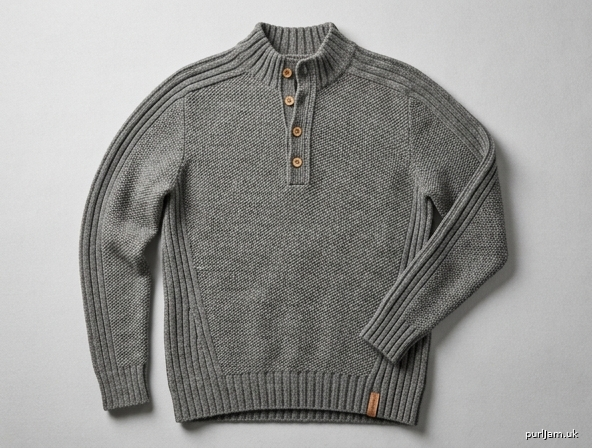
Men’s seamless saddle-shoulder henley pullover
Construction: Seamless, top-down, in the round. Standing 2×2 rib collar opens into a short centre-front henley placket worked with a steek (cut after knitting). Saddle straps carry the 2×2 rib from neck to sleeve; the same rib runs the full sleeve (outer and inner) and the body side panels into the hem. Front and back are moss stitch. Increases and decreases are twisted closed and sit outside the rib panels.
Difficulty: Advanced (steek, saddles, simultaneous textures, tailored shaping).
Sizes: XS (S, M, L, XL, XXL)
To fit chest: 86 (91, 97, 102, 107, 117) cm / 34 (36, 38, 40, 42, 46) in
Finished chest: 91 (96, 102, 107, 112, 122) cm / 36 (38, 40, 42, 44, 48) in
Ease: approx. 5 cm (2 in) positive.
Finished measurements
- Body length from back neck (excl. collar): 66 (67, 68, 70, 71, 73) cm
- Armhole depth (saddle + cap): 21 (22, 23, 24, 25, 26.5) cm
- Saddle width: 8 cm (16 sts)
- Saddle length (each): 11 (11.5, 12, 12.5, 13, 14) cm
- Sleeve length from underarm: 48 (49, 50, 51, 52, 53) cm
- Upper arm: 34 (36, 38, 40, 42, 46) cm
- Collar height: 6 cm standing
- Henley opening (cut length): 12 (12, 13, 13, 14, 14) cm
Yarn
Worsted (aran-light) wool or wool blend, approx. 100 m / 50 g.
Metres: 1150 (1250, 1380, 1500, 1650, 1850) m
Yards: 1260 (1370, 1510, 1640, 1800, 2020) yd
Sample fibre: 100% wool, worsted spun.
Needles (metric)
- 4.5 mm circular 40 cm and 80–100 cm, plus DPNs or magic loop for sleeves
- 3.75 mm circular 40 cm (collar, cuffs, hem, placket bands)
- Spare 4.5 mm for three-needle join if preferred
- Crochet hook 3.5 mm (steek reinforcement)
Notions
Stitch markers (including 2 locking), waste yarn, tapestry needle, 4 (4, 4, 5, 5, 5) buttons 15–18 mm, sewing needle and matching thread (optional, for placket).
Tension (gauge)
After blocking, in the round
- Moss stitch on 4.5 mm: 20 sts and 28 rnds = 10 cm
- 2×2 rib on 3.75 mm, slightly stretched: 24 sts and 28 rnds = 10 cm
- 2×2 rib on 4.5 mm, relaxed: 22 sts = 10 cm
Work a 15 cm swatch in moss in the round. Adjust needle size to match.
Abbreviations (UK knitting)
k, p, st(s), rnd(s), RS, WS
kfb — knit into front and back
k1tbl / p1tbl — knit/purl through back loop
M1L — left-leaning lifted inc (from front, knit through back of strand)
M1R — right-leaning lifted inc (from back, knit through front of strand)
M1Lp / M1Rp — same, purlwise
k2tog tbl — twisted right-leaning dec
ssk — slip, slip, knit (or sl1 kwise, sl1 kwise, k2tog tbl)
pm, slm, sm — place / slip marker
cn — cable needle (not required)
wyif / wyib — with yarn in front / back
Moss stitch (even st count, in the rnd):
Rnd 1: *k1, p1; rep from *.
Rnd 2: *p1, k1; rep from *.
Rep Rnds 1–2.
2×2 rib: *k2, p2; rep from *.
Twisted closed inc (knit side of moss, outside rib): M1R or M1L as specified — work through the back of the new stitch on the following rnd if it would gape.
Twisted closed dec: ssk or k2tog tbl as specified.
Pattern notes
- The rib path is never broken: collar → saddles → sleeve outer rib → cuff → sleeve inner rib → underarm → body side rib → hem.
- All body/sleeve shaping sits in moss, 1 st outside the rib-panel markers, so the rib columns stay vertical.
- The henley steek is 6 sts (3 pairs) of contrasting waste or main yarn; it is not part of the finished stitch count for the chest.
- Short rows at the back neck improve collar sit; they are optional but recommended.
- Sizes are written XS (S, M, L, XL, XXL). When only one number appears, it applies to all sizes.
1. Collar (standing 2×2 rib)
With 3.75 mm, 40 cm circular, CO 88 (92, 96, 100, 104, 108) sts using a tubular or long-tail cast-on for 2×2 rib. Join, pm for BOR at centre back. Work 2×2 rib in the rnd for 6 cm.
Set-up for henley (still 3.75 mm):
Next rnd: rib to 22 (23, 24, 25, 26, 27) sts before BOR (this is left of CF), pm (Left Placket), rib 44 (46, 48, 50, 52, 54) (front neck), pm (Right Placket), rib to BOR.
Check: 22+44+22 = 88 for XS ✓; scale similarly.
Do not break yarn.
2. Begin henley + change to body needle
Change to 4.5 mm. The front opening will be worked with a 6-st steek between Right and Left Placket markers.
Inc rnd (collar to saddle/yoke):
Work in established 2×2 rib, increasing 8 (8, 12, 12, 16, 16) sts evenly only in the back and shoulder sections (not in the 44–54 front sts between placket markers), using M1L as k or p to keep rib.
88 (92, 96, 100, 104, 108) + 8 (8, 12, 12, 16, 16) = 96 (100, 108, 112, 120, 124) sts excluding steek.
Next rnd — place steek:
Rib to Right Placket marker, sm, CO 6 steek sts (k1, p1, k1, p1, k1, p1), sm Left Placket, rib to end.
Total on needle: 102 (106, 114, 118, 126, 130) including steek.
Work 1 rnd even, keeping 2×2 on garment sts and steek in 1×1 (k1, p1).
3. Short-row back neck (optional but recommended)
Keeping rib, work German or wrap-and-turn short rows on the back only:
- Rib to 8 sts before BOR, w&t.
- Rib to 8 sts past BOR the other way, w&t.
- Next 2 turns 6 sts further each side; next 2 turns 4 sts further.
- Resume full rnds, picking up wraps and working them twisted closed into rib.
Work even in rib until total collar + henley depth from CO = 8 cm (collar 6 cm + 2 cm into placket). Continue henley as you work saddles.
4. Divide for saddles
Place markers for 16-st saddles (8 cm) at each shoulder.
From BOR (centre back), work:
Back: 32 (34, 36, 38, 40, 42) sts, pm, Saddle L: 16 sts, pm, Front (incl. steek): 6 steek + 32 (34, 36, 38, 40, 42) front sts split either side of steek, pm, Saddle R: 16 sts, pm.
Adjust 1–2 sts if needed so each saddle is k2, p2 aligned with collar rib (begin each saddle on k2).
Stitch check XS (excl. steek): 32 back + 16 + 32 front + 16 = 96 ✓.
Place front sts + steek and back sts on waste yarn. Saddles remain live.
5. Saddle straps
Work each saddle flat (or in the rnd on 16 sts if you prefer a tiny loop — flat is standard).
RS: Work 16 sts in 2×2 rib as set.
WS: Work rib as they present (k the k, p the p).
Work until saddle measures 11 (11.5, 12, 12.5, 13, 14) cm, ending WS.
Row count: 30 (32, 34, 36, 36, 40) rows at 28 rows/10 cm ≈ listed lengths.
Leave 16 sts live on holder. Make second saddle to match.
The rib now runs from collar, across the shoulder, ready to become the outer sleeve panel.
6. Pick up for yoke (fronts, back, sleeve caps)
With 4.5 mm, 80–100 cm circular, RS facing:
A. Left sleeve cap + join
Starting at front end of Left saddle, pick up and knit 22 (24, 26, 28, 30, 34) sts along saddle selvedge (approx. 3 sts per 4 rows), pm, work 16 saddle sts in rib from holder, pm, pick up 22 (24, 26, 28, 30, 34) sts along remaining saddle selvedge (back side).
Sleeve-cap sts = 60 (64, 68, 72, 76, 84) including saddle.
16 + 22+22 = 60 ✓ (XS).
Place these on waste or leave on cable.
B. Back
Pick up 3 sts per 4 rows along left back saddle edge already counted in sleeve — do not double.
Work 32 (34, 36, 38, 40, 42) back neck sts from holder in moss, then pick up along right back saddle for the right sleeve as in A.
C. Right sleeve — mirror A: 22 (24, 26, 28, 30, 34) + 16 rib + 22 (24, 26, 28, 30, 34).
D. Fronts + steek
Work front sts from holder in moss, maintaining 6-st steek in 1×1. Pick up along front saddle selvedges into the sleeve-cap counts already given.
Yoke now on one circular. Place markers:
| Marker | Meaning |
|---|---|
| BOR | Centre back |
| Side-rib start/end | 12-st body side rib will be established at underarm later |
| Sleeve rib | 16-st outer saddle rib + 16-st inner rib (inner begins when sleeve is joined) |
| Steek | 6 sts CF |
Henley length: Continue working the steek until the cut opening will measure 12 (12, 13, 13, 14, 14) cm from top of collar fold (i.e. from CO). Then stop the steek: on next rnd, bind off the 6 steek sts and join front in the rnd by working across (no extra st). Reinforce and cut after the whole garment is knitted (see Finishing). Until then, you may keep the steek live to the join-rnd if you prefer a longer opening — cut length is as listed.
Recommended: work steek for 34 (34, 36, 36, 40, 40) rnds of yoke/body from start of 4.5 mm, then join.
7. Sleeve-cap / armhole shaping (saddle already done)
Work in the rnd: moss on front and back; 16-st 2×2 rib centred on each saddle continuing down the outer sleeve; remaining sleeve-cap sts in moss or begin a second 16-st 2×2 inner rib on the underarm side of each sleeve as soon as stitch count allows (place it opposite the outer saddle rib).
Sleeve-cap increases (both sleeves, every other rnd):
On moss, 1 st outside each rib panel: M1R, work rib, M1L at outer panel; same at inner panel when it exists.
Inc 8 sts per inc rnd (4 per sleeve) 0 (0, 0, 1, 1, 2) times, then 4 sts per rnd (outer panels only) until each sleeve (incl. both 16-st ribs) has:
Sleeve sts at underarm: 68 (72, 76, 80, 84, 92)
Upper arm 34–46 cm at 20 sts/10 cm: 68–92 ✓.
Body at underarm (excl. sleeves, excl. steek if still open):
Front + back moss + two 12-st side ribs (established over last 4 rnds before split):
182 (192, 204, 214, 224, 244) body sts.
91 cm × 2.0 sts/cm = 182 ✓ XS; 122 cm × 2 = 244 ✓ XXL.
Establish 12-st side rib at each “side seam” line: convert 12 moss sts to 2×2 (k2, p2 three times), aligned so columns will meet sleeve inner rib at the armpit.
Join / split for body and sleeves
Work to first sleeve, place 68 (72, 76, 80, 84, 92) sleeve sts on waste, CO 2 (2, 2, 2, 2, 2) underarm sts (keep side rib continuous — these 2 sts are moss or folded into rib as needed), work back, second sleeve to waste, CO 2 underarm sts.
Body: 182 (192, 204, 214, 224, 244) + 4 underarm = 186 (196, 208, 218, 228, 248) then decrease 4 sts on next rnd (twisted, outside side ribs) to restore 182 (192, 204, 214, 224, 244).
If steek is still open, join CF when henley depth is reached: BO 6 steek, work fronts as one.
8. Body (moss + side ribs, tailored)
Markers: 12-st 2×2 rib at each side; moss elsewhere.
Waist shaping (both sides, outside the 12-st rib, in moss):
From underarm, work even 6 (6, 6, 7, 7, 8) cm.
Dec rnd: On moss, 1 st before side rib: ssk; sm, rib 12, sm, k2tog tbl. Repeat at second side. −4 sts.
Rep dec rnd every 8th rnd 3 times more.
182 (192, 204, 214, 224, 244) − 16 = 166 (176, 188, 198, 208, 228) waist.
Work even 8 (8, 8, 9, 9, 9) cm at waist.
Inc rnd: 1 st before side rib: M1R; rib 12; M1L. Repeat other side. +4 sts.
Rep inc rnd every 8th rnd 3 times more.
166… + 16 = 182 (192, 204, 214, 224, 244) hip. ✓
Work even until body from underarm measures 40 (40, 40, 41, 41, 42) cm, or 7 cm less than desired length.
Hem: Change to 3.75 mm. Convert all sts to 2×2 rib, matching the side-panel columns (do not break the k2 columns). Work 7 cm. BO in rib, or tubular BO.
9. Sleeves
Return 68 (72, 76, 80, 84, 92) sts to 4.5 mm. Pick up 2 underarm sts. 70 (74, 78, 82, 86, 94) sts.
Next rnd: decrease 2 underarm sts twisted, outside inner rib. 68 (72, 76, 80, 84, 92) sts.
Layout each sleeve:
- 16 sts outer 2×2 (from saddle)
- moss
- 16 sts inner 2×2 (from armpit, continuous with body side rib)
- moss
Work in the rnd. Dec rnd: in moss, 1 st outside each rib panel (4 decs): ssk / k2tog tbl as needed to lean into moss.
Dec every 8 (8, 7, 7, 6, 6)th rnd until 48 (48, 52, 52, 56, 56) sts remain.
Work even until sleeve from underarm is 41 (42, 43, 44, 45, 46) cm.
Cuff: 3.75 mm. Work 2×2 rib on all sts, joining outer and inner panels around the cuff so the rib path is continuous. 7 cm. BO in rib.
Visual path: collar → outer sleeve → around cuff → inner sleeve → armpit → body side → hem.
10. Steek, placket, and finishing
Reinforce steek before cutting: with crochet hook 3.5 mm, work two columns of slip-stitch crochet (or machine stitch twice) on the centre of the 6-st steek. Cut between the two centre steek stitches.
Placket bands (3.75 mm):
Pick up 3 sts per 4 rows along each cut edge + 1 st at corners.
Right front (as worn): 2×2 rib, buttonholes on rnds/rows at 2.5 cm intervals — 4 (4, 4, 5, 5, 5) holes (yo, k2tog in a k2 column). Work 3 cm. BO.
Left front: rib 3 cm, no holes. BO.
Overlap right over left; tack steek facing to WS. Sew buttons to left band.
Weave in ends. Block to measurements, pinning moss square and rib panels straight (do not overstretch rib).
Schematic (key)
Collar 6 cm standing → henley 12–14 cm
Saddle 16 sts × 11–14 cm
Chest 91–122 cm
Side rib 12 sts each
Sleeve outer + inner rib 16+16 sts
Hem & cuff 7 cm 2×2
Designer checklist
- Rib columns align at saddle/sleeve/cuff/side/hem: yes if markers never jump a k2.
- Shaping always outside rib: yes.
- Steek cut only after crochet/machine reinforcement.
End of pattern.
Disclaimer: This pattern was generated by AI and should be reviewed for accuracy before use. While we strive for quality, AI-generated content may contain errors. Please verify measurements, stitch counts, charts, and instructions before beginning your project. Generated by purlJam.uk
Love this pattern?
Save this pattern to your free PurlJam libraryAccess your pattern anytime
Bookmark this page to access your pattern anytime