Type
Knitting
Difficulty
beginner
Category
cardigan
AI Thinking Process
Planning
Verification
Pattern
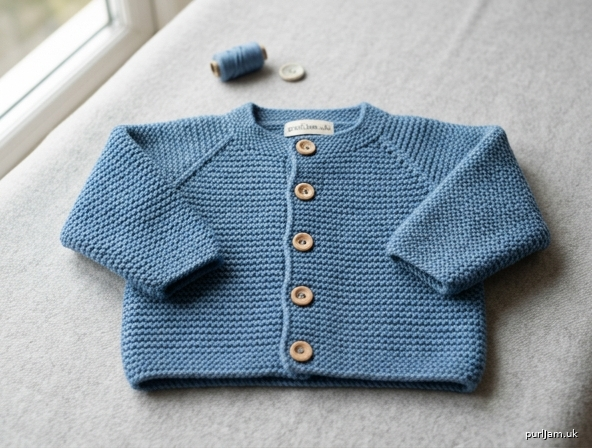
Cosy Ridges Baby Cardigan
A simple dropped-shoulder cardigan worked flat in garter stitch and seamed. Garter stitch lies flat, so there is no ribbing to manage — ideal for a first garment. Instructions are written for five baby sizes; the first figure applies to 0–3 months, with 3–6 months, 6–12 months, 12–18 months and 18–24 months in parentheses.
Materials
Yarn: DK (double knitting) yarn, suitable for babies (acrylic, merino, or a soft blend).
Approximate amounts:
- 0–3 months: 200 m / 100 g
- 3–6 months: 250 m / 125 g
- 6–12 months: 300 m / 150 g
- 12–18 months: 350 m / 175 g
- 18–24 months: 400 m / 200 g
Allow a little extra if you lengthen the body or sleeves.
Needles:
- 4 mm (UK 8 / US 6) straight or circular needles, or size needed to match tension
- Optional: 3.5 mm (UK 10 / US 4) for a slightly firmer button band
Notions:
- 5 buttons, 12–15 mm diameter
- 4 stitch markers
- 2 stitch holders or spare yarn
- Tapestry needle
- Sewing needle and matching thread for buttons
Tension (Gauge)
22 stitches and 44 rows (22 garter ridges) = 10 cm (4 in) over garter stitch on 4 mm needles, after light blocking.
Garter stitch: knit every row.
Work a swatch at least 12 × 12 cm, wash or steam as you will the garment, and measure in the centre. Change needle size if needed — stitch tension affects width; row tension affects length. Because you will mainly work to centimetre measurements, a small row-tension difference is easy to absorb.
Sizes
Figures are given as 0–3 months (3–6 months, 6–12 months, 12–18 months, 18–24 months).
| 0–3 m | 3–6 m | 6–12 m | 12–18 m | 18–24 m | |
|---|---|---|---|---|---|
| To fit chest | 40 cm (15¾ in) | 44 cm (17¼ in) | 48 cm (19 in) | 52 cm (20½ in) | 54 cm (21¼ in) |
| Finished chest (buttoned) | 46 cm (18 in) | 50 cm (19¾ in) | 54 cm (21¼ in) | 58 cm (22¾ in) | 62 cm (24½ in) |
| Length to shoulder | 22 cm (8¾ in) | 25 cm (9¾ in) | 28 cm (11 in) | 31 cm (12¼ in) | 34 cm (13½ in) |
| Sleeve length to underarm | 13 cm (5 in) | 16 cm (6¼ in) | 18 cm (7 in) | 20 cm (8 in) | 22 cm (8¾ in) |
Ease is about 6–8 cm. Choose the size by the baby’s chest, not age.
Abbreviations
- cm – centimetres
- cont – continue
- dec – decrease(ing)
- foll – following
- g – grams
- in – inches
- inc – increase(ing)
- k – knit
- k2tog – knit 2 stitches together (1 stitch decreased)
- kfb – knit into the front and then the back of the same stitch (1 stitch increased)
- m – metres / months (as context)
- rem – remain(ing)
- rep – repeat
- RS – right side
- st(s) – stitch(es)
- WS – wrong side
- yo – yarn over (bring yarn forward between the needles, then over the right needle to the back, ready to knit the next stitch)
Notes
- The cardigan is worked in five pieces: back, left front, right front and two identical sleeves. Shoulders are seamed, sleeves are sewn into dropped armholes, then side and sleeve seams are joined. The button band is picked up along both fronts and the back neck and worked in one piece.
- Garter stitch looks the same on both sides. Treat the first row after casting on as the WS, and mark the RS with a removable marker or safety pin so neck decreases sit on the correct edge.
- A garter ridge is 2 rows. When picking up stitches along a vertical edge, pick up 1 stitch in each ridge (that is, 1 stitch for every 2 rows) to match the 22 sts / 10 cm tension.
- Work the first and last stitch of every row firmly so edges stay neat for seaming. Do not slip edge stitches — a knitted selvedge is easier to seam in garter.
- Instructions in parentheses belong to the larger sizes. Where one number is given, it applies to all sizes.
- For a longer or shorter garment, add or subtract length before the neck shaping. Keep a note of any change so both fronts and the back match.
- Baby safety: sew buttons on with extra passes of thread and a small reinforcing stitch on the reverse. Check they cannot be pulled off. If the cardigan is for a very young baby, press-studs (sewn-on snaps) may be substituted.
Back
With 4 mm needles, cast on 50 (56, 60, 64, 68) sts.
Work in garter stitch (knit every row) until the back measures 20 (23, 26, 29, 32) cm / 8 (9, 10¼, 11½, 12½) in from the cast-on edge, ending with a WS row.
Shape back neck
Next row (RS): k16 (18, 19, 20, 22), cast off the centre 18 (20, 22, 24, 24) sts, k to end.
16 + 18 + 16 = 50 ✓
18 + 20 + 18 = 56 ✓
19 + 22 + 19 = 60 ✓
20 + 24 + 20 = 64 ✓
22 + 24 + 22 = 68 ✓
You now have two shoulder sections. Work each side separately. Leave the first set of sts on a holder if you prefer, or work them later from the same ball.
Left shoulder (as worn) — the side just completed:
Next row (WS): knit. Next row (RS): k1, k2tog, k to end. 15 (17, 18, 19, 21) sts rem. (16 − 1 = 15 ✓; 18 − 1 = 17 ✓; 19 − 1 = 18 ✓; 20 − 1 = 19 ✓; 22 − 1 = 21 ✓)
Knit 3 more rows even (or until the back measures 22 (25, 28, 31, 34) cm / 8¾ (9¾, 11, 12¼, 13½) in from the cast-on edge). Cast off knitwise.
Right shoulder (as worn) — rejoin yarn with WS facing at the neck edge of the remaining sts.
Next row (WS): knit. Next row (RS): k to last 3 sts, k2tog, k1. 15 (17, 18, 19, 21) sts rem.
Knit 3 more rows even, matching the first shoulder length. Cast off knitwise.
Back neck in total: centre cast-off plus 1 decrease each side = 20 (22, 24, 26, 26) sts (18 + 2 = 20 ✓; 20 + 2 = 22 ✓; 22 + 2 = 24 ✓; 24 + 2 = 26 ✓).
Fronts
Make two, mirrored. The right front is the baby’s right-hand side as worn (centre-front edge at the beginning of RS rows). The left front is the baby’s left-hand side as worn (centre-front edge at the end of RS rows).
Right front (as worn)
With 4 mm needles, cast on 24 (26, 28, 30, 32) sts.
Work in garter stitch until the front measures 16.5 (19.5, 22.5, 25.5, 28.5) cm / 6½ (7¾, 8¾, 10, 11¼) in from the cast-on edge, ending with a WS row.
Shape neck
Next row (RS): cast off 3 (3, 4, 4, 4) sts, k to end. 21 (23, 24, 26, 28) sts.
Knit 1 WS row.
Decrease row (RS): k1, k2tog, k to end. 1 st decreased at the neck edge.
Knit 1 WS row.
Rep the last 2 rows a further 5 (5, 5, 6, 6) times. 6 (6, 6, 7, 7) neck decreases in total.
24 − 3 − 6 = 15 ✓
26 − 3 − 6 = 17 ✓
28 − 4 − 6 = 18 ✓
30 − 4 − 7 = 19 ✓
32 − 4 − 7 = 21 ✓
15 (17, 18, 19, 21) sts rem.
Cont even in garter stitch until the front matches the back length to the shoulder — 22 (25, 28, 31, 34) cm / 8¾ (9¾, 11, 12¼, 13½) in from the cast-on edge — ending with a WS row. Cast off knitwise.
Left front (as worn)
With 4 mm needles, cast on 24 (26, 28, 30, 32) sts.
Work in garter stitch until the front measures 16.5 (19.5, 22.5, 25.5, 28.5) cm, ending with a WS row.
Shape neck
Next row (RS): knit. Next row (WS): cast off 3 (3, 4, 4, 4) sts, k to end. 21 (23, 24, 26, 28) sts.
Decrease row (RS): k to last 3 sts, k2tog, k1. 1 st decreased at the neck edge.
Knit 1 WS row.
Rep the last 2 rows a further 5 (5, 5, 6, 6) times. 15 (17, 18, 19, 21) sts rem — matching the right front and the back shoulders.
Cont even until the front matches the back length to the shoulder. Cast off knitwise.
Sleeves
Make 2 alike.
With 4 mm needles, cast on 28 (30, 32, 34, 36) sts.
Knit 8 rows (4 ridges).
Increase row (RS): k1, kfb, k to last 2 sts, kfb, k1. 2 sts increased.
Knit 7 rows.
Rep the last 8 rows a further 5 (6, 7, 8, 9) times. 6 (7, 8, 9, 10) increase rows in total.
28 + (6 × 2) = 40 ✓
30 + (7 × 2) = 44 ✓
32 + (8 × 2) = 48 ✓
34 + (9 × 2) = 52 ✓
36 + (10 × 2) = 56 ✓
40 (44, 48, 52, 56) sts.
Cont even in garter stitch until the sleeve measures 13 (16, 18, 20, 22) cm / 5 (6¼, 7, 8, 8¾) in from the cast-on edge, ending with a WS row. Cast off knitwise, leaving a long tail for seaming.
Sleeve top width: 40 (44, 48, 52, 56) sts = 18 (20, 22, 23.5, 25.5) cm. Half of this width is the armhole depth on the body: 9 (10, 11, 12, 12.5) cm.
Button Bands
Join both shoulder seams first, using mattress stitch or a firm backstitch, matching the 15 (17, 18, 19, 21) shoulder sts of each front to the back. The remaining finishing (side seams and sleeves) can wait until after the band, or be done now — either order works.
Pick-up rate: with RS facing and 4 mm needles (or 3.5 mm for a firmer band), pick up 1 stitch in each garter ridge along vertical edges, and 1 stitch in each cast-off stitch across the back neck. At the two inner corners where front neck meets back neck, pick up an extra stitch if a hole appears.
Starting at the right-front hem (as worn), pick up and knit:
- 36 (43, 50, 56, 63) sts up the right-front edge to the start of neck shaping,
- 14 (14, 16, 16, 16) sts along the right-front neck slope,
- 22 (24, 26, 28, 28) sts across the back neck,
- 14 (14, 16, 16, 16) sts along the left-front neck slope,
- 36 (43, 50, 56, 63) sts down the left-front edge to the hem.
Total: 122 (138, 158, 172, 186) sts.
(36 + 14 + 22 + 14 + 36 = 122 ✓; 43 + 14 + 24 + 14 + 43 = 138 ✓; 50 + 16 + 26 + 16 + 50 = 158 ✓; 56 + 16 + 28 + 16 + 56 = 172 ✓; 63 + 16 + 28 + 16 + 63 = 186 ✓)
If your row tension differed and you are a ridge or two out, adjust the front-edge counts so both fronts match; the band will still sit flat.
Knit 3 rows.
Buttonhole row (RS): buttonholes sit on the right front (as worn) — that is, in the first 36 (43, 50, 56, 63) sts you picked up, which are now at the beginning of this RS row. Work 5 buttonholes evenly along that section, with the first about 1.5 cm from the hem and the last just below the start of the neck, as follows:
k3 (4, 5, 6, 7), [yo, k2tog, k5 (7, 8, 9, 11)] 4 times, yo, k2tog, k to end.
You should have worked 5 (yo, k2tog) pairs and still be on the right-front stitches when the last buttonhole is completed. Knit the remaining neck and left-front stitches as they are.
(Placement is even, not stitch-exact across every size; if a hole sits a stitch or two off the visual centre of a gap, that is fine.)
Knit 5 more rows (6 rows including the buttonhole row, so the holes sit in the middle of the band). Band is 10 rows / 5 ridges ≈ 2.3 cm deep.
Cast off knitwise, neither tightly nor loosely — the neck edge should lie flat without flaring. If the neck feels tight, cast off with a larger needle.
Boys / girls: the buttonholes are written for the right front as worn (a common unisex / girls’ placing). For the traditional boys’ placing, work the buttonholes on the left front instead (the last 36 (43, 50, 56, 63) sts of the RS row).
Finishing
- Armhole markers. On the back, measure 9 (10, 11, 12, 12.5) cm / 3½ (4, 4¼, 4¾, 5) in down from each shoulder seam along the side edge and place a marker. Repeat on each front. The distance between the back marker and the matching front marker, running up over the shoulder, should equal the sleeve top width 18 (20, 22, 23.5, 25.5) cm.
- Set in sleeves. With RS together (or RS facing you if you prefer mattress stitch), sew each sleeve top between a pair of markers, matching the centre of the sleeve cast-off edge to the shoulder seam. Ease the sleeve in evenly; garter is forgiving.
- Side and sleeve seams. Join each side seam from hem to the armhole marker, then continue along the sleeve from underarm to cuff. Use mattress stitch, picking up the bump at the edge of every ridge on each side so the seam stays flat and almost invisible.
- Weave in ends on the WS. Split the plies of DK as you weave so tails stay put through washes.
- Buttons. Sew the 5 buttons to the left front band, opposite the buttonholes. Use sewing thread (not yarn) and pass through each button several times; finish with a small reinforcing stitch on the reverse of the band. Check they are secure.
- Block. For superwash wool or acrylic, a light steam with the iron held above the fabric (do not press garter flat — you will lose the ridges) is enough. Pin to the finished measurements and leave to dry. Non-superwash wool may be soaked, pressed out in a towel, and dried flat to size.
The cardigan should sit with a small overlap at the centre front and a gentle dropped shoulder. If the bands gape, a slightly smaller needle on the pick-up row next time will firm them; if they pull in, pick up one extra stitch every 8–10 ridges.
To alter length: add or subtract centimetres on the back and both fronts before neck shaping, and on the sleeves after the increases are complete. Recalculate the front pick-up counts at 2.2 sts per cm of front edge.
Enjoy the ridges — and the little person who wears them.
Disclaimer: This pattern was generated by AI and should be reviewed for accuracy before use. While we strive for quality, AI-generated content may contain errors. Please verify measurements, stitch counts, charts, and instructions before beginning your project. Generated by purlJam.uk
Love this pattern?
Save this pattern to your free PurlJam libraryAccess your pattern anytime
Bookmark this page to access your pattern anytime