Type
Knitting
Difficulty
advanced
Category
blanket
AI Thinking Process
Planning
Verification
Pattern
Extra Hour Snuggle Blanket or Cowl
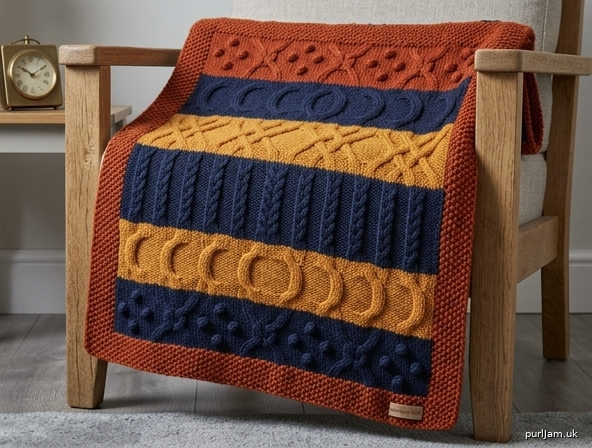
A chunky hand-knit throw for the night the clocks go back. Navy constellation bobbles, amber crescent cables, and a clock braid that reverses direction mark the extra hour and the long, cozy dark. The same charts make a shorter snuggle cowl.
MATERIALS
- Bulky-weight yarn (CYC #5), wool or wool-acrylic blend, that matches the gauge below. UK chunky of the same gauge is suitable.
- Twilight Navy (MC): 900 yards (823 m). About 9 skeins if a skein is 109 yards (100 m).
- Amber (CC1): 420 yards (384 m). About 4 skeins of 109 yards (100 m).
- Burnt Orange (CC2): 680 yards (622 m). About 7 skeins of 109 yards (100 m).
- Cowl only, each color: 200 yards (183 m), about 2 skeins of 109 yards (100 m).
- US 11 / 8 mm circular needle, 40 inches / 100 cm long (a 32-inch / 80 cm needle will work for the cowl).
- Cable needle that can hold 4 bulky stitches, plus a spare double-pointed needle.
- 10 stitch markers and 1 locking marker for the right side.
- Tapestry needle, blocking pins, and a row counter.
- Blocking wires are not required.
Yardage is approximate and includes a buffer for cables, bobbles, and swatching. Buy an extra skein of any color you cannot match later.
GAUGE
In pattern, blocked: 12 stitches and 16 rows = 4 inches (10 cm) over Chart C (The Clock).
Seed stitch, blocked, same needles: 12 stitches and 24 rows = 4 inches (10 cm).
Stitch gauge matches across seed stitch and Chart C. Row gauge does not. Measure both.
Swatch before you start. Cast on 48 stitches. Work 6 seed stitches, 3 repeats of Chart C, and 6 seed stitches for 24 rows. Block. The center cable fabric should measure 4 inches (10 cm) across 12 stitches and 4 inches (10 cm) over 16 rows. If it is too wide, use a smaller needle. If it is too narrow, use a larger needle. Do not start the blanket until both gauges match.
FINISHED SIZE
Blanket, blocked: 40 inches (102 cm) wide × 55 inches (140 cm) long.
- Seed border: 2 inches (5 cm) on every edge.
- Patterned field: 36 inches wide × 51 inches long.
- Check: 2 + 36 + 2 = 40 inches wide ✓. 2 + 51 + 2 = 55 inches long ✓.
Cowl, blocked, after seaming: 28 inches (71 cm) circumference × 18 inches (46 cm) tall.
ABBREVIATIONS
- BO: bind off
- C4B: slip 2 stitches to cable needle, hold in back, k2, k2 from cable needle
- C4F: slip 2 stitches to cable needle, hold in front, k2, k2 from cable needle
- C8B: slip 4 stitches to cable needle, hold in back, k4, k4 from cable needle
- C8F: slip 4 stitches to cable needle, hold in front, k4, k4 from cable needle
- CC1: Amber
- CC2: Burnt Orange
- CO: cast on
- k: knit
- k3tog: knit 3 stitches together
- MB: make bobble — knit into the front, back, and front of the next stitch (3 stitches), turn, p3, turn, k3tog (1 stitch remains)
- MC: Twilight Navy
- p: purl
- pm: place marker
- RS: right side
- sm: slip marker
- st(s): stitch(es)
- WS: wrong side
NOTES
- Difficulty: Advanced. You will read charts, turn a 6-stitch braid around, cross 8 bulky stitches, make bobbles, and twist a border color at two vertical junctions.
- The blanket is worked flat, back and forth. Do not join in the round. A circular needle is used only for the width.
- Do not slip the first stitch. The seed border is the edge.
- Every blanket row has 120 stitches. Every chart repeat uses 12 stitches and returns 12 stitches. MB returns 1 stitch. Each cable returns the number of stitches it consumes.
- Motifs are texture, placed in color bands:
- Stars: paired bobbles with a small spark cable between them (Chart A), in navy at the bottom and burnt orange at the top.
- Crescent moons: horseshoe cables that open one way, then the other (Chart B), in amber, then again in navy after the clocks change.
- Clock face: nine vertical braids, like hour ropes (Chart C). Halfway up the band the braid reverses. That reversal is the clocks going back. It is not a mistake.
- The extra hour: wide amber crosses (Chart D), the hour gained when the clocks change.
- Colors are worked in solid bands, with burnt orange kept at the side edges. There is no stranded color grid. An optional pictorial clock is not required to finish this pattern.
- Keep C8 crosses loose. Spread the 4 held stitches and do not yank the first stitch after the cross, or the amber band will pucker.
- Work MB snugly enough that it does not leave a hole, and push the bobble to the right side.
- Count stitches after every lead-in and at the end of every chart repeat.
- Wet-block the gauge swatch the way you will block the blanket. Cables and bobbles should be patted into shape, not crushed.
CHARTS
These are stitch charts. Work them in the color named in the band. Symbols are listed left to right in the order you work them. Read every row from left to right. The written row and the grid row are the same.
Symbol key
|= knit on RS, purl on WS.= purl on RS, knit on WSB= MB (RS only)f f f f= C4F over these 4 stitches (always a group of 4)b b b b= C4B over these 4 stitches (always a group of 4)8eight times = C8F over these 8 stitches9nine is not used alone; eight9symbols = C8B over these 8 stitches
Chart A — Star Field (12 stitches × 8 rows)
Paired stars with a 4-stitch spark between them.
Written
- Row 1 (RS): P2, MB, P1, C4F, P1, MB, P2
- Row 2 (WS): K2, P1, K1, P4, K1, P1, K2
- Row 3 (RS): P2, K1, P1, K4, P1, K1, P2
- Row 4 (WS): K2, P1, K1, P4, K1, P1, K2
- Row 5 (RS): P2, MB, P1, K4, P1, MB, P2
- Row 6 (WS): K2, P1, K1, P4, K1, P1, K2
- Row 7 (RS): P2, K1, P1, C4B, P1, K1, P2
- Row 8 (WS): K2, P1, K1, P4, K1, P1, K2
Working-order grid (row 1 at top; read left to right)
Row 1 (RS): . . B . f f f f . B . .
Row 2 (WS): . . | . | | | | . | . .
Row 3 (RS): . . | . | | | | . | . .
Row 4 (WS): . . | . | | | | . | . .
Row 5 (RS): . . B . | | | | . B . .
Row 6 (WS): . . | . | | | | . | . .
Row 7 (RS): . . | . b b b b . | . .
Row 8 (WS): . . | . | | | | . | . .
Each line is 12 symbols ✓.
Chart B — Crescent Moon (12 stitches × 16 rows)
Row 1 opens a horseshoe one way. Row 9 opens it the other way: a waxing and waning crescent.
Written
- Row 1 (RS): P2, C4B, C4F, P2
- Row 2 (WS): K2, P8, K2
- Row 3 (RS): P2, K8, P2
- Row 4 (WS): K2, P8, K2
- Row 5 (RS): P2, K8, P2
- Row 6 (WS): K2, P8, K2
- Row 7 (RS): P2, K8, P2
- Row 8 (WS): K2, P8, K2
- Row 9 (RS): P2, C4F, C4B, P2
- Row 10 (WS): K2, P8, K2
- Row 11 (RS): P2, K8, P2
- Row 12 (WS): K2, P8, K2
- Row 13 (RS): P2, K8, P2
- Row 14 (WS): K2, P8, K2
- Row 15 (RS): P2, K8, P2
- Row 16 (WS): K2, P8, K2
Working-order grid
Row  1 (RS): . . b b b b f f f f . .
Row  2 (WS): . . | | | | | | | | . .
Row  3 (RS): . . | | | | | | | | . .
Row  4 (WS): . . | | | | | | | | . .
Row  5 (RS): . . | | | | | | | | . .
Row  6 (WS): . . | | | | | | | | . .
Row  7 (RS): . . | | | | | | | | . .
Row  8 (WS): . . | | | | | | | | . .
Row  9 (RS): . . f f f f b b b b . .
Row 10 (WS): . . | | | | | | | | . .
Row 11 (RS): . . | | | | | | | | . .
Row 12 (WS): . . | | | | | | | | . .
Row 13 (RS): . . | | | | | | | | . .
Row 14 (WS): . . | | | | | | | | . .
Row 15 (RS): . . | | | | | | | | . .
Row 16 (WS): . . | | | | | | | | . .
Chart C — The Clock (12 stitches × 24 rows)
A 6-stitch braid between 3 purl stitches. Rows 1–11 braid forward. Rows 13–23 braid backward: the clocks go back. Work the reversal as written.
Written
- Row 1 (RS): P3, C4F, K2, P3
- Row 2 (WS): K3, P6, K3
- Row 3 (RS): P3, K2, C4B, P3
- Row 4 (WS): K3, P6, K3
- Row 5 (RS): P3, C4F, K2, P3
- Row 6 (WS): K3, P6, K3
- Row 7 (RS): P3, K2, C4B, P3
- Row 8 (WS): K3, P6, K3
- Row 9 (RS): P3, C4F, K2, P3
- Row 10 (WS): K3, P6, K3
- Row 11 (RS): P3, K2, C4B, P3
- Row 12 (WS): K3, P6, K3
- Row 13 (RS): P3, C4B, K2, P3
- Row 14 (WS): K3, P6, K3
- Row 15 (RS): P3, K2, C4F, P3
- Row 16 (WS): K3, P6, K3
- Row 17 (RS): P3, C4B, K2, P3
- Row 18 (WS): K3, P6, K3
- Row 19 (RS): P3, K2, C4F, P3
- Row 20 (WS): K3, P6, K3
- Row 21 (RS): P3, C4B, K2, P3
- Row 22 (WS): K3, P6, K3
- Row 23 (RS): P3, K2, C4F, P3
- Row 24 (WS): K3, P6, K3
Working-order grid
Row  1 (RS): . . . f f f f | | . . .
Row  2 (WS): . . . | | | | | | . . .
Row  3 (RS): . . . | | b b b b . . .
Row  4 (WS): . . . | | | | | | . . .
Row  5 (RS): . . . f f f f | | . . .
Row  6 (WS): . . . | | | | | | . . .
Row  7 (RS): . . . | | b b b b . . .
Row  8 (WS): . . . | | | | | | . . .
Row  9 (RS): . . . f f f f | | . . .
Row 10 (WS): . . . | | | | | | . . .
Row 11 (RS): . . . | | b b b b . . .
Row 12 (WS): . . . | | | | | | . . .
Row 13 (RS): . . . b b b b | | . . .
Row 14 (WS): . . . | | | | | | . . .
Row 15 (RS): . . . | | f f f f . . .
Row 16 (WS): . . . | | | | | | . . .
Row 17 (RS): . . . b b b b | | . . .
Row 18 (WS): . . . | | | | | | . . .
Row 19 (RS): . . . | | f f f f . . .
Row 20 (WS): . . . | | | | | | . . .
Row 21 (RS): . . . b b b b | | . . .
Row 22 (WS): . . . | | | | | | . . .
Row 23 (RS): . . . | | f f f f . . .
Row 24 (WS): . . . | | | | | | . . .
Nine repeats across the blanket sit on a shared purl ground (3 + 3 purl stitches meet at each join), so each braid reads as its own hour rope ✓.
Chart D — The Extra Hour (12 stitches × 8 rows)
One wide cross forward, one wide cross back.
Written
- Row 1 (RS): P2, C8F, P2
- Row 2 (WS): K2, P8, K2
- Row 3 (RS): P2, K8, P2
- Row 4 (WS): K2, P8, K2
- Row 5 (RS): P2, C8B, P2
- Row 6 (WS): K2, P8, K2
- Row 7 (RS): P2, K8, P2
- Row 8 (WS): K2, P8, K2
Working-order grid
Row 1 (RS): . . 8 8 8 8 8 8 8 8 . .
Row 2 (WS): . . | | | | | | | | . .
Row 3 (RS): . . | | | | | | | | . .
Row 4 (WS): . . | | | | | | | | . .
Row 5 (RS): . . 9 9 9 9 9 9 9 9 . .
Row 6 (WS): . . | | | | | | | | . .
Row 7 (RS): . . | | | | | | | | . .
Row 8 (WS): . . | | | | | | | | . .
Eight 9 symbols are one C8B ✓.
PATTERN
Blanket
Cast on and bottom border
With CC2 and US 11 / 8 mm, cast on 120 stitches using a long-tail cast on. Do not cast on tightly.
Work 12 rows of seed stitch: every row, (K1, P1) to the end. 120 is even, so starting every row with K1 makes seed stitch ✓. Row 12 is a WS row. Cut nothing yet. The CC2 ball is now at the start of the next RS row.
Mark this side as RS with a locking marker.
Set the edge colors (first RS row of the center)
The center is 108 stitches: 9 × 12 = 108 ✓. The full cast-on is 6 + 108 + 6 = 120 ✓.
On the next row (RS), begin the Star Field lead-in and place markers:
- With the CC2 already attached, (K1, P1) 3 times. This is the right-hand edge. Pm.
- Join MC. Knit 12, pm; repeat the "knit 12, pm" sequence 8 more times (9 groups of 12, 10 markers in all). The last of these markers sits before the final 6 stitches.
- Join a second ball or bobbin of CC2. (K1, P1) 3 times.
Marker positions: after stitches 6, 18, 30, 42, 54, 66, 78, 90, 102, and 114 ✓. Slip markers on every following row.
Wind the second edge yarn as a bobbin so it does not tangle. Keep one CC2 supply at each edge until the Ember Stars lead-in.
How to work every center row
- Start and end each row with 6 stitches of CC2 seed: (K1, P1) 3 times. This is correct on both RS and WS.
- At each color change, twist the yarns: pick up the new yarn from under the old yarn so a loop locks the two colors. Do this on every row. Skipping the twist leaves a hole.
- Work the center 108 stitches in the band color, repeating the chart 9 times (once between each pair of markers).
- When the center color is also CC2, break the edge bobbins, leave 6-inch (15 cm) tails, and work the whole row from one CC2 strand.
Lead-in (2 rows, worked before every band, not part of the chart)
- RS: edge seed in CC2, knit the 108 center stitches in the new band color, edge seed in CC2.
- WS: edge seed in CC2, purl the 108 center stitches in the band color, edge seed in CC2.
Join each new center color at the start of its lead-in RS row. Leave a 6-inch (15 cm) tail. Do not carry an idle center color up the side. The lead-in puts knit stitches under the first cable row.
Band sequence
Work bands from the bottom of the blanket upward. Do not count lead-in rows as chart rows. Center-row checkpoints include the lead-ins.
- Star Field — MC. Lead-in, then Chart A four times (32 chart rows). Band total 34 rows. Checkpoint: 34 center rows. Navy stars on a purl sky.
- Crescent Moons — CC1. Lead-in, then Chart B twice (32 chart rows). Band total 34 rows. Checkpoint: 34 + 34 = 68 center rows ✓. Amber crescents.
- The Clock — MC. Lead-in, then Chart C twice (48 chart rows). Band total 50 rows. Checkpoint: 68 + 50 = 118 center rows ✓. On the second half of each Chart C repeat, the braid runs backward on purpose.
- The Extra Hour — CC1. Lead-in, then Chart D twice (16 chart rows). Band total 18 rows. Checkpoint: 118 + 18 = 136 center rows ✓. Keep every C8 loose.
- Moon Return — MC. Lead-in, then Chart B twice (32 chart rows). Band total 34 rows. Checkpoint: 136 + 34 = 170 center rows ✓. Navy moons after the clocks have changed.
- Ember Stars — CC2. From this lead-in on, use one strand of CC2 across all 120 stitches. Lead-in, then Chart A four times (32 chart rows). Band total 34 rows. Checkpoint: 170 + 34 = 204 center rows ✓.
Center length: 204 rows ÷ 16 rows × 4 inches = 51 inches ✓.
Top border
Continue with one strand of CC2. Work 12 rows of seed stitch across all 120 stitches, starting with K1 on each row. The first of these rows is a RS row, because row 204 of the center is a WS row.
Bind off in seed stitch on the next row, loosely: knit the knit stitches and purl the purl stitches as you bind them off. A tight bind-off will hoop the top edge.
Cowl variation
Same yarn, needles, gauge, and charts. No edge intarsia. Worked flat and seamed so the charts run in the same direction as the blanket.
With CC2, cast on 86 stitches: 1 garter selvedge + (7 × 12) + 1 garter selvedge = 86 ✓.
End borders (CC2): 6 rows. Every row: K1, (K1, P1) 42 times, K1. The two K1 stitches are garter selvedges for the seam. The center 84 stitches are seed stitch.
Body: Break CC2 if you wish, or carry it only if the next band is CC2. Work 7 chart repeats across the center 84 stitches (7 × 12 = 84 ✓). Every body row: K1 selvedge in the current color, work the center in pattern, K1 selvedge in the current color.
Before each chart, work a 2-row lead-in in the band color: RS — K1, knit 84, K1. WS — K1, purl 84, K1.
- CC1: lead-in, Chart B once (16 rows). Amber moons.
- MC: lead-in, Chart C once (24 rows). The braid reverses on Chart C rows 13–23.
- CC1: lead-in, Chart D once (8 rows). The extra hour. Keep the C8 loose.
- CC2: lead-in, Chart A once (8 rows). Burnt-orange stars.
Second end border (CC2): 6 rows, same as the first end border.
Bind off in pattern, loosely.
Row check: 6 + 6 seed rows = 12. Lead-ins 4 × 2 = 8. Charts 16 + 24 + 8 + 8 = 56. Total 76 rows ✓. Pattern-gauge rows 8 + 56 = 64 = 16 inches. Seed rows 12 = 2 inches at seed-stitch row gauge. Height 18 inches (46 cm) ✓.
Sew the cast-on selvedge to the bind-off selvedge is not the seam. The seam is the two long garter selvedges. Use mattress stitch, matching each color band. The selvedges sit inside the seam; the 84 pattern stitches are the 28-inch (71 cm) circumference ✓.
BORDER
The blanket border is worked as you go. It is not picked up afterward.
- Side borders: 6 stitches of CC2 seed stitch at each end of every row, from the first center row through the Moon Return band. (K1, P1) 3 times at the start of the row and again at the end. Twist CC2 with the center color at both junctions, every row.
- Bottom border: 12 rows of CC2 seed stitch immediately after cast-on, all 120 stitches, one strand.
- Top border: 12 rows of CC2 seed stitch after the Ember Stars band, all 120 stitches, one strand, then a loose bind-off in seed stitch.
- Seed-stitch depth: 24 border rows ÷ 24 rows × 4 inches = 4 inches total, or 2 inches (5 cm) at each end ✓. Side borders are 6 stitches ÷ 12 stitches × 4 inches = 2 inches (5 cm) each ✓.
- From the Ember Stars lead-in through the bind-off, stop using separate edge bobbins. One CC2 strand crosses the whole row, so the orange stars melt into the orange frame.
- If a side edge looks loose, the twist was skipped or the bobbin was carried too loosely. If it looks puckered, the edge seed was worked too tight. Match the edge tension to the center.
- The cowl has no side border. Its borders are the 6 seed-stitch rows at each short end, plus the garter selvedge taken into the seam.
FINISHING
Weave in ends on the wrong side for at least 3 inches (8 cm), following a color block of the same shade. On a plied yarn, split the end into two halves and weave each half separately so bulky tails do not push through to the right side. Anchor each bobble tail under the bobble.
Block the blanket to 40 inches (102 cm) wide × 55 inches (140 cm) long. Damp-block or steam-block. Pin the four corners and the midpoints of each edge. Do not stretch the cables flat and do not crush the bobbles; pat them upward. Let the piece dry completely before unpinning. Blocking sets the seed-stitch borders to 2 inches (5 cm) and opens the braid without opening holes.
Block the cowl to 28 inches (71 cm) around × 18 inches (46 cm) tall before seaming, then sew the long edges. Steam the seam lightly so it lies flat.
No fringe is required. If you want a finish at the corners, add one burnt-orange tassel to each blanket corner after blocking, sewn through the seed-stitch corner so the tassel does not pull the bind-off.
Follow the yarn label for washing. A wool-acrylic blend is the more practical choice if the blanket will be washed often.
Disclaimer: This pattern was generated by AI and should be reviewed for accuracy before use. While we strive for quality, AI-generated content may contain errors. Please verify measurements, stitch counts, charts, and instructions before beginning your project. Generated by purlJam.uk
Love this pattern?
Save this pattern to your free PurlJam libraryAccess your pattern anytime
Bookmark this page to access your pattern anytime