Type
Knitting
Difficulty
intermediate
Category
pullover
AI Thinking Process
Planning
Verification
Pattern
Fair Isle Fish Yoke Pullover
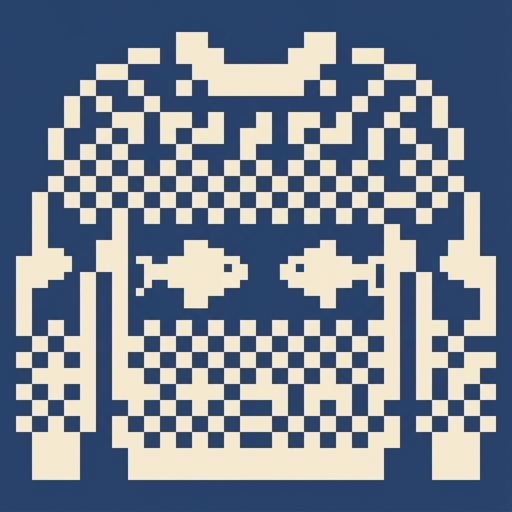
A cozy worsted-weight Nordic-style circular-yoke pullover with stranded Fair Isle fish motifs. Body and sleeves are plain stockinette in the main color; the rounded yoke carries the fish colorwork from the attached chart plus simple peerie borders. Designed for easy stranded knitting: only three colors, generous ease, and clear decrease spacing.
Difficulty: Easy (stranded colorwork in the round; no steeks, no short rows)
Sizes
Small (Medium, Large, XL, 2XL) To fit bust 34–36 (38–40, 42–44, 46–48, 50–52)" / 86.5–91.5 (96.5–101.5, 106.5–112, 117–122, 127–132) cm
Shown in size Medium with approx 4" / 10 cm positive ease.
Finished Measurements
- Bust circumference: 38 (42, 46, 50, 54)" / 96.5 (106.5, 117, 127, 137) cm
- Body length to underarm: 15 (15, 15.5, 16, 16)" / 38 (38, 39.5, 40.5, 40.5) cm
- Yoke depth (underarm to neckband): 9.5 (10, 10.5, 11, 11.5)" / 24 (25.5, 26.5, 28, 29) cm
- Sleeve length to underarm: 17.5 (18, 18, 18.5, 18.5)" / 44.5 (45.5, 45.5, 47, 47) cm
- Upper arm circumference: 12.5 (13.5, 14.5, 15.5, 16.5)" / 32 (34.5, 37, 39.5, 42) cm
- Neck circumference: 19.25 (20, 20.75, 21.5, 22.5)" / 49 (51, 52.5, 54.5, 57) cm
Yarn
Worsted weight wool or wool-blend yarn (approx 200–220 yds / 183–201 m per 100 g)
MC (Main Color) – deep navy or ocean blue
1100 (1200, 1350, 1500, 1650) yds / 1005 (1100, 1235, 1370, 1510) m
CC1 – cream or natural white
250 (280, 310, 350, 390) yds / 230 (255, 285, 320, 355) m
CC2 – teal, coral, or gold (fish accent)
120 (140, 160, 180, 200) yds / 110 (130, 145, 165, 185) m
Choose high-contrast colors so the fish motifs read clearly. Wool is strongly recommended for memory, blocking, and warm floats.
Needles
- US 6 / 4 mm: 16" / 40 cm and 24–32" / 60–80 cm circulars, plus DPNs or magic-loop needle for sleeves and neckband
- US 8 / 5 mm: 16" / 40 cm and 24–32" / 60–80 cm circulars, plus DPNs or magic-loop needle for sleeves
Adjust needle size to obtain gauge. Many knitters need a slightly larger needle for colorwork than for plain stockinette.
Notions
- Stitch markers (including 1 unique BOR marker)
- Waste yarn or stitch holders
- Tapestry needle
- Optional: smooth waste yarn for lifelines before colorwork
Gauge
20 stitches and 28 rounds = 4" / 10 cm over stranded colorwork stockinette stitch on larger needles, blocked.
Also check plain stockinette: approximately 18–20 sts = 4" / 10 cm on larger needles.
Swatch in the attached fish chart (or a stranded swatch using all three colors). Wash and block before measuring. Colorwork fabric is less stretchy than plain stockinette—loose floats are essential.
Abbreviations (US)
BOR – beginning of round
CC – contrast color
CO – cast on
k – knit
k2tog – knit 2 together
m1 – make 1 (any tidy lifted or backward-loop increase)
MC – main color
p – purl
pm – place marker
rnd(s) – round(s)
RS – right side
ssk – slip, slip, knit
st(s) – stitch(es)
St st – stockinette stitch (knit every round in the round)
Notes
- Worked seamless from the bottom up with a circular yoke.
- Body and sleeves are plain MC stockinette; colorwork is confined to the yoke.
- Carry unused yarn loosely across the back of the work. Catch floats every 5 stitches maximum on long runs.
- Hold the dominant motif color (usually CC1 or CC2 for fish) consistently in the same hand/position for even motif appearance.
- When joining body and sleeves, underarm stitches are placed on hold and grafted or sewn later.
- Easy level assumes comfort with knitting in the round and basic stranded colorwork; take time on the first few colorwork rounds.
Attached Stitch Chart
Use the separate attached chart panel supplied with this pattern for all visual colorwork grids. Do not rely on any inline grid in this text—the attached panel is the authoritative motif source.
Where the chart is used
- Lower peerie border (optional small wave/fish-scale band) immediately after the yoke join.
- Main fish motif band (center of yoke).
- Upper peerie or finishing border before the final plain decrease section and neckband.
How to read the chart (knitting in the round)
- Read every chart round from right to left.
- Each square = 1 stitch; each row of squares = 1 round.
- Colors correspond to MC, CC1, and CC2 as labeled on the attached panel key.
- Work chart stitches in stranded stockinette unless the panel marks a special stitch (none expected for this easy fish design).
- Repeat the chart width evenly around the yoke. Stitch counts at the start of colorwork are chosen to be compatible with whole repeats; if your cast-on or decrease landing is a few stitches off a full repeat, add or omit 1–2 plain MC stitches at the underarm “seams” (between markers) rather than distorting the fish.
Color and stitch-count integration
- Begin chart rounds at BOR (center back or center front—choose one and keep it consistent; center back is traditional).
- When a decrease round falls inside a charted section, work the decrease in pattern colors as established, preferring to decrease in background (MC) stitches when possible so fish motifs stay intact.
- After the main fish band, a short plain or peerie section continues while decreases finish the neck shaping.
- Float rule: never leave an uncaught float longer than 5 stitches behind a fish or wave motif.
Pattern Instructions
Body
With smaller 24–32" / 60–80 cm circular needle and MC, CO 190 (210, 230, 250, 270) sts. Pm for BOR and join to work in the round, being careful not to twist.
Ribbing: Work k1, p1 rib for 2" / 5 cm.
Change to larger 24–32" / 60–80 cm circular needle.
Next rnd (increase rnd, optional ease tweak): Knit around, increasing 0 sts evenly—190 (210, 230, 250, 270) sts.
(Validation: 190 ÷ 20 sts × 4" = 38" ✓; 210 → 42" ✓; 230 → 46" ✓; 250 → 50" ✓; 270 → 54" ✓.)
Work even in St st (knit every rnd) until body measures 15 (15, 15.5, 16, 16)" / 38 (38, 39.5, 40.5, 40.5) cm from CO edge, or desired length to underarm.
Separate underarms
Next rnd: K 85 (95, 105, 115, 125), place next 10 (10, 10, 10, 10) sts on waste yarn for underarm, k 85 (95, 105, 115, 125), place next 10 (10, 10, 10, 10) sts on waste yarn for underarm.
Body sts remaining on needle: 170 (190, 210, 230, 250) sts.
Do not break yarn; set body aside.
Sleeves (make 2)
With smaller DPNs or magic-loop needle and MC, CO 44 (48, 52, 56, 60) sts. Pm for BOR and join.
Ribbing: Work k1, p1 rib for 2" / 5 cm.
Change to larger DPNs / magic loop.
Inc rnd: K1, m1, knit to last st, m1, k1—2 sts increased.
Repeat Inc rnd every 8th (8th, 7th, 7th, 6th) rnd 9 (10, 11, 12, 13) more times—64 (70, 76, 82, 88) sts.
(Validation example Small: 44 + 2×10 = 64 ✓; 64 sts ÷ 5 sts/in = 12.8" upper arm ✓.)
Work even until sleeve measures 17.5 (18, 18, 18.5, 18.5)" / 44.5 (45.5, 45.5, 47, 47) cm from CO, or desired length to underarm.
Separate underarm
Next rnd: Knit to last 5 (5, 5, 5, 5) sts, place next 10 (10, 10, 10, 10) sts on waste yarn (the 5 before BOR + 5 after BOR when you rearrange), removing BOR marker as needed.
Sleeve sts remaining: 54 (60, 66, 72, 78) sts. Place remaining sleeve sts on waste yarn or spare needle. Make second sleeve to match.
Join Body and Sleeves (Yoke Setup)
With larger 24–32" / 60–80 cm circular needle and MC yarn still attached to body:
Joining rnd:
Knit across 170 (190, 210, 230, 250) body sts,
pm (left front/back divider optional),
knit across 54 (60, 66, 72, 78) sts of first sleeve,
pm,
knit across remaining body sts already accounted,
knit across 54 (60, 66, 72, 78) sts of second sleeve,
pm for new BOR at center back (or keep original back BOR).
Total yoke sts: 278 (310, 342, 374, 406) sts.
(Validation Small: 170 + 54 + 54 = 278 ✓; Medium: 190 + 60 + 60 = 310 ✓; Large: 210 + 66 + 66 = 342 ✓; XL: 230 + 72 + 72 = 374 ✓; 2XL: 250 + 78 + 78 = 406 ✓.)
Optional setup rnd: Knit 1 rnd plain MC, decreasing 2 (2, 2, 2, 2) sts evenly—276 (308, 340, 372, 404) sts—to land on a friendly multiple for the attached chart repeat and decrease markers. Place 8 (or 10) evenly spaced markers if desired to guide later decreases (remove chart-alignment markers as needed when working motifs).
Work 1–2 more plain MC rnds if you want a short solid band before colorwork. Yoke depth measurement begins at the joining rnd.
Yoke – Colorwork and Shaping
Join CC1 and CC2 as required. Work stranded colorwork from the attached stitch chart as follows:
- Lower peerie / wave border (from attached chart): Work 4–8 rnds, keeping stitch count stable unless chart includes shaping (it should not).
- Main fish motif band (from attached chart): Work the full fish chart height once around. Maintain even tension; catch floats every ≤5 sts.
Total sts still 276 (308, 340, 372, 404) through the main motif unless a chart rnd specifically includes decreases (prefer plain decrease rnds between motif bands). - Between-motif plain or peerie rnds: Work 2–4 rnds per attached chart or in MC/CC1 as shown on panel.
Decrease framework (work these on plain MC or low-motif rnds so fish stay clear; distribute decreases evenly between markers):
Decrease formula each decrease rnd: k2tog, k X around (or ssk, k X for a mirrored look), adjusting X so the round removes approximately 18–22% of current stitches.
Suggested decrease ladder (final counts):
- Dec Rnd 1 (after lower peerie or early in fish band if chart allows): Decrease 48 (56, 60, 64, 68) sts evenly—228 (252, 280, 308, 336) sts remain.
(e.g. Small: 276 − 48 = 228 ✓.) - Work 6–10 rnds even in chart/pattern.
- Dec Rnd 2: Decrease 48 (52, 56, 64, 68) sts evenly—180 (200, 224, 244, 268) sts.
(Small: 228 − 48 = 180 ✓.) - Work 6–10 rnds even (continue/finish main fish chart).
- Dec Rnd 3: Decrease 40 (48, 52, 56, 60) sts evenly—140 (152, 172, 188, 208) sts.
(Small: 180 − 40 = 140 ✓.) - Work upper peerie from attached chart 4–8 rnds, then plain MC as needed.
- Dec Rnd 4: Decrease 28 (32, 40, 44, 52) sts evenly—112 (120, 132, 144, 156) sts.
(Small: 140 − 28 = 112 ✓.) - Work 4–6 rnds even.
- Dec Rnd 5: Decrease 16 (20, 28, 36, 44) sts evenly—96 (100, 104, 108, 112) sts.
(Small: 112 − 16 = 96 ✓; Medium: 120 − 20 = 100 ✓; Large: 132 − 28 = 104 ✓; XL: 144 − 36 = 108 ✓; 2XL: 156 − 44 = 112 ✓.)
Yoke should now measure approximately 9.5 (10, 10.5, 11, 11.5)" / 24 (25.5, 26.5, 28, 29) cm from join. If short, add plain MC rnds before neckband; if long, work final decreases slightly earlier. Neck circumference check: 96 sts ÷ 5 = 19.2" ✓ (and similarly for larger sizes).
Break CC1 and CC2. Continue with MC only.
Neckband
Change to smaller 16" / 40 cm circular needle.
Next rnd: Knit, decreasing 0 (0, 0, 0, 0) or adjust by ±2–4 sts if needed so count is even for rib—96 (100, 104, 108, 112) sts.
Work k1, p1 rib for 1.25 (1.25, 1.5, 1.5, 1.5)" / 3 (3, 4, 4, 4) cm.
Bind off loosely in rib (use a larger needle or sewn bind-off so the neck stretches over the head).
Finishing
- Graft or mattress-stitch each underarm: return held body underarm sts and corresponding sleeve underarm sts to needles and graft together (or seam). Close any small gaps at corners with yarn ends.
- Weave in all ends on the wrong side, following the colors of the floats where possible.
- Soak in lukewarm water with wool wash. Gently squeeze (do not wring). Lay flat to block to finished measurements, evening the yoke colorwork and opening the fish motifs. Allow to dry completely.
- Optional: lightly steam the plain body/sleeves (avoid crushing colorwork floats with heavy steam).
Wear & Care
Hand wash cold, lay flat to dry. The stranded yoke is warmer and slightly less elastic than the body—pull on gently over the head. With traditional ease this pullover layers beautifully over shirts or light midlayers.
Design Notes for the Maker
- Dominant color: For fish to “pop,” hold CC1 (cream) or CC2 (accent) as the dominant strand on motif rounds.
- Easy modifications: Shorten/lengthen body or sleeves in the plain MC sections only. For a closer fit, choose a smaller size; for oversized, go up one size.
- Chart first: If the attached fish repeat width does not divide your yoke count exactly, hide extra MC stitches at the underarm lines—never stretch or squish a fish.
Enjoy your ocean-inspired Fair Isle fish sweater!
Disclaimer: This pattern was generated by AI and should be reviewed for accuracy before use. While we strive for quality, AI-generated content may contain errors. Please verify measurements, stitch counts, charts, and instructions before beginning your project. Generated by purlJam.uk
Love this pattern?
Save this pattern to your free PurlJam libraryAccess your pattern anytime
Bookmark this page to access your pattern anytime