Type
Crochet
Difficulty
beginner
Category
amigurumi
AI Thinking Process
Planning
Verification
Pattern
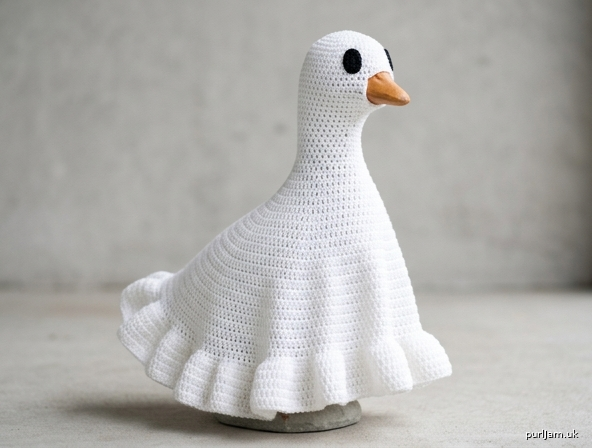
Flowing Ghost Costume for a 17" Porch Goose
A beginner-friendly Halloween cover for a standard 17" (43 cm) porch goose. Worked top down in US double crochet so the fabric drapes like a sheet. The crown sits on the goose’s head, a window at the front lets the beak poke through, and a ruffled hem puddles around the base. Two black ovals are sewn on as classic ghost eyes. This is a hollow costume, not a stuffed toy.
Difficulty: Beginner
Finished size (with stated gauge; fits a 17" / 43 cm porch goose)
- Length: 18" (45.5 cm) from crown to last even round; about 19–20" (48.5–51 cm) including ruffle
- Head circumference: 13¾" (35 cm)
- Neck circumference: 10¼" (26 cm)
- Body circumference (before ruffle): 24" (61 cm)
- Hem circumference (after ruffle): about 48" (122 cm)
Materials
- Worsted weight yarn (4): White (MC), 350 yd / 320 m (one 364 yd skein is usually enough; keep a second skein on hand if your gauge is loose). Black (CC), 15 yd / 14 m for eyes.
- Hook: US H-8 (5 mm), or size needed to obtain gauge. A larger hook than typical toy hooks is intentional — it keeps the fabric flowing.
- Yarn needle
- Stitch marker
- Scissors
- Optional: two black felt ovals instead of crocheted eyes; rust-proof pins for trying on the goose
Yarn note: Smooth acrylic (for example Red Heart Super Saver or similar) holds up well outdoors. Cotton also drapes nicely. Avoid very fuzzy novelty yarn for the first version — stitch counting is harder.
Gauge
14 dc and 8 rounds = 4" × 4" (10 × 10 cm) in joined double crochet, unblocked.
Swatch: Ch 18. Dc in 4th ch from hook and in each ch across (16 dc). Ch 3, turn; dc in each dc across. Work until you have 10 rows. Measure the center 14 stitches and 8 rows.
If you have fewer than 14 dc in 4" (10 cm), go up a hook size. If you have more than 14 dc in 4" (10 cm), go down a hook size. Drape matters more than a stiff fabric — do not work tightly.
Abbreviations (US)
- ch — chain
- dc — double crochet
- dc2tog — double crochet 2 together (decrease)
- sc — single crochet
- sl st — slip stitch
- st(s) — stitch(es)
- rnd — round
- sp — space
- rep — repeat
- MC — main color (white)
- CC — contrasting color (black)
dc2tog: Yarn over, insert hook in next st, yarn over, pull up a loop, yarn over, pull through 2 loops (2 loops on hook); yarn over, insert hook in following st, yarn over, pull up a loop, yarn over, pull through 2 loops (3 loops on hook); yarn over, pull through all 3 loops.
Pattern Notes
- US crochet terms throughout. Double crochet is the main stitch.
- Worked in joined rounds, without turning. The join forms a discreet seam at the back.
- Ch 3 at the start of every dc round counts as the first dc. Join each round with a sl st in the top of that ch-3.
- Place a stitch marker in the join (center back) and move it up every round.
- Do not stuff. The costume is an open-bottom cover that drops over the statue.
- Counts in [brackets] are stitches after that round is complete. Chain-8 spaces are noted separately during the beak window.
- Try the piece on the goose at the checkpoints. Porch geese vary a little in beak size and neck thickness.
Costume (make 1)
With MC and H-8 (5 mm) hook.
Crown and head
Rnd 1: Ch 4. Work 11 dc in the 4th ch from the hook (skipped ch-3 counts as first dc). Join. [12 dc]
Rnd 2: Ch 3, dc in same st (increase made), 2 dc in each remaining st around. Join. [24 dc] (12 increases → 12 + 12 = 24 ✓)
Rnd 3: Ch 3, dc in same st, dc in next st, *2 dc in next st, dc in next st; rep from * around. Join. [36 dc] (12 increases → 24 + 12 = 36 ✓)
Rnd 4: Ch 3, dc in same st, dc in next 2 sts, *2 dc in next st, dc in next 2 sts; rep from * around. Join. [48 dc] (12 increases → 36 + 12 = 48 ✓) Circumference: 48 sts ÷ 3.5 sts per inch = 13¾" (35 cm) ✓
Rnd 5: Ch 3, dc in each st around. Join. [48 dc]
Checkpoint: The circle should sit on top of the goose’s head like a close-fitting cap. If it is much smaller than the head, add one more increase round: (3 dc, 2 dc in next) around [60] and work the beak math on 60 sts (see Customizing). If it is floppy-large, go down a hook size and restart.
Beak opening
The join is center back. The opening sits at center front, opposite the join.
Rnd 6: Ch 3, dc in next 19 sts (20 dc counting the ch-3), ch 8, skip 8 sts, dc in remaining 20 sts. Join. [40 dc + ch-8] (20 + 8 skipped + 20 = 48 positions ✓). Opening width: 8 sts ≈ 2¼" (5.5 cm) ✓
Rnds 7–9: Ch 3, dc in next 19 sts, ch 8, skip the ch-8 space, dc in remaining 20 sts. Join. [40 dc + ch-8]
Four rounds of opening (Rnds 6–9) = 2" (5 cm) tall ✓
Rnd 10 (close the window): Ch 3, dc in next 19 sts, work 8 dc in the ch-8 space, dc in remaining 20 sts. Join. [48 dc] (20 + 8 + 20 = 48 ✓)
Checkpoint: Feed the goose’s beak through the window. It should pass through without stretching the hole hard. If the beak is very thick, undo Rnds 6–10 and skip 10 sts with ch 10 instead of 8.
Optional neatening (recommended): With MC, join yarn at one corner of the opening and work 1 rnd of sc evenly around the beak window (about 8 sc along each short edge and 8 sc along each long edge, 32 sc total). Join, fasten off. This keeps the hole from stretching when you dress the goose.
Neck
Rnd 11: Ch 3, dc in next st, dc2tog, *dc in next 2 sts, dc2tog; rep from * around. Join. [36 dc] (Each repeat uses 4 sts and leaves 3; 12 repeats → 48 − 12 = 36 ✓) Circumference: 36 ÷ 3.5 = 10¼" (26 cm) ✓
Rnds 12–15: Ch 3, dc in each st around. Join. [36 dc] Four even rounds = 2" (5 cm) of neck ✓
Length so far (Rnds 1–15): 15 rounds × 0.5" = 7½" (19 cm) ✓
Checkpoint: Crown on the head, beak through the window, Rnd 15 should sit near the base of the goose’s neck. Add or subtract one even neck round if needed.
Body (flowing A-line)
Increases are 6 per increase round, with a plain round between them so the skirt flares gently.
Rnd 16: Ch 3, dc in next 4 sts, 2 dc in next st, *dc in next 5 sts, 2 dc in next st; rep from * around. Join. [42 dc] (36 + 6 = 42 ✓)
Rnd 17: Ch 3, dc in each st around. Join. [42 dc]
Rnd 18: Ch 3, dc in next 5 sts, 2 dc in next st, *dc in next 6 sts, 2 dc in next st; rep from * around. Join. [48 dc] (42 + 6 = 48 ✓)
Rnd 19: Ch 3, dc in each st around. Join. [48 dc]
Rnd 20: Ch 3, dc in next 6 sts, 2 dc in next st, *dc in next 7 sts, 2 dc in next st; rep from * around. Join. [54 dc] (48 + 6 = 54 ✓)
Rnd 21: Ch 3, dc in each st around. Join. [54 dc]
Rnd 22: Ch 3, dc in next 7 sts, 2 dc in next st, *dc in next 8 sts, 2 dc in next st; rep from * around. Join. [60 dc] (54 + 6 = 60 ✓)
Rnd 23: Ch 3, dc in each st around. Join. [60 dc]
Rnd 24: Ch 3, dc in next 8 sts, 2 dc in next st, *dc in next 9 sts, 2 dc in next st; rep from * around. Join. [66 dc] (60 + 6 = 66 ✓)
Rnd 25: Ch 3, dc in each st around. Join. [66 dc]
Rnd 26: Ch 3, dc in next 9 sts, 2 dc in next st, *dc in next 10 sts, 2 dc in next st; rep from * around. Join. [72 dc] (66 + 6 = 72 ✓)
Rnd 27: Ch 3, dc in each st around. Join. [72 dc]
Rnd 28: Ch 3, dc in next 10 sts, 2 dc in next st, *dc in next 11 sts, 2 dc in next st; rep from * around. Join. [78 dc] (72 + 6 = 78 ✓)
Rnd 29: Ch 3, dc in each st around. Join. [78 dc]
Rnd 30: Ch 3, dc in next 11 sts, 2 dc in next st, *dc in next 12 sts, 2 dc in next st; rep from * around. Join. [84 dc] (78 + 6 = 84 ✓)
Rnd 31: Ch 3, dc in each st around. Join. [84 dc] Circumference: 84 ÷ 3.5 = 24" (61 cm) ✓
Rnds 32–36: Ch 3, dc in each st around. Join. [84 dc] Five even rounds = 2½" (6.5 cm) ✓
Body (Rnds 16–36): 21 rounds = 10½" (26.5 cm) ✓ Total length after Rnd 36: 7½" + 10½" = 18" (45.5 cm) ✓
Checkpoint: Drape over the goose. The hem should reach the statue base or just past it. Add even rounds at 84 sts for a puddled train; skip Rnds 32–36 if you want a shorter cover.
Flowing ruffle hem
Rnd 37: Ch 3, dc in same st, 2 dc in each remaining st around. Join. [168 dc] (84 × 2 = 168 ✓)
Fasten off. Weave in the starting tail and the ending tail on the wrong side (inside of the costume).
Eyes (make 2)
With CC. Eyes are worked in sc so they stay solid and read as dark ovals.
Rnd 1: Ch 6. Sc in 2nd ch from hook, sc in next 3 ch, 3 sc in last ch; working along the other side of the foundation chain, sc in next 3 ch, 2 sc in the last ch (the same chain as the first sc). Do not join; continue around. [12 sc] (1 + 3 + 3 + 3 + 2 = 12 ✓)
Rnd 2: 2 sc in first st, sc in next 3 sts, 2 sc in each of next 3 sts, sc in next 3 sts, 2 sc in each of last 2 sts. Join with sl st. [18 sc] (2 + 3 + 6 + 3 + 4 = 18 ✓)
Fasten off, leaving a 12" (30.5 cm) tail for sewing.
(Felt option: cut two ovals about 1¾" × 1¼" / 4.5 × 3 cm and sew or fabric-glue them in the same positions.)
Finishing
- Weave in all remaining ends.
- Pin the eyes onto the head, above the beak opening: inner edges about ¾–1" (2–2.5 cm) apart, lower edges about ½" (1.3 cm) above the top of the beak window. They should look slightly surprised and sit on either side of center front.
- Try the costume on the goose and adjust eye placement before sewing.
- Sew each eye with the yarn tail, using small whip stitches around the edge. Tie off on the inside.
- Optional light wet-block: soak in cool water, squeeze (do not wring), and lay over a bowl or balloon so the crown stays rounded and the skirt dries in folds. This improves drape. Skip blocking if you used a yarn that stretches a lot when wet.
Dressing the goose
- Hold the costume so the beak window faces the goose’s beak and the join runs down the back.
- Feed the beak through the window first.
- Settle the crown onto the top of the head.
- Smooth the neck, then let the skirt fall over the body and wings.
- Arrange the ruffle so it puddles evenly around the base.
No back opening is needed; the bottom is fully open.
Customizing and fit
- Longer, more puddled ghost: Work extra even rounds at 84 sts before Rnd 37.
- Shorter costume: Stop even rounds earlier (omit some or all of Rnds 32–36), then work the ruffle.
- Fuller skirt: After Rnd 31, work one extra increase round: *dc in next 13 sts, 2 dc in next st; rep from * around [90], then even rounds, then 2 dc in each st for the ruffle [180].
- Less ruffle: Replace Rnd 37 with *dc in next st, 2 dc in next st; rep from * around [126] (84 + 42 = 126 ✓).
- Larger head: After Rnd 4, work (3 dc, 2 dc in next) around [60]. For the beak, dc 26, ch 8, skip 8, dc 26. Close with 8 dc in the space [60]. Neck: (3 dc, dc2tog) around [48], then begin body increases from 48 instead of 36.
- Thicker beak: Use ch 10 / skip 10 in Rnds 6–9, and work 10 dc in the space on Rnd 10. Stitch count of the round stays 48 if you skipped 8 originally; if you skip 10 from 48, work 19 dc, ch 10, skip 10, 19 dc (19 + 10 + 19 = 48 ✓).
Care
Hand wash cold, lay flat to dry. If the goose lives outdoors, bring the costume in during heavy rain. Acrylic is the most weather-tolerant choice.
Disclaimer: This pattern was generated by AI and should be reviewed for accuracy before use. While we strive for quality, AI-generated content may contain errors. Please verify measurements, stitch counts, charts, and instructions before beginning your project. Generated by purlJam.uk
Love this pattern?
Save this pattern to your free PurlJam libraryAccess your pattern anytime
Bookmark this page to access your pattern anytime