Type
Knitting
Difficulty
advanced
Category
scarf
AI Thinking Process
Planning
Verification
Pattern
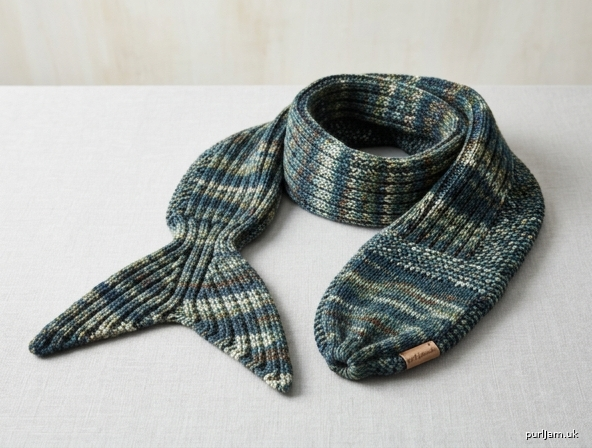
Forked Tail Fish Scarf
Advanced textured scarf — fisherman’s rib, short-row tail, tubular body and head
A skinny, fish-shaped scarf worked from the caudal fin to the snout. The tail is knit flat in reversible fisherman’s rib, with German short rows to fork the two lobes and decreases to taper the peduncle. Stitches are then divided and joined in the round: the body is split half-and-half — fisherman’s rib along the back, garter along the belly — so the tube sits slightly oval, like a real fish. The head is stockinette framed by a garter gill band and two-stitch garter side borders, then decreased to a closed snout.
This is not a rectangular scarf. Fisherman’s rib, short rows inside rib, and mixed-pattern rounds are all used in one piece.
Skill level: Advanced
Finished measurements
Length: about 60 in (152.5 cm) from tail tips to snout, unstretched
Body width: about 3¼ in (8.5 cm) laid flat (about 6¼ in / 16 cm circumference)
Tail span: about 8 in (20.5 cm) at the cast-on edge
One size. Length is easily adjusted in the Body section.
Materials
Yarn: Lang Cloud Tweed (Super Bulky; 260 m / 284 yd per 100 g)
Amount: 2 balls (200 g / 520 m / 568 yd). Fisherman’s rib is yarn-hungry; do not count on a single 100 g ball.
Needles:
- US 11 / 8 mm, 32 in (80 cm) circular needle (tail worked flat, body and head in magic loop)
- Optional: US 11 / 8 mm DPNs for the 20-st tube
Notions:
- 4 stitch markers (one distinct for beginning of round)
- Tapestry needle
- Optional: 2 small buttons or beads (about ½ in / 12 mm) for eyes, plus sewing thread
- Blocking mats and T-pins
Gauge
Fisherman’s rib (unstretched): 14 sts and 20 rows = 4 in (10 cm) on US 11 / 8 mm
Stockinette stitch: 12 sts and 16 rows = 4 in (10 cm) on US 11 / 8 mm
Mixed body fabric (rib + garter in the round): about 18 rounds = 4 in (10 cm)
Work a swatch in fisherman’s rib. The rib half of the body pulls in; the garter half flares. That oval is intended.
Change needle size to obtain gauge. A looser gauge makes a wider fish and may need a third ball.
Notes
- US knitting terminology. Imperial measurements first; metric in parentheses.
- The scarf is worked in one piece from tail to head. There is no bind-off at the tail; the snout is gathered closed.
- Fisherman’s rib is not brioche. There are no yarn overs. You knit (or purl) into the stitch below.
- Fisherman’s rib worked flat is reversible: every row after the setup is
*k1b, p1*. In the round you must alternatek1bandp1brounds or the fabric collapses. - Do not stretch-block the rib. Steam the tail only enough to open the fork.
- Markers are essential once the work is in the round.
Special techniques
K1b (knit 1 below): Insert the right needle into the center of the stitch one row below the next stitch on the left needle and knit it. Let the stitch above drop off the left needle; it is caught by the new stitch.
P1b (purl 1 below): Insert the right needle from back to front into the center of the stitch one row below the next stitch and purl it. Let the stitch above drop off.
German short row (DS): Work to the turning point and turn. With yarn in front, slip 1 purlwise. Pull the yarn up and over the right needle to the back so the slipped stitch shows two legs (a double stitch). Yarn is now in position to knit; bring it forward again if the next stitch is a purl. On later rows, work both legs of the DS together as k or p to match the rib column. Never k1b into a DS.
Magic loop: Divide the 20 sts in half on a long circular and work in the round. DPNs (5-5-5-5) also work.
Abbreviations
BO — bind off
BOR — beginning of round
CO — cast on
dec — decrease
DS — double stitch (German short row)
k — knit
k1b — knit 1 below
k2tog — knit 2 together (1 st dec; right-leaning)
p — purl
p1b — purl 1 below
pm — place marker
rep — repeat
rnd(s) — round(s)
RS — right side
sl — slip
sm — slip marker
ssk — slip, slip, knit (1 st dec; left-leaning)
st(s) — stitch(es)
st st — stockinette stitch
WS — wrong side
Stitch patterns
Fisherman’s Rib (flat, even number of sts)
Setup row (WS): *K1, p1; rep from * to end.
Every following row: *K1b, p1; rep from * to end.
Fisherman’s Rib (in the round, even number of sts)
Rnd 1: *K1b, p1; rep from * to end.
Rnd 2: *K1, p1b; rep from * to end.
Rep Rnds 1–2.
Garter stitch (in the round)
Rnd 1: Knit.
Rnd 2: Purl.
Rep Rnds 1–2.
Body pattern (20 sts in the round)
See Chart B.
Rnd 1: [K1b, p1] 5 times, k10.
Rnd 2: [K1, p1b] 5 times, p10.
Rep Rnds 1–2.
Charts
Read Chart A (flat) as written instructions: after the setup, every row is the same and is worked from right to left on RS and left to right on WS, but because the row is *k1b, p1* in both directions, the chart is identical every row.
Read Chart B (in the round) from right to left on every round.
Symbol key
  k      knit
  p      purl
  k1b    knit 1 below
  p1b    purl 1 below
  —      (Chart B) 10-st panel boundary
Chart A — Fisherman’s Rib, flat (8-st excerpt; repeat across all sts)
        8     7     6     5     4     3     2     1
      +-----+-----+-----+-----+-----+-----+-----+-----+
every | k1b |  p  | k1b |  p  | k1b |  p  | k1b |  p  |
row   +-----+-----+-----+-----+-----+-----+-----+-----+
setup |  k  |  p  |  k  |  p  |  k  |  p  |  k  |  p  |  WS
      +-----+-----+-----+-----+-----+-----+-----+-----+
Work the 2-st repeat (k1b, p1) across all 28 tail sts, then across all 20 peduncle sts. Setup is worked once only.
Chart B — Body, in the round (20 sts; 10 rib + 10 garter)
        20            11  10                     1
      +------------------+-------------------------+
Rnd 2 | p p p p p p p p p p | p1b k p1b k p1b k p1b k p1b k |
      +------------------+-------------------------+
Rnd 1 | k k k k k k k k k k |  p k1b p k1b p k1b p k1b p k1b |
      +------------------+-------------------------+
        garter belly          fisherman's rib back
        (10 sts)              (10 sts; BOR at st 1)
Rnd 1 is the rib “k1b” round and the garter knit round.
Rnd 2 is the rib “p1b” round and the garter purl round.
Repeat Rnds 1–2 for the entire body.
Pattern
Tail (worked flat)
With US 11 / 8 mm circular needle, using a long-tail cast-on, CO 28 sts.
Setup row (WS): *K1, p1; rep from * to end. (28 sts)
Work all following tail rows in fisherman’s rib as established (*k1b, p1* every row), including short rows, unless a decrease is specified.
Short-row fork (German short rows)
The two outer groups of 10 sts (the lobes) are worked extra rows so the cast-on edge becomes a fork: long at the tips, short at the center. Stitch count stays 28 throughout this section.
When you meet a DS, work both legs together as k or p to match the rib column. Do not k1b into a DS.
Left lobe
- Row 1 (RS): Work 10 sts, turn.
- Row 2 (WS): DS, work to end, turn.
- Row 3: Work 8 sts, turn.
- Row 4: DS, work to end, turn.
- Row 5: Work 6 sts, turn.
- Row 6: DS, work to end, turn.
- Row 7: Work 4 sts, turn.
- Row 8: DS, work to end, turn.
- Row 9: Work 2 sts, turn.
- Row 10: DS, work to end, turn.
- Row 11 (RS): Work in pattern across all 28 sts, working each DS as 1 st in rib. (28 sts ✓)
Right lobe
- Row 12 (WS): Work 10 sts, turn.
- Row 13 (RS): DS, work to end, turn.
- Row 14: Work 8 sts, turn.
- Row 15: DS, work to end, turn.
- Row 16: Work 6 sts, turn.
- Row 17: DS, work to end, turn.
- Row 18: Work 4 sts, turn.
- Row 19: DS, work to end, turn.
- Row 20: Work 2 sts, turn.
- Row 21: DS, work to end, turn.
- Row 22 (WS): Work in pattern across all 28 sts, working each DS as 1 st in rib. (28 sts ✓)
Deeper fork (optional): Repeat Rows 1–22 once more before going on. This adds about 2 in (5 cm) to each tip.
Even section: Work 4 rows even in fisherman’s rib across all 28 sts, ending after a WS row. (28 sts ✓)
Peduncle decreases
Maintain fisherman’s rib as well as possible. After each decrease row, work stitches as they appear: k1b (or k) into knit columns, p into purl columns.
Decrease row (RS): K2tog, work in pattern to last 2 sts, ssk. (2 sts dec)
Next row (WS): Work in pattern.
Rep the last 2 rows 3 more times.
4 decrease rows × 2 sts = 8 sts decreased; 28 − 8 = 20 sts ✓
(Counts after each RS decrease: 26, 24, 22, 20.)
Work even in fisherman’s rib on 20 sts until the Tail measures 8 in (20.5 cm) from the longest cast-on tips, ending after a WS row. (20 sts ✓)
Divide and join for Body
The live 20 sts now become a tube. The flat tail remains the open caudal fin; only the peduncle is closed into the round.
With RS facing, pm for BOR and join to work in the round, taking care not to twist. Divide the stitches in half:
- Next 10 sts = dorsal / back (fisherman’s rib)
- Pm
- Remaining 10 sts = ventral / belly (garter)
If you are using magic loop, put 10 sts on each half of the cable, matching this split. If you are using DPNs, 5-5 on the rib half and 5-5 on the garter half is comfortable.
Pull the join snug. A small hole at the join is closed later.
Body (worked in the round)
Work Chart B / Body pattern:
Rnd 1: [K1b, p1] 5 times, sm, k10.
Rnd 2: [K1, p1b] 5 times, sm, p10.
(10 rib + 10 garter = 20 sts ✓)
Rep Rnds 1–2 until the Body measures 42 in (106.5 cm) from the join, ending after Rnd 2.
Total length from tail tips is then about 8 + 42 = 50 in (127 cm) ✓.
Length note: To shorten or lengthen the scarf, change this 42 in (106.5 cm) section only. Every 2 in (5 cm) of body is about 9 rounds.
Head (worked in the round)
The head is stockinette with a garter border: first a four-round garter gill band all the way around, then two 2-st garter columns along the side lines (the old rib/garter split) framing two stockinette panels.
Gill band (garter border)
Keep both markers.
- Rnd 1: Knit.
- Rnd 2: Purl.
- Rnd 3: Knit.
- Rnd 4: Purl.
(20 sts ✓)
Face, with side borders
Re-assign markers as follows, slipping BOR as you go:
Setup rnd: K2, pm (if not already there), k8, pm, k2, pm, k8.
You now have: 2-st garter border, 8-st stockinette panel, 2-st garter border, 8-st stockinette panel. (2 + 8 + 2 + 8 = 20 ✓)
Head rnds:
- Odd rnds: Knit all sts, slipping markers.
- Even rnds: P2, sm, k8, sm, p2, sm, k8.
The p2 on even rounds (with k2 on odd rounds) makes the 2-st garter borders. The 8-st panels are stockinette.
Work Head rnds until the Head measures 5 in (12.5 cm) from the start of the gill band, ending after an even rnd. (20 sts ✓)
Snout decreases
Work decreases on odd (knit) rounds so the garter borders stay 2 sts wide while the stockinette panels lose 2 sts each decrease round.
Decrease rnd: K2, sm, ssk, knit to 2 sts before next marker, k2tog, sm, k2, sm, ssk, knit to 2 sts before BOR, k2tog. (4 sts dec)
Next 3 rnds: Work even in pattern as established (odd rnds knit; even rnds p2 on each border and knit the panels). On even rnds the panel stitch count is whatever remains between markers.
Work the Decrease rnd, then 3 even rnds, 3 times in all:
| After decrease | Borders | Panels | Total |
|---|---|---|---|
| 1st (20 − 4) | 2 + 2 | 6 + 6 | 16 ✓ |
| 2nd (16 − 4) | 2 + 2 | 4 + 4 | 12 ✓ |
| 3rd (12 − 4) | 2 + 2 | 2 + 2 | 8 ✓ |
Work 3 rnds even on 8 sts (k2, k2, k2, k2 on odd rnds; p2, k2, p2, k2 on even rnds).
Next rnd: K2tog around. (8 − 4 = 4 sts ✓)
Knit 1 rnd.
Break yarn, leaving an 8 in (20.5 cm) tail. Thread the tail through the remaining 4 sts, pull tight to close the snout, and fasten off on the inside of the tube.
Head length from gill band through the gathered snout is about 10 in (25.5 cm).
8 in tail + 42 in body + 10 in head = 60 in (152.5 cm) ✓
Finishing
Weave in the cast-on tail along the center of the caudal fin, where it is least visible. Weave in the snout end on the inside of the head. Close the small hole at the join-in-the-round with a couple of mattress-stitch tacks on the WS.
Eyes (optional): On each side of the head, on the stockinette panels, sew a button or bead about 2 in (5 cm) back from the snout and about 1 in (2.5 cm) down from the upper garter border. Alternatively, embroider a French knot in dark leftover yarn. Two eyes, one per side — the head is a tube.
Blocking: Do not wet-block and pin the whole scarf out flat; you will kill the rib and collapse the tube. Steam-block the tail only: pin the two lobes into a clear fork, hover the iron, and let dry. Smooth the head with steam if the stockinette curls at the snout. Leave the body to hang under its own weight.
Schematic (not to scale)
   CO edge, ~8 in (20.5 cm) span
        \            /
         \   fork   /          FLAT — fisherman's rib
          \        /           German short rows + decreases
           \______/
              ||               join in the round (20 sts)
              ||
              ||               BODY 42 in (106.5 cm)
              ||               tube, ~3¼ in (8.5 cm) laid flat
              ||               back: 10 sts fisherman's rib
              ||               belly: 10 sts garter
              ||
           .=:||:=.            gill band — 4 rnds garter
          /        \
         |   HEAD   |          10 in (25.5 cm)
          \  st st  /          2-st garter side borders
           \      /
            \    /
             \  /
              \/               4 sts gathered = snout

Total length ~60 in (152.5 cm)
Stitch-count checkpoint
| Section | Sts | Notes |
|---|---|---|
| Cast on | 28 | Tail span |
| After short-row fork | 28 | Count unchanged ✓ |
| After 4 peduncle decrease rows | 20 | 28 − 8 = 20 ✓ |
| Body (in the round) | 20 | 10 rib + 10 garter ✓ |
| Gill band | 20 | — |
| Head even | 20 | 2 + 8 + 2 + 8 ✓ |
| After 3 snout decrease rnds | 8 | 20 − 12 = 8 ✓ |
| After k2tog around | 4 | gathered closed ✓ |
Disclaimer: This pattern was generated by AI and should be reviewed for accuracy before use. While we strive for quality, AI-generated content may contain errors. Please verify measurements, stitch counts, charts, and instructions before beginning your project. Generated by purlJam.uk
Love this pattern?
Save this pattern to your free PurlJam libraryAccess your pattern anytime
Bookmark this page to access your pattern anytime