Type
Knitting
Difficulty
intermediate
Category
custom
AI Thinking Process
Planning
Verification
Pattern
Little Cat Coaster
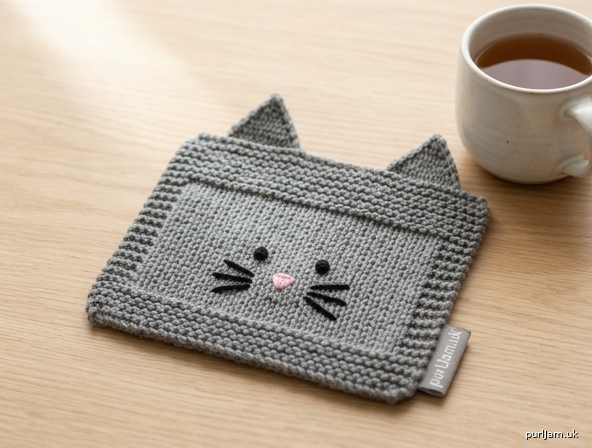
A charming, quick-knit coaster shaped as a cozy square with two perky triangle ears and a hand-embroidered kitty face. Worked entirely in garter stitch, it lies perfectly flat and is a wonderful first project for beginners. Make a whole litter to protect your favorite table!
Materials
- Yarn: Worsted weight (Medium / #4), approximately 15–20 yds (14–18 m) for the coaster body, plus small scraps for the ears and face.
- Main Color (MC) — coaster body and ears (e.g., gray)
- Small amount of contrast yarn for embroidered eyes/nose/whiskers (e.g., pink for nose, black for eyes/whiskers), or use embroidery floss.
- Needles: US 7 / 4.5 mm straight or circular needles (use a size that gives a firm, dense fabric so the coaster lies flat).
- Notions:
- Tapestry (yarn) needle
- Small scissors
- Optional: two small buttons or safety eyes for the eyes (skip if giving to small children — embroider instead)
Gauge
18 sts and 36 rows = 4 in (10 cm) in garter stitch (knit every row).
Gauge is important here so your coaster is firm and lies flat. If your fabric feels loose or floppy, go down a needle size. A slightly tight gauge is ideal for coasters.
Finished Size
Approximately 4 in × 4 in (10 × 10 cm) for the square body, plus ears adding about ¾ in (2 cm) of height at each top corner.
Abbreviations
- CO — cast on
- BO — bind off
- k — knit
- k2tog — knit two stitches together (decrease)
- RS — right side
- WS — wrong side
- st(s) — stitch(es)
Pattern Notes
- The coaster body is a simple garter-stitch square knit flat.
- Garter stitch means you knit every row — no purling required.
- The ears are two tiny triangles worked separately and sewn to the top corners.
- The face is embroidered on at the end.
- 36 knitted rows in garter stitch create 18 garter "ridges" (each ridge = 2 rows). Counting ridges is an easy way to track your progress: aim for 18 ridges.
Instructions
Coaster Body
- With MC, CO 18 sts.
- Knit every row until the piece measures 4 in (10 cm) from the cast-on edge, ending after a completed row.
- This is approximately 36 rows (18 garter ridges).
- Math check: 18 sts ÷ (18 sts per 4 in) = 4 in wide ✓; 36 rows ÷ (36 rows per 4 in) = 4 in tall ✓ → a 4 in square.
- BO all 18 sts knitwise. Cut yarn, leaving a 6 in (15 cm) tail for weaving in.
Ears (make 2)
Each ear is a small triangle worked from the base up to a point.
- With MC, CO 7 sts.
- Row 1 (RS): Knit across. (7 sts)
- Row 2 (WS): Knit across. (7 sts)
- Row 3 (RS): k2tog, knit to last 2 sts, k2tog. (5 sts)
- Math check: 7 − 2 = 5 sts ✓
- Row 4 (WS): Knit across. (5 sts)
- Row 5 (RS): k2tog, k1, k2tog. (3 sts)
- Math check: 5 − 2 = 3 sts ✓
- Row 6 (WS): Knit across. (3 sts)
- Row 7 (RS): k2tog, k1 — you now have 2 sts; then pass the first st over the second...
- Simpler beginner method: k2tog, k1. (2 sts) Math check: 3 − 1 = 2 sts ✓
- Final: Cut yarn leaving a 6 in (15 cm) tail, thread it through the remaining 2 sts, and pull tight to form the point. Secure.
Repeat for the second ear.
Finishing
- Weave in all ends on the coaster body using the tapestry needle, working the tails invisibly into the garter ridges on the wrong side.
- Attach the ears: Position each ear at a top corner of the square, cast-on edge along the top edge of the coaster, points angled slightly outward like real cat ears. Using the ear tails and tapestry needle, whipstitch the cast-on edge of each ear firmly to the coaster. Weave in remaining tails.
- Embroider the face on the front (RS) of the coaster, centered in the lower-middle area:
- Eyes: Using black yarn or floss, embroider two small vertical straight stitches or French knots about 1 in (2.5 cm) apart. (Or sew on two small buttons/safety eyes — avoid buttons for small children.)
- Nose: Using pink yarn, embroider a small triangle or a cluster of 2–3 short stitches centered just below and between the eyes.
- Whiskers: Using a single strand of black yarn or floss, embroider 2–3 long straight stitches extending from each side of the nose.
- Optional mouth: Add a tiny "w" or two short stitches below the nose.
- Block lightly if needed: dampen the coaster, gently pat it into a flat 4 in square, and let it air-dry flat. This helps it lie perfectly on your table.
Tips
- Keep it firm: A dense fabric absorbs less moisture and protects surfaces better. If your coaster curls or feels loose, re-knit at a tighter gauge (smaller needle).
- Make a set: Cast on several at once in different colors — gray, orange, black, and white make an adorable litter.
- Washable yarn: Choose a machine-washable worsted yarn (superwash wool or cotton) so your coasters are easy to clean.
- Cotton option: Cotton worsted yarn is especially absorbent and heat-resistant — great for coasters.
Enjoy your new feline friend! 🐱
Disclaimer: This pattern was generated by AI and should be reviewed for accuracy before use. While we strive for quality, AI-generated content may contain errors. Please verify measurements, stitch counts, and instructions before beginning your project. Generated by purlJam.uk
Access your pattern anytime
Bookmark this page to access your pattern anytime