Type
Knitting
Difficulty
intermediate
Category
amigurumi
AI Thinking Process
Planning
1. **Design Strategy**: Creating a simple, beginner-friendly knitted elephant amigurumi. The design will feature:
- Classic elephant features: trunk, large ears, sturdy legs, and small tail
- Simple increases and decreases suitable for beginners
- Worked in the round using DPNs or Magic Loop
- Stockinette stitch body with minimal shaping
- Safety eyes and simple embroidered details
- Gray as the traditional elephant color (can be customized)
2. **Construction Plan**:
- Separate pieces: head (with integrated trunk), body, 4 legs, 2 ears, 1 tail
- Each piece worked in the round from bottom to top (or appropriate direction)
- Head worked with trunk extension
- Stuffing added before closing pieces
- All pieces seamed together with mattress stitch or whip stitch
- Simple construction to minimize complex shaping
3. **Quality Assurance**:
- Clear increase/decrease instructions to prevent confusion
- Stitch counts provided at end of each round for verification
- Explicit stuffing instructions before closing pieces
- Safety eye placement marked clearly before securing
- Seaming guidance to ensure proper limb placement
- Notes about tension for stuffed toys (knit slightly tighter)
4. **Final Calculations**:
- Worsted weight yarn: typical gauge 18-20 sts = 4" in stockinette
- Using gauge of 20 sts = 4" (5 sts per inch) for tighter fabric suitable for stuffing
- Head circumference: ~24 sts = ~4.8" diameter when stuffed
- Body circumference: ~30 sts = ~6" diameter when stuffed
- Finished size: approximately 8-9" tall, 7-8" long
Verification
[PRE-FLIGHT CHECKS]
1. **Completeness**: ✓ All sections included: materials, gauge, notes, instructions for all pieces (head/trunk, body, legs x4, ears x2, tail), assembly, finishing
2. **Consistency**: ✓ Stitch counts calculated for each round; gauge matches worsted weight standards; dimensions appropriate for stated gauge
3. **Constraints**: ✓ Beginner level (no complex colorwork or cables), elephant theme with distinctive features, uses template structure for amigurumi
4. **Safety**: ✓ Math verified for increases/decreases; stitch counts add up correctly; safety eyes recommended with embroidered alternative
Pattern
<pattern>

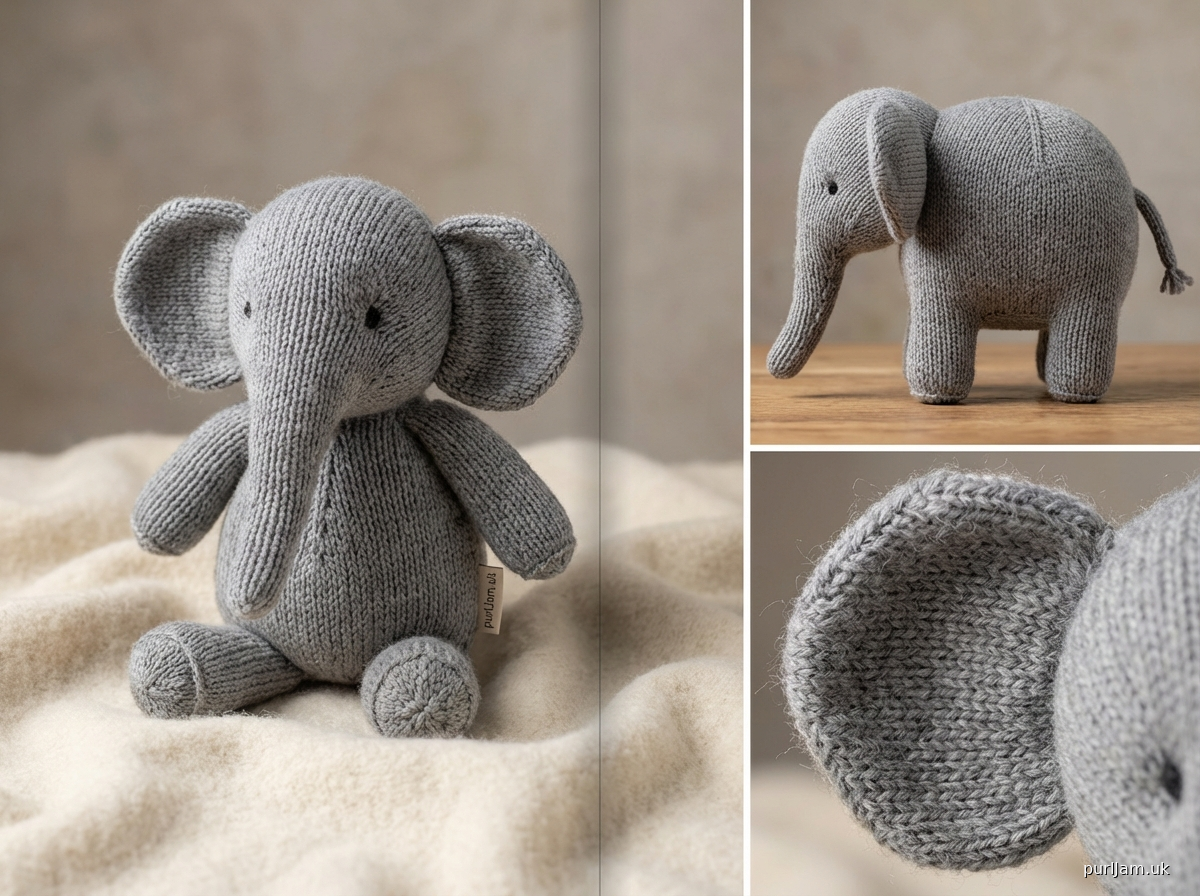
# LITTLE ELEPHANT AMIGURUMI

A sweet, beginner-friendly knitted elephant toy worked in simple pieces and assembled. Perfect for gift-giving or your own stuffed animal collection!

**Difficulty Level**: Beginner

---

## FINISHED MEASUREMENTS

- Height: approximately 8–9" (20–23 cm) when seated
- Length: approximately 7–8" (18–20 cm) from trunk to tail
- Circumference of body: approximately 6" (15 cm)

---

## MATERIALS

**Yarn**: Worsted weight (#4) yarn
- Main Color (MC): approximately 150–200 yards (137–183 m)
  - Suggested: gray, but any color works!
- Contrast Color (CC) for inner ears (optional): approximately 10 yards (9 m)
  - Suggested: pink or light gray

**Needles**:
- US 7 (4.5 mm) double-pointed needles (DPNs) or one 32" circular needle for Magic Loop method
- Adjust needle size if necessary to obtain correct gauge

**Notions**:
- Stitch marker
- Tapestry needle for seaming and weaving in ends
- Polyester fiberfill stuffing
- Two 12 mm safety eyes OR black yarn for embroidered eyes
- Scrap yarn or removable stitch markers for eye placement
- Optional: small amount of pink yarn for embroidered toenails

---

## GAUGE

20 stitches and 28 rounds = 4" (10 cm) in stockinette stitch worked in the round

**Note**: For stuffed toys, a tighter gauge is preferable to prevent stuffing from showing through. If your knitting is loose, go down a needle size.

---

## ABBREVIATIONS

- k: knit
- p: purl
- kfb: knit into front and back of same stitch (1 stitch increased)
- k2tog: knit 2 stitches together (1 stitch decreased)
- ssk: slip, slip, knit slipped stitches together (1 stitch decreased)
- st(s): stitch(es)
- rnd(s): round(s)
- MC: main color
- CC: contrast color
- DPN(s): double-pointed needle(s)

---

## PATTERN NOTES

- **Construction**: This elephant is worked in separate pieces in the round, then stuffed and seamed together.
- **Direction**: Most pieces are worked from bottom to top or from the opening outward.
- **Stitch Counts**: Stitch counts are provided in brackets [##] at the end of rounds where changes occur. Check your count to ensure accuracy.
- **Stuffing**: Stuff pieces firmly but not too tightly—the elephant should be cuddly, not rock-hard.
- **Safety Eyes**: If using safety eyes, insert them before stuffing and closing the head. If making this for a baby or young child, embroider eyes instead.
- **Increases**: kfb creates a small bump; you can substitute M1L/M1R if you prefer an invisible increase.

---

## INSTRUCTIONS

### HEAD AND TRUNK

The head is worked from the trunk tip upward, with increases to shape the trunk into the head.

**With MC, cast on 6 sts. Divide onto 3 DPNs (2-2-2) or prepare for Magic Loop. Join to work in the round, being careful not to twist. Place marker for beginning of round.**

**Trunk:**
- Rnd 1–10: Knit. [6 sts]

**Trunk to Head Transition:**
- Rnd 11: [Kfb] 6 times. [12 sts]
- Rnd 12: Knit.
- Rnd 13: [K1, kfb] 6 times. [18 sts]
- Rnd 14: Knit.
- Rnd 15: [K2, kfb] 6 times. [24 sts]
- Rnds 16–17: Knit.

**Head Shaping:**
- Rnd 18: [K3, kfb] 6 times. [30 sts]
- Rnds 19–28: Knit (10 rounds even). [30 sts]

**Place Safety Eyes**: Between rounds 23 and 24, spaced approximately 8–9 sts apart on front of head. Mark placement first with scrap yarn. If embroidering eyes, mark the position for later.

**Head Decreases:**
- Rnd 29: [K3, k2tog] 6 times. [24 sts]
- Rnd 30: Knit.
- Rnd 31: [K2, k2tog] 6 times. [18 sts]
- Rnd 32: Knit.
- Rnd 33: [K1, k2tog] 6 times. [12 sts]

**Stuff the head and trunk firmly.** Use the end of a knitting needle or chopstick to push stuffing into the trunk.

- Rnd 34: [K2tog] 6 times. [6 sts]

Cut yarn, leaving an 8" tail. Thread tail through remaining 6 sts, pull tight to close, and secure. Weave in end inside the head.

---

### BODY

**With MC, cast on 12 sts. Divide onto 3 DPNs (4-4-4) or prepare for Magic Loop. Join to work in the round, being careful not to twist. Place marker for beginning of round.**

**Bottom of Body:**
- Rnd 1: [Kfb] 12 times. [24 sts]
- Rnd 2: Knit.
- Rnd 3: [K1, kfb] 12 times. [36 sts]
- Rnds 4–5: Knit.

**Body:**
- Rnd 6: [K5, kfb] 6 times. [42 sts]
- Rnds 7–20: Knit (14 rounds even). [42 sts]

**Body Decreases:**
- Rnd 21: [K5, k2tog] 6 times. [36 sts]
- Rnd 22: Knit.
- Rnd 23: [K4, k2tog] 6 times. [30 sts]
- Rnd 24: Knit.
- Rnd 25: [K3, k2tog] 6 times. [24 sts]

**Stuff the body firmly.**

- Rnd 26: [K2, k2tog] 6 times. [18 sts]
- Rnd 27: [K1, k2tog] 6 times. [12 sts]
- Rnd 28: [K2tog] 6 times. [6 sts]

Cut yarn, leaving an 8" tail. Thread tail through remaining 6 sts, pull tight to close, and secure. Leave tail for seaming to head.

---

### LEGS (MAKE 4)

**With MC, cast on 8 sts. Divide onto 3 DPNs (3-3-2) or prepare for Magic Loop. Join to work in the round, being careful not to twist. Place marker for beginning of round.**

**Foot:**
- Rnd 1: [Kfb] 8 times. [16 sts]
- Rnds 2–4: Knit (3 rounds even). [16 sts]

**Leg:**
- Rnd 5: [K2tog, k6] 2 times. [14 sts]
- Rnds 6–16: Knit (11 rounds even). [14 sts]

**Stuff the foot and leg firmly.**

- Rnd 17: [K2tog] 7 times. [7 sts]

Cut yarn, leaving a 10" tail. Thread tail through remaining 7 sts, pull tight to close, and secure. Leave tail for seaming to body.

---

### EARS (MAKE 2)

The ears are worked flat (back and forth in rows), then folded and seamed. You can work them in one color or use CC for the inner ear.

**With MC (or CC for inner ear), cast on 4 sts.**

**Work back and forth in stockinette stitch (knit RS rows, purl WS rows):**
- Row 1 (RS): Kfb, k2, kfb. [6 sts]
- Row 2 (WS): Purl.
- Row 3: Kfb, k4, kfb. [8 sts]
- Row 4: Purl.
- Row 5: Kfb, k6, kfb. [10 sts]
- Row 6: Purl.
- Row 7: Kfb, k8, kfb. [12 sts]
- Rows 8–10: Work even in stockinette stitch (knit RS, purl WS).
- Row 11: Ssk, k8, k2tog. [10 sts]
- Row 12: Purl.
- Row 13: Ssk, k6, k2tog. [8 sts]
- Row 14: Purl.
- Row 15: Ssk, k4, k2tog. [6 sts]
- Row 16: Purl.
- Row 17: Ssk, k2, k2tog. [4 sts]

Bind off remaining 4 sts. Cut yarn, leaving a 12" tail for seaming.

**Optional Two-Color Ears**: Work Rows 1–10 in CC, then switch to MC for Rows 11–17.

Do not stuff the ears. They should remain flat.

---

### TAIL

**With MC, cast on 5 sts. Divide onto 3 DPNs or use Magic Loop. Join to work in the round, being careful not to twist. Place marker for beginning of round.**

- Rnds 1–8: Knit. [5 sts]

Bind off. Cut yarn, leaving a 10" tail for seaming.

**Optional Tassel**: Before seaming to body, you can add a small tassel to the end of the tail by wrapping yarn around two fingers several times, tying it off, and trimming.

Do not stuff the tail.

---

## ASSEMBLY

Use the tapestry needle and yarn tails to seam pieces together. Mattress stitch or whip stitch works well.

1. **Head to Body**: Position the head on top of the body with the trunk facing forward. The bottom of the head should overlap the top of the body slightly. Pin in place if desired, then seam securely all around using the yarn tail from the body.

2. **Legs to Body**: Position the four legs at the bottom of the body. Front legs should be placed toward the front, back legs toward the back, evenly spaced. The body should sit slightly forward on the legs. Seam each leg securely to the body using the yarn tails.

3. **Ears to Head**: Position ears on either side of the head, approximately at rounds 22–26 of the head (just behind and above the eyes). The ears should angle slightly outward. Fold the bottom edge of each ear slightly to create dimension, then seam the bottom edge to the head. If desired, tack the sides of the ears to the head as well.

4. **Tail to Body**: Position the tail at the center back of the body, near the top of the back legs. Seam securely.

---

## FINISHING

1. **Weave in all remaining ends** on the inside of the pieces.

2. **Shape the trunk**: Gently curve the trunk upward or to the side as desired. You can tack it in place with a few stitches if you want it to hold a specific position.

3. **Embroider face details** (if not using safety eyes):
   - **Eyes**: With black yarn, embroider two small circles or French knots where marked.
   - **Optional mouth**: With MC or pink yarn, embroider a small curved line below the trunk for a smile.
   - **Optional toenails**: With pink or gray yarn, make small straight stitches on the front of each foot.

4. **Give your elephant a final shaping**: Fluff and adjust stuffing as needed. Your Little Elephant is complete!

---

## CARE INSTRUCTIONS

Hand wash in cool water with mild detergent. Gently squeeze out excess water (do not wring). Reshape and lay flat to dry. If safety eyes are used, they are typically washable, but always supervise washing to ensure they remain secure.

---

## DESIGN VARIATIONS

- **Size**: Use DK weight yarn and smaller needles (US 5 / 3.75 mm) for a smaller elephant, or bulky yarn and larger needles (US 9 / 5.5 mm) for a larger one.
- **Colors**: Try pink, blue, purple, or even rainbow stripes!
- **Tusks**: Advanced knitters can add small white tusks by casting on 4 sts, working an I-cord for 1", and seaming on either side of the trunk.
- **Blanket or clothing**: Knit a tiny blanket or vest for your elephant.

---

## TROUBLESHOOTING

- **Stuffing shows through**: Your gauge may be too loose. Try going down a needle size.
- **Pieces don't fit together well**: Block pieces lightly before assembly to even out any irregularities.
- **Trunk is floppy**: You may not have stuffed it firmly enough. Use a chopstick or knitting needle to push stuffing all the way to the tip.
- **Legs won't stay in position**: Make sure you're seaming with several passes of yarn for security. You can also sew through the leg and body multiple times.

---

**Pattern Math Verification**:
- Head: 6→12→18→24→30→24→18→12→6 sts ✓
- Body: 12→24→36→42→36→30→24→18→12→6 sts ✓
- Legs: 8→16→14→7 sts ✓
Disclaimer: This pattern was generated by AI and should be reviewed for accuracy before use. While we strive for quality, AI-generated content may contain errors. Please verify measurements, stitch counts, and instructions before beginning your project. Generated by purlJam.uk
Access your pattern anytime
Bookmark this page to access your pattern anytime