Type
Knitting
Difficulty
intermediate
Category
blanket
AI Thinking Process
Planning
Verification
Pattern
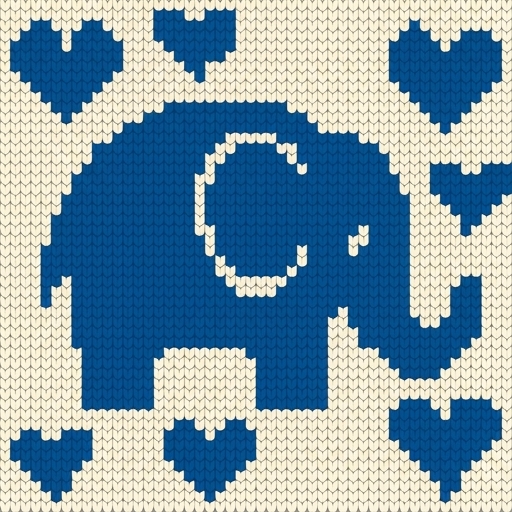
Little Herd — Textured Elephant & Hearts Baby Blanket
A cuddly, beginner-friendly baby blanket worked entirely in knit and purl stitches. Raised elephant and heart motifs appear as knit stitches "popping" against a smooth reverse-stockinette and seed-stitch background — no colorwork, no cables, no charts to fear. Just follow the attached texture chart square by square.
Finished Measurements
- Width: approximately 30½ in (77.5 cm)
- Length: approximately 36 in (91.5 cm)
- A generous stroller/crib size.
Math check: 138 sts ÷ 18 sts per 4 in × 4 = 30.67 in ✓; 216 rows ÷ 24 rows per 4 in × 4 = 36 in ✓.
Materials
- Yarn: Worsted weight (Medium / #4), approximately 850–950 yds (780–870 m). A soft, machine-washable acrylic or cotton-blend baby yarn is recommended.
- Sample shown in a soft gray or cream — any light, solid color best shows the texture.
- Needles: US 8 / 5 mm straight or circular (24 in / 60 cm or longer for comfort holding many stitches). Use a long circular worked back and forth if preferred — do not join.
- Notions: Tapestry needle, stitch markers (optional), locking marker to track chart rows.
Gauge
- 18 sts and 24 rows = 4 in (10 cm) in stockinette stitch, blocked.
- Gauge is not critical for fit, but affects finished size and yarn usage. A slightly loose, drapey fabric is ideal for a baby blanket.
Abbreviations (US terms)
- k – knit
- p – purl
- st(s) – stitch(es)
- RS – right side
- WS – wrong side
- rep – repeat
- Seed st – seed stitch: (k1, p1) across; on following rows, knit the purls and purl the knits as they face you
Construction Overview
The blanket is worked flat, in one piece, from the bottom up:
- A seed-stitch border at the lower edge.
- A 6-stitch seed-stitch border carried up each side throughout.
- A 126-stitch textured center panel worked from the attached chart, alternating rows of elephants and hearts.
- A matching seed-stitch border at the top edge.
Stitch layout across the row (138 sts total):
- 6 sts seed border (right side edge) + 126 sts center chart panel + 6 sts seed border (left side edge) = 138 sts ✓
Attached Stitch Chart
A separate stitch chart panel is attached to this pattern. Do not look for a grid drawn inside these instructions — use the attached chart for the visual grid.
Where it is placed: The attached chart appears as its own panel immediately following this written pattern (labeled "Little Herd — Texture Chart"). It shows one full horizontal motif repeat: 42 stitches wide, which you will work 3 times across the 126-stitch center panel (42 × 3 = 126 ✓).
How to read the chart (knitting, worked flat):
- Each square = 1 stitch; each row of squares = 1 row of knitting.
- Read RS (odd-numbered) rows from RIGHT to LEFT.
- Read WS (even-numbered) rows from LEFT to RIGHT.
- This is a single-color texture chart — there are no color changes. Symbols indicate stitch texture only:
- A blank / knit symbol on a RS row = knit; on a WS row = purl.
- A dot / purl symbol on a RS row = purl; on a WS row = knit.
- The knit stitches worked on a reverse-stockinette (purl) ground are what form the raised elephants and hearts.
Color / yarn management: Only one color is used throughout — no stranding, no carrying second yarns, no joins. Simply keep even tension so the knit "pops" stay crisp.
Stitch-count integration math:
- Center panel = 126 sts = 3 chart repeats of 42 sts (126 ÷ 42 = 3 ✓).
- Always keep the 6 border sts on each end in seed stitch, outside the charted 126 sts.
- The chart is 48 rows tall (one full elephant-and-hearts band). You will work the 48-row chart 4 times for the body (48 × 4 = 192 rows), framed by borders below (12 rows) and above (12 rows): 12 + 192 + 12 = 216 rows total ✓.
Instructions
Lower Border
Cast on 138 sts.
Seed border rows (work 12 rows):
- Row 1 (RS): *K1, p1; rep from * to end. (138 sts)
- Row 2 (WS): Knit the purls and purl the knits as they face you (this keeps seed stitch correct). (138 sts)
- Repeat these 2 rows until you have worked 12 rows total, ending with a WS row.
Body (Chart Section)
On every body row, work the side borders in seed stitch and the center 126 sts from the attached chart.
Every RS row:
- Work 6 sts in seed st (side border).
- Work the attached chart across the next 126 sts (3 repeats of the 42-st chart, read right to left).
- Work 6 sts in seed st (side border).
- (6 + 126 + 6 = 138 sts ✓)
Every WS row:
- Work 6 sts in seed st (side border).
- Work the attached chart across the next 126 sts (3 repeats, read left to right), purling where the chart shows knit and knitting where it shows purl (WS reading).
- Work 6 sts in seed st (side border).
Work the full 48-row chart 4 times (192 rows total), ending after a completed WS chart row.
Row check: 192 body rows ÷ 48-row chart = 4 full repeats ✓.
Tip: Place a locking stitch marker on your work at the start of each chart repeat so you always know which chart row you are on. You may also place markers after the first 6 border sts and before the last 6 border sts to isolate the chart panel.
Upper Border
Work seed stitch across all 138 sts for 12 rows, matching the lower border, ending with a WS row.
Bind off all 138 sts loosely in pattern (knit the knits, purl the purls as you bind off) to keep the edge from puckering.
Total row check: 12 (lower) + 192 (body) + 12 (upper) = 216 rows = 36 in ✓.
Finishing
- Weave in ends with a tapestry needle, working ends into the seed-stitch borders where they hide best.
- Block gently: Soak in cool water with a little baby-safe wash, press out excess water (do not wring), lay flat to measurements (30½ × 36 in), and pin edges straight. Allow to dry completely. Blocking opens up the reverse-stockinette ground so the elephants and hearts stand out.
- Safety note: Ensure all ends are securely woven and trimmed close — loose strands are a hazard for babies.
Notes for the Knitter
- Beginner reassurance: Every stitch in this blanket is either a knit or a purl. If you can do those two things, you can make the whole blanket.
- Keeping texture crisp: The motifs "read" best in a smooth, light, solid-colored yarn. Avoid variegated or very fuzzy yarns, which hide texture.
- Adjusting size: To make the blanket wider, add stitches in full 42-st chart repeats (each repeat adds ~9⅓ in). Remember to keep the 6-st seed borders on each side. To make it longer, work additional full 48-row chart repeats.
Note: For advanced cabled or lace elephant/heart motifs requiring detailed charts (e.g., embossed relief cables or lace outlines), request an advanced difficulty blanket for comprehensive stitch pattern support with detailed charts and instructions.
Enjoy making your Little Herd blanket — a soft, textured welcome for a new little one. 🐘💛
Disclaimer: This pattern was generated by AI and should be reviewed for accuracy before use. While we strive for quality, AI-generated content may contain errors. Please verify measurements, stitch counts, and instructions before beginning your project. Generated by purlJam.uk
Love this pattern?
Save this pattern to your free PurlJam libraryAccess your pattern anytime
Bookmark this page to access your pattern anytime