Type
Crochet
Difficulty
intermediate
Category
pullover
AI Thinking Process
Planning
Verification
Pattern
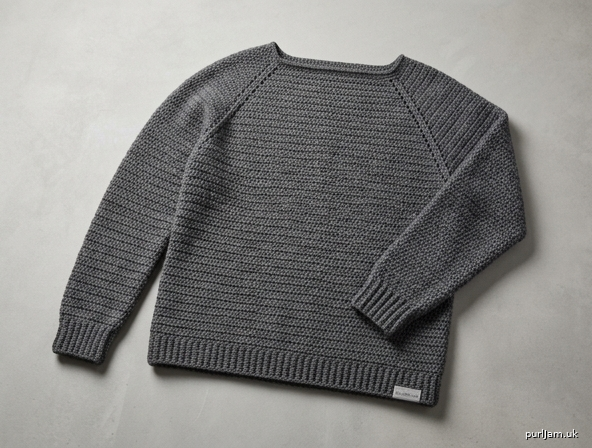
Men's Boat-Neck Raglan Pullover
Construction: Top-down seamless raglan, worked in the round from the neck. This is a wide, level boat neck — front and back begin with the same number of stitches, so the opening sits across the shoulders rather than at the base of the throat. There is no collar and no hood.
The raglan is increased every round at four marked chain spaces. A wide boat neck does not, on its own, grow a comfortable sleeve, so each sleeve also takes four extra increases at its centre. Below the underarm the body is a straight tube. Sleeves are tapered to a ribbed cuff.
Worked here in one colour. Charcoal grey, navy or oatmeal all suit the neckline.
Difficulty: Intermediate. The stitch is plain treble, and a confident beginner who can work in the round and count carefully can make it. It is graded intermediate because the raglan rate, the extra sleeve increases, the underarm join and the tension all have to be right for the fit.
Sizes
S (M, L, XL, XXL)
Figures are given for S, with M, L, XL and XXL in parentheses. Where only one figure is given, it applies to all sizes.
| S | M | L | XL | XXL | |
|---|---|---|---|---|---|
| To fit chest | 96 cm (38 in) | 104 cm (41 in) | 112 cm (44 in) | 122 cm (48 in) | 132 cm (52 in) |
| Finished chest | 106 cm (41.75 in) | 111.5 cm (44 in) | 120 cm (47.25 in) | 131.5 cm (51.75 in) | 140 cm (55 in) |
| Ease over to-fit chest | 10 cm (4 in) | 7.5 cm (3 in) | 8 cm (3.25 in) | 9.5 cm (3.75 in) | 8 cm (3.25 in) |
| Back neck to hem | 68.5 cm (27 in) | 69.75 cm (27.5 in) | 72.25 cm (28.5 in) | 74.75 cm (29.5 in) | 77.25 cm (30.5 in) |
| Underarm to hem | 48.5 cm (19 in) | 48.5 cm (19 in) | 48.5 cm (19 in) | 48.5 cm (19 in) | 48.5 cm (19 in) |
| Underarm to cuff | 46.25 cm (18.25 in) | 47.5 cm (18.75 in) | 48.75 cm (19.25 in) | 50 cm (19.75 in) | 50 cm (19.75 in) |
| Upper arm | 37 cm (14.5 in) | 38.5 cm (15.25 in) | 43 cm (17 in) | 47 cm (18.5 in) | 51.5 cm (20.25 in) |
| Neck across back | 27 cm (10.5 in) | 28.5 cm (11.25 in) | 30 cm (11.75 in) | 31.5 cm (12.5 in) | 33 cm (13 in) |
| Neck opening (foundation) | 66 cm (26 in) | 68.5 cm (27 in) | 74.5 cm (29.25 in) | 77 cm (30.25 in) | 83 cm (32.75 in) |
If you are between sizes, choose the finished chest that is about 8 cm (3 in) larger than the wearer's chest. Size M is the closest fit; at the top of that to-fit chest, consider L.
Crochet fabric grows when it is worn. The ease above is deliberately less than you would add for a knitted sweater. Do not size up "for safety".
Length is measured from the back neck edge, down the centre back, including the hem rib. Larger sizes are longer because the yoke is deeper; the body from underarm to hem is the same in every size.
Materials
- Yarn: Aran-weight wool or wool blend (CYC 4 / US worsted), about 190 m per 100 g. A smooth or lightly heathered yarn that fills a treble stitch. Slippery cotton has less give and the fit is less forgiving — not recommended for a first make.
- Amount (approximate, including a small allowance): 1400 (1550, 1750, 1950, 2150) m / 750 (850, 950, 1050, 1150) g
- Hooks: 5.0 mm for the main fabric; 4.5 mm for ribbing and the neck edging. (US equivalents H/8 and 7, if you use them. Metric sizes are the ones that matter.)
- Notions: 4 locking stitch markers for the raglans; 2 further markers for the sleeve centres; waste yarn; tapestry needle; pins for blocking.
Tension (gauge)
14 tr and 8 rounds = 10 cm (4 in) over treble crochet worked in the round, after blocking, using the 5.0 mm hook.
One round is 1.25 cm (0.5 in). One stitch is 0.71 cm.
Work a swatch in the round, at least 15 cm across, and block it before you measure. A flat swatch will not match this pullover. If you have fewer than 14 stitches to 10 cm, change to a smaller hook. If you have more, change to a larger hook. The neck width, chest and sleeve all depend on this tension.
Ribbing is not tension-critical in the same way. On the 4.5 mm hook, 10 dc in back loop only should measure about 6 cm (2.25 in) deep. Adjust the rib starting chain if yours does not.
Abbreviations (UK)
| Abbreviation | Meaning |
|---|---|
| ch | chain |
| ch-sp | chain space |
| dc | double crochet (US single crochet) |
| tr | treble crochet (US double crochet) |
| tr2tog | treble crochet 2 together |
| sl st | slip stitch |
| BLO | back loop only |
| st(s) | stitch(es) |
| RS | right side |
| rep | repeat |
UK tr is the main stitch. It is the stitch called double crochet in US patterns. UK dc is used only for ribbing and the neck edging.
Ch 3 at the start of a round counts as a tr throughout. The raglan ch 1 does not count as a stitch. Do not turn at the end of a round. The right side faces you for the whole yoke, body and sleeves.
Special stitches
tr2tog: (Yarn over, insert hook in next st, yarn over, pull up a loop, yarn over, pull through 2 loops) twice, yarn over, pull through all 3 loops on the hook. 1 stitch decreased.
Raglan increase — (tr, ch 1, tr) in the raglan ch-sp: Work tr, ch 1, tr all into the marked chain space. Move the marker up into the new ch 1. The two tr count as stitches (one added to each adjoining section). The ch 1 is the new raglan point and is not a stitch.
Extra sleeve increase: 2 tr in the stitch before the sleeve centre marker and 2 tr in the stitch after it. The marker stays between those two stitches and is moved up. This adds 2 stitches at the centre of that sleeve only.
Each ordinary raglan round adds 8 tr: 4 corners × 2 tr = 8 sts. On an extra-increase round the two sleeves add 2 sts each as well, so that round adds 12 tr (8 + 4 = 12 ✓).
Overview
- Chain the neckline, join, and set four raglan markers on Round 1.
- Work the stated number of raglan increase rounds, with four extra sleeve increases on the rounds listed for your size.
- Slip the sleeves onto waste yarn, chain across each underarm, and work the body even.
- Return for each sleeve, taper to the cuff count, and rib.
- Add the hem welt and a narrow neck edging. Block the neck out to its full width.
The join on the yoke falls at the start of the Back, beside one raglan. Keep the beginning ch-3 the same height as the other trebles and it disappears after blocking. Body and sleeve joins sit at the underarm.
Yoke
Foundation
With the 5.0 mm hook, ch 92 (96, 104, 108, 116). Join with a sl st to the first ch to form a ring, without twisting.
This ring is the boat neck. It is not a crew neck and it should feel wide.
Round 1 — setup (no increases)
Ch 3 (counts as first tr of the Back). Tr in each of the next 37 (39, 41, 43, 45) ch. Back: 38 (40, 42, 44, 46) sts. (Ch 3 + 37 tr = 38 for S ✓.)
Ch 1, place raglan marker A in the ch 1. Tr in the next 8 (8, 10, 10, 12) ch. Place a centre marker between the two middle sleeve stitches (after the 4th (4th, 5th, 5th, 6th) sleeve tr). Left Sleeve: 8 (8, 10, 10, 12) sts.
Ch 1, place raglan marker B in the ch 1. Tr in the next 38 (40, 42, 44, 46) ch. Front: 38 (40, 42, 44, 46) sts.
Ch 1, place raglan marker C in the ch 1. Tr in the next 8 (8, 10, 10, 12) ch. Place a centre marker between the two middle sleeve stitches, as for the left sleeve. Right Sleeve: 8 (8, 10, 10, 12) sts.
Ch 1, place raglan marker D in the ch 1. Join with a sl st to the top of the beginning ch-3.
Chains used: 38 + 8 + 38 + 8 = 92 for S; 40 + 8 + 40 + 8 = 96; 42 + 10 + 42 + 10 = 104; 44 + 10 + 44 + 10 = 108; 46 + 12 + 46 + 12 = 116 ✓. Do not count the joining sl st, and do not count the four ch-1 spaces.
Front equals Back in every size. That is what keeps the boat neck level.
Raglan increase round
Ch 3 (counts as the first Back tr). Tr in each remaining Back st until raglan marker A is next. (Tr, ch 1, tr) in the A ch-sp, moving the marker to the new ch 1. The first of these tr finishes the Back; the second begins the Left Sleeve. Tr in each Left Sleeve st to marker B, working the extra sleeve increase if this is a listed round for your size. (Tr, ch 1, tr) in the B ch-sp, moving the marker. Tr in each Front st to marker C. (Tr, ch 1, tr) in the C ch-sp, moving the marker. Tr in each Right Sleeve st to marker D, working the extra sleeve increase if required. (Tr, ch 1, tr) in the D ch-sp, moving the marker. The second of these tr is a new Back stitch, sitting just before the beginning ch-3. Join with a sl st to the top of the beginning ch-3.
On an extra-increase round, the two centre sleeve stitches are the stitches either side of the sleeve marker among the sleeve stitches from the previous round. Do not count the new raglan tr you have just made at the start of the sleeve.
Work this round 15 (16, 18, 20, 22) times.
Also work the extra sleeve increase on both sleeves on these raglan increase rounds:
- S: rounds 3, 6, 9 and 12
- M: rounds 4, 8, 12 and 16
- L: rounds 4, 8, 12 and 16
- XL: rounds 4, 8, 12 and 16
- XXL: rounds 4, 9, 14 and 19
Four extra rounds × 2 sts = 8 extra stitches on each sleeve ✓. No extra increase falls on the setup round.
Checkpoint after the first raglan increase round (not an extra-increase round in any size). Back and Front should each have grown by 2. Each sleeve should have grown by 2.
- S: 40 back, 10 sleeve, 40 front, 10 sleeve
- M: 42, 10, 42, 10
- L: 44, 12, 44, 12
- XL: 46, 12, 46, 12
- XXL: 48, 14, 48, 14
If the first round does not match, the corner is being worked into the wrong place. Stop and correct it before going on.
Stitches at the underarm (before the underarm chains)
After all raglan increase rounds:
| S | M | L | XL | XXL | |
|---|---|---|---|---|---|
| Back | 68 | 72 | 78 | 84 | 90 |
| Each sleeve panel | 46 | 48 | 54 | 58 | 64 |
| Front | 68 | 72 | 78 | 84 | 90 |
| Total tr, excluding raglan ch-1s | 228 | 240 | 264 | 284 | 308 |
Checks: S back 38 + (15 × 2) = 68 ✓; S sleeve 8 + (15 × 2) + 8 = 46 ✓. M: 40 + 32 = 72, sleeve 8 + 32 + 8 = 48 ✓. L: 42 + 36 = 78, sleeve 10 + 36 + 8 = 54 ✓. XL: 44 + 40 = 84, sleeve 10 + 40 + 8 = 58 ✓. XXL: 46 + 44 = 90, sleeve 12 + 44 + 8 = 64 ✓.
Total check, S: start 92 + (15 × 8) + 16 extra sleeve sts = 92 + 120 + 16 = 228 ✓. The same build gives 240, 264, 284 and 308 for the larger sizes.
Yoke depth, including the setup round: 16 (17, 19, 21, 23) rounds × 1.25 cm = 20 (21.25, 23.75, 26.25, 28.75) cm ✓.
Do not fasten off.
Divide for body and sleeves
You are at the start of the Back.
Dividing round (counts as body round 1): Ch 3 (counts as tr). Tr in each Back st to raglan marker A. Do not work into the ch-sp. You should have 68 (72, 78, 84, 90) Back sts, including the ch-3. Ch 6 (6, 6, 8, 8) for the underarm. Skip marker A, slip the 46 (48, 54, 58, 64) Left Sleeve sts onto waste yarn, and skip marker B. Remove those two raglan markers and the sleeve centre marker. Tr in each of the 68 (72, 78, 84, 90) Front sts. Ch 6 (6, 6, 8, 8). Skip marker C, slip the Right Sleeve sts onto waste yarn, and skip marker D. Remove the remaining markers. Join with a sl st to the top of the beginning ch-3.
Body stitch count: 148 (156, 168, 184, 196). S: 68 + 6 + 68 + 6 = 148 ✓. M: 72 + 6 + 72 + 6 = 156 ✓. L: 78 + 6 + 78 + 6 = 168 ✓. XL: 84 + 8 + 84 + 8 = 184 ✓. XXL: 90 + 8 + 90 + 8 = 196 ✓.
The skipped raglan chain spaces are not stitches. A small hole can show at each underarm corner; close it with the tail when you weave the ends in. Do not add stitches to fill it, or the chest count will change.
Body
The dividing round is round 1 of the body. Work a further 33 rounds in tr: ch 3, tr in each st and in each underarm chain around, join. 34 body rounds in all. Stitch count stays 148 (156, 168, 184, 196).
34 rounds × 1.25 cm = 42.5 cm of treble, plus a 6 cm hem rib = 48.5 cm from underarm to hem ✓.
Fasten off.
Length adjustment: each extra or omitted treble round changes the body length by 1.25 cm (0.5 in). Add or remove rounds here, before the rib, not in the yoke. Total length from the back neck will then differ from the table by the same amount.
There is no waist shaping. A straight side is the intended men's fit.
Sleeves (make 2)
With RS facing and the 5.0 mm hook, join yarn with a sl st in the centre underarm chain (3rd chain of 6, or 4th chain of 8).
Joining round (sleeve round 1, even): Ch 3 (counts as 1 tr in that centre chain). Tr in each remaining underarm chain and in each held sleeve stitch. Join to the top of the ch-3.
52 (54, 60, 66, 72) sts. Panel + underarm chain: 46 + 6 = 52; 48 + 6 = 54; 54 + 6 = 60; 58 + 8 = 66; 64 + 8 = 72 ✓.
The round starts at the centre of the underarm. Decreases sit either side of that point.
Decrease round: Ch 3 (counts as tr), tr2tog over the next 2 sts, tr in each st to the last 2 sts, tr2tog over the last 2 sts, join. 2 sts decreased. (The ch-3 replaces the first stitch and is not itself a decrease, so the round loses exactly 2 ✓.)
Even round: Ch 3, tr in each st around, join.
Size S — 33 rounds, ending with 30 sts
The joining round is round 1 (even). Work 1 further even round. [Decrease round, 2 even rounds] 10 times. Work 1 decrease round. Rounds: 1 + 1 + 30 + 1 = 33 ✓. Decreases: 10 + 1 = 11; 11 × 2 = 22; 52 − 22 = 30 ✓.
Size M — 34 rounds, ending with 32 sts
The joining round is round 1. [2 even rounds, 1 decrease round] 11 times. Rounds: 1 + 33 = 34 ✓. Decreases: 11 × 2 = 22; 54 − 22 = 32 ✓.
Size L — 35 rounds, ending with 34 sts
The joining round is round 1 (even). [Decrease round, 1 even round] 13 times. Work 8 even rounds. Rounds: 1 + 26 + 8 = 35 ✓. Decreases: 13 × 2 = 26; 60 − 26 = 34 ✓.
Size XL — 36 rounds, ending with 36 sts
The joining round is round 1 (even). [Decrease round, 1 even round] 15 times. Work 5 even rounds. Rounds: 1 + 30 + 5 = 36 ✓. Decreases: 15 × 2 = 30; 66 − 30 = 36 ✓.
Size XXL — 36 rounds, ending with 38 sts
The joining round is round 1 (even). [Decrease round, 1 even round] 17 times. Work 1 even round. Rounds: 1 + 34 + 1 = 36 ✓. Decreases: 17 × 2 = 34; 72 − 34 = 38 ✓.
S and M decrease every 3rd round. L, XL and XXL decrease every 2nd round, because the upper arm starts wider and must reach the cuff inside the sleeve length. After the last scheduled round the cuff counts are 30 (32, 34, 36, 38).
At tension, these rounds measure 41.25 (42.5, 43.75, 45, 45) cm, and the cuff rib adds 5 cm, for a sleeve of 46.25 (47.5, 48.75, 50, 50) cm ✓.
If you want a longer sleeve, add even rounds after the decreases and before the cuff. Do not skip decreases — the cuff will be too wide. If the sleeve is much too long at the stated rounds, check tension before ripping the shaping out.
Fasten off, leaving a tail long enough to close the underarm corner.
Hem rib
With the 4.5 mm hook, ch 11.
Row 1 (RS): Dc in the 2nd ch from the hook and in each ch across, turn. (10 dc — about 6 cm deep.)
Row 2: Ch 1 (does not count as a st). Dc BLO in each of the first 9 sts. Join the last st to the hem as follows: with the rib against the lower edge of the body, work a sl st through the last rib stitch and the next unworked body stitch, turn.
Following rows: Ch 1, dc BLO in each of the first 9 sts, sl st the last st together with the next body stitch, turn.
Repeat until you have 148 (156, 168, 184, 196) rows — one row for each body stitch (148 body sts = 148 rib rows for S ✓). The smaller hook and the back-loop fabric draw the hem in slightly, which is what you want. Do not stretch the rib to match the treble row for row beyond this 1:1 join.
Join the last row to the first row with a sl st seam through the back loops. Fasten off.
The sideways welt is slow on the larger sizes and looks like a knitted hem. If you prefer, skip it and instead work dc BLO in the round on the 4.5 mm hook until the band measures 6 cm (about 9 or 10 rounds). Join each round, do not turn, and keep the same stitch count.
Cuff rib (both sleeves)
With the 4.5 mm hook, ch 9.
Row 1 (RS): Dc in the 2nd ch from the hook and in each ch across, turn. (8 dc — about 5 cm deep.)
Work in dc BLO, joining the last stitch of every row to the next cuff stitch with a sl st, exactly as for the hem, until you have 30 (32, 34, 36, 38) rows — one row for each cuff stitch. Join the first and last rows. Fasten off.
The cuff draws in by roughly 2 cm from the treble measurement. Finished cuff circumference is about 19 (20.5, 22, 23.5, 25) cm, which is comfortable rather than tight.
Neck edging
Do not work a deep rib on this neck. A rib would pull the boat neck in and turn it into a clumsy crew.
With RS facing and the 4.5 mm hook, join yarn in any foundation chain at the centre back. Ch 1, dc in each foundation chain around, join. 92 (96, 104, 108, 116) dc. (The raglan ch-1 spaces are above this edge, not on it, so they are not included ✓.)
Work 1 further round of dc, 1 dc in each st, join. Fasten off.
If the edge curls after blocking, add a third dc round. Do not decrease.
Finishing
Close any small gap at the four underarm corners with a few stitches of the tail. Weave every end into a solid column of trebles. Do not weave across a raglan chain space or through the underarm chains — those spaces will gape.
Block to the finished measurements. Pin the neck out to the across-back width in the table, 27 (28.5, 30, 31.5, 33) cm, and let it dry flat and wide. Steam or wet-block is enough to settle the treble fabric and even the raglan lines. Do not over-stretch the chest; crochet blocked too wide will not recover to the ease this pattern is written for.
Half-chest, for the blocking pins: 53 (55.75, 60, 65.75, 70) cm.
The neck is meant to rest on the shoulder line, level front and back, wide enough to show the collar of a shirt. If it has been pulled into a scoop, it was blocked too loosely at the sides or the edging was worked too tightly. Pin it again and let it dry.
Numbers at a glance
| S | M | L | XL | XXL | |
|---|---|---|---|---|---|
| Foundation chain | 92 | 96 | 104 | 108 | 116 |
| Back / Front at start | 38 | 40 | 42 | 44 | 46 |
| Each sleeve at start | 8 | 8 | 10 | 10 | 12 |
| Raglan increase rounds | 15 | 16 | 18 | 20 | 22 |
| Extra sleeve-increase rounds | 3, 6, 9, 12 | 4, 8, 12, 16 | 4, 8, 12, 16 | 4, 8, 12, 16 | 4, 9, 14, 19 |
| Back / Front at split | 68 | 72 | 78 | 84 | 90 |
| Sleeve panel at split | 46 | 48 | 54 | 58 | 64 |
| Underarm chain (each side) | 6 | 6 | 6 | 8 | 8 |
| Body stitches | 148 | 156 | 168 | 184 | 196 |
| Body treble rounds (incl. dividing round) | 34 | 34 | 34 | 34 | 34 |
| Sleeve stitches after join | 52 | 54 | 60 | 66 | 72 |
| Sleeve treble rounds (incl. joining round) | 33 | 34 | 35 | 36 | 36 |
| Decrease rounds on sleeve | 11 | 11 | 13 | 15 | 17 |
| Cuff stitches | 30 | 32 | 34 | 36 | 38 |
| Hem rib rows | 148 | 156 | 168 | 184 | 196 |
| Cuff rib rows | 30 | 32 | 34 | 36 | 38 |
| Neck edging stitches | 92 | 96 | 104 | 108 | 116 |
Finished chest from those body counts, at 14 stitches to 10 cm: 148 ÷ 1.4 = 105.7 cm, given as 106 cm; 156 ÷ 1.4 = 111.4 cm, given as 111.5 cm; 168 ÷ 1.4 = 120 cm; 184 ÷ 1.4 = 131.4 cm, given as 131.5 cm; 196 ÷ 1.4 = 140 cm ✓.
Disclaimer: This pattern was generated by AI and should be reviewed for accuracy before use. While we strive for quality, AI-generated content may contain errors. Please verify measurements, stitch counts, charts, and instructions before beginning your project. Generated by purlJam.uk
Love this pattern?
Save this pattern to your free PurlJam libraryAccess your pattern anytime
Bookmark this page to access your pattern anytime