Type
Knitting
Difficulty
intermediate
Category
hat
AI Thinking Process
Planning
Verification
Pattern
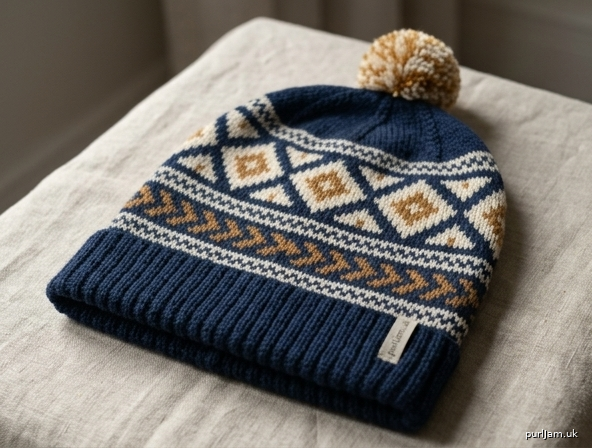
Peerie Fair Isle Beanie
A close-fitting knitted beanie with an unfolded ribbed brim and a traditional stranded band of chevrons and linked diamonds. The colorwork sits on the straight body, where the fabric is flat, and stops before the crown decreases. Worked in the round from the brim up.
This is a beanie. The shape comes from a snug ribbed brim and a six-section crown. It is not a beret (there is no rapid increase to a wide disc), and it is not a bucket hat, cloche, sun hat, bonnet, or balaclava.
Skill level: Intermediate. You should be comfortable knitting in the round, stranding two colors, and decreasing. A plain ribbed beanie would be a beginner project; keeping an even stranded tension, managing floats, and shaping the crown to gauge are what make this one intermediate.
Sizes
Baby (Child, Adult S/M, Adult L)
To fit head circumference: 16 (18–19, 21–22, 23–24) in / 40.5 (45.5–48.5, 53.5–56, 58.5–61) cm
Finished circumference: 14.4 (16.8, 19.2, 21.6) in / 36.5 (42.5, 49, 55) cm Light to moderate negative ease. The ribbed brim stretches over the head.
Finished length, cast-on to crown (brim unfolded): about 6.75 (7.5, 8.25, 9) in / 17 (19, 21, 23) cm
Instructions are written for Baby, with Child, Adult S/M, and Adult L in parentheses. If only one number is given, it applies to all sizes.
Yarn
Worsted weight (CYC #4) wool or wool blend. Wool blocks well and recovers its shape; a cotton yarn will stretch out of fit and is not recommended for this hat.
Yardage includes a gauge swatch.
- MC (ground): 110 (150, 200, 240) yd / 101 (137, 183, 220) m
- CC1 (frames): 40 (50, 65, 75) yd / 37 (46, 60, 69) m
- CC2 (chevrons and diamonds): 50 (60, 75, 90) yd / 46 (55, 69, 82) m
A typical worsted skein is about 200–220 yd (183–201 m) per 100 g. One skein of MC covers Baby and Child. Adult sizes may need a second skein of MC if the skein is under 200 yd. One skein of each contrast is enough for any single size.
Suggested palette: MC a deep navy or charcoal, CC1 cream, CC2 rust or gold. Any three colors with clear contrast will work. Keep MC the darkest so the motifs read. Only two colors are used in any round.
Needles
- Brim: US 7 (4.5 mm) circular needle, 16 in / 40 cm, or double-pointed needles, or a long circular for magic loop
- Body and crown: US 8 (5 mm), same style
- Double-pointed needles or magic loop in US 8 (5 mm) for the crown of every size
Baby and Child circumferences are too small for a 16 in / 40 cm circular. Use DPNs or magic loop for those sizes from the cast-on. Adults may use a 16 in / 40 cm circular until the crown no longer fits comfortably, then change to DPNs or magic loop.
The brim needle is one size smaller than the body needle so the band is firmer than the crown fabric. If your rib feels loose, drop the brim needle to US 6 (4 mm).
Notions
- 6 stitch markers, one distinct, for the beginning of the round
- Tapestry needle
- Optional: pom-pom maker
Gauge
20 stitches and 24 rounds = 4 in (10 cm) in stranded stockinette in the round on US 8 (5 mm) needles, after blocking.
Plain stockinette on the same needles will measure fewer stitches per inch than the stranded fabric. Swatch in stranded knitting, not in plain stockinette. Cast on at least 30 stitches (a multiple of 6), work in the round for at least 4 in (10 cm) using the chevron rounds below, block, and measure. If you have more than 20 stitches in 4 in, go up a needle size; if fewer, go down.
Construction
Bottom-up, in the round, no seams. Ribbed brim on the smaller needle, one plain round, a 16-round Fair Isle band, a few plain rounds, then crown decreases in six equal sections. The brim is worn unfolded. Do not fold it over the colorwork.
Notes
- The motif is a 6-stitch repeat. Every size is an exact multiple of 6, so the pattern joins cleanly.
- Carry the unused color loosely across the wrong side. If a float would pass under more than 4 stitches, catch it: twist the carried yarn once around the working yarn before the next stitch. Do not catch in the same column on consecutive rounds.
- Keep the pattern color (CC1 or CC2) dominant — held below the ground color, or to the left if you knit with both yarns in the left hand — so the motifs sit forward.
- Do not pull the floats tight. Spread the stitches on the right needle as you change colors. A tight band will make the hat smaller than the finished circumference.
- A small jog at the beginning of the round is normal. It sits wherever you place the start of the round; keep that point at the side or back when you put the hat on.
- Do not cut MC. When CC1 or CC2 rests for a few rounds, carry it loosely up the wrong side at the beginning of the round. Cut both contrasts after Round 16 of the band.
- There are no steeks.
- Plain rounds after the band may be added or removed for length. Each 6 rounds is 1 in (2.5 cm). Always work all 16 colorwork rounds, and always work the full crown sequence. Extra plain rounds before the crown will add slouch.
Abbreviations
| Abbreviation | Meaning |
|---|---|
| BOR | beginning of round |
| CC1, CC2 | contrast color 1, contrast color 2 |
| CO | cast on |
| k | knit |
| k2tog | knit 2 stitches together (1 stitch decreased; leans right) |
| MC | main color |
| p | purl |
| pm | place marker |
| rep | repeat |
| rnd(s) | round(s) |
| sm | slip marker |
| st(s) | stitch(es) |
Decrease round: *Knit to 2 sts before the marker, k2tog, sm; rep from * around. 6 sts decreased. When a section has only 2 sts left, k2tog those 2 sts.
Instructions
Brim
With MC and US 7 (4.5 mm) needles, cast on 72 (84, 96, 108) sts using the long-tail cast-on. Cast on loosely enough that the edge can stretch over the head. If your cast-on is tight, use a needle one size larger for the cast-on row only, then change to US 7 (4.5 mm).
Join to work in the round, being careful not to twist. Place the distinct marker for the BOR.
Check: 72 ÷ 6 = 12 repeats; 84 ÷ 6 = 14; 96 ÷ 6 = 16; 108 ÷ 6 = 18. The same counts are also multiples of 4, for 2×2 rib (72 ÷ 4 = 18, 84 ÷ 4 = 21, 96 ÷ 4 = 24, 108 ÷ 4 = 27). ✓
Rib round: *K2, p2; rep from * around.
Repeat the rib round until the brim measures 1.25 (1.5, 1.75, 2) in / 3.2 (3.8, 4.5, 5) cm from the cast-on edge. Do not bind off. Stitch count is still 72 (84, 96, 108).
Straight body
Change to US 8 (5 mm) needles.
Knit 1 round in MC. This settles the needle change before the stranded band.
Colorwork band
The band is about 2.75 in (7 cm) deep at gauge: 16 rounds ÷ 6 rounds per inch = 2.67 in, published as about 2.75 in (7 cm). It is worked entirely on the straight body, above the brim, and is not continued into the crown.
In words, the band is three small peerie patterns. Salt-and-pepper frames in CC1 — single alternating stitches — open, divide, and close the band. Between the first and second frame, CC2 forms a two-track chevron: the contrast stitches step one stitch to the side and then back. Between the second and third frame, CC2 forms a row of linked diamonds, outlined at the edges of each repeat and filled across the middle.
Every round below is repeated to the end of the round. Stitch count does not change. Longest float in this band is 4 stitches.
Rounds 1–2 — salt-and-pepper frame (MC and CC1)
- Round 1: *K1 MC, k1 CC1; rep from * around.
- Round 2: *K1 CC1, k1 MC; rep from * around.
Rounds 3–7 — chevron (MC and CC2)
- Round 3: *K1 CC2, k2 MC, k1 CC2, k2 MC; rep from * around. (1 + 2 + 1 + 2 = 6 ✓)
- Round 4: *K1 MC, k1 CC2, k2 MC, k1 CC2, k1 MC; rep from * around. (1 + 1 + 2 + 1 + 1 = 6 ✓)
- Round 5: *K2 MC, k1 CC2, k2 MC, k1 CC2; rep from * around. (2 + 1 + 2 + 1 = 6 ✓)
- Round 6: Repeat Round 4.
- Round 7: Repeat Round 3.
Rounds 8–9 — salt-and-pepper frame (MC and CC1)
- Round 8: *K1 MC, k1 CC1; rep from * around.
- Round 9: *K1 CC1, k1 MC; rep from * around.
Rounds 10–14 — linked diamonds (MC and CC2)
- Round 10: *K1 CC2, k4 MC, k1 CC2; rep from * around. (1 + 4 + 1 = 6 ✓)
- Round 11: *K2 CC2, k2 MC, k2 CC2; rep from * around. (2 + 2 + 2 = 6 ✓)
- Round 12: *K1 MC, k4 CC2, k1 MC; rep from * around. (1 + 4 + 1 = 6 ✓)
- Round 13: Repeat Round 11.
- Round 14: Repeat Round 10.
Rounds 15–16 — salt-and-pepper frame (MC and CC1)
- Round 15: *K1 MC, k1 CC1; rep from * around.
- Round 16: *K1 CC1, k1 MC; rep from * around.
Cut CC1 and CC2, leaving tails about 6 in (15 cm) long. Continue in MC only.
Check: Stitch count is still 72 (84, 96, 108). No increases or decreases were worked in the band. ✓
Plain rounds
Knit 1 (2, 2, 3) rounds in MC.
The straight body is now 18 (19, 19, 20) rounds from the top of the brim (1 setup + 16 colorwork + 1 (2, 2, 3) plain = 18 (19, 19, 20) ✓), about 3 (3.2, 3.2, 3.3) in / 7.5 (8, 8, 8.5) cm. The last diamond frame should sit fully below the coming decreases.
Crown
Still using MC and US 8 (5 mm) needles.
Setup: Place a marker every 12 (14, 16, 18) sts, using the BOR marker as the last of the six. Six sections. (12 × 6 = 72, 14 × 6 = 84, 16 × 6 = 96, 18 × 6 = 108 ✓)
All crown decreases are k2tog stacked at the markers, so the six decrease lines run straight up the crown. They lean slightly right. That is intentional and looks even after blocking.
Change to DPNs or magic loop when the stitches no longer fit comfortably on the circular needle.
Decrease every other round
Work a Decrease round, then knit 1 round, a total of 4 (4, 5, 5) times.
Stitch count after each Decrease round:
- Baby: 66, 60, 54, 48
- Child: 78, 72, 66, 60
- Adult S/M: 90, 84, 78, 72, 66
- Adult L: 102, 96, 90, 84, 78
First Decrease round removes 6 sts: 72 − 6 = 66; 84 − 6 = 78; 96 − 6 = 90; 108 − 6 = 102. ✓
You should now have 48 (60, 66, 78) sts.
Decrease every round
Work a Decrease round every round 7 (9, 10, 12) times, until 6 sts remain.
Stitch count after each Decrease round:
- Baby: 42, 36, 30, 24, 18, 12, 6
- Child: 54, 48, 42, 36, 30, 24, 18, 12, 6
- Adult S/M: 60, 54, 48, 42, 36, 30, 24, 18, 12, 6
- Adult L: 72, 66, 60, 54, 48, 42, 36, 30, 24, 18, 12, 6
Ending check: 48 − (6 × 7) = 6; 60 − (6 × 9) = 6; 66 − (6 × 10) = 6; 78 − (6 × 12) = 6. ✓
Crown depth at gauge is 15 (17, 20, 22) rounds, about 2.5 (2.8, 3.3, 3.7) in / 6.5 (7, 8.5, 9.5) cm.
Finished length check (brim + body + crown): Baby 1.25 + 3 + 2.5 = 6.75 in; Child 1.5 + 3.2 + 2.8 = 7.5 in; Adult S/M 1.75 + 3.2 + 3.3 = 8.25 in; Adult L 2 + 3.3 + 3.7 = 9 in. ✓
Close the crown
Cut MC, leaving an 8 in (20 cm) tail. Thread the tail through the remaining 6 sts, pull snug, and take the tail to the wrong side. Secure it under the decrease stitches of the crown.
Finishing
Weave in all ends on the wrong side, each end behind stitches or floats of the same color for about 1.5–2 in (4–5 cm). Do not weave a contrast end across a ground-color area where it will flash through.
Blocking: Essential for stranded fabric. Soak in cool water with a little wool wash, press out the water (do not wring), and shape over a bowl, balloon, or hat form slightly smaller than the head size. Do not stretch the rib wider than the body. Let dry fully. The chevrons and diamonds should lie flat, and the crown should be a smooth dome, not a point and not a beret disc.
Wear the brim unfolded.
Optional pom-pom: Make a pom-pom about 2.5 (3, 3.5, 3.5) in / 6.5 (7.5, 9, 9) cm in diameter in CC1, CC2, or a mix, and sew it to the gathered crown stitches.
Care: Hand wash in cool water. Reshape and dry flat or over the form, away from heat. Agitation and heat will felt wool.
Fit note
The hat should sit on the ears with the rib snug and the colorwork band on the flat part of the head, not stretched over the crown of the head. If the band pulls in, the floats were too tight — block firmly, and on the next hat spread the stitches more as you strand. If you want more slouch, add plain MC rounds before the crown, 6 rounds per extra 1 in (2.5 cm). Do not add those rounds inside the colorwork, and do not carry the motif into the decreases.
Disclaimer: This pattern was generated by AI and should be reviewed for accuracy before use. While we strive for quality, AI-generated content may contain errors. Please verify measurements, stitch counts, charts, and instructions before beginning your project. Generated by purlJam.uk
Love this pattern?
Save this pattern to your free PurlJam libraryAccess your pattern anytime
Bookmark this page to access your pattern anytime