Type
Knitting
Difficulty
intermediate
Category
custom
AI Thinking Process
Planning
Verification
Pattern
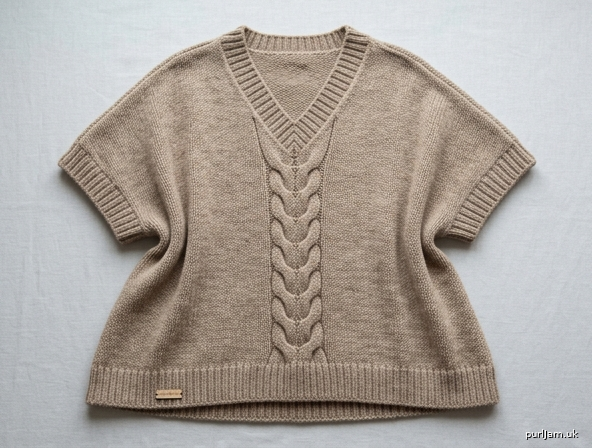
Petite V-Neck Cable Poncho
A small pullover poncho for a person about 5 feet tall. A double-rope cable runs up the center front and stops at the point of a deep V-neck. The back is plain stockinette, so the poncho is not bulky to sit against. The hem flares gently; side seams stop below the bust line and leave an opening for each arm.
Worked flat in two panels, then seamed. Intermediate.
Finished measurements
After blocking. One size: Petite.
| To fit | about 5'0" (152 cm), bust 32–36" (81–91 cm) |
| Hem circumference | 60½" (153.5 cm) |
| Each panel at hem | 30¼" (77 cm) |
| Each panel at upper edge | 22¼" (56.5 cm) |
| Circumference at base of arm openings | 44½" (113 cm) |
| Length, hem to shoulder | 21¼" (54 cm) |
| V-neck depth | 8" (20.5 cm) |
| Back neck width | 8" (20.5 cm) |
| Each shoulder seam | 7" (18 cm) |
| Arm opening depth (before band) | 8" (20.5 cm) |
| Side seam | 13¼" (33.5 cm) |
The front panel may measure about ½" (1.5 cm) narrower than the back because the cable draws in. That is expected. Do not add stitches.
Ease is in the drape, not in a fitted bust. The tube closes only below the arm openings. Worn over a close-fitting top, the hem falls near the high hip on a 5-foot frame.
Materials
- Yarn: 1200 yards (1097 m) worsted weight (CYC #4). A smooth, plied wool or wool blend shows the cables best. Avoid fuzzy or very dark yarns. Six 200-yard skeins, or five 220-yard skeins with little to spare. Buy an extra skein if you lengthen the poncho or knit a large swatch.
- Needles:
- US 8 (5 mm) straight needles, or a 32" (80 cm) circular needle used flat, for the body
- US 7 (4.5 mm) needles for the hem rib
- US 7 (4.5 mm) circular needle, 24" (60 cm), for the neckband and arm bands
- One spare US 8 (5 mm) needle for the three-needle bind-off
- Notions: cable needle, 2 stitch markers, 4 stitch holders or waste yarn, tapestry needle, blocking pins
Gauge
18 stitches and 24 rows = 4" (10 cm) in stockinette stitch on US 8 (5 mm) needles, blocked.
That is 4.5 stitches and 6 rows per inch. Knit a stockinette swatch at least 5" (12.5 cm) square, wash it, and block it before measuring. Change needle size if needed to match gauge. Row gauge matters: the V depth, arm openings, and side seams are written in rows as well as inches.
Size
One size only: Petite. Every number in this pattern is for that size.
Abbreviations
| Abbrev. | Meaning |
|---|---|
| BO | bind off |
| C4B | cable 4 back (see Special stitches) |
| C4F | cable 4 front (see Special stitches) |
| CO | cast on |
| k | knit |
| k2tog | knit 2 stitches together (1 stitch decreased, right-leaning) |
| p | purl |
| pm | place marker |
| rem | remaining |
| rep | repeat |
| RS | right side |
| ssk | slip, slip, knit (see Special stitches) |
| st(s) | stitch(es) |
| St st | stockinette stitch: knit on RS, purl on WS |
| WS | wrong side |
Special stitches
ssk: Slip 2 stitches knitwise, one at a time. Return them to the left needle and knit them together through the back loops. 1 stitch decreased, left-leaning.
C4F (Cable 4 Front): Slip 2 stitches to the cable needle and hold in front, k2, then k2 from the cable needle.
C4B (Cable 4 Back): Slip 2 stitches to the cable needle and hold in back, k2, then k2 from the cable needle.
Double Rope Cable Panel (16 sts)
| Row | Work |
|---|---|
| 1 (RS) | P3, k4, p2, k4, p3 |
| 2 (WS) | K3, p4, k2, p4, k3 |
| 3 | P3, k4, p2, k4, p3 |
| 4 | K3, p4, k2, p4, k3 |
| 5 | P3, k4, p2, k4, p3 |
| 6 | K3, p4, k2, p4, k3 |
| 7 | P3, C4B, p2, C4F, p3 |
| 8 | K3, p4, k2, p4, k3 |
Repeat Rows 1–8. Every WS row of this panel is the same: k3, p4, k2, p4, k3.
On the Front, the panel row matches the body-row number. Body Row 9 is Cable Panel Row 1, Body Row 10 is Cable Panel Row 2, and so on. Cable crosses fall on Body Rows 7, 15, 23, 31, 39, 47, 55, 63, and 71. Side decreases never fall on a cross row.
Three-needle bind-off: Hold two sets of stitches together with right sides facing, each on its own needle. With a third needle, knit the first stitch of each needle together. Knit the next stitch of each needle together, then pass the first stitch on the right needle over the second. Repeat from * until 1 stitch remains. Cut the yarn and pull it through.
Pattern notes
- The cable is on the Front only. It is centered, worked for 9 full repeats, and ends at the base of the V. Above that, both fronts are stockinette.
- Slip markers as you come to them.
- Side decreases are always k1, ssk at the start of a RS row and k2tog, k1 at the end. This leaves a 1-stitch selvedge for seaming.
- Neck decreases are worked 1 stitch in from the center-front edge.
- Bind off the neckband loosely. The neck opening, before the band, is about 24" (61 cm) around (8" + 8" + 8"), which is enough to pull over the head if the bind-off is not tight.
- For a more open, cape-like drape, sew a shorter side seam (see Finishing). For an extra 1" (2.5 cm) of length, work 6 extra even rows at the end of both panels before placing stitches on holders, and pick up 4 extra stitches along each V-edge.
Back
With US 7 (4.5 mm) needles, CO 136 sts using a long-tail cast-on.
Rib row 1 (RS): *K2, p2; rep from * to end.
Rib row 2 (WS): *P2, k2; rep from * to end.
Repeat Rib rows 1–2 three more times (8 rib rows total; about 1¼" / 3 cm).
Change to US 8 (5 mm) needles.
Body Row 1 (RS, decrease): K1, ssk, knit to the last 3 sts, k2tog, k1. (134 sts)
Body Rows 2–4: Work in St st, with no decreases.
Body Row 5 (RS, decrease): K1, ssk, knit to the last 3 sts, k2tog, k1. (132 sts)
Continue in St st, decreasing 1 st at each end every 4th row 16 more times. Decrease rows are Body Rows 1, 5, 9, 13, 17, 21, 25, 29, 33, 37, 41, 45, 49, 53, 57, 61, 65, and 69 (18 decrease rows).
Checkpoint: after Body Row 37 (the 10th decrease), 116 sts remain (136 − 20 = 116).
After Body Row 69: 100 sts. (18 decreases × 2 = 36 sts decreased; 136 − 36 = 100 ✓)
Body Rows 70–120: Work even in St st. (51 rows; 100 sts remain)
After Body Row 120 (WS), slip stitches to holders without knitting a further row:
- Slip the first 32 sts to a holder (shoulder).
- Slip the next 36 sts to a second holder (back neck).
- Slip the last 32 sts to a third holder (shoulder).
(32 + 36 + 32 = 100 ✓)
Cut the yarn, leaving a 6" (15 cm) tail. The Back is complete.
Front
With US 7 (4.5 mm) needles, CO 136 sts and work 8 rows of 2×2 rib exactly as for the Back.
Change to US 8 (5 mm) needles.
Body Row 1 (RS, decrease): K1, ssk, k57, pm, work Cable Panel Row 1 over the next 16 sts, pm, k57, k2tog, k1. (134 sts)
The markers stay around the 16-stitch panel for the rest of the cable section. Stitches used on this row: 60 + 16 + 60 = 136 ✓.
Body Row 2 (WS): Purl to the marker, work Cable Panel Row 2, purl to the end.
Body Row 3 (RS): Knit to the marker, work the next Cable Panel row, knit to the end.
Body Row 4: Purl to the marker, work the next Cable Panel row, purl to the end.
Body Row 5 (RS, decrease): K1, ssk, knit to the marker, work the next Cable Panel row, knit to the last 3 sts, k2tog, k1. (132 sts)
Continue in this way through Body Row 72:
- On every WS row, purl to the marker, work the cable panel (always k3, p4, k2, p4, k3), purl to the end.
- On RS rows that are not decrease rows, knit to the marker, work the next Cable Panel row, knit to the end.
- Decrease 1 st at each end on Body Rows 1, 5, 9, 13, 17, 21, 25, 29, 33, 37, 41, 45, 49, 53, 57, 61, 65, and 69 only (18 times).
- Cross the cable on Body Row 71 (Cable Panel Row 7). That row is not a decrease row.
After Body Row 69: 100 sts, with 42 sts outside each marker and 16 sts between the markers. (42 + 16 + 42 = 100 ✓)
Body Rows 70–72: Work 3 rows even in pattern, crossing the cable on Row 71. The 9th cable repeat ends on Body Row 72. (72 ÷ 8 = 9 repeats ✓)
Divide for the V-neck
Body Row 73 (RS): Removing the markers as you come to them, knit 50 sts. Turn. Place the remaining 50 sts on a holder for the second front. (50 + 50 = 100 ✓)
Do not work the cable on this row or after it. The last cable cross, on Body Row 71, sits just under the V.
You will decrease only at the neck edge. The outer (arm) edge is worked even.
First front
The neck edge is at the end of RS rows.
Body Row 74 (WS): Purl.
Decrease 1 st at the neck edge every RS row 18 times, beginning on Body Row 75 and ending on Body Row 109:
Decrease row (RS): Knit to the last 3 sts, k2tog, k1.
WS rows: Purl.
After Body Row 109: 32 sts. (50 − 18 = 32 ✓)
Body Rows 110–120: Work even in St st (11 rows).
Slip the 32 sts to a holder. Cut the yarn, leaving a 6" (15 cm) tail.
Second front
Return the held 50 sts to the working needle with RS facing. Rejoin the yarn at the center-front edge. The neck edge is at the beginning of RS rows.
Body Row 73 (RS): Knit 50.
Body Row 74 (WS): Purl.
Decrease 1 st at the neck edge every RS row 18 times, beginning on Body Row 75 and ending on Body Row 109:
Decrease row (RS): K1, ssk, knit to the end.
WS rows: Purl.
After Body Row 109: 32 sts. (50 − 18 = 32 ✓)
Body Rows 110–120: Work even in St st.
Slip the 32 sts to a holder. Cut the yarn, leaving a 6" (15 cm) tail.
Each V-edge is Body Rows 73–120, which is 48 rows, or 8" (20.5 cm) at 6 rows per inch. ✓
Finishing
Block both panels before seaming. Pin each to a trapezoid: 30¼" (77 cm) at the hem, 22¼" (56.5 cm) at the top, and 21¼" (54 cm) long. The Front may be about ½" (1.5 cm) narrower. Let them dry completely.
Shoulders
Lay the Front on the Back with the cable facing you and the side edges aligned. Hold one set of 32 front shoulder stitches against the 32 back shoulder stitches on the same side, right sides together. Join with a three-needle bind-off, using the spare US 8 (5 mm) needle. Repeat for the other shoulder. (Each seam is 32 sts, about 7" / 18 cm ✓)
Leave the 36 back-neck stitches on their holder.
Try the poncho on. The V should sit comfortably on the chest and the head should pass through without strain. If the arm openings feel too deep, plan a slightly longer side seam in the next step.
Side seams
Sew each side seam with mattress stitch, one stitch in from the edge, from the cast-on edge up through Body Row 72. Match the ribbing and the decrease rows.
That seam is the 8 rib rows plus 72 body rows: about 13¼" (33.5 cm). Leave Body Rows 73–120 unseamed on each side. Those 48 rows are the 8" (20.5 cm) arm opening. ✓
For a more open drape, stop the seam at about 8" (20.5 cm) above the hem instead.
At the top of the seam the panels are 100 sts each, so the closed circumference there is 44½" (113 cm). ✓
Arm bands
Make both alike.
With RS facing and the US 7 (4.5 mm) 24" circular needle, begin at the top of one side seam. Pick up 36 sts along the front edge of the opening and 36 sts along the back edge (3 sts for every 4 rows). Skip the shoulder-seam stitch, or pick it up only once, so the band does not pucker at the top. (72 sts ✓)
Place a marker and join to work in the round.
Rounds 1–5: *K1, p1; rep from * to end.
Bind off loosely in rib. The band is about ¾" (2 cm) deep.
Neckband
With RS facing and the US 7 (4.5 mm) 24" circular needle, begin at the center-front point of the V.
- Pick up 36 sts evenly along one V-edge to the shoulder (3 sts for every 4 rows; 48 rows × 3/4 = 36 ✓).
- Knit the 36 held back-neck stitches.
- Pick up 36 sts evenly down the other V-edge, ending at the center front.
(36 + 36 + 36 = 108 sts ✓)
Place a marker for the start of the round at the center front and join, being careful not to twist.
Round 1: *K1, p1; rep from * to end.
Round 2 (decrease): Ssk, work in established rib to the last 2 sts, k2tog. (106 sts)
Round 3: Work in established rib. A small disruption in the rib next to the decreases is normal.
Round 4 (decrease): Ssk, work in rib to the last 2 sts, k2tog. (104 sts)
Round 5: Work in rib.
Round 6 (decrease): Ssk, work in rib to the last 2 sts, k2tog. (102 sts)
Round 7: Work in rib.
Bind off loosely in rib. A tight neckband will not go over the head. The three decrease rounds form the miter at the point of the V. (108 − 6 = 102 sts at the bind-off ✓)
Close
Weave in all ends. Steam or wet-block the seams, the V point, and the hem so the cable lies flat and the neckband miter is smooth. Do not flatten the cable twist.
Wearing
The cable is the front. The poncho rests on the shoulders, the V opens over the chest, and the arms come out the side openings. On a 5-foot wearer it is a small hip-length layer, not a long cape.
If you adjust anything later, adjust both panels the same way, and keep the cable panel between its markers so it stays centered.
Disclaimer: This pattern was generated by AI and should be reviewed for accuracy before use. While we strive for quality, AI-generated content may contain errors. Please verify measurements, stitch counts, charts, and instructions before beginning your project. Generated by purlJam.uk
Love this pattern?
Save this pattern to your free PurlJam libraryAccess your pattern anytime
Bookmark this page to access your pattern anytime