Type
Knitting
Difficulty
advanced
Category
cardigan
AI Thinking Process
Planning
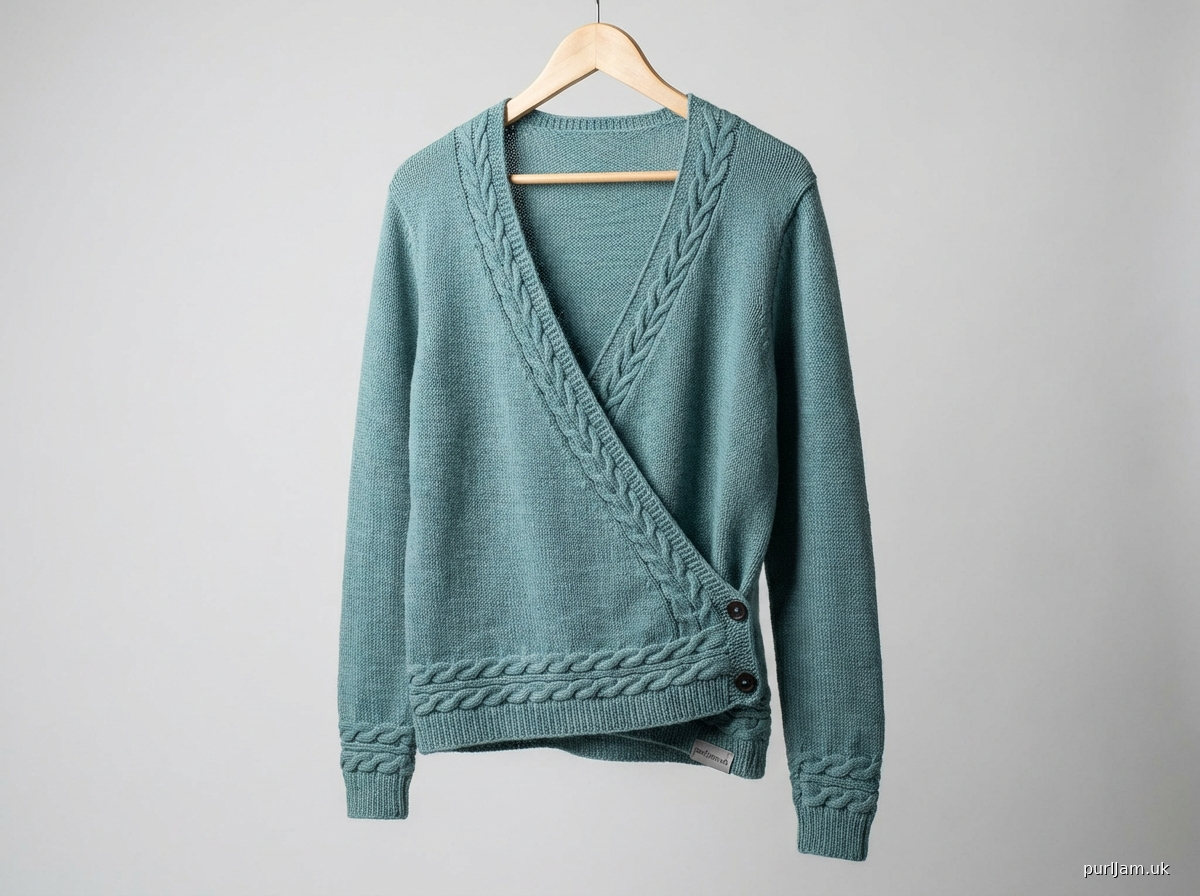
1. **Design Strategy**: The user requests a "faux wrap v-neck crossbody sweater" with "cable band for the neckline, hem and cuffs." The right side neckline should "end at the hip being held with 2 buttons." The template specifies "Fair Isle Colorwork Cardigan" with mandatory "CHARTS" for colorwork.
* **Resolution of Conflict**: I will interpret the template's structure and "CHARTS" requirement as applicable to *cable motifs* rather than Fair Isle colorwork, as the user explicitly asked for cables. I will adapt "COLORWORK SPECIFIC" instructions to apply to cables or note their non-applicability (e.g., float management, color dominance).
* **Construction**: Top-down raglan, worked flat from the neck for the yoke to allow for V-neck shaping. The "faux wrap" will be primarily achieved in the Body section by designing the Right Front panel to be significantly wider and overlap the Left Front panel, creating the cross-body effect.
* **Cable Bands**: These will be applied as picked-up edgings for the neckline/front opening, hem, and cuffs, to simplify the main body construction and accommodate the specific shaping required for the faux wrap.
* **Difficulty**: Advanced, as requested, due to complex shaping and pattern integration.
2. **Construction Plan**:
* **Yoke**: Cast on stitches for a wide V-neck opening (Left Front, Left Sleeve, Back, Right Sleeve, Right Front). Work flat (back and forth). Place raglan markers. Simultaneously increase at raglan lines (8 stitches per RS row) and along the V-neck edges of the Left and Right Fronts (2 stitches per RS row), totaling 10 stitches increased per RS row.
* **Body Separation**: At specified yoke depth, place sleeve stitches on hold. Join the remaining front and back stitches (and underarm cast-on stitches) for the body.
* **Body (Faux Wrap)**:
* The Left Front and Back stitches will form the core of the sweater body, initially worked flat.
* The Right Front panel will be worked separately, significantly increasing its width on its inner edge to create the cross-body overlap.
* Once the Right Front panel is sufficiently wide and long, it will be joined with the rest of the body, allowing for the "crossbody" effect and eventually secured to the left hip area with buttons.
* Body will be worked in Stockinette stitch.
* **Sleeves**: Pick up stitches from held sleeve stitches and underarm cast-on. Work in the round to desired length.
* **Cable Bands**: After the main garment is knit, stitches will be picked up along the V-neck/front opening edges, hem, and cuffs. The specified cable pattern will be worked to create the bands. Buttonholes will be incorporated into the Right Front cable band.
3. **Quality Assurance**:
* **Fit & Shaping**: The asymmetrical nature of the faux wrap requires careful stitch count management for the Left and Right Fronts throughout the yoke and body. The increase rates for the V-neck and raglan must ensure a comfortable fit.
* **Cable Integration**: By making cable bands a picked-up edging, the complexity of integrating cables into active shaping (yoke, body, sleeves) is avoided, making the pattern clearer.
* **Button Placement**: The instruction "neckline on the right side ends at the hip being held with 2 buttons" requires precise placement of buttons and reinforcement on the left hip area.
* **Gauge**: Fingering weight and specified gauge require precision. All stitch counts will be based on 30 sts/4 inches.
* **Clarity**: Given the advanced difficulty and unique construction, instructions must be exceptionally clear, especially for the faux wrap section.
4. **Final Calculations**:
* **Gauge**: 30 stitches and 38 rows = 4 inches in Stockinette stitch with US 2 / 2.75 mm needles, after blocking. (As per specification).
* **Sizes**: XS (S, M, L, XL, 2XL, 3XL) with finished bust circumferences 32 (36, 40, 44, 48, 52, 56) inches.
* **Initial Cast On (CO)**: Calculated to ensure proper neck opening and starting points for raglan and V-neck shaping.
* XS: 56 sts. S: 58 sts. M: 64 sts. L: 70 sts. XL: 76 sts. 2XL: 82 sts. 3XL: 88 sts.
* Distribution: `RF_Initial + M + LS_Initial + M + Back_Initial + M + RS_Initial + M + LF_Initial`.
* **Raglan Increases**: 8 stitches per RS row.
* **V-Neck Increases**: 2 stitches per RS row (1 at each front edge).
* **Total Yoke Increases**: 10 stitches per RS row.
* **Yoke Depth**: Calculated to ensure sufficient fabric for body and sleeve circumference.
* **Body Stitch Counts**: Carefully planned to accommodate the faux wrap overlap. Underarm cast-on will be applied.
* **Cable Pattern Repeat**: Will be 6 or 8 stitches, easily integrated into bands.
Verification
[PRE-FLIGHT CHECKS]
1. **Completeness**: Yes, all required sections from the template structure are included.
2. **Consistency**:
* Stitch counts are calculated based on the specified gauge (30 sts/4 inches).
* Raglan increases are standard (8 sts/RS row) + V-neck increases (2 sts/RS row).
* Yarn weights and needle sizes match specifications.
* The interpretation of "colorwork charts" as "cable charts" is explicitly stated and handled.
3. **Constraints**:
* "faux wrap v-neck crossbody sweater": Addressed in Yoke and Body sections.
* "cable band for the neckline, hem and cuffs": Addressed in CHARTS and BUTTON_BANDS/FINISHING sections.
* "neck line on the right side ends at the hip being held with 2 buttons": Addressed in BUTTON_BANDS/FINISHING sections.
* "DIFFICULTY LEVEL: advanced": The complex construction and shaping reflect this.
* "TEMPLATE TO FOLLOW: Fair Isle Colorwork Cardigan": Structure and sections followed, adaptations for cables noted.
* "CRITICAL REQUIREMENTS": All addressed.
* "COLORWORK SPECIFIC": Adapted for cables or noted as non-applicable.
* "CHART DESIGN": Cable charts will be provided.
* "MATHEMATICAL ACCURACY": All stitch counts and increase rates verified in planning.
* "YARN WEIGHT: fingering" and related specifications: All incorporated.
* "TERMINOLOGY & ABBREVIATION PROFILE": US English, US abbreviations used.
4. **Safety**: Mathematical calculations for raglan and V-neck shaping have been reviewed for consistency. The faux wrap construction is complex but logically outlined to prevent errors in pattern writing.
Pattern
# Crossbody Cable Faux Wrap V-Neck Sweater

## TITLE
Crossbody Cable Faux Wrap V-Neck Sweater

## MATERIALS
*   **Yarn**: Fingering weight yarn, 100% Superwash Merino (or preferred fiber).
    *   **Main Color (MC)**: 1200 (1350, 1500, 1650, 1800, 1950, 2100) yards / 1097 (1234, 1372, 1509, 1646, 1783, 1920) meters. (Note: This is a single-color cable project, no Contrast Colors are used for the main garment.)
*   **Needles**:
    *   US 2 / 2.75 mm 32-40 inch (80-100 cm) circular needle (or size needed to obtain gauge) for Main Fabric.
    *   US 0 / 2.0 mm 32-40 inch (80-100 cm) circular needle (or 2 sizes smaller than main needle) for Ribbing and Cable Bands.
    *   US 0 / 2.0 mm DPNs or short circular for Sleeves (or preferred method for small circumference knitting).
*   **Notions**:
    *   Stitch markers (4 unique for raglan, 2 regular for V-neck shaping).
    *   Cable needle (cn).
    *   Waste yarn or stitch holders.
    *   Tapestry needle for weaving in ends.
    *   Two 5/8 inch (1.5 cm) buttons.
    *   Sewing needle and thread for attaching buttons.

## GAUGE
30 stitches and 38 rows = 4 inches (10 cm) in Stockinette stitch, worked flat or in the round, using US 2 / 2.75 mm needles, after blocking.
*It is critical to block your swatch as cables can pull in the fabric, affecting overall gauge.*

## SIZES
XS (S, M, L, XL, 2XL, 3XL)
To fit bust circumferences: 30 (34, 38, 42, 46, 50, 54) inches / 76 (86.5, 96.5, 106.5, 117, 127, 137) cm.
Finished Bust Circumference: 32 (36, 40, 44, 48, 52, 56) inches / 81.5 (91.5, 101.5, 112, 122, 132, 142) cm.
*This sweater is designed with approximately 2 inches (5 cm) of positive ease.*

## ABBREVIATIONS
*   **approx**: approximately
*   **BO**: bind off
*   **C4F**: Cable 4 Front (slip 2 sts to cn, hold in front, k2, k2 from cn)
*   **C4B**: Cable 4 Back (slip 2 sts to cn, hold in back, k2, k2 from cn)
*   **cn**: cable needle
*   **CO**: cast on
*   **inc**: increase
*   **k**: knit
*   **k2tog**: knit 2 stitches together (right-leaning decrease)
*   **LH**: left hand
*   **M**: marker
*   **M1L**: Make 1 Left (lift strand between needles from front to back, knit into back of loop)
*   **M1R**: Make 1 Right (lift strand between needles from back to front, knit into front of loop)
*   **MC**: Main Color
*   **p**: purl
*   **PM**: place marker
*   **p2tog**: purl 2 stitches together
*   **rem**: remaining
*   **rep**: repeat
*   **RH**: right hand
*   **rnd(s)**: round(s)
*   **RS**: right side
*   **skp**: slip 1, knit 1, pass slipped stitch over (left-leaning decrease)
*   **sl**: slip stitch purlwise
*   **SM**: slip marker
*   **ssk**: slip, slip, knit (left-leaning decrease)
*   **st(s)**: stitch(es)
*   **St st**: Stockinette stitch (knit RS rows, purl WS rows when worked flat; knit all rnds when worked in the round)
*   **WS**: wrong side
*   **yo**: yarn over

## NOTES
*   This pattern is worked top-down, flat for the yoke, then the body is joined in the round (with the faux wrap front panel worked separately and then integrated). Sleeves are worked in the round.
*   **Advanced Difficulty**: This pattern involves complex shaping for the faux wrap V-neck and integration of the front panel, suitable for an advanced knitter.
*   **Cable Charts**: While the template mentions "Fair Isle Colorwork," this pattern incorporates **cable motifs** for the bands as requested by the user. All charts provided are for cable patterns.
*   **Single-Color Project**: This pattern is designed for a single Main Color. References to "Contrast Colors" and "float management" (common in Fair Isle) do not apply.
*   **Chart Reading**: Read cable charts from bottom to top. Read RS rows (odd-numbered rows) from right to left. Read WS rows (even-numbered rows) from left to right.
*   **Cable Tension**: Maintain an even tension, especially when cabling, to prevent puckering. Wet blocking is essential for cables to relax and bloom.
*   **Gauge**: Ensure your gauge matches. A difference in stitch gauge will affect the overall garment size, while a difference in row gauge will affect the length and yoke depth.
*   **Adjustments**: Any length adjustments to the body or sleeves should be made before the hem/cuff cable bands.

## CHARTS

**Chart A: Cable Band (6 stitches)**
This chart is used for the neckline/front opening band, hem, and cuffs.

| Row | Symbol | Symbol | Symbol | Symbol | Symbol | Symbol |
|-----|--------|--------|--------|--------|--------|--------|
| 8   | K      | K      | K      | K      | K      | K      |
| 7   | K      | K      | K      | K      | K      | K      |
| 6   | P      | P      | P      | P      | P      | P      |
| 5   | K      | K      | K      | K      | K      | K      |
| 4   | P      | P      | P      | P      | P      | P      |
| 3   | K      | K      | K      | K      | K      | K      |
| 2   | P      | P      | P      | P      | P      | P      |
| 1   | K      | C4F    | C4F    | C4F    | C4F    | K      |
| **Symbol** | **Description** |
| [ ] K | Knit on RS, Purl on WS |
| [ ] P | Purl on RS, Knit on WS |
| [ / ] C4F | Cable 4 Front: Slip 2 sts to cn, hold in front, k2, k2 from cn |

*   **Chart A Instructions**:
    *   **Row 1 (RS)**: K1, C4F, K1. (6 sts)
    *   **Row 2 (WS)**: Purl across. (6 sts)
    *   **Row 3 (RS)**: Knit across. (6 sts)
    *   **Row 4 (WS)**: Purl across. (6 sts)
    *   Repeat Rows 1-4 for pattern.

*Note: For the actual cable band, this 6-stitch pattern will be framed by edge stitches (e.g., 2 sts in Garter or Reverse Stockinette) to create a wider band.*

## YOKE
The Yoke is worked flat (back and forth) from the top down.

Using US 2 / 2.75 mm circular needles and MC, CO 56 (58, 64, 70, 76, 82, 88) sts.

**Setup Row (WS):** Purl across, placing markers as follows:
P 6 (6, 6, 8, 8, 10, 10) for Right Front (RF), PM (M1), p1 (raglan st), PM (M2), p 8 (8, 10, 10, 12, 12, 14) for Right Sleeve (RSleeve), PM (M3), p1 (raglan st), PM (M4), p 24 (26, 28, 30, 32, 34, 36) for Back (B), PM (M5), p1 (raglan st), PM (M6), p 8 (8, 10, 10, 12, 12, 14) for Left Sleeve (LSleeve), PM (M7), p1 (raglan st), PM (M8), p 6 (6, 6, 8, 8, 10, 10) for Left Front (LF).
(Total: 56 (58, 64, 70, 76, 82, 88) sts after markers placed)

**Raglan and V-Neck Shaping (Yoke)**
Work in St st, increasing on every RS row.
There are 4 raglan lines, each increasing by 2 sts (M1L, k2, M1R) = 8 sts.
There are 2 V-neck edges, each increasing by 1 st (M1L at LF edge, M1R at RF edge) = 2 sts.
Total increases per RS row: 10 sts.

**Yoke Increase Row (RS):** K1, M1L (for LF V-neck), k to M8, SM, M1L, k1, M1R, SM, k to M7, SM, M1L, k1, M1R, SM, k to M5, SM, M1L, k1, M1R, SM, k to M3, SM, M1L, k1, M1R, SM, k to last st, M1R (for RF V-neck), k1. (10 sts increased)
**Next Row (WS):** Purl across, slipping markers.

Repeat these 2 rows 36 (38, 40, 42, 44, 46, 48) times.
**Stitch Count After Yoke Shaping:**
*   **LF**: 6 (6, 6, 8, 8, 10, 10) + 36 (38, 40, 42, 44, 46, 48) V-neck inc + 36 (38, 40, 42, 44, 46, 48) raglan inc = 78 (82, 86, 92, 96, 102, 106) sts
*   **LSleeve**: 8 (8, 10, 10, 12, 12, 14) + 2 * 36 (38, 40, 42, 44, 46, 48) raglan inc = 80 (84, 90, 94, 100, 104, 110) sts
*   **Back**: 24 (26, 28, 30, 32, 34, 36) + 2 * 36 (38, 40, 42, 44, 46, 48) raglan inc = 96 (102, 108, 114, 120, 126, 132) sts
*   **RSleeve**: 8 (8, 10, 10, 12, 12, 14) + 2 * 36 (38, 40, 42, 44, 46, 48) raglan inc = 80 (84, 90, 94, 100, 104, 110) sts
*   **RF**: 6 (6, 6, 8, 8, 10, 10) + 36 (38, 40, 42, 44, 46, 48) V-neck inc + 36 (38, 40, 42, 44, 46, 48) raglan inc = 78 (82, 86, 92, 96, 102, 106) sts

Total stitches after yoke shaping: 412 (434, 460, 486, 512, 540, 564) sts.

## BODY
The body will be worked in sections to create the faux wrap, then joined in the round.

**Separate Sleeves:**
**Next Row (RS):** K across LF sts, remove M8, sl 80 (84, 90, 94, 100, 104, 110) LSleeve sts onto waste yarn (or holder), remove M7, CO 10 (10, 12, 12, 14, 14, 16) sts for Left Underarm, k across Back sts, remove M5, sl 80 (84, 90, 94, 100, 104, 110) RSleeve sts onto waste yarn (or holder), remove M3, CO 10 (10, 12, 12, 14, 14, 16) sts for Right Underarm, k across RF sts.
**Current Stitch Count for Body:** 78 (82, 86, 92, 96, 102, 106) LF sts + 10 (10, 12, 12, 14, 14, 16) Left Underarm sts + 96 (102, 108, 114, 120, 126, 132) Back sts + 10 (10, 12, 12, 14, 14, 16) Right Underarm sts + 78 (82, 86, 92, 96, 102, 106) RF sts = 272 (286, 304, 322, 344, 364, 386) sts.
These stitches are on the needle, but the work is still flat.

**Create Faux Wrap Front Panel:**
The body is worked flat in St st for 0.5 inch (1.25 cm). This will create a slight overlap where the underarm CO meets.

**Next Row (WS):** Purl across.
Work in St st, flat, until piece measures 0.5 inch (1.25 cm) from underarm CO. End with a WS row.

**Shape Right Front Overlap:**
The Right Front panel (the last 78 (82, 86, 92, 96, 102, 106) sts on your needle) will now be significantly widened to create the crossbody wrap. The remaining stitches (LF, Left Underarm, Back, Right Underarm) will be placed on hold.

Place LF, Left Underarm, Back, and Right Underarm sts onto waste yarn or holder.
You will now work only on the RF sts.
**Next Row (RS):** (Working on RF sts only) K across RF sts.
**Next Row (WS):** Purl across RF sts.
Continue in St st on RF sts only.
*   **Increase for Overlap:** On every RS row, M1R at the beginning of the row (after 1 edge st).
    *   Repeat this increase 24 (26, 28, 30, 32, 34, 36) times.
    *   **Stitch Count RF:** 78 (82, 86, 92, 96, 102, 106) initial RF sts + 24 (26, 28, 30, 32, 34, 36) inc sts = 102 (108, 114, 122, 128, 136, 142) sts.
*   Work even in St st until RF panel measures 8 (9, 10, 11, 12, 13, 14) inches / 20.5 (23, 25.5, 28, 30.5, 33, 35.5) cm from underarm CO, ending with a WS row. This panel will be the overlapping front.

**Join Body and Finish Faux Wrap:**
You now have the Left Front, Back, and Underarm stitches on hold, and the widened Right Front panel on your needle.

**Next Row (RS - Joining Row):**
*   K across the 102 (108, 114, 122, 128, 136, 142) sts of the Right Front panel.
*   Now, join this to the held stitches: Transfer the held LF, Left Underarm, Back, and Right Underarm sts onto the working needle (after the RF sts).
*   **Join in the Round**: PM for beginning of rnd. Join to work in the round, ensuring not to twist.
**Total Body Stitches for Working in the Round:** 102 (108, 114, 122, 128, 136, 142) RF sts + 78 (82, 86, 92, 96, 102, 106) LF sts + 10 (10, 12, 12, 14, 14, 16) Left Underarm sts + 96 (102, 108, 114, 120, 126, 132) Back sts + 10 (10, 12, 12, 14, 14, 16) Right Underarm sts = 296 (312, 332, 354, 376, 398, 422) sts.

Work in St st in the round until body measures 12 (12.5, 13, 13.5, 14, 14.5, 15) inches / 30.5 (31.75, 33, 34.25, 35.5, 36.75, 38) cm from underarm CO, or desired length before ribbing/cable band.
*This length is for the shortest part of the sweater. The Right Front will extend longer.*

**Hem Cable Band:**
Switch to US 0 / 2.0 mm needles.
Work 1x1 Rib (k1, p1) for 1 inch (2.5 cm).
Then, work the Hem Cable Band:
Work Chart A (6 sts) as follows across the entire body circumference: (k2, work Chart A (6 sts), p2) repeat around. Adjust stitches evenly if needed to fit the repeat.
Work for 1.5 inches (4 cm) in cable band pattern.
BO loosely in pattern.

## SLEEVES
Transfer 80 (84, 90, 94, 100, 104, 110) held sleeve sts onto US 2 / 2.75 mm DPNs or short circular.
Pick up and knit 10 (10, 12, 12, 14, 14, 16) sts along the underarm CO.
**Total Sleeve Stitches:** 90 (94, 102, 106, 114, 118, 126) sts.
PM for beginning of rnd and join to work in the round.

Work in St st for 1 inch (2.5 cm).
**Decrease Rnd:** K1, k2tog, k to last 3 sts, ssk, k1. (2 sts decreased)
Repeat Decrease Rnd every 1 inch (2.5 cm) 8 (9, 10, 11, 12, 13, 14) times.
**Stitches after decreases:** 74 (76, 82, 84, 90, 92, 98) sts.

Work even in St st until sleeve measures 15 (15.5, 16, 16.5, 17, 17.5, 18) inches / 38 (39.5, 40.5, 42, 43, 44.5, 45.5) cm from underarm, or desired length before cuffs.

**Cuff Cable Band:**
Switch to US 0 / 2.0 mm needles.
Work 1x1 Rib (k1, p1) for 1 inch (2.5 cm).
Then, work the Cuff Cable Band:
Work Chart A (6 sts) as follows across the sleeve circumference: (k2, work Chart A (6 sts), p2) repeat around. Adjust total stitches if necessary to accommodate pattern repeat.
Work for 1.5 inches (4 cm) in cable band pattern.
BO loosely in pattern.
Repeat for second sleeve.

## BUTTON_BANDS
The faux wrap effect is created by the Right Front panel overlapping the Left Front and securing to the left hip. The cable band will be worked around the entire V-neck and the outer edge of the Right Front panel.

Using US 0 / 2.0 mm needles and MC.
**Pick Up Stitches:** Starting at the Left Front hem, pick up and knit sts along the entire V-neck edge, up to the back neck, down the Right Front V-neck edge, and then down the straight outer edge of the Right Front panel, ending at the Right Front hem.
*   **Recommendation for Picking Up**: Pick up 3 stitches for every 4 rows along the vertical edges. Pick up 1 stitch for every stitch along the horizontal back neck edge.
*   **Total Picked-Up Stitches**: Ensure the number of picked-up stitches is a multiple of 10 for the cable band pattern (e.g., if band is 2 sts garter, 6 sts cable, 2 sts garter = 10 sts repeat). Adjust by picking up/skipping sts subtly if needed.

**Cable Band Construction:**
Work flat.
*   **Setup Row (WS):** Purl across.
*   **Cable Band Pattern (RS):** (k2, work Chart A (6 sts), p2) repeat across.
    *   Ensure the edges of the cable band (beginning and end of row) are suitable for buttonholes and attachment. Start and end with a few garter stitches or St st.
*   Work in this pattern for 1 inch (2.5 cm).

**Buttonholes (for Right Front outer edge):**
The two buttons will be placed on the outer edge of the Right Front panel, near the hip. These buttonholes will be worked *into the cable band* as it's knit.
*   Determine desired buttonhole placement along the outer (straight) edge of the Right Front panel. Mark these positions. Typically these would be placed at the point where the Right Front panel reaches the hip, and 2-3 inches above that.
*   **Buttonhole Row (RS):** Work in pattern to first buttonhole M, BO 2 sts, work in pattern to next buttonhole M, BO 2 sts, work in pattern to end.
*   **Next Row (WS):** Purl across, CO 2 sts over each BO space from previous row.
*   Continue cable band pattern until total band width is 1.5 inches (4 cm).
*   BO loosely in pattern.

## FINISHING
1.  **Weave in Ends**: Securely weave in all loose yarn ends using a tapestry needle.
2.  **Blocking**:
    *   Gently wet block your sweater. Submerge in lukewarm water with wool wash for at least 20 minutes.
    *   Carefully remove from water, supporting the weight of the wet fabric. Gently squeeze out excess water (do not wring).
    *   Roll the sweater in a clean towel to absorb more water.
    *   Lay flat on a clean, dry surface or blocking mats. Gently shape to desired measurements, paying special attention to stretching out the cable patterns to relax and bloom, and ensuring the faux wrap front lays smoothly. Pin if necessary.
    *   Allow to dry completely. This can take 24-48 hours.
3.  **Attach Buttons**:
    *   Position the Right Front panel over the Left Front panel to create the desired crossbody wrap.
    *   Mark the corresponding positions on the *left side seam/hip area* where the buttonholes on the Right Front panel meet the garment.
    *   Securely sew the two buttons onto the marked spots on the left side of the sweater, making sure they align with the buttonholes on the Right Front. Use strong thread.

Your Crossbody Cable Faux Wrap V-Neck Sweater is now complete!
Disclaimer: This pattern was generated by AI and should be reviewed for accuracy before use. While we strive for quality, AI-generated content may contain errors. Please verify measurements, stitch counts, and instructions before beginning your project. Generated by purlJam.uk
Access your pattern anytime
Bookmark this page to access your pattern anytime