Type
Crochet
Difficulty
beginner
Category
scarf
AI Thinking Process
Planning
Verification
Pattern
PHYSICHROMIE SCARF
A beginner single-crochet color study inspired by Carlos Cruz-Diez
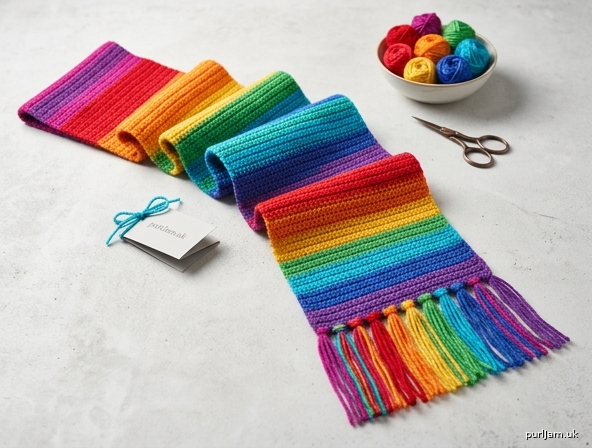
An original crochet interpretation of the chromatic investigations of Carlos Cruz-Diez (1923–2019)—not a copy of any specific work. Parallel bands of saturated color sit side by side so the eye mixes them at the boundaries (additive color / chromatic induction). As the scarf moves, those edges appear to vibrate, the Physichromie idea in worsted yarn.
Worked entirely in single crochet. Both sides look the same.
Skill level: Beginner (chain, single crochet, changing color, weaving ends)
Finished size (after light blocking, excluding optional fringe): 7" wide × 64" long (18 cm × 163 cm)
Materials
Yarn: Worsted weight (Category 4), 8 high-chroma colors.
Approximately 65 yd / 60 m of each color for the body (about 520 yd / 475 m total). Optional fringe uses extra yarn (see Finishing).
Buy one standard 3.5 oz / 100 g skein of each color (most worsted skeins are 180–220 yd / 165–200 m); you will have leftovers.
Suggested palette (Color A → Color H). Use the strongest, clearest hues you can find:
| Color | Hue |
|---|---|
| A | Magenta / fuchsia |
| B | True red |
| C | Bright orange |
| D | Golden yellow |
| E | Kelly or lime green |
| F | Turquoise / cyan |
| G | Cobalt blue |
| H | Violet / purple |
Hook: US H/8 (5 mm), or size needed to obtain gauge
Notions: Yarn needle, scissors, measuring tape. Blocking mats and pins (optional).
Gauge
16 sc and 18 rows = 4" (10 cm) in single crochet, lightly blocked.
Work a swatch at least 5" (13 cm) square, block it, then measure the center 4" (10 cm).
If your swatch is too small (more than 16 sc in 4"): go up one hook size. If your swatch is too large (fewer than 16 sc in 4"): go down one hook size.
Stitch count is written for this gauge. Changing gauge changes width and yarn amounts.
Abbreviations (US)
- ch — chain
- sc — single crochet
- st(s) — stitch(es)
- yo — yarn over
- RS — right side (the side facing you on odd-numbered rows of each stripe)
Turning chain does not count as a stitch.
Pattern notes
- Scarf is a rectangle of 28 sc, worked in rows until 288 rows (16 stripes) are complete.
- Each stripe is 18 rows of one color (4" / 10 cm). Eight colors run in order, then the whole sequence repeats once.
- 18 is even, so every color change lands on the same long edge. Keep all tails on that edge; weaving is much easier.
- Change color on the last yarn-over of the last stitch of the stripe (see Color change). Cut the old color, leaving a 6" (15 cm) tail.
- Chain 1 and turn at the end of every row. Work the first sc into the first sc of the previous row (not into the turning chain).
- Count stitches every few rows. You should always have 28 sc.
- Weave tails as you go, into the matching color band along the join edge, so you are not left with 32 ends at the finish.
Color change (beginner method): Work the last sc of the stripe until 2 loops remain on the hook. Drop the old color. Yo with the new color and pull through both loops. Ch 1, turn. Continue in the new color. Gently snug the first stitch of the new row so the join sits flush with the edge.
Instructions
Foundation (Color A): Ch 29. Sc in 2nd ch from hook and in each ch across. (28 sc ✓) Ch 1, turn.
Stripe 1 — Color A (magenta): Row 1 (RS): Sc in each sc across. (28 sc) Rows 2–18: Ch 1, turn. Sc in each sc across. (28 sc)
At the end of Row 18, change to Color B on the last yo.
Stripes 2–16: Work 18 rows of sc in the next color in the sequence below. Always: ch 1, turn; sc in each of 28 sc. Change color on the last yo of Row 18 of each stripe (except the final stripe).
Stripe sequence
Work each line for 18 rows (4" / 10 cm). Total: 16 × 18 = 288 rows = 64" ✓
First pass
- Color A — magenta
- Color B — red
- Color C — orange
- Color D — yellow
- Color E — green
- Color F — turquoise
- Color G — blue
- Color H — violet
Second pass (repeat) 9. Color A — magenta 10. Color B — red 11. Color C — orange 12. Color D — yellow 13. Color E — green 14. Color F — turquoise 15. Color G — blue 16. Color H — violet
After Stripe 16, Row 18: fasten off Color H. Leave a 6" (15 cm) tail.
Check as you go: After 4 stripes you should have about 16" (40 cm); after 8 stripes, 32" (81 cm); after 16 stripes, 64" (163 cm). If your row gauge differs, add or omit rows inside a stripe in pairs so color changes stay on the same edge, and stop when the piece measures 64" (163 cm).
Finishing
- Weave in all remaining tails along the join-edge selvedge, each tail into its own color. Do not weave a tail through a neighboring color or it will show.
- Block: soak in cool water, press out water in a towel (do not wring), pin to 7" × 64" (18 × 163 cm), and dry flat. Blocking evens the starting-chain edge and the color joins.
- Trim any stray fibers.
Optional fringe (not required): Cut 14" (35.5 cm) strands. For each end, use the color of that end stripe (A at the starting end, H at the finishing end), or mix all eight colors for a chromatic fringe.
- Fold 3 strands in half.
- Insert hook from the RS through a stitch on the short edge, catch the fold, pull a loop through, then pull the cut ends through the loop (lark’s head).
- Place one tassel in every other stitch: 14 tassels per end (28 sc ÷ 2 = 14 ✓).
- Trim even to about 6" (15 cm).
Fringe uses about 40 yd / 37 m extra if you fringe both ends in two colors, or about 8 yd / 7 m of each of the eight colors if mixed.
Schematic (not to scale)
        <——  7" / 28 sc  ——>
        +------------------+     ^
        | A  magenta   4"  |     |
        | B  red       4"  |     |
        | C  orange    4"  |     |
        | D  yellow    4"  |     |
        | E  green     4"  |     |
        | F  turquoise 4"  |    64"
        | G  blue      4"  |     |
        | H  violet    4"  |     |
        | A–H repeat   32" |     |
        +------------------+     v
   all color changes on this edge →
Designer notes for wearing
Cruz-Diez wanted color to behave as an event, not a static surface. Drape the scarf so several bands sit next to each other at the neck; walk past a window. The red/green and blue/orange meetings are where chromatic induction is strongest. There is no “right side”—flip it freely.
Disclaimer: This pattern was generated by AI and should be reviewed for accuracy before use. While we strive for quality, AI-generated content may contain errors. Please verify measurements, stitch counts, charts, and instructions before beginning your project. Generated by purlJam.uk
Love this pattern?
Save this pattern to your free PurlJam libraryAccess your pattern anytime
Bookmark this page to access your pattern anytime