Type
Knitting
Difficulty
beginner
Category
pullover
AI Thinking Process
Planning
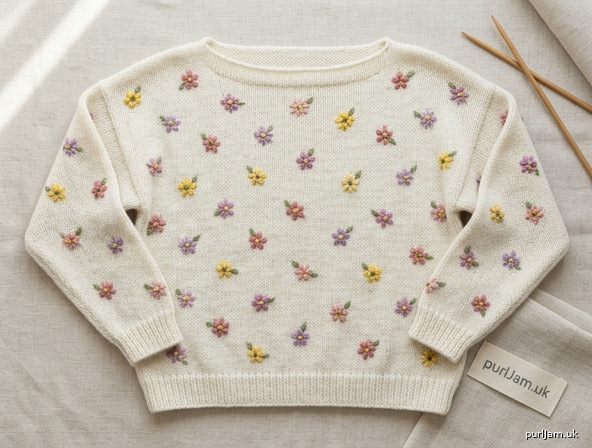
1. **Design Strategy**: A beginner-friendly oversized drop-shoulder pullover in off-white worsted yarn, worked as simple rectangles with a boatneck (the easiest neckline). Small scattered flowers are added after knitting using embroidery (lazy daisy + French knots) in yellow, pink, purple and green, keeping the knitting itself completely plain for beginners.
2. **Construction Plan**: Knit Back and Front as plain rectangles, seam shoulders leaving centre open for boatneck, pick up sleeve stitches along the straight armhole edge and work down to cuff, then seam sides/underarms and embroider flowers.
3. **Quality Assurance**:
- Ensure generous oversized ease (≈20 cm / 8" total) without losing beginner simplicity.
- Sleeve pick-up rate must match tension (3 sts ≈ 4 rows) to avoid flaring.
- Embroidery placement must be even/random — provide spacing guidance to avoid clustering.
4. **Final Calculations**:
- Tension: 18 sts × 24 rows = 10 cm in st st on 5mm needles.
- Sizes (finished chest): S 112cm, M 122cm, L 132cm, XL 142cm, 2XL 152cm.
- Back/Front CO: 100 / 110 / 118 / 128 / 136 sts (half-chest × 18/10 + selvedge ease).
- Body length: 60 / 62 / 64 / 66 / 68 cm.
- Sleeve pick-up: armhole depth 25/26/27/28/29 cm → ~90/94/98/100/104 sts.
- Cuff: 40/42/44/46/48 sts after decreases.
Verification
[PRE-FLIGHT CHECKS]
1. **Completeness**: Back, Front, Shoulder join (boatneck), Sleeves (picked up, no cap), finishing/embroidery all present. ✓
2. **Consistency**: 100 sts ÷ 18 sts/10cm = 55.5 cm half-width × 2 = 111 cm ≈ 112 cm chest (S). ✓ All sizes verified below in pattern.
3. **Constraints**: Off-white base ✓; oversized (8" ease) ✓; boatneck (template default) ✓; beginner level (plain rectangles + embroidery) ✓; small multicoloured scattered flowers ✓; UK English + metric-first ✓; worsted yarn ✓.
4. **Safety**: Sleeve pick-up rate 3 sts per 4 rows checked; decrease counts produce even cuff numbers. ✓
Pattern
# Scattered Blooms — Oversized Drop-Shoulder Pullover

A cosy, boxy pullover in off-white worsted yarn, scattered all over with tiny embroidered flowers in yellow, pink, purple and green. The knitting itself is completely plain (simple rectangles and a relaxed boatneck), making this an ideal first sweater. All the personality comes from quick, beginner-friendly surface embroidery worked once the knitting is finished.

**Difficulty:** Beginner
**Construction:** Drop shoulder, worked flat. Back and Front rectangles, shoulders seamed, sleeves picked up and worked down, then embroidered.

---

## Sizes

| Size | S | M | L | XL | 2XL |
|------|---|---|---|----|-----|
| Finished chest (cm) | 112 | 122 | 132 | 142 | 152 |
| Finished chest (in) | 44 | 48 | 52 | 56 | 60 |
| Body length (cm) | 60 | 62 | 64 | 66 | 68 |
| Armhole depth (cm) | 25 | 26 | 27 | 28 | 29 |

*Designed with approximately 20 cm (8") of positive ease for an oversized fit. Choose your size based on your actual bust/chest measurement plus this ease, or measure a favourite oversized jumper and match the finished chest.*

Figures are given as S (M, L, XL, 2XL). Where only one number appears, it applies to all sizes.

---

## Materials

- **Yarn:** Worsted weight (Aran-ish/medium, CYC 4) in off-white.
  Approx. quantities: 850 (950, 1050, 1150, 1250) m.
- **Small amounts** of worsted or DK yarn for embroidery in **yellow, pink, purple and green** (a few metres of each — leftover oddments are perfect).
- **Needles:** 5 mm (UK 6 / US 8) for main fabric; 4.5 mm (UK 7 / US 7) for ribbing. Use circular needles if you prefer, but work flat.
- **Notions:** Tapestry/darning needle (blunt, for seaming), embroidery needle (sharp, for flowers), stitch markers, scrap yarn or stitch holders.

---

## Tension (Gauge)

**18 sts and 24 rows = 10 cm (4")** over stocking stitch on 5 mm needles, after blocking.

*Please make a tension square — it determines whether the jumper fits. If you have more stitches than 18, try a larger needle; if fewer, try a smaller needle.*

---

## Abbreviations (UK)

- **CO** – cast on
- **BO** – bind/cast off
- **k** – knit
- **p** – purl
- **st(s)** – stitch(es)
- **st st** – stocking stitch (k on RS, p on WS)
- **RS / WS** – right side / wrong side
- **k2tog** – knit two together (decrease)
- **rep** – repeat
- **PU** – pick up and knit

---

## Pattern Notes

This is a drop-shoulder design: the Back and Front are plain rectangles with **no armhole shaping**. The shoulder seam sits well down the upper arm — this is intentional and gives the relaxed, oversized look. The boatneck requires no neck shaping; you simply leave the centre stitches open when seaming the shoulders.

---

## BACK

With **4.5 mm needles**, CO **100 (110, 118, 128, 136) sts**.

**Ribbing:** Work in k1, p1 rib for 6 cm (2½"), ending with a WS row.

Change to **5 mm needles**.

Work straight in **st st** (k on RS, p on WS) until piece measures **60 (62, 64, 66, 68) cm** from cast-on edge, ending with a WS row.

**Check:** 100 sts ÷ 18 sts per 10 cm = 55.6 cm wide → ×2 = 111 cm ≈ 112 cm (S). ✓ Length matches table. ✓

**Shoulders & neck:** You will divide the stitches into two shoulders and a centre boatneck section.

- Shoulder sts (each): **30 (34, 37, 41, 44) sts**
- Centre neck sts: **40 (42, 44, 46, 48) sts**

Check: 30 + 40 + 30 = 100 (S) ✓ · 34+42+34=110 (M) ✓ · 37+44+37=118 (L) ✓ · 41+46+41=128 (XL) ✓ · 44+48+44=136 (2XL) ✓

**Next row (RS):** BO all sts loosely, OR place shoulder sts on holders and keep centre neck sts on a holder for a smoother boatneck join (recommended). If binding off, BO **30 (34, 37, 41, 44)** for first shoulder, BO **40 (42, 44, 46, 48)** for neck, BO remaining **30 (34, 37, 41, 44)** for second shoulder.

---

## FRONT

Work **exactly as for the Back** — same cast-on, same ribbing, same length, same shoulder/neck division.

*Because this is a boatneck, the Front and Back are identical. No front neck shaping is needed.*

---

## JOIN SHOULDERS

With RS together (or use a tapestry needle and mattress stitch on the RS), seam the **right shoulder**: join the 30 (34, 37, 41, 44) Back shoulder sts to the matching Front shoulder sts.

Repeat for the **left shoulder**.

Leave the centre **40 (42, 44, 46, 48) sts** of Front and Back **unseamed** — this open span forms the boatneck. The neck opening will measure approximately **22 (23, 24, 25, 27) cm** across.

*Tip: A 3-needle bind off gives a tidy, sturdy shoulder seam — work it with RS together over the held shoulder stitches.*

---

## SLEEVES (picked up and worked down)

The sleeves are worked downward from the straight armhole edge. Because there is no armhole indentation, there is **no sleeve cap** — the sleeve top is flat.

**Mark the armhole:** Lay the joined body flat. From the shoulder seam, measure **25 (26, 27, 28, 29) cm** down each side of the Front and the Back, and place a marker. This span (×2 for front + back) is your armhole opening.

With **5 mm needles** and RS facing, starting at one marker, **pick up and knit** stitches evenly along the armhole edge to the other marker.

- PU **90 (94, 98, 100, 104) sts** total.

**Pick-up rate guide:** Pick up roughly **3 sts for every 4 rows** (matching the 24-row/10 cm tension). Armhole depth 25 cm × 2 sides = 50 cm of edge → 50 cm × ~1.8 sts/cm ≈ 90 sts (S). ✓

Work in **st st**, beginning with a WS (purl) row.

**Sleeve shaping (decreases):** To taper toward the cuff, work decreases as follows:

**Decrease row (RS):** k2, k2tog, knit to last 4 sts, k2tog, k2. *(2 sts decreased)*

Work this decrease row every **6th row** a total of **23 (24, 25, 25, 26) times**.

- Stitches after shaping: 90 − 46 = **44 (46, 48, 50, 52) sts**.

Check (M): 94 − (24×2) = 94 − 48 = 46 ✓
Check (2XL): 104 − (26×2) = 104 − 52 = 52 ✓

Continue straight (no further decreases) until sleeve measures **42 (43, 44, 45, 46) cm** from the pick-up edge, or 4 cm short of desired length, ending with a WS row.

**Adjust to a tidy cuff number** if needed: on the next RS row, decrease evenly to **40 (42, 44, 46, 48) sts** (decrease 4 (4, 4, 4, 4) sts spaced across the row).

**Cuff:** Change to **4.5 mm needles**. Work k1, p1 rib for 6 cm (2½"). BO loosely in rib.

Work the **second sleeve** identically on the other armhole.

---

## MAKING UP (Finishing)

1. **Side and underarm seams:** With RS together (or mattress stitch on RS), seam each side of the body and the underside of the sleeve in one continuous line, from cuff to hem. Match the underarm point carefully.
2. **Weave in** all ends.
3. **Block** the jumper: gently wet-block or steam to the finished measurements. This evens out the stocking stitch and the picked-up sleeves. Lay flat to dry.

---

## EMBROIDERED SCATTERED FLOWERS

This is where your jumper comes to life. The flowers are small and dotted **all over** in yellow, pink, purple and green. Work them once the jumper is blocked and seamed.

**You will use two simple stitches:**

- **Lazy daisy (detached chain)** — makes each flower petal.
- **French knot** — makes the flower centre.

### Flower recipe (each flower ≈ 2 cm wide)

1. Choose a petal colour (yellow, pink, or purple). Bring the embroidery needle up at the flower centre.
2. Work **5 lazy daisy petals** in a ring around the centre point (like a clock at 12, 2½, 5, 7½, 10).
3. Work a **French knot** in the centre — use a contrasting colour (e.g. a yellow centre on a pink flower, or green for variety).
4. Optionally add **2–3 tiny green lazy daisy "leaves"** beside some flowers.

#### Lazy daisy how-to
Bring needle up at the centre. Insert it back down right beside where it came up, but don't pull tight — leave a small loop. Bring the needle up again at the tip of the petal, *inside* the loop. Pull gently to form a petal, then insert the needle just outside the loop to anchor it. Repeat for each petal.

#### French knot how-to
Bring needle up at the centre. Wrap the yarn around the needle 2–3 times. Insert the needle back down very close to where it came up (not the same hole), holding the wraps snug, and pull through.

### Placement

- Scatter flowers **randomly and evenly** across the Front, Back and Sleeves.
- Aim for roughly one flower every **10–12 cm** in a loose, irregular spacing — avoid straight lines or obvious rows.
- **Vary the colours** so no two neighbouring flowers match. A balanced mix per flower: about 40% pink, 30% purple, 30% yellow, with green used for centres and leaves.
- A typical jumper uses approximately **40–60 flowers** total. Start with a few, step back, and fill gaps.

*Tip: Place a few flowers across the boatneck and cuffs too, so the scatter looks continuous. Mark random dots lightly with a water-soluble fabric pen first if you'd like a guide.*

---

## FINISHED MEASUREMENTS RECAP

| Size | S | M | L | XL | 2XL |
|------|---|---|---|----|-----|
| Chest (cm) | 112 | 122 | 132 | 142 | 152 |
| Body length (cm) | 60 | 62 | 64 | 66 | 68 |
| Sleeve length (cm) | 48 | 49 | 50 | 51 | 52 |
| Neck opening (cm) | 22 | 23 | 24 | 25 | 27 |

Sleeve length = pick-up to cuff (42/43/44/45/46) + cuff (6) = 48 (49, 50, 51, 52) cm. ✓

Enjoy your blooming oversized jumper! 🌼
Disclaimer: This pattern was generated by AI and should be reviewed for accuracy before use. While we strive for quality, AI-generated content may contain errors. Please verify measurements, stitch counts, and instructions before beginning your project. Generated by purlJam.uk
Access your pattern anytime
Bookmark this page to access your pattern anytime