Type
Knitting
Difficulty
advanced
Category
scarf
AI Thinking Process
Planning
Verification
Pattern
Snowfall Scarf
(Worked Flat)
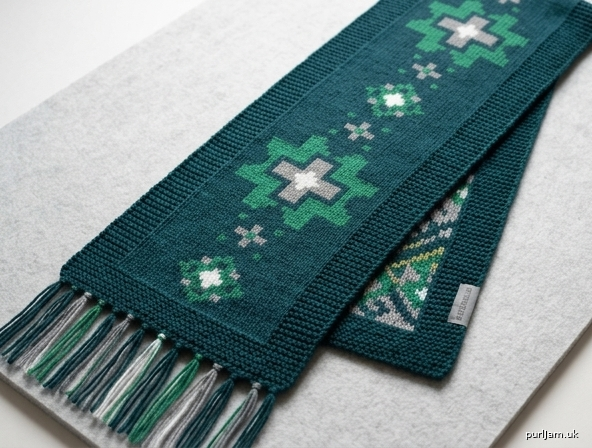
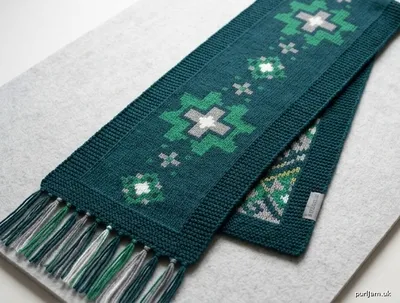
A long, single-layer fingering-weight scarf in stranded colorwork, knit straight on two needles. Deep peacock green and gray form a drifting snowfield; white and emerald are used as sparkle. Garter borders keep the edges flat. Optional fringe finishes both short ends.
This is an original flat construction. If you are following snow-motif charts labeled A (opening), B (transition), and C (allover field), use them for color placement. Work the center panel in pattern; keep the 6-stitch borders in MC garter throughout.
Skill level: Advanced (stranded colorwork worked flat)
Finished measurements
Width: 7¼" (18.5 cm), blocked
Length: 63" (160 cm), excluding fringe
Fringe: about 6" (15 cm) at each short end (optional)
Materials
Yarn: Fingering weight (4-ply), 4 colors
Suggested amounts (you will have leftover from the original 3-skein MC / CC1 quantities):
- MC Peacock green: 500 yd / 457 m (fingering)
- CC1 Gray: 500 yd / 457 m (fingering)
- CC2 White: 44 yd / 40 m (fingering)
- CC3 Emerald green: 44 yd / 40 m (fingering)
A smooth, tightly spun fingering (the original used Nikke Victor Fingering) gives crisp motifs and manageable floats.
Needles: One pair US 2½ / 3 mm straight needles, or size needed to obtain gauge
(A short circular used flat is fine if you prefer the cable; the work is still knitted back and forth, not joined.)
Notions:
- 2 stitch markers
- Tapestry needle
- Blocking mats and pins
- Optional: US C-2 / 2.75 mm crochet hook for placing fringe
Gauge
36 stitches and 33 rows = 4" (10 cm) in stranded colorwork, blocked, on US 2½ / 3 mm.
Work a colorwork swatch at least 5" (12.5 cm) square and measure the center. Do not measure stockinette; stranded fabric is denser.
If your swatch is tighter than 36 sts / 4" (10 cm), go up one needle size (US 3 / 3.25 mm). If looser, go down (US 2 / 2.75 mm). Drape should be firm but not board-like.
Notes
Construction. The scarf is a flat rectangle: garter edge, stranded panel, garter edge. It is not a tube and is not folded.
Colorwork, flat.
- RS rows: knit the center panel, reading a chart from right to left (or following the written color order for that row).
- WS rows: purl the center panel, reading a chart from left to right.
- Both yarns stay on the wrong side of the fabric. On WS rows that means both yarns are at the front of the work while you purl.
- Catch (wrap) the unused yarn every 5 stitches if a float would run longer than that. At the two panel edges, catch every 3–4 stitches so the border join stays tidy.
- Do not carry contrast colors through the garter borders. Park CC at the panel markers; twist MC and the active contrast once at each marker so a hole does not form.
- Keep floats even and slightly looser than the stitches they pass behind, or the scarf will draw in.
Motifs. The field is two-color stranded knitting with occasional white and emerald sparks — snow crystals, drift bands, and small geometric flakes. Chart A is the opening border, Chart B the transition, Chart C the repeating snowfield. Work A, then B, then C to length, then B, then A so both ends match.
If a chart is not in front of you. Work the 54 center stitches in MC and CC1 stockinette (knit RS, purl WS), adding CC2 and CC3 as small 1-stitch or 3-stitch highlights every few inches, and keep the 6-stitch MC garter borders. The scarf will still be a straight, two-needle colorwork piece of the same size.
Cast-on / chart width. 54 center stitches equal one full motif width from a 108-stitch tubular version that worked the chart twice around. If your motif repeat is a different width, change only the center stitch count to a multiple of that repeat; keep 6 garter stitches at each side and recast on. Example: a 12-stitch repeat × 4 = 48 center sts + 12 border sts = 60 sts total.
Tension at the edges. The first and last stitch of every row may be slipped purlwise with yarn in front (WS) or in back (RS) if you want a chain selvedge for fringe. Otherwise knit them in garter with the rest of the border.
Abbreviations (US)
BO — bind off
CC1, CC2, CC3 — contrast colors 1, 2, 3
CO — cast on
k — knit
MC — main color
p — purl
pm — place marker
RS — right side
sl — slip stitch purlwise
st(s) — stitch(es)
WS — wrong side
wyib — with yarn in back
wyif — with yarn in front
Pattern
Cast on
With MC and US 2½ / 3 mm needles, CO 66 sts using a long-tail or knitted cast-on (firm but not tight).
(6 garter + 54 colorwork + 6 garter = 66 ✓)
Setup row (WS): K6, pm, p54, pm, k6.
66 sts remain.
Beginning — Chart A, then Chart B
Join CC1 (and later CC2 / CC3 when the motif calls for them). Do not cut MC.
Row 1 (RS): K6 (garter border, MC only), slip marker, work the 54-st snow motif panel in stranded knitting (Chart A, beginning at row 2 if you are using the original A/B charts that skip their first row; otherwise begin at Chart A row 1), slip marker, k6 MC.
Row 2 (WS): K6 MC, slip marker, purl the 54-st panel in pattern (read the chart from left to right), slip marker, k6 MC.
Continue Chart A in this manner until it is complete, then work Chart B the same way (RS knit / WS purl between the markers; 6-st MC garter every row).
66 sts every row.
When a motif row uses only MC, still keep the markers and knit/purl the center 54 in stockinette so the panel gauge does not change.
Main field — Chart C
Work Chart C across the 54 center stitches, repeating the motif along the length of the scarf.
Every RS row: K6 MC, work Chart C in knit stranded colorwork, k6 MC.
Every WS row: K6 MC, work Chart C in purl stranded colorwork, k6 MC.
Continue until the piece measures 55" (140 cm) from the cast-on edge, ending with a WS row. Measure on the blocking surface without stretching.
(Beginning A+B plus ending B+A will add about 4" / 10 cm at each end, bringing the blocked body to 63" / 160 cm ✓)
Ending — Chart B, then Chart A
Work Chart B across the center 54 stitches (flat, as before), then Chart A, so the second end mirrors the first.
If the original charts were started at row 2 at the cast-on, end Chart A on the corresponding last row so the bind-off edge matches the cast-on visually.
66 sts remain.
Bind off
With MC, bind off in pattern on the RS: knit the 6 border stitches, then bind off the center stitches knitwise (or in the colors of that last motif row), then knit the final 6. Keep the bind-off as elastic as the fabric — a too-tight bind-off will pull the end inward. A sewn or very loose knitted bind-off is recommended.
Cut yarns, leaving 6" (15 cm) tails.
Finishing
Weave in ends. On the wrong side, weave each tail along a matching-color float or into the garter border. Do not weave a contrast tail across a long stretch of a different color; it will show through. Trim after blocking.
Block. Wet-block. Soak in lukewarm water with a drop of wool wash for 15–20 minutes. Roll in a towel. Pin to 7¼" (18.5 cm) wide and 63" (160 cm) long. Do not overstretch the stranded panel — you want motif definition, not a sagging fabric. Let dry completely.
Fringe (optional).
Cut 12" (30 cm) strands. For each bundle, use 3 strands held together (MC, or MC+CC1+CC2 for a mixed fringe).
- Fold the 3 strands in half to make a 6" (15 cm) loop.
- With a crochet hook, pull the loop through a stitch at the short end (cast-on or bind-off).
- Pass the cut ends through the loop and pull snug (lark’s head).
- Repeat along both short ends, about every 4 stitches (15 bundles per end: 15 × 4 = 60, with the 6 leftover stitches absorbed at the two corners ✓).
- Trim the fringe even to 5½–6" (14–15 cm).
No seaming and no folding. The scarf is complete as a single flat layer.
Knitting checklist
- 66 sts every row (count at the borders if the panel is busy).
- Contrast yarn never travels through the 6-st garter edges.
- Floats caught at least every 5 sts (every 3–4 sts next to a marker).
- Charts read right-to-left on RS, left-to-right on WS.
- Length: A, B, then C to 55" (140 cm), then B, A, then bind off.
- Blocked size: 7¼ × 63" (18.5 × 160 cm), plus fringe.
Disclaimer: This pattern was generated by AI and should be reviewed for accuracy before use. While we strive for quality, AI-generated content may contain errors. Please verify measurements, stitch counts, charts, and instructions before beginning your project. Generated by purlJam.uk
Love this pattern?
Save this pattern to your free PurlJam libraryAccess your pattern anytime
Bookmark this page to access your pattern anytime