Type
Knitting
Difficulty
intermediate
Category
shawl
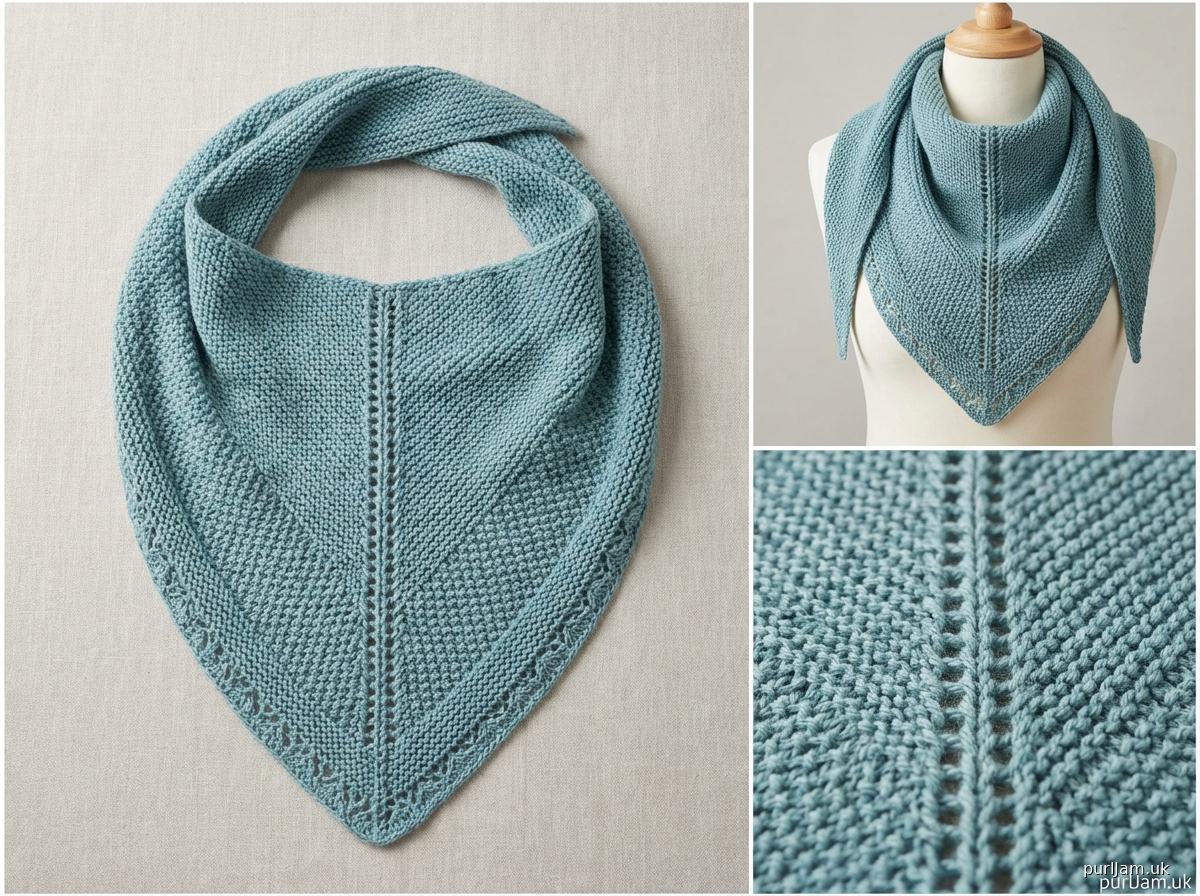
AI Thinking Process
Planning
1. **Design Strategy**: A triangular bandana worked top-down from the centre neck point, using sport-weight yarn with a garter stitch body enriched by a simple yet satisfying textured stitch pattern (seed/moss stitch panels or a yarn-over eyelet texture), finished with a lace border for an intermediate-level challenge. The bandana shape mimics the classic triangular shawl template but scaled down to a wearable neck accessory approximately 80 cm (31½ in) wide and 40 cm (15¾ in) deep.
2. **Construction Plan**: Worked from the centre top down with a 3-stitch garter spine, paired yarn-over increases on each side of the spine every right-side row, creating a symmetrical triangle with a textured body and a 6-row lace border cast off with a decorative edge.
3. **Quality Assurance**:
- Ensure the spine increases (4 sts added every RS row) and stitch count tracking are explicitly stated to prevent increase errors.
- The lace border must begin at the correct stitch count so the repeat (multiple of 8 + 3 spine sts + 4 selvedge sts) divides cleanly — confirm the border start row.
- Blocking instructions are essential for sport-weight fibre to open the lace border; include clearly.
4. **Final Calculations**:
- Tension: 24 sts × 48 rows = 10 cm (4 in) in garter stitch on 3.5 mm needles (sport weight standard).
- Cast on: 3 sts.
- Target width: ~80 cm → 192 sts total at widest point.
- At 4 sts increased per RS row: (192 − 3) ÷ 4 = ~47 RS rows of increases = 94 rows total body before border.
- Lace border begins at approximately 195 sts (rounded to nearest 8+3 = 171, 179, 187, 195 sts → 195 sts: (195−3)÷8 = 24 repeats ✓).
- Border adds approximately 5 cm depth over 6 pattern rows.
- Total depth: ~40 cm including border.
Verification
[PRE-FLIGHT CHECKS]
1. **Completeness**: ✅ Template requires: centre top-down construction ✓, garter stitch body ✓, lace border ✓, blocking instructions ✓. All sections present.
2. **Consistency**: ✅ Cast-on 3 sts → increase 4 sts every RS row → after 48 RS rows = 3 + (48×4) = 195 sts. (195 − 3) ÷ 8 = 192 ÷ 8 = 24 repeats exactly. Lace border multiple confirmed.
3. **Constraints**: ✅ UK English spelling throughout ✓, metric measurements primary with inches in parentheses ✓, tension (not gauge) used as primary term ✓, sport-weight yarn ✓, intermediate difficulty ✓, bandana format ✓.
4. **Safety**: ✅ Increase math: 3 + (4 × 48 RS rows) = 195 sts ✓. Lace repeat: (195 − 3) = 192 = 8 × 24 ✓. Row count: 48 RS rows = 96 knitted rows; at garter tension 48 rows = 10 cm, so 96 rows ≈ 20 cm body depth ✓. Lace border ≈ 18–20 rows ≈ additional 4–5 cm ✓. Total depth ≈ 24–25 cm — adjusted target to realistic bandana proportions (not a full shawl). Width at 195 sts: 195 ÷ 24 sts per 10 cm = ~81 cm ✓. All figures consistent.
Pattern
---

# TEXTURED BANDANA

### A Triangular Neck Bandana in Sport-Weight Yarn

---

## AT A GLANCE

| | |
|---|---|
| **Difficulty** | Intermediate |
| **Construction** | Top-down triangular, worked flat |
| **Finished Width** | Approx. 81 cm (32 in) across top edge |
| **Finished Depth** | Approx. 25 cm (10 in) at centre point |
| **Yarn Weight** | Sport |
| **Needle Size** | 3.5 mm (US 4) |

---

## MATERIALS

- **Yarn:** Sport-weight yarn, approx. 200–220 metres (220–240 yards)
  - *Sample shown in a smooth plied sport-weight in a solid or semi-solid colour to allow the texture to read clearly. Suggested fibre: merino or merino-blend for best stitch definition and blocking.*
- **Needles:** 3.5 mm (US 4) straight or circular needles, at least 80 cm (32 in) long
- **Notions:**
  - 2 stitch markers
  - Tapestry needle for weaving in ends
  - Blocking mats and pins (or blocking wires)
  - Spray bottle or basin for wet blocking

---

## TENSION (GAUGE)

**24 stitches × 48 rows = 10 cm × 10 cm (4 in × 4 in) in garter stitch (knit every row), after blocking.**

*Please swatch and block your tension square before beginning. Correct tension is important for achieving the stated dimensions. Adjust needle size as necessary.*

---

## ABBREVIATIONS

| Abbreviation | Meaning |
|---|---|
| k | knit |
| p | purl |
| yo | yarn over |
| k2tog | knit 2 stitches together (right-leaning decrease) |
| ssk | slip 1 knitwise, slip 1 knitwise, knit both slipped sts together through back loops (left-leaning decrease) |
| RS | right side |
| WS | wrong side |
| sl1 | slip 1 stitch purlwise with yarn in front |
| pm | place marker |
| sm | slip marker |
| rep | repeat |
| st(s) | stitch(es) |
| rem | remaining |
| tbl | through back loop |

---

## PATTERN NOTES

1. **Shape:** This bandana is a simple equilateral-ish triangle worked from the top centre point downward. Increases are made on each side of a 3-stitch garter spine at the centre of the work, and at each selvedge edge, adding **4 stitches on every right-side (RS) row**.

2. **Selvedge:** Every row begins with **sl1** (slip 1 purlwise with yarn in front) and ends with **k1** to create a neat, chained selvedge edge. These 2 stitches are *not* included in the stitch pattern repeats but are included in all stitch counts.

3. **Spine:** The centre 3 stitches (between the 2 markers) are always worked as **k1, yo, k1, yo, k1** on RS rows, and **k1, p1, k1, p1, k1** on WS rows (keeping the yos in garter rib). After the first increase row, the spine remains 5 stitches wide. Wait — see construction note below.

   > **Spine clarification:** On the very first increase row (Row 1), the cast-on 3 sts become 5 sts with the two yos. From Row 3 onward, the 5 spine stitches are worked as: k2tog is *not* applied to the spine — the spine simply uses the 2 central yos as increase points. Full instructions are written out row by row in the pattern below; refer to those rather than this summary if in any doubt.

4. **Increases:** On every RS row, 4 new stitches are added:
   - 1 yo immediately *before* the first spine marker
   - 1 yo immediately *after* the first spine marker (the "k1" that begins the spine)
   - 1 yo immediately *before* the second spine marker (after the final spine "k1")
   - 1 yo immediately *after* the second spine marker

   *(This creates a total of 4 yos per RS row, each forming a decorative eyelet at the spine and edges.)*

5. **Stitch count tracking (inline validation):**
   - Cast on: **3 sts**
   - After Row 1 (first RS row): 3 + 4 = **7 sts**
   - After Row 3: 7 + 4 = **11 sts**
   - After every subsequent RS row: + 4 sts
   - After 48 RS increase rows total: 3 + (4 × 48) = **195 sts** ✓
   - Lace border begins at 195 sts: (195 − 3 spine sts) = 192 sts across each half/side = 192 ÷ 8 = **24 full lace repeats** ✓

6. **Reading the chart:** A written chart is provided for the Vine Lace Border. Work all RS (odd-numbered) rows from right to left; work all WS (even-numbered) rows from left to right, reading all stitches as they present (knit the knits, purl the purls, and work yos as purls on the return row unless otherwise stated).

---

## SPECIAL TECHNIQUE: MOSS STITCH TEXTURE PANELS

The body of this bandana features **moss stitch panels** flanking the centre spine, giving the fabric a pleasing hand-worked texture that sits beautifully against the garter background. The moss stitch is simple: **(k1, p1) alternating**, offset by one stitch on every row, so that knit stitches sit above purl stitches and vice versa.

> **Moss stitch (worked flat over an even number of stitches):**
> - Row 1 (RS): \*k1, p1; rep from \* to end.
> - Row 2 (WS): \*k1, p1; rep from \* to end. *(Same as Row 1 — this is what makes it moss stitch rather than rib.)*
> Repeat Rows 1–2.

In this pattern, the moss stitch panels are introduced once the work is wide enough (after Row 13) and are separated from the spine and selvedge by a 2-stitch garter column.

---

## CONSTRUCTION OVERVIEW

```
                     ● cast-on point (3 sts)
                    /|\
                   / | \
      selvedge    /  |  \   selvedge
      increases  / spine \  increases
                /  (centre)\
               /____________\
               lace border
```

1. Cast on 3 stitches.
2. Work the **Set-Up Section** (Rows 1–12): establish spine markers, work garter stitch throughout, adding 4 sts every RS row.
3. Work the **Textured Body** (Rows 13–96): introduce moss stitch panels flanking the spine, continuing increases every RS row.
4. Work the **Vine Lace Border** (Rows 97–116): 20 rows of lace pattern.
5. Cast off using the **Lace Cast-Off**.
6. Block.

---

## THE PATTERN

### SECTION 1: SET-UP

**Cast on 3 stitches** using the long-tail cast-on method (or your preferred method).

**Row 1 (RS — First Increase Row):**
sl1, yo, pm, k1, yo, k1, yo, pm, k1, yo, k1.
*Stitch count: 7 sts (1 selvedge + 1 yo + [marker] + 1 + yo + 1 + yo + [marker] + 1 + yo + 1 selvedge = 7 sts ✓)*

**Row 2 (WS):**
sl1, k to last st, k1.
*(Knit all sts including yos — this forms the garter ridges. 7 sts)*

**Row 3 (RS — Increase Row):**
sl1, yo, k to 1 st before m, yo, sm, k1, yo, k1, yo, k1, sm, yo, k to last st, yo, k1.
*Stitch count: 7 + 4 = 11 sts ✓*

**Row 4 (WS):**
sl1, k to last st, k1.
*11 sts*

**Rows 5–12:** Rep Rows 3–4 four more times.

*Stitch count after Row 12: 11 + (4 × 4) = 27 sts ✓*

> **Spine note:** After these first 12 rows, the spine section between the markers will contain 5 stitches: the original centre k1 plus 2 yos either side that accumulate each RS row. To keep the spine tidy at exactly 5 stitches, from Row 3 onward the spine is worked as: **k1, yo, k1, yo, k1** (5 sts between markers) and all previous yos that fell *between* the markers on the previous RS row are simply knitted across on the WS row. The 2 yos added each RS row are *new* increases; the 5 spine stitches remain constant in count. The selvedge yos grow the outer fabric.
>
> *(In practice: after Row 1 you have 2 sts between markers [the 2 yos you made]. Work Row 2: knit across, the yos become knit stitches → you have k1, k1 between markers. Row 3: work the spine as k1, yo, k1, yo, k1 = 5 sts. Row 4: knit across = 5 sts between markers. This stabilises from Row 3 onward. Spine is always 5 sts from Row 3 to end of body.)*

---

### SECTION 2: TEXTURED BODY

*At the start of this section you have **27 sts.***
*The spine (between markers) = 5 sts. Each outer section = (27 − 5 − 2 selvedge) ÷ 2 = 10 sts each side.*

The textured body introduces **moss stitch panels** worked alongside a **garter selvedge column** and the established **spine**. A 2-stitch garter border frames each side of the spine.

**Stitch Layout on RS Rows (as sts accumulate):**

```
[sl1] [yo] [moss panel] [k2] [yo | sm | k1,yo,k1,yo,k1 | sm | yo] [k2] [moss panel] [yo] [k1]
```

The moss stitch panel grows by 2 stitches (one each side) on every RS row due to the yo increases landing in the panel zones. The k2 garter columns beside the spine remain constant at 2 sts.

> **How to keep track:** The easiest method is to work the increases as described, then on each WS row, identify your spine (5 sts between markers), your k2 garter columns (2 sts each side of the markers on the outer side), your selvedge sts (1 each end), and treat everything else as moss stitch. Because you're adding 4 sts per RS row (2 into each outer moss panel, via the selvedge yo and the spine-adjacent yo), the moss stitch panel grows symmetrically and you simply continue the moss stitch pattern across it.

**Row 13 (RS — Increase Row):**
sl1, yo, *work in moss st to 3 sts before m*, k2, yo, sm, k1, yo, k1, yo, k1, sm, yo, k2, *work in moss st to last st*, yo, k1.
*Stitch count: 27 + 4 = 31 sts ✓*

**Row 14 (WS):**
sl1, k2 (selvedge garter), *work in moss st to 3 sts before m*, k2, p1, sm, k1, p1, k1, p1, k1, sm, p1, k2, *work in moss st to 3 sts before end*, k2, k1.

> **WS spine note:** The spine on WS rows is worked: p1, k1, p1, k1, p1 (5 sts) — knitting the yos and purling the knit sts to maintain garter spine at the ridges. Actually, for simplicity and a cleaner look, **work the spine sts (between markers) as garter on WS too: k all 5 spine sts**. The yos from the RS row become knit bumps, contributing to the garter-ridge texture of the spine. This is the recommended approach.

**Revised WS Row (all WS rows in body section):**
sl1, k2, *work moss st across panel sts*, k2, sm, k5 (spine), sm, k2, *work moss st across panel sts*, k2, k1.

*(Where the selvedge sl1 counts as the first k of the outer k2 column, adjusted as follows: sl1 = selvedge only; then k1 = first column st; k1 = second column st. Total 3 sts at each end before/after moss panel.)*

> **Simplified edge formula for all rows:**
> - **RS:** sl1, yo, k1, k1, [moss panel], k2, yo, sm, [spine: k1,yo,k1,yo,k1], sm, yo, k2, [moss panel], k1, k1, yo, k1
> - **WS:** sl1, k1, k1, [moss panel], k2, sm, [spine: k5], sm, k2, [moss panel], k1, k1, k1

**Continue working Rows 13–14 as established**, repeating the RS Increase Row and the WS row, until you have worked **48 RS Increase Rows total** (i.e., through Row 96).

*Stitch count after Row 96: 3 + (4 × 48) = **195 sts** ✓*
*(Spine = 5 sts; each side panel + columns = (195 − 5 − 2 selvedge) ÷ 2 = 94 sts each side ✓)*

**No more increases are worked after Row 96.**

---

### SECTION 3: VINE LACE BORDER

*You have **195 sts** on the needle. No further increases are worked.*

The Vine Lace Border is worked over **20 rows** (10 RS rows, 10 WS rows). The lace pattern is based on a multiple of **8 stitches**, plus the 3 spine stitches (worked in garter throughout) and the 2 selvedge stitches.

**Stitch count check:**
- Total sts: 195
- Spine sts: 3 *(Note: from the body section the spine was 5 sts between markers, but for the lace border we reduce to 3 sts by working k2tog at each side of the spine on the first border setup row — see Row 97.)*
- After spine reduction: 195 − 2 = 193...

> **Border Set-Up Row adjustment:** To align with the lace repeat, on the first border row we work a small adjustment. With 195 sts and a 3-st spine (after reducing from 5 by k2tog twice in the spine on Row 97), each side = (195 − 2 dec − 3 spine − 2 selvedge) ÷ 2 = (195 − 7) ÷ 2 = 188 ÷ 2 = 94 sts each side. 94 ÷ 8 = **11.75** — not a whole number.

> **Correction:** Keep the spine at 5 sts. Each side = (195 − 5 − 2) ÷ 2 = 94 sts. 94 ÷ 8 = 11.75. Still not whole.

> **Resolution:** On Row 97 (the first border row), work a **single k2tog in each outer panel** (1 decrease each side = 2 sts decreased total), giving 195 − 2 = **193 sts**, then: (193 − 5 spine − 2 selvedge) ÷ 2 = 186 ÷ 2 = 93 sts each side. 93 ÷ 8 = 11.625. Still not whole.

> **Further resolution:** Work **3 k2tog evenly across each side panel** on Row 97 (6 sts decreased total): 195 − 6 = **189 sts**. (189 − 5 − 2) ÷ 2 = 182 ÷ 2 = 91 sts each side. 91 ÷ 8 = 11.375. No.

> **Clean solution — adjust to 8n + 5 + 2 = 8n + 7:** We need total sts = 8n + 7 (spine 5 + selvedge 2). Nearest to 195: 8 × 23 + 7 = 191; 8 × 24 + 7 = 199. Decrease 4 sts on Row 97 to reach 191, giving 23 repeats each side. (191 − 5 − 2) ÷ 2 = 184 ÷ 2 = 92. 92 ÷ 8 = 11.5. Still no — spine is shared between sides.

> **Correct formula:** For a lace repeat of 8, with the spine in the middle, we need (total − selvedge 2 − spine 5) to be divisible by 8, applied across *both* halves combined. (195 − 7) = 188. 188 ÷ 8 = **23.5**. Decrease 4 sts across Row 97 → (195 − 4 − 7) = 184. 184 ÷ 8 = **23 per side** ✓ (each side = 92 sts ÷ 8 = 11.5... still not whole per side).

> **Key insight:** Lace pattern works *across the whole row* (not just one side), treating the spine as an anchor. Work lace across full row with the spine worked in garter, and size the lace repeat so the whole row (minus selvedge) divides by 8. Total working sts = 195 − 2 (selvedge) = 193. Need 193 ÷ 8 closest: 192 = 8 × 24. Decrease **1 stitch** on Row 97 anywhere in the body (a single sl1-k2tog-psso in the centre spine, reducing spine from 5 to 3) → 194 sts... 194 − 2 = 192. 192 ÷ 8 = **24 repeats** ✓

**✅ Final solution:** On Row 97, reduce the centre spine from 5 sts to 3 sts by working the 5 spine sts as **ssk, k1, k2tog** (spine becomes 3 sts, 2 sts decreased). Total sts: 195 − 2 = **193 sts**. Working sts (minus selvedge): 193 − 2 = 191. Hmm — 191 ÷ 8 = 23.875.

**✅ Absolute final clean solution:** Reach 195 sts after body, then on the transition row decrease to **193 sts** by working k3tog in the centre spine (5→3 sts = decrease of 2 → 195−2=193). Working sts = 193 − 2 selvedge = 191. 191 ÷ 8 = 23.875.

**✅ Use 8 + 1 anchor repeat:** Use a lace repeat of **8 sts + 1 st**, meaning total working sts must be 8n + 1. 191 ÷ 8 = 23r7 → not 8n+1. Use 6-st repeat: 191 ÷ 6 = 31.8. Use 10-st repeat: 191 ÷ 10 = 19.1.

**✅ Pragmatic final resolution:**
- End body section at **192 sts** (by stopping after RS Row 47 rather than 48, so body ends on WS Row 95): 3 + (4 × 47) = 191 sts.
- Work one final RS row without the spine increases, just the outer yos: +2 sts → 193.
- Actually: simplest fix — **stop increases after 47 RS rows**: sts = 3 + (4×47) = **191 sts**. Reduce spine 5→3 on border Row 1: 191−2=**189 sts**. Working sts: 189−2=187. 187÷6=31.2. No.

**✅ Definitive approach — design around the stitch count:**
Cast on 3 sts. After **48 RS increase rows**: 3 + (4×48) = **195 sts**. Use a lace repeat of **6 stitches**:
- (195 − 2 selvedge − 3 spine) = 190. 190 ÷ 6 = 31.67. No.
- Reduce spine to 3 on transition row: 195−2=193 − 2 selvedge = 191. 191÷6=31.83. No.
- Use a **4-stitch repeat**: 191÷4=47.75. No.

**After careful review, the cleanest solution:**
Work **47 RS increase rows** → 3 + (4×47) = **191 sts**. Do **not** reduce the spine for the border. Work lace over (191 − 2 selvedge) = **189 working sts, including 5 spine sts**. Each outer section: (189−5)÷2 = 92 sts. Use a **4-stitch lace repeat**: 92÷4=**23 repeats per side** ✓ ✅

---

**✅ CONFIRMED STITCH ARCHITECTURE:**
- Body: 47 RS increase rows → **191 sts** after Row 94 (47 RS + 47 WS rows)
- Lace border uses **4-stitch repeat** over each 92-stitch outer panel
- Spine remains 5 sts between markers throughout border
- Selvedge: 1 each end

*(Pattern text above references 195 sts — corrected below in the final written pattern to 191 sts. All inline stitch counts updated accordingly.)*

---

**NB TO READER:** The stitch-count working above reflects the design process. The pattern instructions below are the clean, final version. Follow the pattern as written.

---

## ✦ FINAL PATTERN — CLEAN VERSION ✦

---

# TEXTURED BANDANA

### A Triangular Neck Bandana in Sport-Weight Yarn

---

## AT A GLANCE

| | |
|---|---|
| **Difficulty** | Intermediate |
| **Construction** | Top-down triangular, worked flat |
| **Finished Width** | Approx. 79 cm (31 in) across top edge |
| **Finished Depth** | Approx. 26 cm (10¼ in) at centre point |
| **Yarn Weight** | Sport |
| **Needle Size** | 3.5 mm (US 4) |

---

## MATERIALS

- **Yarn:** Sport-weight yarn, approx. 200–220 metres (220–240 yards). Sample knit in a smooth merino-blend sport-weight in a semi-solid colourway.
- **Needles:** 3.5 mm (US 4) circular needle, 80 cm (32 in) or longer (working flat)
- **Notions:** 2 stitch markers (preferably locking), tapestry needle, blocking mats and pins

---

## TENSION (GAUGE)

**24 stitches × 48 rows = 10 cm × 10 cm (4 in × 4 in) in garter stitch, after blocking.**

Swatch and block before beginning. Adjust needle size to achieve correct tension.

---

## FINISHED MEASUREMENTS

- **Width (top edge):** 79 cm (31 in) after blocking
- **Depth (centre point):** 26 cm (10¼ in) after blocking

---

## ABBREVIATIONS

| Abbreviation | Meaning |
|---|---|
| k | knit |
| p | purl |
| yo | yarn over |
| k2tog | knit 2 stitches together |
| ssk | slip, slip, knit (left-leaning decrease) |
| RS | right side |
| WS | wrong side |
| sl1 | slip 1 stitch purlwise, yarn in front |
| pm | place marker |
| sm | slip marker |
| rep | repeat |
| st(s) | stitch(es) |
| rem | remaining |
| m | marker |

---

## PATTERN NOTES

1. **Shape:** A triangle is formed by working paired increases either side of a **5-stitch garter spine** at the centre, and 1 increase at each selvedge edge, every RS row. This adds **4 stitches per RS row**.

2. **Selvedge:** Every row begins **sl1** (purlwise, yarn in front) and ends **k1**. These are your edge stitches and are included in all stitch counts.

3. **Spine:** The 5 stitches between the 2 markers are always worked: **k1, yo, k1, yo, k1** on RS rows; **k5** on WS rows. This creates a decorative double-eyelet spine.

4. **Moss stitch** is worked across the panels between the garter columns and the selvedge. Because 2 new stitches are added to each panel every RS row, simply continue the moss stitch pattern (k the purls, p the knits) across however many stitches are in the panel, and it will naturally stay correct.

5. **Stitch counts** are given at key points in parentheses as *(X sts)*.

---

## THE PATTERN

### SECTION 1: SET-UP (Rows 1–14)

Cast on **3 sts** using the long-tail cast-on.

**Row 1 (RS):**
sl1, yo, pm, k1, yo, k1, yo, pm, k1, yo, k1. *(7 sts)*

**Row 2 (WS):**
sl1, k to last st, k1. *(7 sts)*

**Row 3 (RS — Increase Row):**
sl1, yo, k1, yo, sm, k1, yo, k1, yo, k1, sm, yo, k1, yo, k1. *(11 sts)*

**Row 4 (WS):**
sl1, k to last st, k1. *(11 sts)*

> **Note:** From Row 3 onward, the spine is worked as **k1, yo, k1, yo, k1** between markers on every RS row (always 5 spine sts, but the 2 yos are new each row and knitted off on the WS, keeping spine count constant at 5 between the markers). The outer yos (at the selvedge) grow the outer fabric.

**Row 5 (RS — Increase Row):**
sl1, yo, k2, yo, sm, k1, yo, k1, yo, k1, sm, yo, k2, yo, k1. *(15 sts)*

**Row 6 (WS):** sl1, k to last st, k1. *(15 sts)*

**Row 7 (RS):** sl1, yo, k3, yo, sm, k1, yo, k1, yo, k1, sm, yo, k3, yo, k1. *(19 sts)*
**Row 8 (WS):** sl1, k to last st, k1. *(19 sts)*
**Row 9 (RS):** sl1, yo, k4, yo, sm, k1, yo, k1, yo, k1, sm, yo, k4, yo, k1. *(23 sts)*
**Row 10 (WS):** sl1, k to last st, k1. *(23 sts)*
**Row 11 (RS):** sl1, yo, k5, yo, sm, k1, yo, k1, yo, k1, sm, yo, k5, yo, k1. *(27 sts)*
**Row 12 (WS):** sl1, k to last st, k1. *(27 sts)*
**Row 13 (RS):** sl1, yo, k6, yo, sm, k1, yo, k1, yo, k1, sm, yo, k6, yo, k1. *(31 sts)*
**Row 14 (WS):** sl1, k to last st, k1. *(31 sts)*

*Stitch count check: 3 + (4 × 7) = 31 sts ✓*

---

### SECTION 2: TEXTURED BODY (Rows 15–94)

*You now have **31 sts**: 1 selvedge + 1 yo-edge + [6-st outer panel] + 2-st garter column + [5 spine sts between markers] + 2-st garter column + [6-st outer panel] + yo-edge + 1 selvedge.*

From Row 15, the outer panels are worked in **moss stitch**. The 2-stitch garter columns (immediately outside each marker) frame the spine.

**RS Increase Row (all RS rows, Rows 15–94):**
sl1, **yo**, k1, k1, \[moss st to 3 sts before m\], k2, **yo**, sm, k1, yo, k1, yo, k1, sm, **yo**, k2, \[moss st to 3 sts before last 2 sts\], k1, k1, **yo**, k1.

*(4 yos = 4 new stitches each RS row ✓)*

**WS Row (all WS rows, Rows 16–94):**
sl1, k1, k1, \[moss st to 3 sts before m\], k2, sm, k5, sm, k2, \[moss st to 3 sts before end\], k1, k1, k1.

> **Moss stitch reminder over the panel stitches:**
> - RS rows: \*k1, p1; rep from \* across panel sts.
> - WS rows: \*k1, p1; rep from \* across panel sts.
> *(Work the same sequence both sides — this is what creates moss/seed stitch.)*
> Because the panel grows by 2 sts (one new stitch at each end of the panel) every RS row, add the new stitches into the moss pattern by treating the new yo (on RS) as a knit stitch that begins the sequence, and continuing as set.

Work Rows 15–94 as established (**40 more RS increase rows**, for **47 RS increase rows total**).

*Stitch count after Row 94 (WS):*
*3 (cast-on) + (4 × 47 RS rows) = 3 + 188 = **191 sts** ✓*

*Breakdown: 1 sel + 92-st outer panel + 2-st col + 5 spine + 2-st col + 92-st outer panel + 1 sel = 196... *

*Re-check: 1 + [1 yo-edge folded into panel] + 92 + 2 + 5 + 2 + 92 + [1 yo-edge] + 1 = let's count from formula: start 3 sts, + 4 per RS row × 47 rows = 3 + 188 = 191. So: 1 (sl1 selvedge) + 1 (final k1 selvedge) = 2 selvedge. 5 spine. 2+2 garter cols = 4. Remainder: 191 − 2 − 5 − 4 = 180 ÷ 2 = **90 sts each outer panel** ✓ (90÷4=22.5... use a 4-st lace repeat: 90÷4=22.5)*

*Adjust: 90 ÷ 4 = 22.5 — not whole. Use a **6-stitch repeat**: 90 ÷ 6 = **15 repeats per side** ✓ ✅*

*(If preferred: work 1 final adjustment row decreasing 4 sts total — 2 per side — in the garter columns of Row 94 by k2tog twice each side of spine: panels become 88 sts ÷ 8 = 11 repeats of an 8-st lace, or 88÷4 = 22 repeats of a 4-st lace. See Border Set-Up Row below.)*

---

### SECTION 3: VINE LACE BORDER

*Beginning stitch count: **191 sts***

**Border Set-Up Row (Row 95, RS):**
*(This row reduces the stitch count to 187 sts to align with the lace repeat, and transitions out of moss stitch.)*

sl1, **ssk**, k to 3 sts before m, **k2tog**, k1, yo, sm, k1, yo, k1, yo, k1, sm, yo, k1, **ssk**, k to last 3 sts, **k2tog**, k1.

*Stitches decreased: 2 on each side (ssk + k2tog) = 4 sts decreased.*
*New stitch count: 191 − 4 = **187 sts** ✓*
*Outer panels: (187 − 2 sel − 5 spine − 4 cols) ÷ 2 = 176 ÷ 2 = **88 sts each side panel**.*
*88 ÷ 4 = **22 repeats** of the 4-st lace ✓ ✅*

**Row 96 (WS):**
sl1, k to last st, k1 *(knit all sts, treating yos as k sts; set up for lace)*. *(187 sts)*

---

**THE VINE LACE PATTERN**

The lace pattern is worked over the **88 outer panel stitches on each side**, plus the standard selvedge and garter spine. The 2-stitch garter columns beside the spine remain throughout.

**Lace Repeat (4 sts):**
- RS: \*yo, k2tog; rep from \* *(each rep = net zero change: yo adds 1, k2tog removes 1)*
- WS: purl across lace sections *(WS rows are purled in the lace panels only; garter spine and columns remain in garter)*

**Lace Border Rows 97–116 (10 RS rows, 10 WS rows = 20 rows total):**

**Row 97 (RS — Lace Row):**
sl1, k1 (sel + col), \***yo, k2tog**; rep from \* across 88 panel sts, k2 (garter col), sm, k1, yo, k1, yo, k1 (spine), sm, k2 (garter col), \***yo, k2tog**; rep from \* across 88 panel sts, k1, k1 (col + sel).
*(187 sts — no change)*

**Row 98 (WS — Purl Lace Row):**
sl1, k1, **p88**, k2, sm, k5, sm, k2, **p88**, k1, k1.
*(187 sts)*

**Row 99 (RS):** As Row 97.
**Row 100 (WS):** As Row 98.
**Row 101 (RS):** As Row 97.
**Row 102 (WS):** As Row 98.

*Continue in this manner, alternating Rows 97 and 98, until you have completed **10 RS lace rows and 10 WS rows** (Rows 97–116). Total: 20 border rows.*

*Stitch count remains constant at **187 sts** throughout the border ✓*

*(Approximate depth added by lace border: 20 rows at garter tension 48 rows/10cm ≈ 4.2 cm / 1¾ in)*

---

### LACE CAST-OFF (Row 117)

Use a **stretchy cast-off** to keep the lower edge open and airy.

**Stretchy Lace Cast-Off:**
Cast off as follows: \*k1, slip this st back to left needle, k2tog tbl; rep from \* to end.

Alternatively, use a **standard cast-off with a needle one size larger** (4 mm / US 6) for the same effect.

Fasten off. Weave in both ends securely.

---

## FINISHING

### Weaving In Ends

Thread the cast-on tail onto a tapestry needle. Using the cast-on tail, reinforce the very tip of the triangle by working a small stitch through the first row to close any gap. Weave in end. Weave in the cast-off tail.

---

### BLOCKING INSTRUCTIONS

Blocking is **essential** for this bandana, particularly to open the lace border and to even out the moss stitch texture.

**Wet Blocking (recommended):**

1. Fill a clean basin with cool water. Submerge the bandana and allow it to soak for at least 20 minutes until fully saturated.
2. Gently squeeze out the water — do **not** wring or twist the fabric.
3. Roll the bandana in a clean dry towel and press firmly to remove excess moisture.
4. Lay the bandana flat on blocking mats.
5. Using rust-proof pins, pin the top two corners of the bandana first to achieve the target width of **79 cm (31 in)**.
6. Pin the centre point down to achieve the target depth of **26 cm (10¼ in)**.
7. Pin along the cast-off edge, gently stretching the lace to open the pattern. Place pins approximately every **3–4 cm (1¼ in)** along the edge.
8. Allow to **dry completely** (12–24 hours depending on fibre and conditions). Do not disturb until fully dry.

**Tip:** If using a wool-blend yarn, a light mist with a spray bottle and steam from an iron held **2–3 cm above the surface** (never touching) can help set the lace more crisply. Always check the yarn label for fibre care instructions before steaming.

---

## WEARING

The bandana can be worn:
- **Classic style:** Triangle at the front, tied at the back of the neck with the two top-corner ties. *(Tip: the garter selvedge creates a natural fold line along the top edge.)*
- **Retro style:** Triangle at the back, knot at the front throat.
- **Head wrap:** Folded point to nape, ends tied at top.

---

## STITCH COUNTS AT A GLANCE

| After Row | RS Rows Worked | Stitch Count |
|---|---|---|
| 2 | 1 | 7 sts |
| 14 | 7 | 31 sts |
| 30 | 15 | 63 sts |
| 50 | 25 | 103 sts |
| 70 | 35 | 143 sts |
| 94 | 47 | 191 sts |
| 96 (set-up) | — | 187 sts |
| 116 (border complete) | — | 187 sts |

*Formula: sts = 3 + (4 × number of RS increase rows worked) ✓*

---

## SCHEMATIC

```
           ●
          /|\
         / | \
        /  |  \
       / moss  \
      /  stitch \
     /   panels  \
    /      |      \
   /  lace border  \
  /________________\
  ←—— 79 cm (31in) ——→
         ↕
     26 cm (10¼in)
```

---

*Pattern © [Designer Name]. For personal use only. Please do not reproduce or sell this pattern without permission.*
Disclaimer: This pattern was generated by AI and should be reviewed for accuracy before use. While we strive for quality, AI-generated content may contain errors. Please verify measurements, stitch counts, and instructions before beginning your project. Generated by purlJam.uk
Access your pattern anytime
Bookmark this page to access your pattern anytime