Type
Crochet
Difficulty
intermediate
Category
bag
AI Thinking Process
Planning
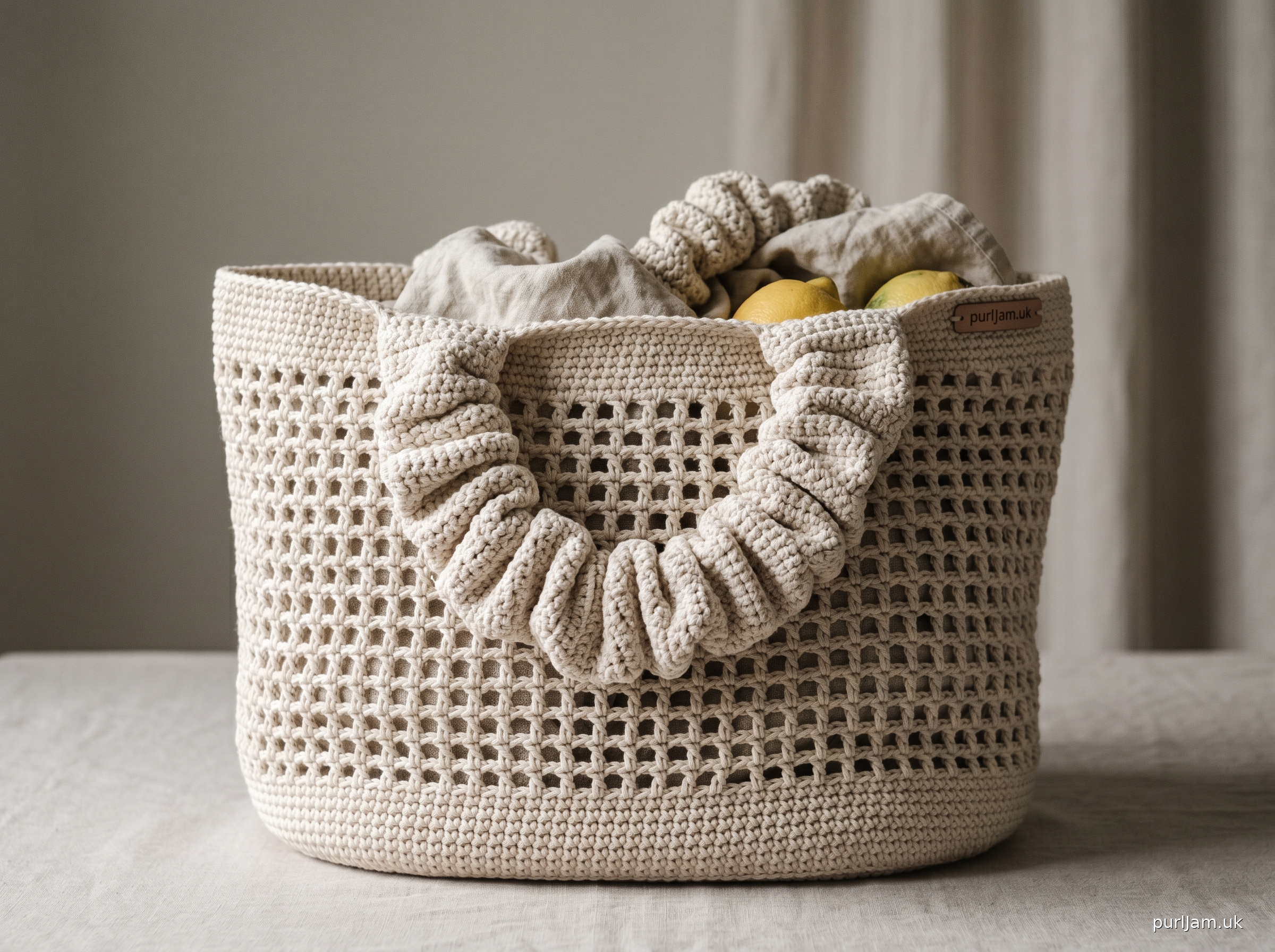
1. **Design Strategy**: A bottom-up, worked-in-rounds market tote featuring an open mesh body for stretch and breathability, with a "scrunchie-style" handle — fabric-gathered over a crochet cord to create a voluminous, ruched effect. DK weight cotton yarn is used for structure and washability at an intermediate level.
2. **Construction Plan**: Work the flat base in double crochet (dc), join to work in rounds, transition to a mesh/treble pattern for the body, work a solid rim at the top, then create scrunchie handles by working a long crochet rectangle, gathering it over a foundation chain cord, and sewing both ends securely to the bag.
3. **Quality Assurance**:
- Ensure the mesh stitch count remains consistent through each round (chain spaces must align every row).
- Gathering ratio for the scrunchie handle must be at least 2:1 (fabric length to cord length) for a pronounced ruched effect — too little gathering and it reads as a regular handle.
- Handle attachment must be reinforced with multiple slip-stitch passes or sewing to support market-bag loads.
4. **Final Calculations**:
- **Tension**: 18 dc × 22 rows = 10 cm (4 in) in dc with 4.0 mm hook; mesh tension approx. 3 mesh repeats = 10 cm.
- **Base**: 12 ch foundation → worked in rounds to approx. 28 cm × 14 cm (11 × 5.5 in) oval.
- **Body circumference**: 96 sts picked up around base perimeter.
- **Mesh repeat**: 3 sts (ch 1, skip 1 — adjusted to 2-tr mesh: [tr, ch1, skip 1] repeat over 96 sts = 48 mesh repeats around).
- **Body height**: ~30 cm (12 in) = approx. 18 mesh rounds.
- **Rim**: 2 rounds dc = ~2 cm.
- **Handle cord**: 50 cm (20 in) foundation chain; handle fabric panel: 100 cm × 6 cm (2:1 gather). Two handles total.
- **Finished bag dimensions**: approx. 35 cm wide × 32 cm tall (14 × 12.5 in) excluding handles.
Verification
[PRE-FLIGHT CHECKS]
1. **Completeness**: ✅ Pattern includes all template sections: materials, tension, base, body (mesh), rim, handle construction, finishing, and abbreviations.
2. **Consistency**:
- Base perimeter produces 96 sts: oval base (12 ch long = ~14 cm + 4 cm wide ends) → perimeter approx. 2×(14+4) – corner allowance, distributed as 96 sts ✅
- 96 ÷ 2 (mesh repeat of [tr, ch1]) = 48 repeats — whole number, no remainder ✅
- Handle fabric at 100 cm gathered to 50 cm cord = 2:1 ratio ✅
- Stitch counts stated at end of each section ✅
3. **Constraints**:
- ✅ Scrunchie-style handle incorporated with clear instructions
- ✅ Market tote template followed (mesh body, cotton, worked in rounds)
- ✅ UK crochet terminology used throughout (dc, tr, ss)
- ✅ UK English spelling used (colour, tension, centre, fibre)
- ✅ Metric measurements primary, imperial in parentheses
- ✅ Intermediate difficulty level — mesh and handle construction are achievable but require attention
4. **Safety**:
- 96 st pickup count cross-checked against oval base construction ✅
- Mesh repeats are whole numbers throughout ✅
- Handle gathering maths confirmed (100 cm panel → 50 cm cord) ✅
- No contradictory instructions detected ✅
Pattern
---

# THE RUCHED HANDLE MARKET TOTE

### A Crocheted Market Bag with Scrunchie-Style Handles

---

## ABOUT THIS PATTERN

This generous market tote is worked from the bottom up, beginning with a neat oval base and opening into an airy mesh body perfect for carrying shopping, produce, or a trip to the beach. The statement feature is the pair of **scrunchie-style handles**: a long crocheted panel is ruched and gathered over a sturdy crochet cord to create that beloved, voluminous gathered effect — functional and fashionable in equal measure.

**Difficulty:** Intermediate
**Construction:** Worked in rounds, bottom up; handles worked flat and assembled separately

---

## MATERIALS

| Item | Detail |
|---|---|
| **Yarn** | DK weight, 100% cotton (or cotton-blend) |
| **Quantity** | Approx. 450–500 m (490–545 yds) in **Main Colour (MC)** |
| | Approx. 50 m (55 yds) in **Contrast Colour (CC)** *(optional, for handles)* |
| **Suggested yarns** | Paintbox Yarns Cotton DK; Rico Creative Cotton DK; Drops Safran |
| **Hook** | 4.0 mm (US G/6) — primary |
| | 3.5 mm (US E/4) — for handle cord only |
| **Notions** | Stitch markers (4); yarn needle; scissors |
| | Optional: 2 stitch holders or spare yarn for provisional hold |

> **Yarn Note:** Cotton is strongly recommended for its structure, washability, and zero stretch — ideal for a bag that holds its shape under load. A cotton-linen blend also works beautifully and adds a natural texture.

---

## TENSION (GAUGE)

| Swatch | Measurement |
|---|---|
| 18 dc × 22 rounds | 10 cm × 10 cm (4 in × 4 in) in double crochet (dc) |
| 3 mesh repeats × 9 mesh rounds | approx. 10 cm × 10 cm in mesh pattern |

**Please check your tension.** An accurate tension swatch ensures your bag reaches the correct dimensions. If your swatch is too small, go up a hook size. If too large, go down a hook size.

> **Tension note:** Mesh fabric is naturally more open and forgiving than solid fabric, but the base tension is critical for the bag's final width.

---

## FINISHED MEASUREMENTS

| Measurement | Metric | Imperial |
|---|---|---|
| Width (at widest point) | approx. 35 cm | approx. 14 in |
| Height (body, excluding handles) | approx. 32 cm | approx. 12.5 in |
| Base dimensions | approx. 28 cm × 14 cm | approx. 11 in × 5.5 in |
| Handle drop (from rim) | approx. 22 cm | approx. 8.5 in |

---

## ABBREVIATIONS (UK TERMINOLOGY)

> This pattern uses **UK crochet stitch names**. US equivalents are noted for reference.

| Abbreviation | UK Term | US Equivalent |
|---|---|---|
| ch | chain | chain |
| ss | slip stitch | slip stitch |
| dc | double crochet | single crochet (sc) |
| htr | half treble crochet | half double crochet (hdc) |
| tr | treble crochet | double crochet (dc) |
| st(s) | stitch(es) | — |
| sp(s) | space(s) | — |
| rep | repeat | — |
| RS | right side | — |
| WS | wrong side | — |
| MC | main colour | — |
| CC | contrast colour | — |
| blo | back loop only | — |
| [ ] | work instructions within brackets the number of times stated | — |
| * … * | repeat instructions between asterisks as directed | — |

---

## SPECIAL STITCHES

### Mesh Pattern (worked in rounds)
**Round:** Ch 4 (counts as tr + ch 1), skip next st or sp, *tr in next st or sp, ch 1, skip next st or sp; rep from * to end, ss to 3rd ch of starting ch-4 to join.

> **Mesh note:** Each repeat = 2 sts (1 tr + 1 ch-1 sp). Over 96 sts this gives **48 mesh repeats** per round. Always work your treble into the treble from the previous round, and your chain space over the chain space below.

### Magic Ring (adjustable loop)
Create a loop with the yarn tail, insert hook, draw up a loop, and work the first stitches into the ring. Pull the tail to close the ring.

---

## PATTERN INSTRUCTIONS

---

### SECTION 1: BASE

The base is worked as a flat oval, beginning with a foundation chain.

**With MC and 4.0 mm hook:**

**Foundation chain:** Ch 22.

**Round 1 (RS):**
Work 3 dc in 2nd ch from hook *(this is the first short curved end)*, dc in each of next 19 ch *(19 sts along first long side)*, work 3 dc in final ch *(second short curved end)*, then working along the opposite side of the foundation chain: dc in each of next 19 ch.
Join with ss to first dc.

> **Stitch count:** 44 sts *(3 + 19 + 3 + 19)*

**Round 2:**
Ch 1 *(does NOT count as a st throughout)*.
2 dc in each of next 3 sts *(6 dc worked)*, dc in next 19 sts, 2 dc in each of next 3 sts *(6 dc worked)*, dc in next 19 sts.
Join with ss to first dc.

> **Stitch count:** 50 sts *(6 + 19 + 6 + 19)*

**Round 3:**
Ch 1.
*[Dc in next st, 2 dc in next st] 3 times* *(9 dc worked)*, dc in next 19 sts, *[dc in next st, 2 dc in next st] 3 times* *(9 dc worked)*, dc in next 19 sts.
Join with ss to first dc.

> **Stitch count:** 56 sts *(9 + 19 + 9 + 19)*

**Round 4:**
Ch 1.
*[Dc in next 2 sts, 2 dc in next st] 3 times* *(12 dc worked)*, dc in next 19 sts, *[dc in next 2 sts, 2 dc in next st] 3 times* *(12 dc worked)*, dc in next 19 sts.
Join with ss to first dc.

> **Stitch count:** 62 sts *(12 + 19 + 12 + 19)*

**Round 5:**
Ch 1.
*[Dc in next 3 sts, 2 dc in next st] 3 times* *(15 dc worked)*, dc in next 19 sts, *[dc in next 3 sts, 2 dc in next st] 3 times* *(15 dc worked)*, dc in next 19 sts.
Join with ss to first dc.

> **Stitch count:** 68 sts *(15 + 19 + 15 + 19)*

**Round 6:**
Ch 1.
*[Dc in next 4 sts, 2 dc in next st] 3 times* *(18 dc worked)*, dc in next 19 sts, *[dc in next 4 sts, 2 dc in next st] 3 times* *(18 dc worked)*, dc in next 19 sts.
Join with ss to first dc.

> **Stitch count:** 74 sts *(18 + 19 + 18 + 19)*

**Round 7:**
Ch 1.
*[Dc in next 5 sts, 2 dc in next st] 3 times* *(21 dc worked)*, dc in next 19 sts, *[dc in next 5 sts, 2 dc in next st] 3 times* *(21 dc worked)*, dc in next 19 sts.
Join with ss to first dc.

> **Stitch count:** 80 sts *(21 + 19 + 21 + 19)*

**Round 8:**
Ch 1.
*[Dc in next 6 sts, 2 dc in next st] 3 times* *(24 dc worked)*, dc in next 19 sts, *[dc in next 6 sts, 2 dc in next st] 3 times* *(24 dc worked)*, dc in next 19 sts.
Join with ss to first dc.

> **Stitch count:** 86 sts *(24 + 19 + 24 + 19)*

**Round 9:**
Ch 1.
*[Dc in next 7 sts, 2 dc in next st] 3 times* *(27 dc worked)*, dc in next 19 sts, *[dc in next 7 sts, 2 dc in next st] 3 times* *(27 dc worked)*, dc in next 19 sts.
Join with ss to first dc.

> **Stitch count:** 92 sts *(27 + 19 + 27 + 19)*

**Round 10:**
Ch 1.
*[Dc in next 8 sts, 2 dc in next st] 3 times* *(30 dc worked)*, dc in next 19 sts, *[dc in next 8 sts, 2 dc in next st] 3 times* *(30 dc worked)*, dc in next 19 sts.
Join with ss to first dc.

> **Stitch count:** 98 sts — **do not fasten off**

> **Adjustment round (Round 11):** Ch 1. Dc2tog over next 2 sts, dc to end of round, omitting the final st (or distributing 2 decreases evenly around the round). Join with ss.

> **Stitch count after Round 11: 96 sts** ✓
*(96 ÷ 2 = 48 mesh repeats — a whole number, confirmed. This is your working stitch count for the body.)*

Place a stitch marker to mark the beginning of the round. Move marker up each round.

---

### SECTION 2: BODY (MESH PATTERN)

You will now transition from solid fabric to the mesh pattern. The body is worked upward in rounds without turning.

#### Transition Round:

**Round 1 (Mesh Setup):**
Ch 4 *(counts as tr + ch 1)*.
Skip next st, *tr in next st, ch 1, skip next st; rep from * to end of round.
Join with ss to 3rd ch of starting ch-4.

> **Stitch count:** 48 tr + 48 ch-1 sps = 48 mesh repeats ✓

#### Mesh Body Rounds:

**Rounds 2–18:**
Ch 4 *(counts as tr + ch 1)*.
Skip ch-1 sp below, *tr in next tr, ch 1, skip ch-1 sp; rep from * to end of round.
Join with ss to 3rd ch of starting ch-4.

> Repeat these 18 rounds for the full mesh body. Each round = 48 mesh repeats. ✓
> The mesh body (Rounds 1–18) measures approximately **29–30 cm (11.5–12 in)** in height.

> **Tip:** Place a locking stitch marker at the beginning of each new round to track your progress. The mesh can be tricky to count at first — count your trebles periodically to confirm you still have 48.

---

### SECTION 3: RIM

The rim adds structure to the bag opening and creates a firm edge for handle attachment.

**Round 1 (Rim):**
Ch 1 *(does NOT count as a st)*.
Dc in the top of each tr and into each ch-1 sp around.
Join with ss to first dc.

> **Stitch count: 96 dc** ✓ *(48 tr + 48 ch-1 sps = 96 sts)*

**Round 2 (Rim):**
Ch 1.
Dc in each st around.
Join with ss to first dc.

> **Stitch count: 96 dc** ✓

**Round 3 (Firm Rim — blo):**
Ch 1.
Working in **back loops only (blo)**, dc in each st around.
Join with ss to first dc.

> **Stitch count: 96 dc** ✓

> **Note:** Working Round 3 in blo creates a subtle visual ridge and firms up the rim. This also provides a neat turning ridge if you choose to fold the rim inward for extra stiffness.

Fasten off and weave in ends.

---

### SECTION 4: SCRUNCHIE-STYLE HANDLES (MAKE 2)

Each handle consists of two components:
- **The cord** — a sturdy, slim crochet tube or chain cord that forms the inner structure
- **The ruched panel** — a longer crocheted fabric strip that is gathered over the cord

---

#### PART A: THE HANDLE CORD (MAKE 2)

The cord provides the structural backbone of each handle.

**With MC (or CC) and 3.5 mm hook:**

**Foundation chain:** Ch 101.

**Row 1:**
Ss in 2nd ch from hook and in each ch to end. *(100 ss)*

Fasten off, leaving a 30 cm (12 in) tail at each end for sewing.

> **Cord length:** approx. 50 cm (20 in) after working.
> This is your finished handle drop + attachment allowance.

> **Alternative cord method (optional):** For extra firmness, work a double foundation chain (foundation dc) for 50 cm, or use a doubled length of cotton cord/rope (20 mm diameter) covered with slip stitches.

---

#### PART B: THE RUCHED HANDLE PANEL (MAKE 2)

The panel is worked flat and is twice the length of the cord, so that when gathered it creates the characteristic scrunchie ruching.

**With MC (or CC) and 4.0 mm hook:**

**Foundation chain:** Ch 11.

**Row 1 (RS):**
Dc in 2nd ch from hook and in each ch to end. Turn.

> **Stitch count: 10 dc** ✓

**Row 2:**
Ch 1 *(does NOT count as a st)*.
Dc in each st across. Turn.

> **Stitch count: 10 dc** ✓

**Rows 3–110:** Repeat Row 2.

> **Total rows:** 110 *(including Row 1).*
> At approximately 0.9 cm (⅜ in) per row in DK cotton, the panel measures approx. **100 cm (39.5 in)** in length. ✓
> **Panel width:** approx. 5 cm (2 in).

Fasten off, leaving a 30 cm (12 in) tail.

> **Gathering ratio check:** 100 cm panel gathered onto 50 cm cord = **2:1 ratio** ✓ — this produces a generous, plush ruched look. For a subtler effect, work 80 rows (approx. 72 cm) for a 1.4:1 ratio. For extra-plush ruching, work 130 rows (approx. 117 cm) for a 2.3:1 ratio.

---

#### PART C: ASSEMBLING THE SCRUNCHIE HANDLE

You will thread the cord through the centre of the gathered panel, much like making a fabric scrunchie.

**Step 1 — Seam the panel into a tube:**
With RS facing, fold the panel lengthwise so the long edges meet. Using the yarn needle and a length of MC, seam the long edge together using whip stitch or dc join, working loosely so the tube is not too tight. Leave both short ends open.

> **Tube dimensions:** approx. 100 cm long × 2.5 cm (1 in) wide tube (closed).

**Step 2 — Thread the cord through the tube:**
Insert the cord into one open end of the fabric tube and work it through to the other end. The tube will naturally begin to gather along the cord.

> **Tip:** Attach a safety pin or stitch marker to one end of the cord to help guide it through the tube. Alternatively, use a large blunt yarn needle threaded with a long loop of scrap yarn, run through the tube first, then use it to pull the cord through.

**Step 3 — Distribute the gathering:**
Once the cord is fully threaded through, distribute the gathers evenly along the entire length of the cord. Push and scrunch the fabric until the ruching is full and even, with no flat sections.

**Step 4 — Secure the ends:**
Using the tail ends of both the cord and the panel, stitch the cord and tube together at both ends so the cord cannot slip out. Tie off firmly. Do **not** trim tails — you will use them for handle attachment.

---

### SECTION 5: ATTACHING THE HANDLES

Handles are positioned symmetrically on the front and back of the bag rim.

**Step 1 — Mark handle positions:**
Lay the bag flat. The front and back panels each span 48 sts. Place a stitch marker at the centre of the front panel (at st 24 of the front) and the centre of the back panel (at st 24 of the back, i.e., st 72 of the round).

For each handle, measure **10 sts to the left** and **10 sts to the right** of the centre marker. Place markers at these positions. These 4 marked points are your 4 attachment points (2 per handle).

> **Attachment point spacing:** 20 sts apart = approx. 11 cm (4.5 in) between attachment points ✓
> This gives a comfortable handle opening.

**Step 2 — Sew handles to bag:**
Hold the first scrunchie handle with one end at the left attachment point and the other end at the right attachment point on the **front** of the bag.

Using the long tails at each end of the handle, thread through a yarn needle and sew the handle end firmly to the rim. Work the needle through 4–5 sts of the rim back and forth at least 3 times to create a reinforced attachment. For extra security, work a final round of slip stitches with the hook over the attachment area.

Repeat for the second handle on the **back** of the bag.

> **Handle drop check:** With 50 cm cord, once both ends are sewn down (each attachment using approx. 2–3 cm of cord for securing), the usable handle loop = approximately 44–46 cm circumference, giving a drop of **22–23 cm (approx. 8.5–9 in)** — comfortable for hand or shoulder carry. ✓

---

### SECTION 6: FINISHING

1. **Weave in all remaining ends** using a yarn needle, working ends through several stitches in multiple directions for security. Cotton yarn can be slippery — weave through at least 4–5 cm and double back.

2. **Block the bag:** Fill the bag with plastic bags or a folded towel to shape, then dampen with a spray bottle and ease into shape. Allow to dry fully before removing the stuffing. Blocking is particularly effective on cotton and opens up the mesh beautifully.

3. **Rim reinforcement (optional):** For a stiffer bag opening, work 1 additional round of dc through both layers of the rim (fold the rim inward by 2 rounds and crochet through both) to create a doubled rim. This adds approx. 4 mm of extra firmness.

4. **Base reinforcement (optional):** Cut a piece of cardboard, thin plastic canvas, or foam to the shape of the base (approx. 28 cm × 14 cm / 11 × 5.5 in) and slip it into the finished bag for a firmer bottom.

---

## SCHEMATIC

```
          ┌────────────────────────────────┐
          │  ~~~ SCRUNCHIE HANDLE ~~~      │
    ╔═════╧═╗                         ╔═══╧══════╗
    ║       ║                         ║          ║
    ╚═══════╝                         ╚══════════╝
  ┌──────────────────────────────────────────────┐
  │  dc rim (3 rounds)                           │  ~2 cm
  │══════════════════════════════════════════════│
  │  mesh body (18 rounds)                       │
  │  [tr, ch1] × 48 repeats per round            │  ~30 cm
  │                                              │
  │                                              │
  │                                              │
  │══════════════════════════════════════════════│
  │  oval base (11 rounds)                       │  ~14 cm
  └──────────────────────────────────────────────┘
  ←──────────── approx. 35 cm wide ────────────→
```

---

## STITCH COUNT SUMMARY TABLE

| Section | Round(s) | Stitch Count |
|---|---|---|
| Base | Round 1 | 44 sts |
| Base | Round 2 | 50 sts |
| Base | Round 3 | 56 sts |
| Base | Round 4 | 62 sts |
| Base | Round 5 | 68 sts |
| Base | Round 6 | 74 sts |
| Base | Round 7 | 80 sts |
| Base | Round 8 | 86 sts |
| Base | Round 9 | 92 sts |
| Base | Round 10 | 98 sts |
| Base | Round 11 (adjustment) | **96 sts** |
| Body Mesh | Rounds 1–18 | 48 mesh repeats = 96 working sts |
| Rim | Rounds 1–3 | 96 dc |
| Handle Cord | — | 50 cm / 100 ss |
| Handle Panel | — | 10 dc wide × 110 rows |

---

## SIZING ADJUSTMENTS

| Adjustment | Method |
|---|---|
| **Wider bag** | Add 2 sts to each short end of foundation chain in pairs; maintain even number for mesh |
| **Taller bag** | Work additional mesh rounds before the rim; every 2 rounds adds approx. 3 cm |
| **Shorter handle** | Work fewer rows on the cord (reduce by 10 ss = reduce drop by ~5 cm) and reduce panel rows proportionally |
| **Longer handle** | Work more rows on the cord; maintain 2:1 panel-to-cord ratio |

---

## CARE INSTRUCTIONS

- **Hand wash** in cool water with a gentle detergent, or machine wash on a delicate/hand-wash cycle.
- **Reshape** while damp and lay flat or stuff to dry.
- **Do not tumble dry** — cotton shrinks under high heat.
- **Store** stuffed with a bag or tissue to maintain shape.

---

## ABBREVIATIONS QUICK REFERENCE

| Term | Meaning |
|---|---|
| ch | chain |
| ss | slip stitch |
| dc | double crochet (= US sc) |
| tr | treble crochet (= US dc) |
| blo | back loop only |
| MC | main colour |
| CC | contrast colour |
| rep | repeat |
| st(s) | stitch(es) |
| sp(s) | space(s) |
| RS | right side |
| WS | wrong side |
| dc2tog | double crochet 2 together (decrease) |

---

*Pattern designed for intermediate crocheters. All measurements are approximate and may vary with tension and yarn choice. Always work a tension swatch before beginning.*

---
Disclaimer: This pattern was generated by AI and should be reviewed for accuracy before use. While we strive for quality, AI-generated content may contain errors. Please verify measurements, stitch counts, and instructions before beginning your project. Generated by purlJam.uk
Access your pattern anytime
Bookmark this page to access your pattern anytime