Type
Knitting
Difficulty
beginner
Category
cowl
AI Thinking Process
Planning
Verification
Pattern
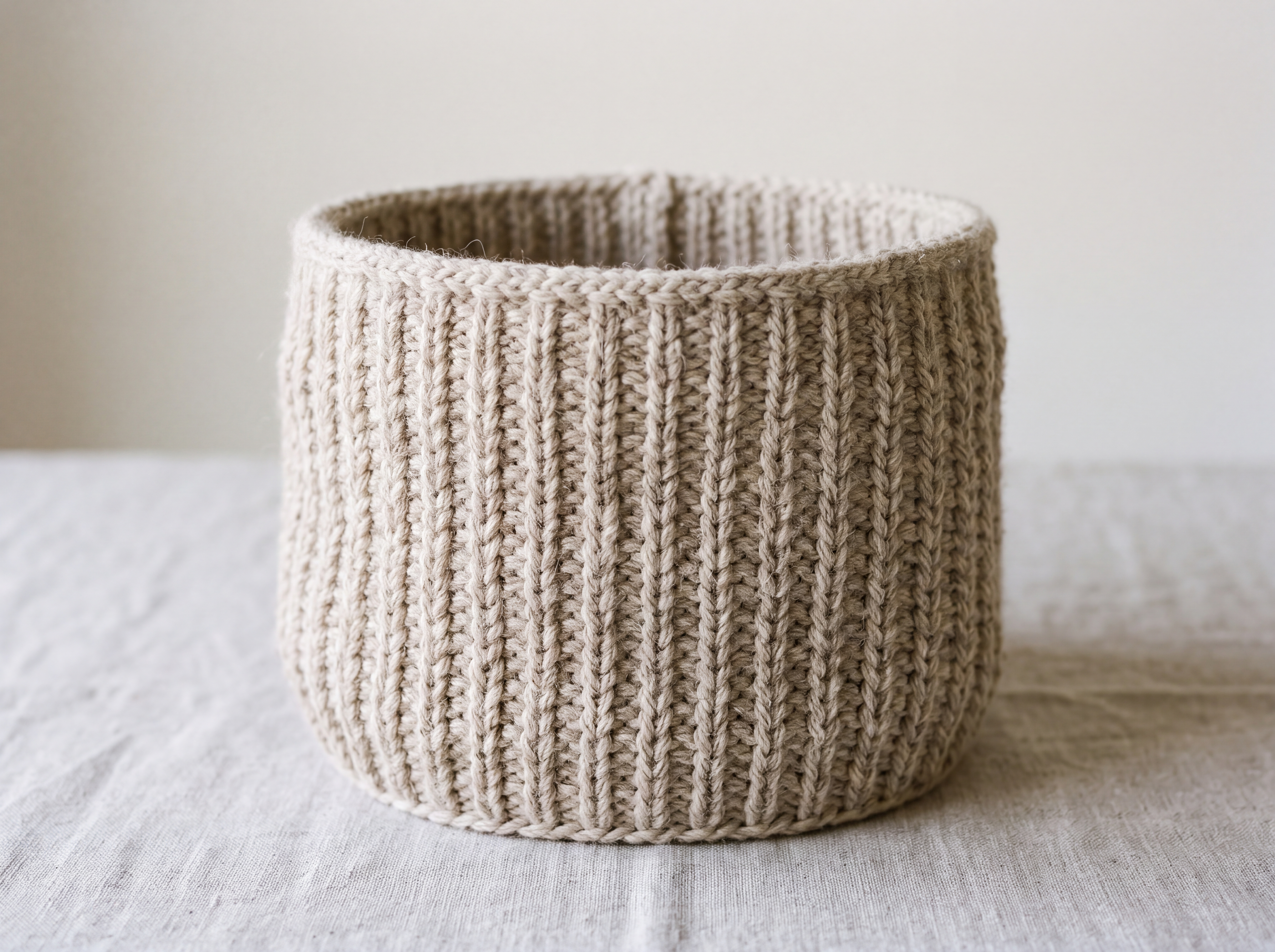
Tuck-In Moss Rib Cowl
A chunky single-loop infinity cowl in a plush, reversible moss rib. It is worked seamlessly in the round and finished with tubular edges that lie flat and do not roll, so the loop can tuck snugly inside a winter jacket or coat collar. Both faces look the same if the cowl twists while you wear it.
Difficulty: Beginner
Skills used: Knit, purl, slip stitches purlwise, join in the round. Tubular cast-on and tubular bind-off are written step by step below. Practice the cast-on once before you start the cowl. The body is only knit and purl.
Finished Measurements
| Circumference | 28" (71 cm) |
| Height | 10" (25 cm) |
| Laid flat | 14" (35.5 cm) wide × 10" (25 cm) tall |
One size. This is a close single loop, not a double wrap. It pulls over an average adult head (about 22–23" / 56–58 cm) and sits near the neck so it can tuck into a collar.
     28" (71 cm) circumference
  ┌────────────────────────────┐
  │ tubular bind-off           │ ┐
  │ 1×1 rib edge               │ │
  │                            │ │
  │ Moss Rib body              │ │ 10" (25 cm)
  │                            │ │
  │ 1×1 rib edge               │ │
  │ tubular cast-on            │ ┘
  └────────────────────────────┘
  Laid flat: 14" (35.5 cm)
Yarn
Bulky weight (CYC #5) wool blend, 260 yards (238 m).
Purchase 275 yards (251 m) so you have enough for a gauge swatch and a small margin.
- 2 skeins if each skein has about 140 yards (128 m)
- 3 skeins if each skein has 100–110 yards (91–100 m)
Choose a blend with at least half wool (wool/acrylic or wool/nylon). Wool gives warmth and a plush hand; a little acrylic or nylon adds strength and helps the cowl hold its shape inside a collar. A heather or tweed makes the moss texture easy to see. Solid colors work just as well.
This pattern’s gauge, 14 stitches = 4" (10 cm), sits in the standard bulky range of 12–15 stitches per 4" (10 cm).
Needles
US 10.5 / 6.5 mm circular needle, 24" (60 cm) long, or size needed to obtain gauge.
A 16–24" (40–60 cm) cable is fine. The cable must be shorter than 28" (71 cm). A wood or bamboo needle grips bulky yarn and makes the tubular cast-on easier to control than a very slippery metal needle.
Notions
- 1 stitch marker
- Tapestry needle
- Scissors
- Row counter (optional, helpful for Moss Rib)
- Small amount of smooth waste yarn in a contrasting color, for cast-on practice (optional)
Gauge
14 stitches and 24 rounds = 4" (10 cm) in Moss Rib, blocked.
That is 3.5 stitches and 6 rounds to 1" (2.5 cm).
Take time to check gauge. Stitch gauge controls the circumference. A stockinette swatch will not match this fabric.
Swatch in the round: Cast on 30 stitches, join, and work Moss Rib for 28 rounds. Bind off, block, and let it dry. In the center of the swatch, 14 stitches should measure 4" (10 cm) across, and 24 rounds should measure 4" (10 cm) tall. Do not include the cast-on or bind-off in the measurement. Measure stitches along one layer only.
- Fewer than 14 stitches in 4" (10 cm): switch to a smaller needle.
- More than 14 stitches in 4" (10 cm): switch to a larger needle.
Expect to land between US 10 / 6 mm and US 11 / 8 mm, depending on your yarn and hands.
Construction
The cowl is worked in one piece from the lower edge up. A tubular cast-on and matching tubular bind-off make rounded edges with no ridge and no roll. Four rounds of 1×1 rib at each end lock those edges. The body is Moss Rib.
Moss Rib here is a reversible double moss: two rounds of 1×1 rib, then two rounds with the knits and purls swapped. It lies flat, looks the same on both sides, and feels thicker than stockinette.
Abbreviations
| Abbreviation | Meaning |
|---|---|
| BO | bind off |
| CO | cast on |
| k | knit |
| p | purl |
| pm | place marker |
| rep | repeat |
| rnd(s) | round(s) |
| sl | slip purlwise |
| sm | slip marker |
| st(s) | stitch(es) |
| wyib | with yarn in back |
| wyif | with yarn in front |
Pattern Stitches
1×1 Rib (even number of sts, in the round)
Every round: *K1, p1; rep from * to end.
Moss Rib (even number of sts, in the round)
- Round 1: *K1, p1; rep from * to end.
- Round 2: *K1, p1; rep from * to end.
- Round 3: *P1, k1; rep from * to end.
- Round 4: *P1, k1; rep from * to end.
Repeat Rounds 1–4.
Rounds 1–2 look exactly like 1×1 rib. That is correct. The texture breaks on Rounds 3–4, when each knit is worked above a purl and each purl above a knit.
How to read your knitting: On Rounds 1–2, a knit sits on a knit. On Rounds 3–4, a knit sits on a purl. If that is not what you see, tink back to the marker.
Special Techniques
Tubular Cast-On for 1×1 Rib
This cast-on alternates a knit stitch and a purl stitch and rounds over the edge so it will not roll. Any tubular (Italian) 1×1 cast-on you already know is fine, if it gives 98 stitches, begins with a knit stitch, and ends with a purl stitch. Otherwise use the method below.
Practice on 20 stitches, then unravel, before you cast on the cowl.
Leave a tail 3 yards (2.7 m) long. Make a slip knot and place it on the right needle. The slip knot does not count. You will drop it before you join.
Hold the tail over your left thumb (front strand) and the working yarn over your left index finger (back strand), as you would for a long-tail cast-on. Keep both strands snug with your other fingers.
Knit stitch
- Dip the needle under the front strand, from front to back.
- Sweep the needle over the back strand, catch it, and bring it forward under the front strand.
- Drop the thumb loop and snug the stitch. Do not pull it tight.
Purl stitch
- Dip the needle under the back strand, moving the needle away from you.
- Sweep the needle over the front strand, catch it, and bring it back under the back strand.
- Drop the index-finger loop, then set both strands back on thumb and index finger. Snug the stitch gently.
Alternate knit stitch, purl stitch, until 98 stitches are on the needle, not counting the slip knot. The first counted stitch is a knit. The last is a purl (98 ÷ 2 = 49 pairs ✓).
Drop the slip knot off the needle. Count again. You must have 98 stitches.
Tubular Set-Up
These two rounds fold the cast-on into a rounded lip. They are not part of the 60-round height count. Slip every slipped stitch purlwise.
- Set-up Round 1: *K1, sl 1 wyif; rep from * to end.
- Set-up Round 2: *Sl 1 wyib, p1; rep from * to end.
After Round 2, the edge should look like a smooth roll with knit and purl columns ready for rib. If the edge gapes, you skipped a set-up round or worked it too loosely.
Tubular Bind-Off for 1×1 Rib
Work this only after the ending 1×1 rib, when the first stitch of the round is a knit stitch and the second is a purl. Do not bind off straight from Moss Rib. The offset moss columns will not graft into a clean tube.
Cut the yarn, leaving a tail 3½ yards (3.2 m) long — about 4 times the circumference (4 × 28" = 112" ✓). Thread it on a tapestry needle. Keep the tail untwisted. Do not pull the sewing yarn tighter than the cast-on edge. Stop every 10 stitches and stretch the edge; it should stretch as easily as the cast-on.
The round begins with a knit stitch.
Set-up (once)
- Insert the tapestry needle into the first stitch as if to purl. Pull the yarn through. Leave the stitch on the knitting needle.
- Insert the tapestry needle into the second stitch as if to knit. Pull the yarn through. Leave the stitch on the knitting needle.
Repeat
- Insert the tapestry needle into the first stitch as if to knit. Slip that stitch off the knitting needle.
- Bring the tapestry needle in front of the new first stitch (a purl). Insert it into the next stitch (a knit) as if to purl. Pull the yarn through. Leave that stitch on the knitting needle.
- Insert the tapestry needle into the first stitch as if to purl. Slip that stitch off the knitting needle.
- Bring the tapestry needle behind the new first stitch (a knit). Insert it into the next stitch (a purl) as if to knit. Pull the yarn through. Leave that stitch on the knitting needle.
Repeat steps 3–6 around.
Close the round: When 2 stitches remain (knit, then purl), work step 3 and step 5, but pass the tapestry needle through the matching first bound-off stitch of the round so the circle is continuous and there is no step at the marker. The path should follow the same knit column and purl column you have been sewing.
Weave the tail down the inside of the tubular edge for about 2" (5 cm). Trim.
Instructions
Cast on and join
Work the Tubular Cast-On: 98 stitches. Confirm the first stitch is a knit and the last is a purl.
Place a marker on the right needle and join to work in the round, being careful not to twist. The last stitch (purl) should meet the first stitch (knit) so the alternation continues around the circle. The working yarn comes from the last cast-on stitch.
(28" × 14 sts ÷ 4" = 98 sts; 98 is divisible by 2 ✓)
Snug the cast-on tail to close the gap at the join as you work the first set-up round. Do not cast on an extra stitch to close the gap; an odd count would break the rib.
Work Tubular Set-Up Rounds 1 and 2 once.
Beginning edge
Work 4 rounds in 1×1 Rib.
These rounds, plus Moss Rib Rounds 1–2 that follow, form a neat ribbed lip about 1" (2.5 cm) deep before the texture breaks. (6 rounds × 4" ÷ 24 rounds = 1" ✓)
Body
Work Moss Rib for 13 full repeats (52 rounds), ending with Round 4.
(13 × 4 = 52 rounds ✓)
At the stated gauge this is 8⅔" (22 cm) of Moss Rib. The first two of these rounds still look like 1×1 rib. Do not restart the pattern when you notice that.
Measurement checkpoint: If your row gauge does not match, ignore the 52-round target. Continue Moss Rib until the cowl measures 9⅓" (23.5 cm) from the cast-on edge, and stop only after a Round 4.
Ending edge
Work 4 rounds in 1×1 Rib.
You must return to 1×1 rib before the bind-off. Round 4 of Moss Rib ends with purls on the knit columns; the first ending-rib round (k1, p1) puts a knit back on the first stitch, which is what the tubular bind-off needs.
(4 + 52 + 4 = 60 stacked rounds. 60 × 4" ÷ 24 rounds = 10" ✓)
The cowl should now measure about 10" (25 cm) from the cast-on edge. The two set-up rounds are the rounded lip and add no meaningful extra height.
Bind off
Bind off using the Tubular Bind-Off. Keep the edge as elastic as the cast-on. A tight bind-off will not pull over your head.
Finishing
Weave the cast-on tail into the inside of the tubular edge for about 2" (5 cm). Weave in any other ends. Trim.
Block to 28" (71 cm) circumference and 10" (25 cm) height. Wet-block or steam gently, following your ball band. Do not twist or wring a wool blend. Lay the cowl flat as a double layer, 14" (35.5 cm) wide and 10" (25 cm) tall, or ease it over a towel rolled into a 28" (71 cm) loop. Let it dry fully. Blocking evens the moss rib and settles the tubular edges so they do not flare.
How to Wear
Pull the loop over your head. It is a single loop, not a double wrap. Tuck the lower tubular edge inside your jacket or coat collar so the flat edge rests against you and the moss-rib body fills the collar opening. The 10" (25 cm) height can also fold once over a shorter collar. Either face may show.
Care
Hand wash in cool water with a wool-safe wash. Squeeze out water in a towel. Lay flat to dry. Do not tumble dry. Follow the ball band if it is stricter than this.
Customization
Cast on a multiple of 2 stitches so both 1×1 rib and Moss Rib come out even. Every 2 stitches changes the circumference by about ½" (1.5 cm) at this gauge (2 × 4" ÷ 14 = 0.57" ✓).
- Closer loop, about 26" (66 cm): cast on 90 stitches.
- Looser loop, about 30" (76 cm): cast on 104 stitches.
- Double-loop cowl, about 56" (142 cm): cast on 196 stitches, use a 32–40" (80–100 cm) circular needle, and buy about twice the yarn (520 yards / 475 m for the cowl). Still join without a twist unless you specifically want a mobius, which this pattern does not.
To change height, add or remove full 4-round Moss Rib repeats. Each repeat changes the height by about ⅔" (1.7 cm) (4 × 4" ÷ 24 = ⅔" ✓). Keep the 4-round rib borders and both tubular edges, or the ends will roll and the bind-off will not match.
A different bulky yarn is fine if you match gauge. A fuzzier yarn will soften the moss texture; a smoother wool blend will show it more clearly.
Tips and Troubleshooting
- Count once more before you join. 98 stitches, knit then purl all the way around, beginning with knit and ending with purl.
- Twisted join: The cast-on must run in a smooth circle, not a spiral. You can fix a twist only in the first round or two. After that, the spiral is knitted in.
- Edge flares: Set-up rounds were skipped, or they were worked much looser than the rib.
- Edge will not stretch: Bind-off was pulled tight. Unpick it and sew it again at the same tension as the cast-on.
- Moss looks like plain rib: You are still on Rounds 1–2, or you forgot to switch to Round 3. Two matching rounds, then two opposite rounds.
- A column drifted: You worked an odd number of rounds before switching. Tink back to the marker and restart that 2-round pair.
- Gap at the join: Snug the cast-on tail on the first set-up round. The tubular edge will close further when you weave that tail in.
The finished cowl should feel thick and soft, with rounded edges that stay flat when you slide it inside a collar.
Disclaimer: This pattern was generated by AI and should be reviewed for accuracy before use. While we strive for quality, AI-generated content may contain errors. Please verify measurements, stitch counts, charts, and instructions before beginning your project. Generated by purlJam.uk
Love this pattern?
Save this pattern to your free PurlJam libraryAccess your pattern anytime
Bookmark this page to access your pattern anytime