Type
Knitting
Difficulty
advanced
Category
scarf
AI Thinking Process
Planning
Verification
Pattern
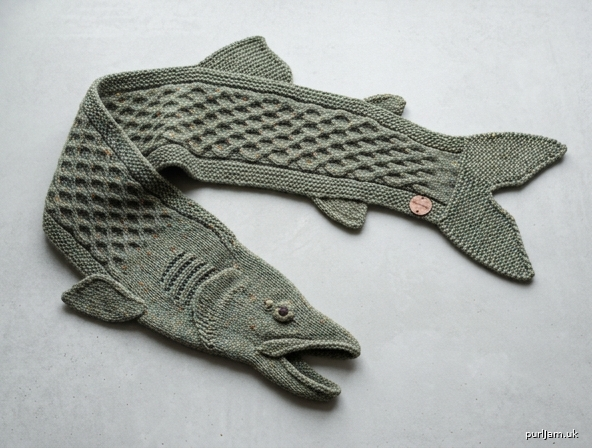
Tweedscale Trout Scarf
An advanced fish-shaped scarf worked flat from tail to head. Two garter-stitch caudal lobes form a forked tail; the body is a honeycomb cable that reads as trout scales in tweed; the head is decreased, short-rowed, and split into upper and lower jaws. A dorsal fin, adipose fin, anal fin, and two pectoral fins finish the silhouette. Designed to use 2 balls of Lang Yarns Cloud Tweed; the even body is the yarn-adjustment zone.
Difficulty: Advanced
Skills used: Cables, directional increases, two-piece join, wrap & turn short rows, bobble (optional), picking up stitches, multi-piece finishing.
Finished measurements
After steam blocking (your fabric may vary slightly):
- Length: approximately 54–58" (137–147 cm), adjustable in the body
- Body width: approximately 8" (20.5 cm)
- Tail span (lobes pinned apart): approximately 9–10" (23–25.5 cm)
- Head / snout: tapers from 8" (20.5 cm) to approximately 2" (5 cm)
Materials
Yarn: Lang Yarns Cloud Tweed, worsted weight; 2 balls.
Pattern is calculated for a total of approximately 320 yd / 293 m. Check your ball band. If each ball contains less than 150 yd (137 m), work a shorter body (see Body yarn checkpoint). Tweed flecks read as trout spotting—olive, steel, rust, or natural are especially effective.
Needles:
- US 8 / 5 mm, straight or circular, for the scarf
- US 7 / 4.5 mm, for fins (firmer fabric so fins stand away from the body)
Notions:
- Cable needle
- Stitch markers (2)
- Stitch holder or waste yarn
- Tapestry needle
- Blocking pins / wires
- Small amount of dark scrap yarn for embroidered pupils (optional)
Gauge
18 stitches and 24 rows = 4" (10 cm) in Honeycomb Scale pattern (Chart A), steam-blocked, on US 8 / 5 mm.
Honeycomb pulls in. Do not substitute a stockinette gauge. If you have fewer than 18 sts to 4" (10 cm) in pattern, go down a needle size so 2 balls will cover the length.
Abbreviations (US)
BO — bind off
C4B — sl 2 sts to CN, hold to back, k2, k2 from CN
C4F — sl 2 sts to CN, hold to front, k2, k2 from CN
cdd — slip 2 sts together knitwise, k1, pass 2 slipped sts over (centered double decrease; 2 sts decreased)
CN — cable needle
CO — cast on
k — knit
k2tog — knit 2 together (right-leaning decrease)
m1L — make 1 left (lift strand from front to back, knit through back loop)
m1R — make 1 right (lift strand from back to front, knit through front loop)
p — purl
pm — place marker
rep — repeat
RS — right side
sl — slip
ssk — slip, slip, knit (left-leaning decrease)
st(s) — stitch(es)
w&t — wrap and turn
WS — wrong side
wyib / wyif — with yarn in back / with yarn in front
Stitch guide
Garter stitch: Knit every row.
Honeycomb Scale (multiple of 8; 8-row repeat) — also Chart A:
- Row 1 (RS): *C4B, C4F; rep from * to end of panel.
- Row 2 (WS): Purl.
- Row 3: Knit.
- Row 4: Purl.
- Row 5: *C4F, C4B; rep from * to end of panel.
- Row 6: Purl.
- Row 7: Knit.
- Row 8: Purl.
Rep Rows 1–8 for pattern.
Wrap & turn (w&t): On RS, sl next st purlwise wyib, bring yarn to front, sl st back to left needle, turn. On WS, sl next st purlwise wyif, bring yarn to back, sl st back to left needle, turn. On a later row, work the wrap together with its stitch.
Optional bobble (eye): (K1, yo, k1, yo, k1) into 1 st (5 sts), turn, p5, turn, k5, turn, p5, turn, sl 2, k3tog, p2sso (1 st remains).
Cable cast-on: *Insert right needle between first 2 sts on left needle, knit 1, place new st on left needle; rep from * to required count.
Chart A — Honeycomb Scale
8-st repeat × 8-row repeat. Worked over the center 32 sts (4 repeats). Read RS rows (odd) from right to left; WS rows (even) from left to right. Row 1 is at the bottom.
        |  8   7   6   5   4   3   2   1
--------+--------------------------------  (one 8-st repeat)
Row 8 WS|  —   —   —   —   —   —   —   —
Row 7 RS|  k   k   k   k   k   k   k   k
Row 6 WS|  —   —   —   —   —   —   —   —
Row 5 RS|  [     C4F      ][     C4B      ]
Row 4 WS|  —   —   —   —   —   —   —   —
Row 3 RS|  k   k   k   k   k   k   k   k
Row 2 WS|  —   —   —   —   —   —   —   —
Row 1 RS|  [     C4B      ][     C4F      ]
How it sits in the 40-st body:
[ 4 sts garter |  32 sts Chart A (4 × 8)  | 4 sts garter ]
     belly              scales                 dorsal
Symbol key
| Symbol | RS | WS |
|---|---|---|
| k / □ | knit | purl |
| — | — (not used on RS in this chart) | purl the panel (all WS chart rows are purled) |
| C4B | sl 2 to CN, hold back, k2, k2 from CN | — |
| C4F | sl 2 to CN, hold front, k2, k2 from CN | — |
Cables are worked on RS rows only.
Notes
- Scarf is worked flat, tail to head. RS is the scale (cable) side.
- Dorsal edge = last 4 sts of a RS row. Belly edge = first 4 sts of a RS row. Mark them if it helps when placing fins.
- Slip the first stitch of every row purlwise wyif and knit the last stitch — this chain selvedge makes fin pickup even.
- Begin Chart A only when there are 40 sts (32-st panel). Until then, the center is stockinette with garter edges.
- Yarn checkpoint (2 balls): when 30 g / approximately 100 yd (91 m) remain, stop the even body and begin head shaping, even if the scarf is short of the stated length. Head + all fins use roughly that amount.
- Keep 2 markers throughout the body: they sit between garter edges and the honeycomb panel.
Pattern
Tail — Left lobe
With US 8 / 5 mm, CO 18 sts.
Row 1 (WS): Knit.
Row 2 (RS): K1, ssk, knit to end. (17 sts)
Row 3: Knit.
Rep Rows 2–3 until 10 sts remain. (18 − 8 = 10 sts ✓; 8 decrease rows = 16 rows of shaping.)
Work 1 WS knit row. Place 10 sts on holder. Break yarn, leaving a 12" (30 cm) tail.
Tail — Right lobe
CO 18 sts.
Row 1 (WS): Knit.
Row 2 (RS): Knit to last 3 sts, k2tog, k1. (17 sts)
Row 3: Knit.
Rep Rows 2–3 until 10 sts remain. (18 − 8 = 10 sts ✓)
Work 1 WS knit row. Do not break yarn.
Join and peduncle
Joining row (RS): Knit 10 right-lobe sts, cable CO 4 sts, knit 10 left-lobe sts from holder.
24 sts (10 + 4 + 10 = 24 ✓).
Work 7 rows garter (ending with a WS row). Peduncle measures approximately 1¼" (3 cm) from the joining row.
The two free inner selvedges form the fork of the tail. Do not sew them shut.
Body increases
Maintain 4 garter sts at each edge; all new stitches are worked in stockinette (knit RS, purl WS) inside those edges.
Inc row (RS): K4, m1L, knit to last 4 sts, m1R, k4. (2 sts increased)
Next row (WS): K4, purl to last 4 sts, k4.
Next 2 rows: Work even in established edge/stockinette.
Rep these 4 rows 7 more times — 8 increase rows total.
24 + 16 = 40 sts ✓.
Work 1 WS row even as established.
Setup row (RS): K4, pm, work Chart A Row 1 over next 32 sts (4 repeats of C4B, C4F), pm, k4.
Body (even)
RS rows: K4, slm, work next RS row of Chart A over 32 sts, slm, k4.
WS rows: K4, slm, purl 32 (Chart A WS), slm, k4.
Continue until 30 full 8-row repeats of Chart A have been worked (240 rows of honeycomb; 240 ÷ 6 rows per inch = 40" / 101.5 cm ✓), or until the piece measures approximately 48" (122 cm) from the tail-lobe cast-on edges, or until 30 g / ~100 yd remain — whichever comes first.
End having completed Chart A Row 8 (WS).
Place a removable marker on the dorsal selvedge (left edge as viewed on RS, last 4 sts of RS rows) at the following points, for later fin pickup:
- Adipose (optional): 2½" (6.5 cm) forward of the peduncle (toward the head from the tail)
- Dorsal fin: a 5" (12.5 cm) span beginning 8" (20.5 cm) forward of the peduncle
- Anal fin (belly edge): a 2½" (6.5 cm) span beginning 3" (7.5 cm) forward of the peduncle
Head
Keep working Chart A over as many full 8-st repeats as still fit between the edges. Extra center sts that are no longer a full repeat are worked in stockinette. When fewer than 16 panel sts remain, drop Chart A and work the center in stockinette.
Decrease sequence A — every 4th row, 6 times:
Dec row (RS): K1, ssk, work as established to last 3 sts, k2tog, k1. (2 sts decreased)
Work 3 rows even as established.
After 6 decrease rows: 40 − 12 = 28 sts ✓. (24 rows ≈ 4" / 10 cm)
Gill row 1 (RS): K3, yo, ssk, k2, yo, ssk, work to last 11 sts, k2tog, yo, k2, k2tog, yo, k3. (count unchanged)
Next row (WS): Work even, knitting the 4 edge sts and purling the center, working each yo as a stitch.
Gill row 2 (RS): K4, yo, ssk, k1, yo, ssk, work to last 11 sts, k2tog, yo, k1, k2tog, yo, k4.
Next row: Work even.
Decrease sequence B — every RS row, 6 times:
Dec row (RS): K1, ssk, work to last 3 sts, k2tog, k1.
WS: Work even.
After 6 decrease rows: 28 − 12 = 16 sts ✓. (12 rows ≈ 2" / 5 cm)
Optional eye bobble (RS), on the first row of Sequence B that you prefer visually: work to 5 sts before the dorsal edge, make bobble in next st, finish the row. Embroider a pupil later on both faces of the fabric so the scarf reads as a fish from either side.
Short-row snout
Working in stockinette with 1 knit selvedge st each side:
Short row 1 (RS): K13, w&t.
Short row 2 (WS): P10, w&t.
Short row 3: K8, w&t.
Short row 4: P6, w&t.
Next row (RS): Knit to end, working wraps together with their stitches.
Next row (WS): Purl to end, working remaining wraps together with their stitches.
16 sts remain ✓.
Jaws
Divide (RS): K8 (upper jaw); place remaining 8 sts on holder (lower jaw).
Upper jaw
Work 4 rows even in stockinette (knit RS, purl WS), keeping 1 knit selvedge st each side.
Dec row (RS): K1, ssk, knit to last 3 sts, k2tog, k1.
WS: Purl.
Rep the last 2 rows twice more: 8 → 6 → 4 → 2 sts ✓.
BO 2 sts. Break yarn.
Lower jaw
With WS facing, rejoin yarn to 8 held sts. Purl 1 row.
Work 2 rows even (so the lower jaw is slightly shorter — the mouth sits a little open).
Work the same decrease sequence as the upper jaw: 8 → 6 → 4 → 2 sts ✓.
BO 2 sts. Break yarn, leaving a 8" (20 cm) tail. Use it to neaten the corner of the mouth if needed; do not sew the jaws shut.
Fins
Use US 7 / 4.5 mm unless noted. All fins are garter stitch (knit every row).
Dorsal fin
With RS facing, along the marked 5" (12.5 cm) dorsal span, pick up and knit 18 sts evenly (about 1 st per garter ridge, plus extras as needed).
Row 1 (WS): Knit.
Row 2 (RS): K1, m1L, knit to last st, m1R, k1. (20 sts; 18 + 2 = 20 ✓)
Rows 3–5: Knit.
Dec row (RS): K1, ssk, knit to last 3 sts, k2tog, k1.
Next row: Knit.
Rep the last 2 rows until 2 sts remain. (20 − 18 = 2 ✓; 9 decrease rows)
K2tog, fasten off.
Adipose fin (optional, trout detail)
With RS facing, pick up and knit 5 sts at the adipose marker.
Knit 3 rows.
Next row: K1, cdd, k1. (3 sts)
Knit 1 row.
Next row: Cdd. Fasten off.
Anal fin
With RS facing, along the marked 2½" (6.5 cm) belly span, pick up and knit 10 sts.
Knit 1 WS row.
Dec row (RS): K1, ssk, knit to last 3 sts, k2tog, k1.
Next row: Knit.
Rep the last 2 rows until 2 sts remain. K2tog, fasten off.
Pectoral fins (make 2)
CO 12 sts.
Knit 4 rows.
Dec row (RS): K1, ssk, knit to end. (1 st decreased — this is the leading/head edge)
Next 3 rows: Knit.
Rep the last 4 rows until 4 sts remain. (12 − 8 = 4 ✓)
Next RS: Ssk, k2tog. (2 sts)
Next row: K2tog. Fasten off.
Finishing
- Weave in ends on the WS, following cable columns where possible so nothing shows on the scale side.
- Pectoral fins: Sew the cast-on edge of each fin to the body at the gill line (the yarnover slits), one fin on each face of the fabric, angled toward the tail. The decrease (leading) edge points toward the snout. A 1" (2.5 cm) attach line is enough; leave the rest free.
- Eyes: With dark scrap (or the tweed itself), embroider a small filled circle on both faces, about 1½" (4 cm) back from the snout and one-third of the way down from the dorsal edge. If you worked a bobble, stitch a pupil into its center.
- Mouth: Tack the inner corners of the jaws with one hidden stitch if they flare; keep the bind-off edges open.
- Block:
- Body: Steam-block gently to approximately 8" (20.5 cm) wide. Hover the iron; do not press cables flat.
- Tail: Pin the two lobes apart so the fork is obvious and the trailing edges measure about 9–10" (23–25.5 cm) span.
- Fins: Pin each fin out to a clean triangle; let dry fully.
- Head: Pin the snout to a blunt point; do not stretch the jaws out of shape.
- Once dry, weave any remaining tails. Do not add hardware (buttons, beads) if the scarf will be worn by children.
Wear with the fish wrapped once or twice, head and tail hanging. The honeycomb is intentionally denser than the garter fins so the body drapes and the fins stand slightly away.
Schematic (not to scale)
        *                    *          <-- tail tips (CO edges of lobes)
         \      LOBE        / \
          \                /   \ LOBE
           \______________/     \____   <-- inner selvedges = fork (do not sew)
                    |  24 sts  |
                    | peduncle |
                   /  increase  \
                  /    to 40     \
                 |  4 | 32 HC | 4 |     <-- garter | Chart A | garter
                 |    BODY ~40"   |========  dorsal fin
                 |    honeycomb   |    *     adipose (optional)
                 |                |
                  \    HEAD      /====== pectoral (one each face)
                   \  yo gills  /
                    \  snout   /
                     \ jaws  /          <-- upper longer than lower
                       ====
                         anal fin on belly edge (not shown)
Stitch-count path (for your row tally):
18 + 18 lobes → 10 + 4 + 10 = 24 join ✓ → 24 + 16 = 40 body ✓ → 40 − 12 = 28 ✓ → 28 − 12 = 16 ✓ → 8 + 8 jaws ✓.
Disclaimer: This pattern was generated by AI and should be reviewed for accuracy before use. While we strive for quality, AI-generated content may contain errors. Please verify measurements, stitch counts, charts, and instructions before beginning your project. Generated by purlJam.uk
Love this pattern?
Save this pattern to your free PurlJam libraryAccess your pattern anytime
Bookmark this page to access your pattern anytime