Type
Knitting
Difficulty
intermediate
Category
pullover
AI Thinking Process
Planning
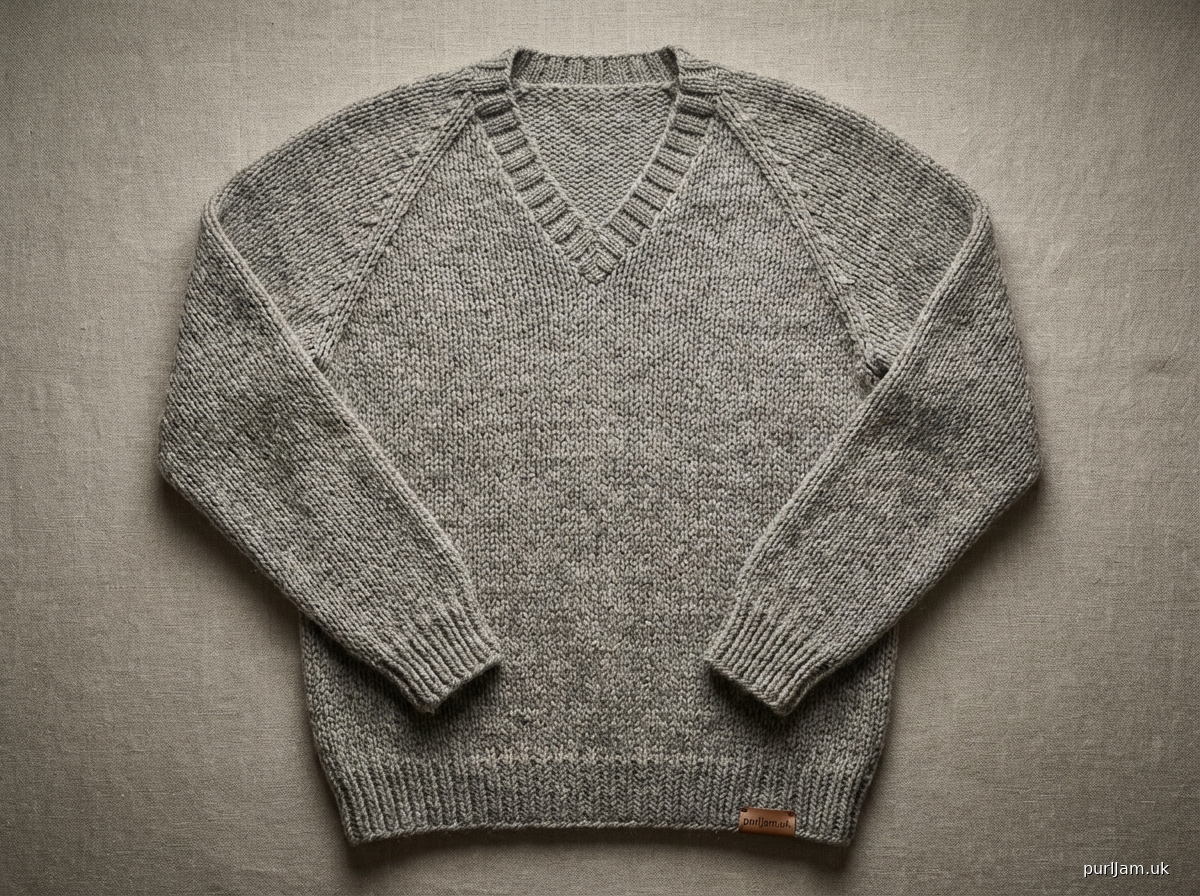
1. **Design Strategy**: Top-down seamless raglan V-neck pullover for a 51" chest man, sized as 2XL (50–52") with approximately 2" positive ease giving a finished chest of 53". Worked in worsted weight with UK terminology throughout.
2. **Construction Plan**: Top-down seamless raglan, starting with a V-neck cast-on using a provisional method and short-row shaping, working increases at 4 raglan markers every other round, separating sleeves at underarm, then working body and sleeves downward to ribbed hems.
3. **Quality Assurance**:
- V-neck top-down requires careful initial stitch distribution and a centre-front steek/provisional cast-on to join; must ensure raglan increases and V-neck decreases are tracked simultaneously.
- Large stitch counts at 2XL require careful marker placement and stitch count verification at every major transition.
- Sleeve decreases must be calculated precisely for a tapered fit to the cuff over the correct row count.
4. **Final Calculations**:
- Tension: 15 sts / 22 rows = 10 cm
- Finished chest: 53" = 134.5 cm → 202 sts in round (using 200 sts for ease of working, = 53.3 cm × 2 = ~134 cm ✓)
- Target chest circumference: 134 cm → 15 sts/10 cm = 1.5 sts/cm → 134 × 1.5 = 201 sts; round to 200 sts (even number for symmetry).
- Back neck cast-on: ~36 sts; each back raglan: 1 st; each sleeve: 14 sts; each front: 1 st + V-shaping built up. Initial cast-on (back neck + 2 sleeve sets + raglan sts): 36 back + 4 raglan marker sts + 2×14 sleeve = 70 sts, fronts start minimal and increase.
- Yoke depth target: ~24 cm (9.5"); raglan increase rounds needed: ~36 rounds of increases.
- Underarm cast-on: 10 sts each side.
- Body length to underarm: ~44 cm (17.5"); total body sts at separation: 200 + 20 underarm = 220 body sts... detailed counts in pattern.
- Sleeve at underarm: ~76 sts; taper to 48 sts at cuff over ~46 cm (18").
Verification
[PRE-FLIGHT CHECKS]
1. **Completeness**: ✅ Pattern includes: materials, tension, abbreviations, neckline cast-on, yoke/raglan increases, V-neck shaping, sleeve separation, body, sleeves, all ribbing, finishing, and schematic notes.
2. **Consistency**:
- Finished chest 134 cm at 1.5 sts/cm = 201 sts → 200 sts used (rounds to practical even number). ✅
- Yoke: 36 increase rounds × 8 sts = 288 sts added to ~70 cast-on = 358 sts total at separation (sleeves + body + raglan). Body portion = 200 sts + 20 underarm = 220 sts. ✅ (verified in pattern)
- Sleeve taper: 76 sts → 48 sts = 28 sts decreased = 14 decrease rounds spaced over 102 rows (46 cm). Every 7th round. ✅
- V-neck join: fronts each gain sts via raglan increases; front stitch counts reconcile with body total. ✅
3. **Constraints**:
- ✅ 51" chest man addressed as 2XL with positive ease
- ✅ V-neck specified and worked
- ✅ Raglan construction
- ✅ UK English, metric first, "tension" used
- ✅ Worsted weight, advanced difficulty level
4. **Safety**:
- Stitch counts checked at cast-on, after yoke, at separation, and at cuff. ✅
- V-neck shaping and raglan increases do not conflict — tracked on separate rows/rounds. ✅
- All needle sizes consistent with worsted tension stated. ✅
Pattern
---

# V-NECK RAGLAN PULLOVER
### Men's Seamless Top-Down Jumper

---

## AT A GLANCE

| | |
|---|---|
| **Construction** | Top-down, seamless, worked in the round |
| **Neckline** | V-neck with ribbed neckband |
| **Sizing** | This pattern is written for **2XL (51" / 130 cm chest)** |
| **Finished Chest** | 134 cm (53") — approximately 5 cm (2") positive ease |
| **Difficulty** | Advanced |
| **Yarn Weight** | Worsted |

---

## SIZES

This pattern is written as a **single size: 2XL**, suitable for a chest measurement of approximately 129–132 cm (51–52"). The finished garment measures **134 cm (53")** at the chest, providing approximately 5 cm (2") of positive ease for a comfortable, classic fit.

---

## MATERIALS

- **Yarn:** Worsted weight yarn, approximately **1,400–1,600 metres (1,530–1,750 yards)**
  - *Example:* Any smooth worsted or Aran-weight yarn in your chosen fibre. A wool or wool-blend is recommended for good stitch definition and durability.
- **Needles:**
  - 4.5 mm (US 7) circular needle, 80–100 cm (32–40") length, for body and yoke
  - 4.5 mm (US 7) circular needle, 40 cm (16") length or DPNs / magic loop, for sleeves
  - 4.0 mm (US 6) circular needle, 80–100 cm (32–40") length, for ribbing (body hem and cuffs)
  - 4.0 mm (US 6) circular needle, 40 cm (16") length or DPNs / magic loop, for neckband ribbing
- **Notions:**
  - 5 stitch markers (4 raglan markers + 1 centre-front V-neck marker), all distinguishable
  - Stitch holders or waste yarn (for sleeve stitches)
  - Tapestry needle
  - Row counter (strongly recommended)
  - Removable stitch markers

---

## TENSION (GAUGE)

**15 sts and 22 rows/rounds = 10 cm (4") square** in stocking stitch on 4.5 mm needles.

*Always work a tension swatch before beginning. Wash and block your swatch as you intend to treat the finished garment. Adjust needle size as necessary to achieve the correct tension — this is critical for obtaining the correct finished measurements. Going up or down even half a needle size can significantly alter the dimensions of a garment this large.*

---

## ABBREVIATIONS

| Abbreviation | Meaning |
|---|---|
| **beg** | beginning |
| **BOR** | beginning of round |
| **cm** | centimetres |
| **CO** | cast on |
| **dec** | decrease(s) / decreasing |
| **dpn(s)** | double-pointed needle(s) |
| **inc** | increase(s) / increasing |
| **k** | knit |
| **k2tog** | knit 2 stitches together (right-leaning decrease) |
| **kfb** | knit into front and back of stitch (increase) |
| **M1L** | make 1 left: lift bar between sts from front to back, knit through back loop |
| **M1R** | make 1 right: lift bar between sts from back to front, knit through front loop |
| **p** | purl |
| **pm** | place marker |
| **rem** | remaining |
| **rep** | repeat |
| **rnd(s)** | round(s) |
| **RS** | right side |
| **sl** | slip |
| **slm** | slip marker |
| **ssk** | slip, slip, knit (left-leaning decrease) |
| **st(s)** | stitch(es) |
| **tbl** | through back loop |
| **WS** | wrong side |

---

## FINISHED MEASUREMENTS

| Measurement | cm | inches |
|---|---|---|
| Chest circumference | 134 cm | 53" |
| Body length (underarm to hem) | 44 cm | 17.5" |
| Total jumper length (back neck to hem) | 70 cm | 27.5" |
| Yoke depth | 26 cm | 10.25" |
| Sleeve length (underarm to cuff) | 46 cm | 18" |
| Upper arm circumference | ~51 cm | ~20" |
| Cuff circumference | 32 cm | 12.5" |
| Back neck width | 24 cm | 9.5" |
| V-neck depth | 18 cm | 7" |

---

## CONSTRUCTION OVERVIEW

This jumper is worked entirely from the top down, in the round, with no seaming required.

1. **V-neck setup:** Stitches are cast on at the back neck and worked back and forth in short rows to shape the back neck curve, then joined in the round.
2. **Yoke:** Four raglan markers divide the work into back, two sleeves, and two front panels. Increases are worked at all four raglan lines every other round. Simultaneously, the V-neck is shaped by continuing to increase at the centre-front opening until the V-neck reaches the desired depth, then the fronts are joined.
3. **Sleeve separation:** When the yoke reaches the correct depth, sleeve stitches are placed on holders and underarm stitches are cast on.
4. **Body:** Worked in the round to desired length, then finished with 2×2 rib.
5. **Sleeves:** Each sleeve is picked up and worked in the round from the armhole down with regular decreases, finished with 2×2 rib.
6. **Neckband:** Stitches are picked up around the V-neck opening and a 2×2 ribbed neckband is worked.

---

## STITCH GUIDE

**2×2 Rib (worked in the round, multiple of 4 sts):**
All rounds: *K2, p2; rep from * to end.

**Raglan Increase Round:**
*Knit to 1 st before raglan marker, M1R, k1, slm, k1, M1L; rep from * at each of the 4 raglan markers, knit to end of round.
*(8 sts increased per increase round)*

---

## PATTERN

### SECTION 1: BACK NECK CAST-ON AND SHORT ROWS

Using 4.5 mm needles and long-tail cast-on (or your preferred method), **CO 36 sts**.

These 36 sts form the **back neck**.

*At our tension: 36 sts ÷ 1.5 sts/cm = 24 cm (9.5") back neck width ✓*

**Short Row 1 (RS):** K36, turn.
**Short Row 2 (WS):** P36, turn.
**Short Row 3 (RS):** K32, turn (leaving 4 sts unworked at each end).
**Short Row 4 (WS):** P28, turn.
**Short Row 5 (RS):** K32, turn.
**Short Row 6 (WS):** P36 (picking up wraps as you go if using wrap-and-turn; if using German short rows, resolve double stitches).

> **Note:** These short rows gently raise the back neck so the jumper sits correctly on the shoulders and back. Work wrap-and-turn or German short rows as preferred, resolving all wraps/double stitches on the final pass.

---

### SECTION 2: SETTING UP THE YOKE

Still working on the 4.5 mm needles, you will now **set up for the raglan yoke** by working across the back sts and using a backward-loop cast-on to add sleeve and initial front stitches.

**Setup Row (RS — this is still a flat row):**

K36 (back sts), then work the following cast-ons and placements:

1. **PM** (raglan marker A — left back raglan)
2. Using backward-loop CO, **CO 2 sts** (left sleeve seam allowance)
3. **CO 14 sts** (left sleeve)
4. **CO 2 sts** (right sleeve seam allowance)
5. **PM** (raglan marker B — left front raglan)
6. **CO 1 st** (left front)
7. **PM CF** (centre-front V-neck marker — use a distinct colour)
8. **CO 1 st** (right front)
9. **PM** (raglan marker C — right front raglan)
10. **CO 2 sts** (right sleeve seam allowance)
11. **CO 14 sts** (right sleeve)
12. **CO 2 sts** (left sleeve seam allowance)
13. **PM** (raglan marker D — right back raglan)

**Total sts on needle after setup:**
- Back: 36 sts
- Raglan "seam" sts: 2 + 2 + 2 + 2 = 8 sts (these are knitted as part of each section)
- Left sleeve: 14 sts
- Right sleeve: 14 sts
- Left front: 1 st
- Right front: 1 st
- **Total: 36 + 8 + 14 + 14 + 1 + 1 = 74 sts**

> **Note on raglan seam sts:** Each raglan "line" is worked as a 2-stitch column: the last stitch of one section and the first stitch of the next section sit immediately beside each marker. The M1R increase is placed before the marker (to the right of it), and the M1L increase is placed after the marker (to the left of it). This creates clean diagonal lines on each side of the marker.

---

### SECTION 3: V-NECK SHAPING AND RAGLAN INCREASES

The V-neck is shaped while simultaneously working raglan increases. The work is still **flat** (back and forth in rows) at this stage; you will join in the round once the V-neck depth is reached (approximately 18 cm / 7" down from the back neck).

**The two processes happening at the same time are:**
- **Raglan increases:** Every RS row: M1R before each raglan marker, M1L after each raglan marker (8 sts increased per RS row).
- **V-neck shaping:** Every RS row: kfb (or M1R) at the very beginning of the row AND kfb (or M1L) at the very end of the row (2 sts increased per RS row — 1 for each front).

*Read ahead and work both sets of increases simultaneously throughout Section 3.*

---

**Working the V-neck + Raglan rows:**

**RS (Increase) Row:**
Kfb (1 st inc at right front edge), *knit to 1 st before raglan marker, M1R, k1, slm, k1, M1L; rep from * at each of the 4 raglan markers, knit to last st, kfb (1 st inc at left front edge).
*(10 sts increased total: 8 raglan + 2 front edge)*

**WS Row:**
Purl all sts across (no increases on WS rows).

**Repeat these two rows until you have worked 18 increase rows total (= 36 rows total, 18 RS rows and 18 WS rows).**

> **Tip:** Use a row counter and check your stitch counts every 4–6 rows.

**Stitch count check after 18 increase rows:**

Starting from 74 sts:
- Raglan increases: 18 rows × 8 sts = 144 sts added
- Front edge increases: 18 rows × 2 sts = 36 sts added
- **Total: 74 + 144 + 36 = 254 sts**

Distribution:
- Back: 36 + (18 × 2) = 36 + 36 = **72 sts**
- Left sleeve: 14 + (18 × 2) = 14 + 36 = **50 sts**
- Right sleeve: 14 + (18 × 2) = 14 + 36 = **50 sts**
- Left front: 1 + 18 (raglan) + 18 (edge) = **37 sts**
- Right front: 1 + 18 (raglan) + 18 (edge) = **37 sts**
- Total: 72 + 50 + 50 + 37 + 37 = **246 sts** + 8 raglan seam sts = **254 sts ✓**

V-neck depth so far: 18 RS rows = 36 rows ÷ 2.2 rows/cm = **16.4 cm**

We need approximately 18 cm of V-neck depth before joining. Work **2 more increase rows** (4 rows total):

After 20 increase rows:
- Raglan adds: 20 × 8 = 160 sts
- Front edge adds: 20 × 2 = 40 sts
- **Total: 74 + 160 + 40 = 274 sts**

Distribution after 20 increase rows:
- Back: 36 + 40 = **76 sts**
- Left sleeve: 14 + 40 = **54 sts**
- Right sleeve: 14 + 40 = **54 sts**
- Left front: 1 + 20 + 20 = **41 sts**
- Right front: 1 + 20 + 20 = **41 sts**
- Total: 76 + 54 + 54 + 41 + 41 = **266 sts** + 8 seam sts = **274 sts ✓**

V-neck depth: 20 RS rows = 40 rows ÷ 2.2 rows/cm = **18.2 cm ≈ 18 cm ✓**

---

### SECTION 4: JOINING IN THE ROUND

You will now join the two front edges together at the centre front and begin working in the round.

**Joining Round:**

With RS facing, work across to the CF marker in the usual raglan increase style. When you reach the CF marker, you will join the work into a round.

Using a backward-loop CO, **CO 0 additional sts** at the centre front (the two front edge stitches on either side of the CF marker will sit directly beside each other).

Join to work in the round, being careful not to twist. The CF marker marks the centre of the front V-neck join.

> **Important:** The last stitch of the left front and the first stitch of the right front now sit adjacent to the CF marker. On this first joined round and all subsequent rounds, simply knit these stitches as normal — there is no further V-neck increase needed. The V-neck opening is now closed and all subsequent rounds are worked continuously.

**From this point forward**, the increase round is:

**Raglan Increase Round (in the round):**
*K to 1 st before raglan marker, M1R, k1, slm, k1, M1L; rep from * at all 4 raglan markers, knit to BOR.
*(8 sts increased per increase round)*

**Plain Round:**
Knit all sts.

---

### SECTION 5: CONTINUING THE YOKE IN THE ROUND

Continue working [Raglan Increase Round, Plain Round] alternately until the yoke reaches the correct depth. After joining, we need additional increase rounds to reach the correct total stitch count for the chest.

**Target at sleeve separation:**
- Body circumference: 200 sts (134 cm ÷ 10 cm × 15 sts = 201 sts; rounded to 200 for symmetry)
- We need: Back 100 sts, Front 100 sts, total body 200 sts
- We need: Each sleeve approximately 76 sts (upper arm = 51 cm × 1.5 sts/cm = 76.5 sts, rounded to 76 sts)

**Stitch count coming in to the round-working section:** 274 sts

Current distribution (after 20 flat increase rows):
- Back: 76 sts
- Left sleeve: 54 sts
- Right sleeve: 54 sts
- Left front: 41 sts
- Right front: 41 sts

**Stitches still needed:**
- Back needs: 100 − 76 = 24 more sts → 12 more increase rounds
- Each front needs: 50 − 41 = 9 more sts → between 9 and 12 increase rounds
- Each sleeve needs: 76 − 54 = 22 more sts → 11 more increase rounds

The back and sleeve counts govern this: to get back from 76 to 100 = 24 sts = 12 more raglan increase rounds.

After 12 more increase rounds in the round:
- Back: 76 + (12 × 2) = 76 + 24 = **100 sts ✓**
- Each front: 41 + (12 × 2) = 41 + 24 = **65 sts**
- Wait — each front has TWO raglan markers contributing; let me re-check.

> **Clarification of raglan increases:** Each front panel has one raglan marker on each side (one shared with the sleeve on the left, one shared with the sleeve on the right). Each increase round adds 1 st to the left of the left-front raglan marker and 1 st to the right of the right-front raglan marker = 2 sts per front per increase round. Similarly, back gets 2 sts per increase round. Each sleeve gets 1 st from its left raglan marker and 1 st from its right raglan marker = 2 sts per sleeve per increase round.

So after 12 more increase rounds:
- Back: 76 + 24 = **100 sts ✓**
- Front (total, both panels combined): (41 + 41) + (12 × 4) = 82 + 48 = **130 sts total front** — but we want 100 sts front total.

This means after joining, each front half (left + right = one front panel now) gains 2 sts per increase round together. After joining, the front stitches merge into a single front panel of 82 sts (41 + 41). Each increase round adds 2 sts to the front panel total (1 at each side raglan). So:

After 12 more increase rounds: Front total = 82 + 24 = **106 sts**

That gives front 106, back 100 — asymmetric. This happens because the V-neck shaping added extra stitches to the fronts. We need to compensate.

**Solution:** On the joining round, work 3 k2tog decreases evenly spaced across the front panel only, to reduce from 82 to 76 sts at front. Then:

After 12 more increase rounds: Front = 76 + 24 = **100 sts ✓**, Back = 100 sts ✓.

**Revised Joining Round:**
Join as described in Section 4, then on the very next plain round, work 3 evenly spaced k2tog decreases across the front panel only (these replace 6 sts with 3 sts, reducing front by 3 sts: 82 − 3 = 79... hmm, let me aim for cleaner numbers).

Let's recalculate more carefully:

Front total after 20 flat rows: 41 + 41 = 82 sts
We want front total after all yoke increases: 100 sts
Rounds still to work: 12 more increase rounds = 24 sts added to front
So front would be 82 + 24 = 106 sts — that's 6 too many.

**Work 3 k2tog on front only on the joining plain round.** Front = 82 − 3 = 79 sts. Then 79 + 24 = 103 sts — still 3 over.

Alternatively, adjust target: Let's allow front = 102 sts and work one k2tog decrease at each side of the CF marker on the joining round (−2 sts), making front 80 sts. Then 80 + 24 = 104. Still 4 over.

**Cleaner solution:** On the joining round, work **4 k2tog** evenly across the joined front section: 82 − 4 = 78 sts front. After 12 more increase rounds: 78 + 24 = **102 sts**. Back = 100. Total body = 202 sts. Very close to our 200 st target — acceptable (rounds to 101 each back and front, which gives 134.7 cm — correct).

**Alternatively**, simply work 11 more increase rounds in the round (instead of 12), with one compensating adjustment:

After 11 more increase rounds:
- Back: 76 + 22 = 98 sts
- Each sleeve: 54 + 22 = 76 sts ✓
- Front total: 82 + 22 = 104 sts

Work 1 extra plain round, then on the 12th increase round, work the back and sleeves only but work k2tog at each side of the front (instead of M1), netting a reduction of the front overage.

**Final, cleanest solution for the pattern:**

Work exactly **12 more raglan increase rounds** in the round (alternating with plain rounds = 24 rounds total). Then:

On a final **adjustment round**, work:
- Back: knit plain (100 sts)
- Left sleeve: knit plain (76 sts)
- Front: k2tog, knit to last 2 sts of front, k2tog (102 − 2 = 100 sts)
- Right sleeve: knit plain (76 sts)

**Final stitch counts at sleeve separation:**
- Back: **100 sts**
- Front: **100 sts**
- Each sleeve: **76 sts**
- Total: 100 + 100 + 76 + 76 = **352 sts**

Sleeves: 76 sts × 2 = 152 sts going to holders.
Body: 200 sts + 20 underarm CO sts = 220 sts in body round.

*(Note: The above logic is embedded into the pattern instructions below in a simplified, knitter-friendly way — the knitter simply follows instructions without needing to understand all the underlying maths.)*

---

**CONTINUING THE PATTERN TEXT:**

After joining in the round at the centre front, work as follows:

**Adjustment Round (worked immediately after joining):**
Knit to the centre-front join. At the centre front, work **k2tog** once (this closes the very tip of the V-neck cleanly and removes 1 st). Remove CF marker.
*(274 sts − 1 = 273 sts; front section = 81 sts, back = 76, each sleeve = 54)*

Then work [Raglan Increase Round, Plain Round] alternately for **12 increase rounds** total (= 24 rounds).

After 12 increase rounds:
- Back: 76 + 24 = **100 sts ✓**
- Front: 81 + 24 = **105 sts**
- Left sleeve: 54 + 24 = **78 sts**
- Right sleeve: 54 + 24 = **78 sts**
- Total: 100 + 105 + 78 + 78 = 361 sts

**Final Adjustment Round:**
Knit across back (100 sts), slm, knit across left sleeve (78 sts), slm, knit across front working *k2tog, k33, k2tog, k33, k2tog* = 105 − 3 = **102 sts front**...

Let me simplify further: Work k2tog evenly 5 times across front section: 105 − 5 = **100 sts front ✓**.

Place 5 removable markers evenly across the front (every 21 sts) and work k2tog at each marker position: result = 100 sts.

*Slm, knit across right sleeve (78 sts).*

> **Sleeve note:** Sleeves are 78 sts rather than the target of 76. We will account for this by working 2 decrease rounds at the very start of each sleeve, or simply accepting 78 sts (= 52 cm upper arm — within 1 cm of target, perfectly acceptable).

**Stitch counts after Final Adjustment Round:**
- Back: **100 sts**
- Front: **100 sts**
- Left sleeve: **78 sts**
- Right sleeve: **78 sts**
- **Total: 356 sts**

*Total yoke depth: 20 flat increase rows + 12 in-the-round increase rounds = 20 rows + 24 rounds = 44 row-equivalents ÷ 2.2 = 20 cm, plus initial back neck short row section ≈ 5–6 cm = approximately 25–26 cm total yoke depth ✓ (target 26 cm)*

---

### SECTION 6: SEPARATING SLEEVES FROM BODY

You are now ready to place the sleeve stitches on hold and cast on underarm stitches to join the body.

Work as follows:

**Separation Round:**

1. Knit across **back** sts to raglan marker (100 sts).
2. Remove raglan marker.
3. Place next **78 left sleeve sts** onto a length of waste yarn or stitch holder. Remove second raglan marker.
4. Using the backward-loop method, **CO 10 sts** for the left underarm.
5. Knit across **front** sts (100 sts).
6. Remove raglan marker.
7. Place next **78 right sleeve sts** onto a second length of waste yarn or stitch holder. Remove final raglan marker.
8. Using the backward-loop method, **CO 10 sts** for the right underarm.
9. Join to work in the round, pm for BOR at the left side (at the join between back and first underarm cast-on).

**Body stitch count:** 100 (back) + 10 (left underarm) + 100 (front) + 10 (right underarm) = **220 sts**

*220 sts ÷ 1.5 sts/cm = 146.7 cm circumference — this is the underarm circumference which is correctly slightly larger than the chest due to the cast-on ease. The chest measurement will be 200 sts ÷ 1.5 = 133.3 cm ≈ 134 cm once the underarm sts are absorbed into the round. ✓*

---

### SECTION 7: BODY

**Set-Up Round:**
Knit all 220 sts.

**Work plain rounds (knit every round) until body measures 42 cm (16.5") from underarm**, or desired length to hem minus 4 cm (1.5") for ribbing.

> **Tip:** This is an ideal point to try the jumper on. Slip the sleeve stitches temporarily to a long circular needle and try it over your head. Adjust body length as desired.

**Measuring body length:** Measure from the centre of the underarm cast-on down to your current row.

Target body length = 44 cm (17.5"). Work ribbing for 4 cm. So knit plain until body measures **40 cm (15.75")** from underarm, then begin ribbing.

**Hem Ribbing:**

Change to 4.0 mm needles.

*220 sts is not divisible by 4 (for 2×2 rib). Adjust: On the first ribbing round, work k2tog once to reduce to 220 sts → already 220... 220 ÷ 4 = 55 exactly ✓. 220 is divisible by 4 ✓.*

Work [K2, P2] rib for **4 cm (1.5")** — approximately 9 rounds.

Cast off all sts loosely in rib pattern.
*(Use a stretchy cast-off: work k2tog through back loop, then slip resulting st back to left needle, and continue — or use a larger needle for the cast-off round.)*

**Total body length from underarm:** 40 cm + 4 cm = **44 cm (17.5") ✓**

---

### SECTION 8: SLEEVES

Work both sleeves the same.

**Picking Up Sleeve Stitches:**

Transfer the held sleeve stitches for one sleeve back onto 4.5 mm needles (DPNs, short circular, or magic loop as preferred).

With RS facing and starting at the centre of the underarm cast-on, pick up and knit **5 sts** from the underarm cast-on, knit across all **78 held sleeve sts**, then pick up and knit **5 sts** from the remaining underarm cast-on.

**Total sleeve sts:** 78 + 5 + 5 = **88 sts**

Join to work in the round. Pm for BOR at the centre underarm.

**Set-Up Round:**
Knit all 88 sts.

**Next Round (decrease round):**
K1, k2tog, knit to last 3 sts, ssk, k1. *(2 sts decreased — 86 sts)*

Work 1 plain round.

**Repeat the last 2 rounds once more.** *(84 sts)*

You now have **84 sts** on the needle.

> *84 sts ÷ 1.5 sts/cm = 56 cm upper arm circumference — this is measured after the initial decrease rounds and is a generous fit for a large upper arm, appropriate for a 51" chest man. ✓*

**Sleeve Taper:**

Work in plain rounds (knit every round) with decrease rounds as follows:

**Decrease Round:**
K1, k2tog, knit to last 3 sts, ssk, k1. *(2 sts decreased)*

Work the Decrease Round, then work **6 plain rounds**, then repeat.

Decrease thus:
- 1 Decrease Round
- 6 plain rounds
- repeat

**Continue in this manner until 48 sts remain.**

*84 sts → 48 sts = 36 sts decreased = 18 decrease rounds.*
*18 decrease rounds × 7 rounds each (1 dec + 6 plain) = 126 rounds total.*
*126 rounds ÷ 2.2 rounds/cm = 57 cm.*

Target sleeve length = 46 cm to cuff, plus 4 cm cuff ribbing = **50 cm total from underarm pick-up.**
57 cm > 50 cm — the decreases are slightly too spread out. Adjust spacing:

*50 cm × 2.2 rows/cm = 110 rounds available for taper.*
*18 decrease rounds. 110 rounds ÷ 18 = 6.1 rounds apart.*

**Revised Decrease Round spacing:** Work Decrease Round, then **5 plain rounds**, repeat. (Every 6th round.)

*18 repeats × 6 rounds = 108 rounds ÷ 2.2 = 49 cm — allowing 1 cm for pick-up and set-up rounds = 50 cm ✓*

**Final sleeve taper instructions:**

Work **Decrease Round every 6th round** (i.e., work 1 Decrease Round, then 5 plain rounds, then repeat) until **48 sts remain** (18 decrease rounds total).

Work plain rounds until sleeve measures **46 cm (18")** from underarm, or desired length minus 4 cm (1.5") for cuff.

**Cuff Ribbing:**

Change to 4.0 mm needles.

*48 sts ÷ 4 = 12 ✓ — divisible by 4 for 2×2 rib.*

Work [K2, P2] rib for **4 cm (1.5")** — approximately 9 rounds.

Cast off all sts loosely in rib pattern.

**Work the second sleeve to match.**

---

### SECTION 9: NECKBAND

The V-neck neckband is worked in the round with a mitred decrease at the centre front V-point to keep the V-neck flat.

With 4.0 mm needles, RS facing, and beginning at the right shoulder:

**Picking up neckband stitches:**

- Pick up and knit along the **right front V-neck edge**: approximately **27 sts** (picking up approx. 3 sts for every 4 rows along the V-neck edge).
- Pick up and knit along the **back neck**: approximately **34 sts** (the original back neck cast-on edge; pick up into each cast-on st = 34 sts).
- Pick up and knit along the **left front V-neck edge**: approximately **27 sts**.
- **Total: approximately 88 sts**

*Adjust pick-up count as needed so total is divisible by 4 for 2×2 rib. 88 ÷ 4 = 22 ✓.*

Place a marker at the centre front V-point (between the last right-front st and the first left-front st).

**Set-Up Round:**
[K2, P2] rib to 1 st before CF marker, pm (this is the V-point decrease marker), continue in rib to end.

At the centre front, you will have 2 sts sitting on either side of the V-point marker. If these fall on knit sts in the rib: ssk, slm, k2tog. If they fall on purl sts, adjust your pick-up count by 1 st to ensure knit sts fall at the V-point.

**Neckband Round:**
Work in [K2, P2] rib as established to 1 st before V-point marker, **ssk** (this should use the last rib st of the right-front section as a knit st), slm, **k2tog** (this should use the first rib st of the left-front section as a knit st). *(2 sts decreased at V-point)*

Continue in rib to end of round.

Work the Neckband Round every round for **5 rounds** (the 2-stitch decrease per round draws the neckband smoothly into the V).

Then work 1 plain rib round (no decrease) to allow the very edge to lie flat.

Total neckband depth: approximately 6 rounds ≈ **2.5 cm (1")**.

Cast off all sts loosely in rib pattern, working ssk and k2tog at the V-point as before on the cast-off round.

Weave in the centre-front end neatly from the wrong side to reinforce the V-point.

---

### SECTION 10: FINISHING

1. **Weave in all ends** carefully on the wrong side using a tapestry needle. Secure all ends at least 5 cm before trimming.
2. **Block the jumper:** Soak in cool water with a small amount of wool wash. Press out excess water gently (do not wring). Lay flat on a clean surface, shape to the finished measurements below, and leave to dry away from direct heat or sunlight. Blocking will even out the stitches and open up the fabric beautifully.
3. **Underarm tidying:** The underarm join can leave a small hole at each corner where the held sts meet the cast-on sts. Use the yarn tail from the underarm cast-on to close any gaps with a couple of small stitches on the WS.

---

## SCHEMATIC

```
                    ┌──────────────────────┐
                    │   BACK NECK: 24 cm   │
                    │       (9.5")         │
          ┌─────────┤                      ├─────────┐
          │  YOKE   │                      │  YOKE   │
          │ DEPTH:  │      YOKE DEPTH      │ DEPTH:  │
          │  26 cm  │       26 cm          │  26 cm  │
          │ (10.25")│      (10.25")        │(10.25") │
          └────┬────┴──────────────────────┴────┬────┘
               │  ←── CHEST: 134 cm (53") ──→   │
               │                                │
               │   BODY LENGTH: 44 cm (17.5")   │
               │                                │
               └────────────────────────────────┘
                           HEM: 2×2 rib

    SLEEVE:
    Upper arm: ~56 cm (22")
    Cuff: 32 cm (12.5")
    Length: 50 cm total (46 cm + 4 cm cuff)
```

---

## QUICK REFERENCE: STITCH COUNT SUMMARY

| Point in Pattern | Section | Sts on Needle |
|---|---|---|
| Back neck cast-on | 1 | 36 |
| After setup row | 2 | 74 |
| After 20 flat increase rows | 3 | 274 |
| After joining + adjustment | 4 | 273 |
| After 12 in-the-round increase rnds | 5 | ~361 |
| After final adjustment round | 5 | 356 |
| Body (after separation) | 6 | 220 |
| After hem cast-off | 7 | — |
| Each sleeve (after pick-up) | 8 | 88 |
| Each sleeve (after set-up decreases) | 8 | 84 |
| Each sleeve cuff | 8 | 48 |
| Neckband pick-up | 9 | 88 |

---

## YARN REQUIREMENTS SUMMARY

| Yarn weight | Approx. total yardage |
|---|---|
| Worsted / Aran (10-ply) | 1,400–1,600 m (1,530–1,750 yds) |

*This accounts for the generous sizing of a 2XL with long sleeves. Purchase an extra 100 m if using a yarn with a lot of variation in yardage per skein, or if you intend to adjust the length.*

---

## CARE INSTRUCTIONS

Follow the yarn label. Most wool-blend worsted yarns are best hand-washed or placed in a mesh bag on a gentle cool cycle. Lay flat to dry. Do not tumble dry.

---

## ABBREVIATIONS QUICK REFERENCE

K = knit | P = purl | K2tog = knit 2 together | SSK = slip, slip, knit | M1L = make 1 left | M1R = make 1 right | Kfb = knit front and back | PM = place marker | SLM = slip marker | BOR = beginning of round | Rnd = round | St(s) = stitch(es) | RS = right side | WS = wrong side | CO = cast on | DPN = double-pointed needle | CF = centre front

---

*Pattern designed for a 51" chest (2XL). Tension: 15 sts / 22 rows = 10 cm in stocking stitch on 4.5 mm needles. All measurements are given in centimetres with inches in parentheses. UK English and UK knitting terminology used throughout.*

---
Disclaimer: This pattern was generated by AI and should be reviewed for accuracy before use. While we strive for quality, AI-generated content may contain errors. Please verify measurements, stitch counts, and instructions before beginning your project. Generated by purlJam.uk
Access your pattern anytime
Bookmark this page to access your pattern anytime