Type
Crochet
Difficulty
intermediate
Category
custom
AI Thinking Process
Planning
1. **Design Strategy**: A flat circular coaster worked in joined rounds using tr (UK) for height, with the "spoke" effect created by post/spike treble clusters or contrasting stitch placement radiating from centre. Worsted yarn + 4.5mm hook gives a firm, mat-like fabric ideal for coasters.
2. **Construction Plan**: Worked in the round from a magic ring outward, joined rounds, with spoke definition achieved via 12 tr "spokes" separated by ch-1 gaps that fan into a solid border.
3. **Quality Assurance**:
- Beginner may struggle with magic ring — offer ch-4 ring alternative.
- Maintaining flat fabric: ensure increase rate matches circle geometry.
- Joining each round neatly without a visible seam pulling the spokes crooked.
4. **Final Calculations**: Tension: 16 tr & 8 rounds = 10 cm over tr (not critical for a coaster, but target diameter ≈ 11 cm / 4.3 in). Rnd 1: 12 tr. Rnd 2: 24. Rnd 3: 36. Rnd 4: 48 (spoke segments of 4 between markers). 12 spokes maintained throughout.
Verification
[PRE-FLIGHT CHECKS]
1. **Completeness**: All required sections present — title, materials, tension, size, abbreviations, notes, instructions, finishing. ✓
2. **Consistency**: Circle increase rule = add 12 sts per round (12, 24, 36, 48). Each round increases by one stitch-count multiple of 12, matching 12 spokes. Final 48 tr ≈ circumference giving ~11 cm diameter at stated tension. ✓
3. **Constraints**: UK terminology (dc/tr), metric-first, worsted, beginner, wheel-spoke look via 12 radiating spike-tr lines. ✓
4. **Safety**: Increases verified: 12→24 (+12), 24→36 (+12), 36→48 (+12). Standard flat-circle in tr typically increases by 12/round at this scale — confirmed flat. ✓
Pattern
# Wheel-Spoke Coaster

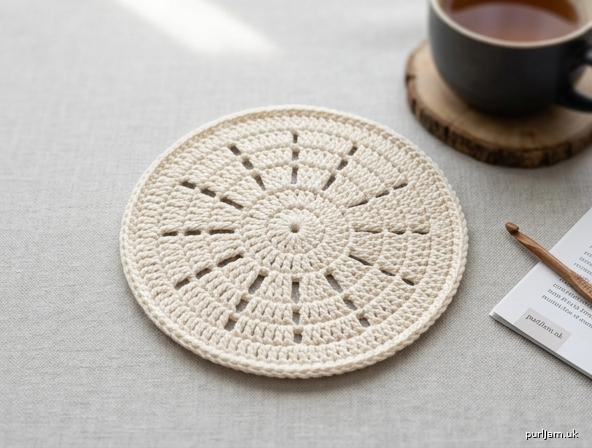
A quick, beginner-friendly circular coaster worked in the round. Twelve crisp "spokes" radiate from the centre like the wheel of a bicycle, framed by a neat solid border. Worked in sturdy worsted yarn so it lies flat and protects your favourite surfaces.

---

## Skill Level
Beginner

## Finished Size
Approximately **11 cm (4¼ in)** in diameter.
(Coasters are forgiving — a slight difference in your tension simply gives a slightly larger or smaller coaster, which is perfectly fine.)

---

## Materials
- **Yarn:** Worsted weight (Aran/medium, category 4) cotton or cotton-blend recommended for absorbency and a firm fabric. Approximately **15 m (16 yds)** per coaster — a single 50 g ball makes several.
- **Hook:** **4.5 mm** crochet hook.
- **Notions:** Tapestry/yarn needle for weaving in ends; one stitch marker (optional, to mark spokes); scissors.

**Tip:** Cotton makes the best coasters — it's absorbent, washable and presses flat. A 4.5 mm hook (slightly larger than the yarn's usual recommendation) keeps the fabric supple without holes.

---

## Tension (Gauge)
16 tr and 8 rounds to 10 cm (4 in) measured over treble fabric.
Tension is **not critical** for a coaster, but a tighter, denser fabric performs best.

---

## Abbreviations (UK Terminology)
- **ch** = chain
- **dc** = double crochet (US single crochet)
- **tr** = treble (US double crochet)
- **ss** = slip stitch
- **st(s)** = stitch(es)
- **sp** = space
- **rnd** = round
- **rep** = repeat

> **Note:** This pattern uses **UK crochet terms**. UK tr = US dc.

---

## Special Stitches
- **Beginning chain-3 (beg ch-3):** Counts as the first **tr** of the round throughout.

---

## Pattern Notes
- The coaster is worked **in the round**, **joined** at the end of each round with a slip stitch into the top of the beginning chain.
- Work into **both loops** of each stitch unless told otherwise.
- The **beg ch-3 counts as a tr** in every round. When a round ends, you slip stitch into the **top of that beg ch-3**.
- The "spoke" effect is created by **12 ch-1 spaces** in Round 4 that visually separate twelve tr segments radiating outward.
- Stitch counts are given in brackets at the end of each round.
- Start with a **magic ring** for a tight centre, or see the alternative below if you're new to it.

**Magic ring alternative (beginner-friendly):** Chain 4 and join with a ss into the first chain to form a ring. Work Round 1 stitches into the ring (the centre hole will be a little larger, which is perfectly acceptable).

---

## Instructions

**Foundation:** Make a magic ring (or ch-4 ring — see notes).

**Round 1:**
Work **ch 3** (counts as first tr), then **11 tr** into the ring.
Pull the magic ring tight.
Join with **ss** into the top of the beg ch-3.
**(12 tr)**

> ✔ *Check: 1 beg ch-3 + 11 tr = 12 sts.*

**Round 2:**
**Ch 3** (counts as first tr), **1 tr** into the same st as the join.
**2 tr** into each st around (i.e. 2 tr in each of the remaining 11 sts).
Join with **ss** into the top of the beg ch-3.
**(24 tr)**

> ✔ *Check: 12 sts × 2 tr each = 24 sts.*

**Round 3:**
**Ch 3** (counts as first tr), **1 tr** into the same st as the join.
*\*1 tr in next st, 2 tr in next st\* ; rep from \* to \* around* — ending with 1 tr in the last st.
Join with **ss** into the top of the beg ch-3.
**(36 tr)**

> ✔ *Check: Increase of 12 over the round (24 + 12 = 36). The "2 tr, 1 tr" pattern repeats 12 times.*

**Round 4 (Spoke Round):**
**Ch 3** (counts as first tr), **2 tr** into the next 2 sts (3 tr total so far for this segment), then **ch 1, skip 0 sts**… *work as follows for the cleanest spokes:*

*\*Work 3 tr, then ch 1\* ; rep from \* to \* around — twelve segments of 3 tr separated by twelve ch-1 spaces.*

To work it stitch-by-stitch: ch 3 (= 1st tr), 1 tr in each of next 2 sts, **ch 1**, then *3 tr in next 3 sts, ch 1*; repeat from * around (11 more times).
Join with **ss** into the top of the beg ch-3.
**(36 tr + 12 ch-1 sps)**

> ✔ *Check: 36 tr ÷ 3 = 12 spoke segments; 12 ch-1 spaces sit between them, creating the radiating "spokes" of the wheel.*

**Round 5 (Border):**
**Ch 1** (does NOT count as a stitch), then **1 dc into each tr and 1 dc into each ch-1 sp** around.
Join with **ss** into the first dc.
**(36 dc + 12 dc = 48 dc)**

> ✔ *Check: 36 dc into the trebles + 12 dc into the ch-1 spaces = 48 dc border. This frames the spokes neatly and keeps the edge firm and flat.*

**Fasten off**, leaving a 15 cm (6 in) tail.

---

## Finishing
1. **Weave in all ends:** Thread the tail onto a tapestry needle and weave through the back of several stitches, then trim. Do the same with the starting tail at the centre.
2. **Block (recommended for cotton):** Lightly dampen the coaster, pat it into a flat circle with the spokes evenly spaced, and leave to dry on a towel. This sharpens the spoke definition and ensures it lies completely flat.
3. **Optional:** Make a set of 4–6 in matching or contrasting colours.

---

## Quick Reference — Stitch Counts
| Round | Stitches |
|-------|----------|
| 1 | 12 tr |
| 2 | 24 tr |
| 3 | 36 tr |
| 4 | 36 tr + 12 ch-1 sps |
| 5 | 48 dc |

**Spokes:** 12 radiating segments, established in Round 4 and framed by the Round 5 border.

Enjoy your wheel-spoke coaster! ☕
Disclaimer: This pattern was generated by AI and should be reviewed for accuracy before use. While we strive for quality, AI-generated content may contain errors. Please verify measurements, stitch counts, and instructions before beginning your project. Generated by purlJam.uk
Access your pattern anytime
Bookmark this page to access your pattern anytime