Type
Crochet
Difficulty
beginner
Category
kimono
AI Thinking Process
Planning
Verification
Pattern
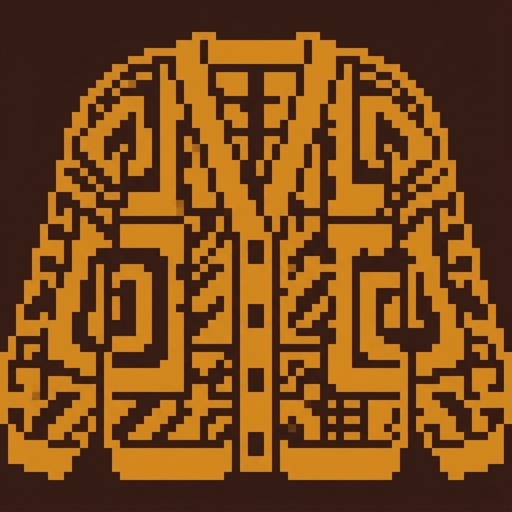
Amberfall Mosaic Kimono Cardigan
An easy, oversized T-shaped kimono cardigan in two-color overlay mosaic crochet. Autumnal rust and gold (or any warm pair) form a repeating geometric mosaic from the attached chart. The body and sleeves are plain rectangles—no armhole shaping, no waist shaping, and no tapered sleeves—so you can stay in the stitch pattern from hem to shoulder. Dropped shoulders, wide sleeves, and an open front with a simple band and sash give a boxy, throw-on fit.
Skill Level: Easy (sc, dc, BLO, color carry; no shaping)
Sizes
S/M (L/XL, 2XL/3XL)
Shown/written for a loose kimono fit with generous positive ease. Instructions are given for S/M with L/XL and 2XL/3XL in parentheses. When only one number is given, it applies to all sizes.
To fit bust: 34–42 (44–52, 54–64) in / 86.5–106.5 (112–132, 137–162.5) cm
Finished Measurements
Measurements are of the mosaic fabric after blocking, before edging.
- Bust circumference (back + both fronts, worn open): 49.5 (61.5, 73.5) in / 126 (156, 187) cm
- Back width: 24.5 (30.5, 36.5) in / 62 (77.5, 93) cm
- Front width (each): 12.5 (15.5, 18.5) in / 32 (39.5, 47) cm
- Body length (hem to shoulder): 28 in / 71 cm
- Sleeve length (underarm to cuff): 16 in / 40.5 cm
- Sleeve circumference: 18.5 (21.5, 24.5) in / 47 (54.5, 62) cm
- Shoulder seam: 6 (7.5, 9) in / 15 (19, 23) cm
- Back neck opening: 12.5 (15.5, 18.5) in / 32 (39.5, 47) cm
Front bands add about 1 in / 2.5 cm to each front edge (light overlap when the sash is tied). Hem and cuff bands add about 1 in / 2.5 cm to body length and sleeve length.
Yarn
Worsted weight (CYC 4), wool or wool-blend for autumn warmth, or a wool/cotton blend for extra drape.
Color A (background, darker): warm rust / terracotta
Color B (motif, lighter): goldenrod / mustard
Yardage:
- Color A: 850 (1150, 1500) yd / 777 (1052, 1372) m
- Color B: 750 (1000, 1300) yd / 686 (914, 1189) m
Example (197 yd / 180 m per skein): Color A 5 (6, 8) skeins; Color B 4 (6, 7) skeins.
Palette swaps that stay autumnal: olive + cream, burgundy + gold, chocolate + pumpkin, forest + rust. Keep A darker than B so the attached chart reads clearly.
Hook & Notions
- US I-9 / 5.5 mm crochet hook, or size needed to obtain gauge
- Yarn needle
- Stitch markers (at least 6)
- Scissors
- Blocking mats and pins
- Optional: 2 wooden toggles
Gauge
16 sts and 16 rows = 4 in / 10 cm in overlay mosaic, blocked.
Swatch at least 2 chart repeats wide and 2 repeats tall: 26 sts × 32 rows (2 selvedge + 2 × 12-st repeats, and 2 × 16-row repeats). Measure the center 16 sts and 16 rows.
If you have too many sts per 4 in / 10 cm, go up a hook size (drape matters more than a dense fabric). If you have too few, go down a hook size.
Abbreviations (US)
- BLO — back loop only
- CC — contrast color (Color B)
- ch — chain
- dc — double crochet
- FLO — front loop only
- Fsc — foundation single crochet
- MC — main color (Color A)
- mdc — mosaic double crochet (see Special Stitches)
- rep — repeat
- RS — right side
- sc — single crochet
- sl st — slip stitch
- st(s) — stitch(es)
- WS — wrong side
Special Stitches
Fsc (foundation single crochet): Ch 2, insert hook in 2nd ch from hook, yarn over, pull up a loop, yarn over, pull through 1 loop (ch made), yarn over, pull through 2 loops (sc made). *Insert hook in ch at base of previous Fsc, yarn over, pull up a loop, yarn over, pull through 1 loop, yarn over, pull through 2 loops; rep from * to required count.
sc BLO: Sc in the back loop only of the next stitch.
mdc (mosaic double crochet / overlay dc): Dc in the unused front loop of the stitch 2 rows below, working in the current row’s color. Skip the stitch behind the mdc on the current row (do not also sc into it). The mdc should sit at the same height as the sc sts in the current row.
On RS rows, the unused FLO 2 rows below faces you. On WS rows, tilt the work slightly and insert into that same unused loop (the loop left sitting on the RS when previous rows were worked BLO).
Selvedge st: First and last stitch of every row: sc BLO in the current color, even if the chart square in that position would show an mdc. These 2 sts are not on the attached chart.
Pattern Notes
- US crochet terms throughout.
- Kimono construction: rectangles only. Sleeves join at right angles to the body (T-shape). Shoulders are a straight seam. No armhole decreases, no sleeve taper, no waist shaping.
- Overlay mosaic: one color per row. Color A on odd-numbered chart rows; Color B on even-numbered chart rows, unless the attached chart labels a row otherwise.
- Turn at the end of every row. Ch 1 at the start of each row does not count as a stitch.
- Carry the unused color loosely up the selvedge. Do not cut at every row. Front-edge carries are covered by the band; side-edge carries are hidden in the seams.
- Never change color in the middle of a row. Empty chart squares = sc BLO in the row color. Filled/marked squares = mdc in the row color, which pulls the opposite color up from 2 rows below.
- Stitch count does not change on any piece.
- Length is the same for all sizes (28 in / 71 cm body, 16 in / 40.5 cm sleeve). Add or remove 16-row chart repeats to lengthen or shorten; each repeat is 4 in / 10 cm.
- Block every piece before seaming so the mosaic opens and the rectangles actually measure as written.
Attached Stitch Chart
Use the separate attached chart panel for the visual grid. Do not work from a homemade ASCII copy—the overlay placement lives only on that panel.
Where it is: The companion panel is labeled “Autumn Mosaic Chart” and sits beside (or directly below) this pattern text, in the chart/asset area of the document. All Back, Front, and Sleeve mosaic rows refer to that panel.
How to read it (crochet overlay mosaic, worked in turned rows):
- Rows run bottom to top. Row 1 is the row just above the foundation.
- RS (odd) rows: read right to left. WS (even) rows: read left to right.
- The color for each row is marked on the side of the chart (A or B). Work the entire row in that color.
- Empty / light squares: sc BLO in the row color.
- Filled / dark / X squares: mdc in the row color into the FLO 2 rows below; skip the current-row st behind it.
- Chart Row 1 has no mdc (there are not yet 2 rows below). Work it as sc BLO across the chart stitches.
- After Chart Row 16, return to Chart Row 1 and repeat. Color sequence continues to alternate A, B, A, B.
Color and yarn management:
- Color A = rust (darker); Color B = gold (lighter), unless you have swapped the pair.
- Drop the old color at the selvedge, turn, pick up the other color, ch 1, and work the next row.
- Carry unused yarn up the side, not across the back of the fabric.
- Weave in only when a piece is finished, or when you join a new ball at a selvedge.
Stitch-count integration (chart vs. garment):
The attached chart is one 12-stitch repeat by 16-row repeat. Selvedge stitches sit outside the chart.
- Each mosaic row: 1 selvedge, then the 12-st chart repeat the stated number of times, then 1 selvedge.
- Back: 2 + 12 × 8 (10, 12) = 2 + 96 (120, 144) = 98 (122, 146) sts ✓
- Each front: 2 + 12 × 4 (5, 6) = 2 + 48 (60, 72) = 50 (62, 74) sts ✓
- Each sleeve: 2 + 12 × 6 (7, 8) = 2 + 72 (84, 96) = 74 (86, 98) sts ✓
- Body rows: 16 × 7 = 112 rows = 28 in / 71 cm ✓
- Sleeve rows: 16 × 4 = 64 rows = 16 in / 40.5 cm ✓
If a chart row appears to ask for an mdc in a selvedge stitch, ignore the chart for that stitch and work sc BLO.
Back
With Color A, Fsc 98 (122, 146).
(2 selvedge + 8 (10, 12) × 12-st repeats = 2 + 96 (120, 144) = 98 (122, 146) sts ✓)
Turn.
Row 1 (RS, Color A): Ch 1, sc BLO in first st (selvedge), work Attached Chart Row 1 across the next 96 (120, 144) sts (8 (10, 12) repeats of the 12-st chart ✓), sc BLO in last st (selvedge). Turn. — 98 (122, 146) sts.
Row 2 (WS, Color B): Ch 1, sc BLO in first st, work Attached Chart Row 2 across the next 96 (120, 144) sts, sc BLO in last st. Turn.
Rows 3–16: Continue in this manner, following Attached Chart Rows 3–16, always working 1 selvedge st at each end and 8 (10, 12) chart repeats between them. Odd rows Color A (RS); even rows Color B (WS), unless the chart labels otherwise. Stitch count remains 98 (122, 146) every row ✓.
Rows 17–112: Rep Attached Chart Rows 1–16 six more times (7 repeats total).
(16 × 7 = 112 rows ✓; 112 rows ÷ 4 rows per inch = 28 in / 71 cm ✓)
Fasten off both colors, leaving a long Color A tail for seaming.
Place markers on the top edge (Row 112) as follows, counting from the left when RS faces you:
- Marker 1 at st 1 (left armhole corner)
- Marker 2 after 24 (30, 36) sts (left shoulder inner end)
(24 (30, 36) sts = 6 (7.5, 9) in ✓) - Marker 3 after the next 50 (62, 74) sts (right shoulder inner end)
(98 − 24 − 24 = 50; 122 − 30 − 30 = 62; 146 − 36 − 36 = 74 ✓; back neck = 12.5 (15.5, 18.5) in ✓) - Marker 4 at the last st (right armhole corner)
The 24 (30, 36) sts at each side are the shoulder seams. The center 50 (62, 74) sts stay open for the back neck.
Fronts (make 2, identical)
With Color A, Fsc 50 (62, 74).
(2 selvedge + 4 (5, 6) × 12-st repeats = 2 + 48 (60, 72) = 50 (62, 74) sts ✓)
Turn.
Row 1 (RS, Color A): Ch 1, sc BLO in first st, work Attached Chart Row 1 across the next 48 (60, 72) sts (4 (5, 6) repeats ✓), sc BLO in last st. Turn. — 50 (62, 74) sts.
Rows 2–16: Follow the attached chart as for the Back, with 1 selvedge at each end and 4 (5, 6) chart repeats between them.
Rows 17–112: Rep Attached Chart Rows 1–16 six more times (7 repeats total).
(112 rows = 28 in / 71 cm, matching the Back ✓)
Fasten off both colors, leaving a long Color A tail.
On the top edge of each front, mark 24 (30, 36) sts in from the armhole (side) edge. Those marked sts are the shoulder seam. The remaining 26 (32, 38) sts toward center front stay open as the front neck edge.
(50 − 24 = 26; 62 − 30 = 32; 74 − 36 = 38 ✓)
Make the second front the same way. (For Easy, do not mirror the chart; a geometric mosaic reads well on both sides.)
Sleeves (make 2)
Worked from cuff to underarm so the mosaic runs in the same direction as the body.
With Color A, Fsc 74 (86, 98).
(2 selvedge + 6 (7, 8) × 12-st repeats = 2 + 72 (84, 96) = 74 (86, 98) sts ✓)
Turn.
Row 1 (RS, Color A): Ch 1, sc BLO in first st, work Attached Chart Row 1 across the next 72 (84, 96) sts (6 (7, 8) repeats ✓), sc BLO in last st. Turn. — 74 (86, 98) sts.
Rows 2–16: Follow the attached chart as for the Back, with 1 selvedge at each end and 6 (7, 8) chart repeats between them. Count stays 74 (86, 98) ✓.
Rows 17–64: Rep Attached Chart Rows 1–16 three more times (4 repeats total).
(16 × 4 = 64 rows ✓; 64 ÷ 4 = 16 in / 40.5 cm ✓)
Fasten off both colors, leaving a long Color A tail. The last row is the underarm/armhole edge (the edge that sews to the body). The foundation is the cuff.
No tapering: the sleeve is the same width from cuff to body.
Finishing
Block all five rectangles to the finished measurements before seaming. Wet-block, pin to size, and dry fully so the mosaic relaxes and the edges straighten.
Use Color A and mattress stitch (or sl st on the WS if you prefer a faster seam). Keep mosaic motifs aligned where two chart edges meet.
1. Shoulder seams
With RS facing, join the top of the Left Front to the Back from the armhole edge inward for 24 (30, 36) sts (6 (7.5, 9) in ✓). Repeat for the Right Front.
Back neck remains open across the center 50 (62, 74) sts (12.5 (15.5, 18.5) in ✓). Each front’s inner 26 (32, 38) sts remain open as the front neck.
You now have a straight shoulder line and a T waiting for sleeves. Do not shape an armhole.
2. Attach sleeves (right angles)
Find the shoulder seam. On the body side edge, count 37 (43, 49) rows down the Back from the shoulder and 37 (43, 49) rows down the Front from the shoulder. Mark both points.
(37 + 37 = 74; 43 + 43 = 86; 49 + 49 = 98 body rows ✓, matching the 74 (86, 98) sleeve sts ✓)
Pin the sleeve’s last row (74 (86, 98) sts) to that marked body section, matching the sleeve midpoint to the shoulder seam. Sew the sleeve to the body. The sleeve sits perpendicular to the body (T-shape), and the seam sits below the natural shoulder (dropped shoulder).
Repeat for the second sleeve.
3. Side seams
From the hem, sew Front to Back up to the underarm marker. Remaining side-seam length:
112 − 37 (43, 49) = 75 (69, 63) rows = 18.75 (17.25, 15.75) in / 47.5 (44, 40) cm ✓.
4. Sleeve undersides
Fold each sleeve and sew the long edges together from cuff to underarm, matching mosaic rows. Join the underarm to the side seam.
Edging
All edging is Color A, sc through both loops, RS facing. Work 3 sc in each corner so the band lies flat. Keep the carried mosaic floats on the front edges enclosed inside the first round.
Cuffs
Join Color A at a sleeve seam. Work 1 sc in each foundation st around, sl st to join.
Rounds 2–4: Ch 1, sc in each st around, sl st to join. Fasten off.
(4 rounds ≈ 1 in / 2.5 cm; finished sleeve length ≈ 17 in / 43 cm)
Front bands and neck
Join Color A at the lower Right Front corner (RS facing). Work up the Right Front selvedge (1 sc per row-end), 3 sc in the inner front corner, across the unseamed front neck sts, across the back neck sts, across the other front neck, 3 sc in the inner front corner, and down the Left Front selvedge to the hem. Turn.
Rows 2–4: Ch 1, sc in each st, 3 sc in each inner neck corner. Fasten off.
(4 rows ≈ 1 in / 2.5 cm per front)
Hem (optional but recommended)
Join Color A at a side seam. Sc evenly across the entire lower edge (Left Front, Back, Right Front), working 3 sc in each lower front corner. Turn.
Rows 2–4: Ch 1, sc in each st, 3 sc in each lower front corner. Fasten off.
Finished body length ≈ 29 in / 73.5 cm.
Sash
With Color A, Fsc 8.
Row 1: Ch 1, turn, sc in each st. — 8 sts.
Rep Row 1 until the sash measures 60 (66, 72) in / 152.5 (167.5, 183) cm, or long enough to wrap and tie. Fasten off. Weave in ends. Wear tied at the waist, or leave the cardigan open.
Optional toggles: Sew two wooden toggles to the Right Front band at about 12 in / 30.5 cm and 16 in / 40.5 cm up from the hem, with chain-loop closures on the Left Front.
Blocking & Wear
Steam- or wet-block the finished kimono to the schematic measurements, paying extra attention to the mosaic so overlay stitches sit flat. Do not stretch the front bands so much that they flare.
Wear open, wrapped with the sash, or lightly overlapped. The fit is meant to be boxy: dropped shoulders, wide rectangular sleeves, and no waist shaping.
Schematic (text)
        |<-- sleeve 16 in -->|     |<-- sleeve 16 in -->|
        _____________________       _____________________
       |                     |     |                     |
       |     SLEEVE          |     |      SLEEVE         |
       |  18.5 (21.5, 24.5) in circumference
       |_____________________|     |_____________________|
                 |                         |
   ______________|_______neck________|______________
  |              |  12.5 (15.5, 18.5) in  |              |
  | LEFT FRONT   |         BACK           | RIGHT FRONT  |
  | 12.5 (15.5,  |  24.5 (30.5, 36.5) in  | 18.5) in     |
  | 18.5) in     |                        |              |
  |              |                        |              |
  |              |     28 in length       |              |
  |______________|________________________|______________|
  |<-------- bust 49.5 (61.5, 73.5) in ----------------->|
Shoulder seam at each side: 6 (7.5, 9) in. Side seam from hem to underarm: 18.75 (17.25, 15.75) in.
Quick Reference Counts
| Piece | Stitches | Chart repeats | Rows | Chart repeats |
|---|---|---|---|---|
| Back | 98 (122, 146) | 8 (10, 12) | 112 | 7 |
| Front (each) | 50 (62, 74) | 4 (5, 6) | 112 | 7 |
| Sleeve (each) | 74 (86, 98) | 6 (7, 8) | 64 | 4 |
Every stitch count = 2 selvedge + (repeats × 12) ✓. Every row count = repeats × 16 ✓.
Disclaimer: This pattern was generated by AI and should be reviewed for accuracy before use. While we strive for quality, AI-generated content may contain errors. Please verify measurements, stitch counts, charts, and instructions before beginning your project. Generated by purlJam.uk
Love this pattern?
Save this pattern to your free PurlJam libraryAccess your pattern anytime
Bookmark this page to access your pattern anytime