Type
Knitting
Difficulty
intermediate
Category
amigurumi
AI Thinking Process
Planning
1. **Design Strategy**: Fully jointed macaque baby monkey, 12 inches (30 cm) tall, worked in pieces on 4.5 mm straight needles in garter stitch using two-tone fluffy fur yarn for back/limbs, sand fluffy for belly/chest, biscuit cotton for face/ears. Note: template suggests round/DPNs but user explicitly requested straight needles — honour user request, use flat pieces seamed.
2. **Construction Plan**: Flat knitted panels in garter stitch (front belly piece, back piece, 2 arms, 2 legs, hands/feet, head front/back, sculpted face oval, ears) seamed together; joints via button-and-thread cotter-style jointing for arms/legs/head.
3. **Quality Assurance**:
- Fluffy fur yarn hides stitches — count by feel; mark rows with waste yarn.
- Sculpted face needs firm stuffing under cotton panel to shape muzzle.
- Joints must be installed before final stuffing/closing.
4. **Final Calculations**: Tension 10 sts × 18 rows = 10 cm in garter st. For 30 cm tall toy: body ~14 cm tall = 25 rows × 14 sts wide. Head ~10 cm = 18 rows. Arms ~12 cm, legs ~13 cm. All counts derived from 1 cm = 1 st, 1 cm = 1.8 rows.
Verification
1. **Completeness**: Materials, tension, abbreviations, all pieces, assembly, finishing — included.
2. **Consistency**: 10 sts/10 cm → 14 sts ≈ 14 cm width; 18 rows/10 cm → 25 rows ≈ 14 cm height. ✓
3. **Constraints**: Straight 4.5 mm needles ✓, garter throughout ✓, two-tone fur back ✓, sand belly ✓, cotton face/ears ✓, glass eyes ✓, fully jointed ✓, 12 inch (30 cm) tall ✓, UK terminology ✓.
4. **Safety**: Glass eyes and button joints = NOT a baby toy; safety warning included.
Pattern
# Baby Macaque — Fully Jointed Knitted Monkey

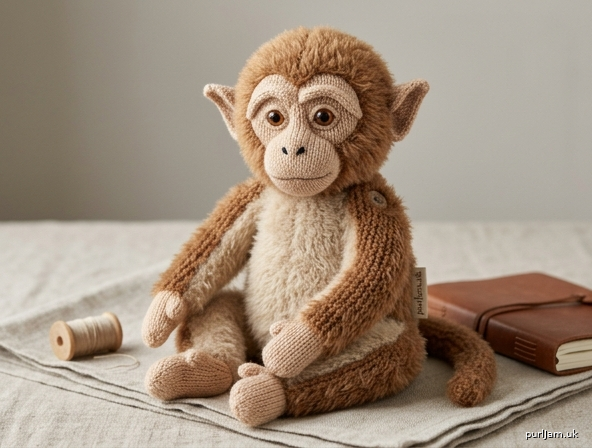
A 30 cm (12 inch) tall heirloom-style baby macaque, fully jointed at neck, shoulders and hips, with a sculpted cotton muzzle, pointy elf-like ears and glass eyes. Worked entirely in garter stitch on straight needles, then seamed and jointed.

**Skill level:** Intermediate
**Finished height:** approx. 30 cm (12 in) seated, 33 cm (13 in) standing
**Style:** Collector's / display toy — not suitable for children under 3 due to glass eyes and small joint hardware.

---

## Materials

- **Yarn A** — Long-fibre fluffy "fur" yarn, two-tone (e.g. caramel/chocolate or grey/brown), worsted weight — approx. 100 g (for back, sides, outer arms, outer legs, back of head)
- **Yarn B** — Long-fibre fluffy "fur" yarn, sand colour, worsted weight — approx. 60 g (for belly, chest, inner arms, inner legs)
- **Yarn C** — Soft cotton yarn, biscuit/pale tan, worsted weight — approx. 30 g (for face panel, hands, feet, ears)
- 1 pair 4.5 mm bamboo straight knitting needles
- 1 pair glass eyes on wire loops, 10–12 mm, amber or brown
- 5 sets cotter-pin doll joints, 25–30 mm (for neck, both shoulders, both hips) — *or* 5 sets button joints with strong upholstery thread
- Polyester toy stuffing, approx. 150–200 g
- Tapestry needle (blunt) and sharp embroidery needle
- Stitch markers, waste yarn for row counting (essential with fluffy yarn)
- Small amount black embroidery thread (nose, mouth detail)
- Long doll-maker's needle (12–15 cm) for sculpting face
- Fabric scissors

---

## Tension (Gauge)

**10 sts and 18 rows = 10 cm (4 in) square measured over garter stitch on 4.5 mm needles.**

Take time to check tension — with fluffy yarn, count rows using a waste-yarn marker every 10 rows, since stitches will be obscured by fibre.

---

## Abbreviations (UK)

- k — knit
- p — purl
- st(s) — stitch(es)
- k2tog — knit two together (decrease)
- ssk — slip, slip, knit (decrease)
- kfb — knit into front and back of stitch (increase)
- RS / WS — right side / wrong side
- garter st — knit every row
- rep — repeat

---

## Construction Notes

The macaque is made in **flat panels** worked back and forth on straight needles, then seamed with mattress stitch. The body has a two-colour construction: a back/side panel in Yarn A and a front belly/chest panel in Yarn B, joined down the side seams. The head is similarly two-toned. The face is a separate biscuit cotton oval, stitched onto the front of the head and sculpted with needle-sculpting stitches.

**Five joints** are installed before final stuffing: neck, both shoulders, both hips. This makes the toy fully poseable.

---

## PATTERN

### 1. Back & Side Panel (make 1, in Yarn A — two-tone fur)

This single panel forms the back, sides and bottom of the body.

Cast on **14 sts**.
Work in garter st (knit every row).

- Rows 1–4: knit (4 rows). *(14 sts — 2 cm)*
- Row 5: kfb, k to last st, kfb. *(16 sts)*
- Rows 6–8: knit.
- Row 9: kfb, k to last st, kfb. *(18 sts — widest at hips, approx. 18 cm circumference half)*
- Rows 10–20: knit (11 rows straight).
- Row 21: ssk, k to last 2 sts, k2tog. *(16 sts)*
- Rows 22–26: knit.
- Row 27: ssk, k to last 2 sts, k2tog. *(14 sts — narrowing toward shoulders)*
- Rows 28–32: knit.

Cast off loosely.

*Check: 32 rows ÷ 1.8 = ~17.8 cm tall ✓ Body length target 14–17 cm ✓*

### 2. Front Belly & Chest Panel (make 1, in Yarn B — sand fluffy)

Cast on **12 sts**.

- Rows 1–4: knit.
- Row 5: kfb, k to last st, kfb. *(14 sts)*
- Rows 6–18: knit (13 rows).
- Row 19: ssk, k to last 2 sts, k2tog. *(12 sts)*
- Rows 20–28: knit.
- Row 29: ssk, k to last 2 sts, k2tog. *(10 sts)*
- Rows 30–32: knit.

Cast off loosely.

### 3. Arms (make 2, in Yarn A — outer; Yarn B — inner)

Each arm consists of an **outer strip (Yarn A)** and an **inner strip (Yarn B)** seamed together with a cotton hand attached.

**Outer arm (make 2 in Yarn A):**
Cast on **8 sts**.
- Rows 1–22: knit (22 rows — approx. 12 cm).
- Row 23: ssk, k to last 2 sts, k2tog. *(6 sts)*
- Rows 24–26: knit.

Cast off.

**Inner arm (make 2 in Yarn B):** Work exactly as outer arm.

### 4. Hands (make 2, in Yarn C — cotton)

Cast on **6 sts**.
- Rows 1–2: knit.
- Row 3: kfb, k to last st, kfb. *(8 sts)*
- Rows 4–8: knit.
- Row 9: ssk, k to last 2 sts, k2tog. *(6 sts)*
- Row 10: ssk, k2, k2tog. *(4 sts)*
- Row 11: k2tog, k2tog. *(2 sts)*

Cast off. Hand will be approx. 4 cm long.

### 5. Legs (make 2, in Yarn A — outer; Yarn B — inner)

**Outer leg (make 2 in Yarn A):**
Cast on **9 sts**.
- Rows 1–24: knit (24 rows — approx. 13 cm).
- Row 25: ssk, k to last 2 sts, k2tog. *(7 sts)*
- Rows 26–28: knit.

Cast off.

**Inner leg (make 2 in Yarn B):** Work exactly as outer leg.

### 6. Feet (make 2, in Yarn C — cotton)

Cast on **7 sts**.
- Rows 1–2: knit.
- Row 3: kfb, k to last st, kfb. *(9 sts)*
- Rows 4–10: knit.
- Row 11: ssk, k to last 2 sts, k2tog. *(7 sts)*
- Row 12: ssk, k to last 2 sts, k2tog. *(5 sts)*

Cast off. Foot will be approx. 5 cm long — slightly longer than hands, as macaques have prominent feet.

### 7. Head Back (make 1, in Yarn A — two-tone fur)

Cast on **10 sts**.
- Rows 1–2: knit.
- Row 3: kfb, k to last st, kfb. *(12 sts)*
- Rows 4–5: knit.
- Row 6: kfb, k to last st, kfb. *(14 sts)*
- Rows 7–14: knit (8 rows straight — widest part of head).
- Row 15: ssk, k to last 2 sts, k2tog. *(12 sts)*
- Rows 16–17: knit.
- Row 18: ssk, k to last 2 sts, k2tog. *(10 sts)*
- Rows 19–20: knit.

Cast off.

*Check: 20 rows ÷ 1.8 = 11 cm tall, 14 sts = 14 cm wide ✓ proportional to 30 cm toy.*

### 8. Head Front / Forehead (make 1, in Yarn A)

Work exactly as Head Back. The face oval will be appliquéd onto this piece.

### 9. Face Panel (make 1, in Yarn C — biscuit cotton)

Cast on **6 sts**.
- Row 1: knit.
- Row 2: kfb, k to last st, kfb. *(8 sts)*
- Rows 3–4: knit.
- Row 5: kfb, k to last st, kfb. *(10 sts)*
- Rows 6–12: knit (7 rows straight).
- Row 13: ssk, k to last 2 sts, k2tog. *(8 sts)*
- Rows 14–15: knit.
- Row 16: ssk, k to last 2 sts, k2tog. *(6 sts)*
- Row 17: ssk, k2, k2tog. *(4 sts)*

Cast off. Oval face panel, approx. 6 cm tall × 5 cm wide.

### 10. Ears (make 2, in Yarn C — cotton)

Pointy elf-like, worked from base to tip.

Cast on **6 sts**.
- Rows 1–2: knit.
- Row 3: ssk, k2, k2tog. *(4 sts)*
- Rows 4–5: knit.
- Row 6: ssk, k2tog. *(2 sts)*
- Row 7: k2tog. *(1 st)*

Fasten off, leaving a long tail for attaching.

---

## Assembly

Work in this order. Press all pieces lightly under a damp cloth (cotton pieces only) before assembly — do not press fur yarn.

### A. Build the Body Shell
1. Lay back panel RS down. Place front belly panel centred on top, RS up, aligning bottom edges.
2. Seam the side edges of the front to the back with mattress stitch in matching yarn, leaving the **top open** for joints and the **bottom 5 cm open** for stuffing.
3. Seam the bottom (cast-on edge of back wraps under and joins cast-on edge of belly) leaving the 5 cm stuffing gap.

### B. Build the Limbs
1. Place each outer arm (A) and inner arm (B) WS together, seam along both long edges and the top, leaving the wrist (cast-off) end open.
2. Pin a cotton hand to the wrist opening, seam neatly so the hand protrudes 3–4 cm.
3. Repeat for legs, attaching cotton feet at the ankle end.
4. Stuff lightly — limbs should be firm but flexible. Leave the top 2 cm un-stuffed for joint installation.

### C. Build the Head
1. Place head front and head back WS together, seam around the curved edge, leaving the cast-on (neck) edge open.
2. **Insert glass eyes**: mark eye positions on the face panel approx. 2 cm apart, slightly above centre. Push wire loops through the cotton and secure on the WS with strong thread, wrapped firmly several times.
3. Pin face panel to the front of the head, centred, with the wider end at the brow. Slip stitch around the edge in Yarn C.
4. **Sculpt the muzzle**: stuff the head firmly through the neck opening, packing extra stuffing under the cotton face panel to push it forward. Using a long doll needle and strong thread, take a sculpting stitch from the back of the head through to either side of where the nostrils should be, pull gently to create brow indentations and a defined muzzle. Repeat for mouth corners.
5. Embroider two small black nostrils (satin stitch) and a thin closed-mouth line in black thread on the cotton panel.
6. Attach ears: fold each ear base slightly to cup, then whip-stitch to the side of the head at roughly eye level, tips pointing outward and slightly back (elf-style).

### D. Install the Five Joints
For each joint (neck, 2 × shoulders, 2 × hips):
1. Push the cotter-pin disc through the limb (or head) opening with the pin pointing outward.
2. Pierce the body fabric at the joint location with the pin tip.
3. Inside the body, place a second disc over the pin and split/curl the cotter pin firmly with pliers (or, for button joints, tie off the upholstery thread with multiple secure knots through a button on the inside).
4. Test that each joint rotates with friction but holds its pose.

**Joint placement on body:**
- Neck: centre top, between shoulder seams.
- Shoulders: 1 cm down from top, at each side seam.
- Hips: 2 cm up from base, at each side seam.

### E. Final Stuffing and Closing
1. Stuff the body firmly through the bottom opening, working stuffing around the joint discs.
2. Close the bottom seam with mattress stitch in Yarn A.
3. Close the top of each limb around the joint pin with a small running stitch, gathering the opening tight against the disc.

### F. Finishing Touches
- Weave in all yarn ends into the interior of the body.
- Gently tease out the fur fibres along all seams using the tip of a tapestry needle — this hides the seams completely.
- Brush the fur yarn lightly with a pet slicker brush to fluff.
- Optional: tint the cheeks of the cotton face panel with a touch of dry blush for a "baby" look.

---

## AI Image Prompt for Finished Toy

> *"A fully jointed handknitted baby macaque monkey, 12 inches tall, seated. Long-fibre fluffy two-tone caramel-and-chocolate fur on back, sides, outer arms, outer legs and back of head. Sand-coloured fluffy belly, chest, inner limbs. Soft biscuit cotton sculpted face with pointy elf-like ears in matching cotton, amber glass eyes, tiny embroidered nostrils and mouth. Cotton hands and feet. Photographed on a neutral linen background, soft daylight, heirloom collector toy aesthetic, sharp focus."*

---

## Math Validation Summary

| Piece | Stitches × Rows | Calculated size | Target |
|---|---|---|---|
| Back panel | 18 sts max × 32 rows | 18 cm × 17.8 cm | torso ✓ |
| Front panel | 14 sts × 32 rows | 14 cm × 17.8 cm | torso front ✓ |
| Arms | 8 sts × 26 rows | 8 cm × 14.4 cm | arm + hand ≈ 18 cm ✓ |
| Legs | 9 sts × 28 rows | 9 cm × 15.5 cm | leg + foot ≈ 20 cm ✓ |
| Head | 14 sts × 20 rows | 14 cm × 11 cm | head ✓ |
| **Total seated height** | head 11 + torso 14 + thigh fold 5 | ≈ 30 cm | **12 in ✓** |

Enjoy your baby macaque — a true heirloom piece.
Disclaimer: This pattern was generated by AI and should be reviewed for accuracy before use. While we strive for quality, AI-generated content may contain errors. Please verify measurements, stitch counts, and instructions before beginning your project. Generated by purlJam.uk
Access your pattern anytime
Bookmark this page to access your pattern anytime