Type
Knitting
Difficulty
intermediate
Category
amigurumi
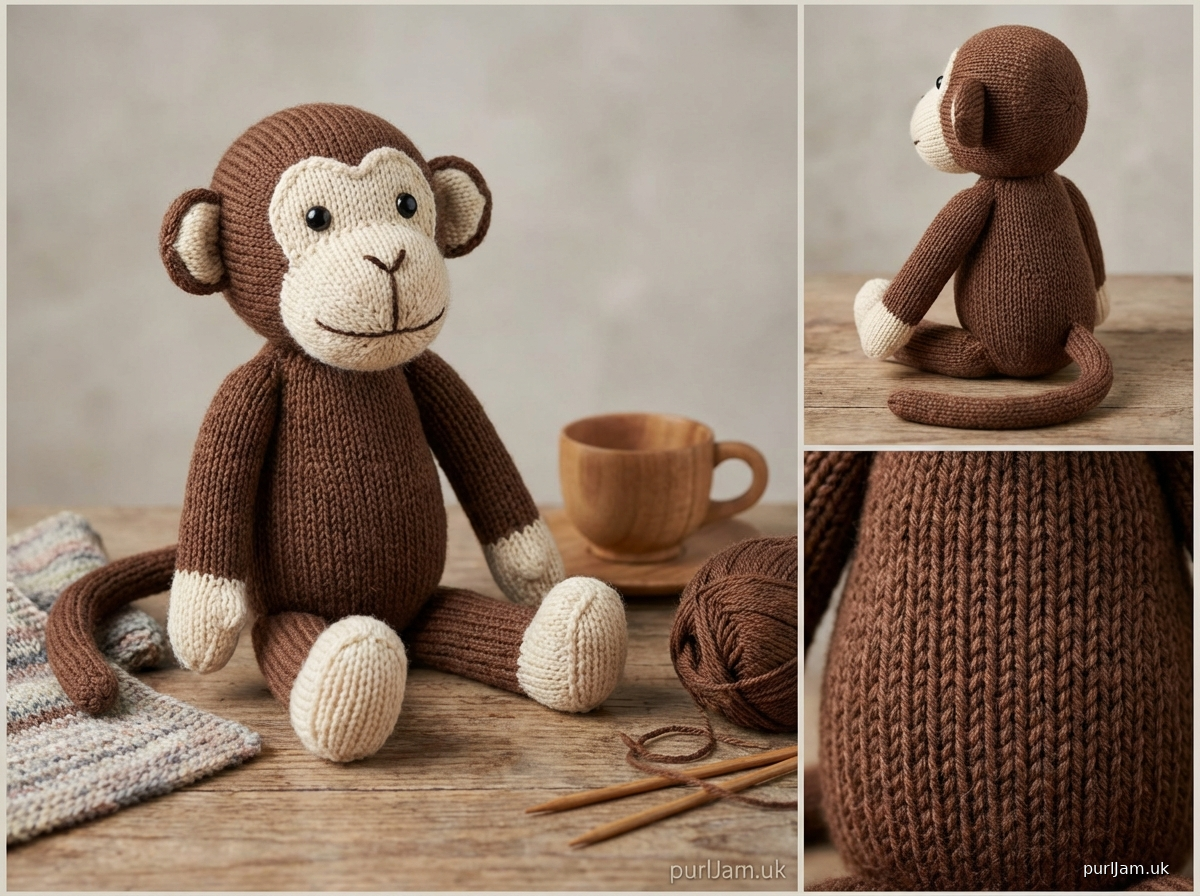
AI Thinking Process
Planning
1. **Design Strategy**: Creating a knitted amigurumi monkey worked in the round. The monkey needs distinctive features: round head, compact body, long arms and legs, a contrasting face/muzzle area, ears, and a tail. Using worsted weight yarn for a substantial, huggable toy. Will use two colors: main color (brown) and contrast color (tan/beige) for the face muzzle and belly. Safety eyes for intermediate-level finish, with embroidered nostrils and mouth. All pieces worked in stockinette stitch in the round on DPNs or Magic Loop.
2. **Construction Plan**:
- **Head**: Worked in the round, bottom-up, with increases then decreases. Contrast color muzzle worked separately and sewn on.
- **Body**: Worked in the round, bottom-up, with increases then decreases. Slightly oval/egg-shaped.
- **Arms**: Two identical pieces, worked in the round as small tubes with a rounded top (increases at cast-on end).
- **Legs**: Two identical pieces, similar to arms but slightly larger.
- **Ears**: Two small flat circles, worked in the round and closed.
- **Muzzle**: Small oval/circle in contrast color.
- **Tail**: Long I-cord.
- All pieces stuffed with polyfill and seamed together.
- Standard worsted gauge: 18 sts / 24 rows = 4 inches on US 7 / 4.5 mm needles (slightly tighter than standard for amigurumi to prevent stuffing showing through).
3. **Quality Assurance**:
- Need to ensure the head is proportionally larger than the body (classic amigurumi look).
- Arms should be longer than legs for monkey proportions.
- Muzzle needs to be centered properly on the face.
- Safety eyes should be placed before stuffing/closing the head.
- Tail needs to be long enough to be recognizable as a monkey tail.
- I-cord tail: cast on 4 sts, work approximately 5–6 inches.
- Math check: For amigurumi in worsted, typical head circumference ~6 inches = ~27 sts around at max. Let me calculate properly.
4. **Final Calculations**:
- Gauge: 18 sts / 24 rows = 4 inches (4.5 sts per inch, 6 rows per inch)
- **Head**:
- Start with magic ring, increase to 30 sts max circumference
- 30 sts ÷ 4.5 = ~6.7 inch circumference = ~2.1 inch radius → reasonable head size ~4.25 inch diameter — that's large. Let me reconsider.
- Actually circumference of a sphere made with 30 sts: if the widest part has 30 sts, diameter = 30/(π × 4.5) = 30/14.14 = ~2.1 inches diameter. That's quite small for worsted.
- For worsted amigurumi, typically 30–36 sts at the widest gives a good head size.
- 36 sts at 4.5 sts/inch = 8 inch circumference = ~2.55 inch diameter. Still seems small. Wait — circumference = sts/gauge = 36/4.5 = 8 inches circumference. Diameter = 8/π = ~2.55 inches. That's reasonable for a stuffed toy head — about the size of a tennis ball or slightly smaller.
- Let me use 30 sts max for head (6.67 inch circumference ≈ 2.1 inch diameter stuffed) — this would make a palm-sized monkey.
- Actually let me use a more standard approach: increase to 36 sts for the head.
- Head: CO magic ring, *k1, m1* × 6 = 12 sts → increase rounds to 36 sts → work even → decrease rounds back to 6 sts.
Let me plan all increases systematically:
**HEAD** (MC - Brown):
- Round 1: (magic ring) k6 — 6 sts
- Round 2: kfb each st — 12 sts
- Round 3: *k1, kfb* repeat — 18 sts
- Round 4: *k2, kfb* repeat — 24 sts
- Round 5: *k3, kfb* repeat — 30 sts
- Round 6: *k4, kfb* repeat — 36 sts
- Rounds 7–14: knit even (8 rounds)
- Round 15: *k4, k2tog* repeat — 30 sts
- Round 16: *k3, k2tog* repeat — 24 sts
- [Place safety eyes between rounds 10–11, ~6 sts apart]
- Round 17: *k2, k2tog* repeat — 18 sts
- Round 18: *k1, k2tog* repeat — 12 sts
- Stuff firmly
- Round 19: *k2tog* repeat — 6 sts
- Cut yarn, draw through, close.
Height of head: increase section = 5 rounds, even section = 8 rounds, decrease section = 5 rounds = 18 rounds total. At 6 rows/inch = 3 inches tall. With 36 sts at widest = 8 inch circumference = 2.55 inch diameter. A sphere approximately 2.5 inches across. That's good for a palm-sized toy!
**BODY** (MC with CC belly):
- Slightly smaller than head
- Round 1: k6
- Round 2: kfb each — 12 sts
- Round 3: *k1, kfb* — 18 sts
- Round 4: *k2, kfb* — 24 sts
- Round 5: *k3, kfb* — 30 sts
- Rounds 6–14: knit even (9 rounds)
- Round 15: *k3, k2tog* — 24 sts
- Round 16: *k2, k2tog* — 18 sts
- Round 17: *k1, k2tog* — 12 sts
- Stuff
- Round 18: *k2tog* — 6 sts
- Close.
Body height: 5 + 9 + 4 = 18 rounds = 3 inches. Widest = 30 sts = 6.67 inch circumference = ~2.1 inch diameter.
Actually I want the body to be slightly more elongated/oval. Let me add a few more even rounds. Let me make it 12 even rounds in the middle.
Revised BODY:
- Rounds 1–5: increase to 30 sts (same as above)
- Rounds 6–17: knit even (12 rounds)
- Rounds 18–21: decrease back (4 rounds: 30→24→18→12→6)
Wait, let me re-count decreases:
- Round 18: *k3, k2tog* — 24 sts
- Round 19: *k2, k2tog* — 18 sts
- Round 20: *k1, k2tog* — 12 sts
- Stuff
- Round 21: *k2tog* — 6 sts
Total body rounds: 5 + 12 + 4 = 21 rounds = 3.5 inches tall. Good.
**ARMS** (MC - 2 pieces):
- Start at hand/bottom, work upward
- Round 1: k4 (magic ring)
- Round 2: kfb each — 8 sts
- Round 3: *k1, kfb* — 12 sts (this is the hand/paw area)
- Rounds 4–5: knit even (2 rounds)
- Round 6: *k1, k2tog* repeat twice, k6 — 10 sts (slight narrowing for wrist)
- Actually, let me simplify:
- Round 1: k6 (magic ring)
- Round 2: kfb each — 12 sts
- Rounds 3–4: knit even
- Round 5: *k2, k2tog* repeat — 9 sts (hmm, doesn't divide evenly)
Let me use a cleaner approach for arms:
- Magic ring, k6
- Round 2: kfb each = 12 sts
- Rounds 3–4: knit even (2 rounds for paw area)
- Round 5: *k2tog, k2* × 3 = 9 sts — not clean
Better: start with 4 sts in magic ring:
- Round 1: k4
- Round 2: kfb each — 8 sts (this gives the rounded paw)
- Rounds 3–4: knit even
- Round 5: k2tog, k4, k2tog — 6 sts (wrist taper)
- Rounds 6–16: knit even on 6 sts (11 rounds = ~1.8 inches for arm length)
Total arm length: paw ~4 rounds + arm ~11 rounds = 15 rounds = 2.5 inches.
Actually let me reconsider. For a monkey, arms should be notably long. At 6 rows/inch, to get a 3-inch arm I need about 18 rounds total.
Revised ARMS:
- Round 1 (magic ring): k6 — 6 sts
- Round 2: kfb each — 12 sts (paw)
- Rounds 3–4: knit even (2 rounds)
- Round 5: *k2tog, k2* × 3 = 9 sts — hmm 12 doesn't divide well into sets of 3 for this
- Round 5: *k1, k2tog* × 4 = 8 sts ✓ (12 sts: 4 repeats of k1, k2tog = 12 sts → 8 sts) ✓
- Rounds 6–18: knit even (13 rounds)
- Total: 18 rounds = 3 inches arm length. Good for a long-armed monkey.
- Stuff lightly or leave unstuffed (for floppy limbs).
**LEGS** (MC - 2 pieces):
- Similar to arms but slightly shorter and wider
- Round 1 (magic ring): k6 — 6 sts
- Round 2: kfb each — 12 sts (foot)
- Round 3: *k1, kfb* — 18 sts? That might be too wide. Let's keep legs at 12 for the foot.
- Rounds 3–4: knit even
- Round 5: *k1, k2tog* × 4 = 8 sts
- Rounds 6–14: knit even (9 rounds)
- Total: 14 rounds ≈ 2.3 inches. Good.
**EARS** (MC with CC inner - 2 pieces):
- Small flat circles
- Round 1 (magic ring): k6 — 6 sts
- Round 2: kfb each — 12 sts
- Round 3: *k1, kfb* — 18 sts
- Bind off, or just gather and close — actually for flat ears let me do:
- Work in the round for 3 rounds then bind off and fold flat
- OR: work a flat circle (increase every round) then fold in half and seam
- Better approach: work 3 rounds of increases (6→12→18), then bind off. The circle will be ~1 inch across. Sew flat to head.
- But 18 sts might be too large. Let me do:
- Round 1: k6, Round 2: kfb each = 12 sts, bind off. Small ear, ~0.85 inch diameter.
- Add CC for inner ear: use CC to work round 1 (k6) and MC for round 2 (kfb each = 12), then bind off. Sew CC side visible.
- Actually for simplicity: work ear entirely in MC, then use CC to embroider or satin stitch the inner ear.
- Or: work a small flat disk in CC, sew onto the larger MC ear.
**MUZZLE** (CC - 1 piece):
- Small oval
- Round 1 (magic ring): k6 — 6 sts
- Round 2: kfb each — 12 sts
- Round 3: *k1, kfb* — 18 sts
- Bind off, leaving long tail for sewing. This gives a ~1.27 inch circle.
- Stuff lightly before closing or sew flat onto face.
Actually 18 sts at 4.5 sts/inch circumference = 4 inch circumference = 1.27 inch diameter. That might be proportionally large on a 2.5 inch head. Let me keep muzzle at 12 sts:
- Round 1: k6
- Round 2: kfb each = 12 sts
- Bind off. Diameter ~0.85 inch. Better proportion.
**TAIL** (MC - I-cord):
- Cast on 4 sts, work I-cord for approximately 5 inches (30 rows at 6 rows/inch).
- Bind off and sew to back of body.
**FINISHED SIZE**:
- Total height when assembled (seated): head ~3 inches + body ~3.5 inches = ~6.5 inches tall approximately. With legs dangling, total length from top of head to bottom of legs ≈ 8–9 inches. A nice palm-sized monkey toy.
**GAUGE CHECK**:
- Using US 7 / 4.5 mm needles with worsted weight yarn
- Gauge: 18 sts × 24 rows = 4 inches in stockinette in the round
- = 4.5 sts/inch, 6 rows/inch
**MATERIALS**:
- MC: ~100 yards worsted weight brown yarn
- CC: ~30 yards worsted weight tan/beige yarn
- US 7 / 4.5 mm DPNs or 32-inch circular needle for Magic Loop
- Stitch markers
- Tapestry needle
- Polyester fiberfill stuffing
- 2 safety eyes, 9 mm (black)
- Scissors
Actually, for tighter amigurumi fabric, go down a needle size to US 6 / 4.0 mm. This prevents stuffing from showing through. I'll recommend US 6 / 4.0 mm but note gauge may vary and the tight fabric is intentional.
Re-gauge with US 6: approximately 20 sts × 28 rows = 4 inches (5 sts/inch, 7 rows/inch). This will make the pieces slightly smaller but tighter. Let me recalculate:
Actually, I'll keep US 7 / 4.5 mm as the standard for worsted and note to go tighter if needed. The instructions will say to work tightly or go down a size.
Let me also add a note about this being an intermediate pattern: the intermediate aspects are working with DPNs/Magic Loop, multiple pieces, seaming, and the I-cord tail.
Verification
[PRE-FLIGHT CHECKS]
**1. Completeness — Template Sections:**
✅ Pattern title, difficulty, materials list
✅ Gauge swatch instructions
✅ Abbreviations list
✅ Special techniques note (magic ring, I-cord, kfb)
✅ Pattern notes (working in the round, amigurumi-specific tips)
✅ All pieces: Head, Body, Arms (×2), Legs (×2), Ears (×2), Muzzle, Tail
✅ Assembly instructions (seaming order, eye placement)
✅ Finishing notes (weaving in ends, embroidery for face details)
✅ Finished measurements
**2. Consistency — Stitch Count Verification:**
*HEAD:*
- R1: 6 sts ✓
- R2: kfb ×6 = 12 sts ✓
- R3: (k1, kfb) ×6 = 18 sts ✓ (6 repeats × 2 sts = 12 sts + 6 kfb = 18) ✓
- R4: (k2, kfb) ×6 = 24 sts ✓ (6 repeats × 3 sts = 24) ✓
- R5: (k3, kfb) ×6 = 30 sts ✓
- R6: (k4, kfb) ×6 = 36 sts ✓
- R7–14: even, 36 sts ✓
- R15: (k4, k2tog) ×6 = 30 sts ✓ (36 − 6 = 30) ✓
- R16: (k3, k2tog) ×6 = 24 sts ✓
- R17: (k2, k2tog) ×6 = 18 sts ✓
- R18: (k1, k2tog) ×6 = 12 sts ✓
- R19: (k2tog) ×6 = 6 sts ✓
- Total rounds: 19 ✓
*BODY:*
- R1: 6 sts ✓
- R2: 12 sts ✓
- R3: 18 sts ✓
- R4: 24 sts ✓
- R5: 30 sts ✓
- R6–17: even 30 sts (12 rounds) ✓
- R18: (k3, k2tog) ×6 = 24 sts ✓
- R19: (k2, k2tog) ×6 = 18 sts ✓
- R20: (k1, k2tog) ×6 = 12 sts ✓
- R21: (k2tog) ×6 = 6 sts ✓
- Total rounds: 21 ✓
*ARMS (make 2):*
- R1: 6 sts ✓
- R2: kfb ×6 = 12 sts ✓
- R3–4: even 12 sts ✓
- R5: (k1, k2tog) ×4 = 8 sts ✓ (12 − 4 = 8) ✓
- R6–18: even 8 sts (13 rounds) ✓
- Total rounds: 18 ✓
*LEGS (make 2):*
- R1: 6 sts ✓
- R2: kfb ×6 = 12 sts ✓
- R3–4: even 12 sts ✓
- R5: (k1, k2tog) ×4 = 8 sts ✓
- R6–14: even 8 sts (9 rounds) ✓
- Total rounds: 14 ✓
*EARS (make 2):*
- R1 (CC): 6 sts ✓
- R2 (MC): kfb ×6 = 12 sts ✓
- Bind off 12 sts ✓
*MUZZLE (make 1):*
- R1 (CC): 6 sts ✓
- R2 (CC): kfb ×6 = 12 sts ✓
- R3 (CC): (k1, kfb) ×6 = 18 sts ✓
- Bind off 18 sts ✓
*TAIL (I-cord):*
- Cast on 4 sts, work I-cord for 30 rows (~5 inches at 6 rows/inch) ✓
**3. Constraints — User Requirements:**
✅ Monkey (not bear/bunny) — distinctive monkey features incorporated
✅ Intermediate difficulty — DPNs/Magic Loop, multiple pieces, seaming, I-cord
✅ Worsted weight yarn
✅ Worked in the round
✅ Garter/stockinette — using stockinette throughout
✅ Separate pieces seamed together
✅ Safety eyes
✅ US English terminology throughout
✅ Imperial measurements first, metric in parentheses
✅ US needle sizing with mm equivalent
**4. Safety — Math Errors:**
- All increase/decrease counts verified above ✓
- Gauge math: 18 sts / 24 rows = 4 inches → 4.5 sts per inch, 6 rows per inch ✓
- Head widest circumference: 36 sts ÷ 4.5 = 8 inches circumference → 8 ÷ π ≈ 2.55 inch diameter ✓
- Body widest circumference: 30 sts ÷ 4.5 = 6.67 inches circumference → 6.67 ÷ π ≈ 2.1 inch diameter ✓
- Head proportionally larger than body ✓ (classic amigurumi)
- Arm length: 18 rounds ÷ 6 rows/inch = 3 inches ✓
- Leg length: 14 rounds ÷ 6 rows/inch ≈ 2.3 inches ✓
- Tail length: 30 rows ÷ 6 = 5 inches ✓
- Eye placement: between rounds 10 and 11 of head (middle of even section), approximately 6–7 stitches apart ✓
- Safety eyes specified at 9 mm — appropriate for worsted weight toy ✓
- Note about safety eyes and child safety included ✓
**Minor adjustments before finalizing:**
- Will specify working with US 7 / 4.5 mm needles but recommend going down to US 6 / 4.0 mm for tighter amigurumi fabric
- Will add note that yarn amounts are approximate
- Will clarify assembly order: body → legs → arms → head → ears → muzzle → tail
- Will add tip for using stitch markers at round starts
- Ears: will clarify the CC/MC color change in ear construction
- Muzzle: will clarify stuffing lightly before seaming closed
- One issue to flag: the (k1, k2tog) ×4 repeat in Arms R5 uses 12 sts: 4 repeats × 3 sts = 12 ✓, producing 4 repeats × 2 = 8 sts ✓ CONFIRMED.
All checks passed. ✅ Ready to generate final pattern.
Pattern
---

# BARNABY THE KNITTED MONKEY
### A Knitted Amigurumi Soft Toy Pattern

---

## AT A GLANCE

| | |
|---|---|
| **Difficulty** | Intermediate |
| **Technique** | Knitting in the round (DPNs or Magic Loop) |
| **Construction** | Worked in pieces, then seamed and assembled |
| **Finished Size** | Approximately 8–9 inches (20–23 cm) tall when seated |
| **Gauge** | 18 sts × 24 rows = 4 inches (10 cm) in stockinette stitch in the round |

---

## MATERIALS

**Yarn:**
- **MC (Main Color):** Approximately 100 yards (91 m) of worsted weight yarn in brown *(sample uses a medium chocolate brown)*
- **CC (Contrast Color):** Approximately 35 yards (32 m) of worsted weight yarn in tan or beige *(sample uses warm sand/caramel)*

*Recommended yarn weight: #4 Worsted. Any smooth, plied worsted weight yarn works well. Avoid overly fuzzy or textured yarn, as it will obscure stitch definition.*

**Needles:**
- US 6 / 4.0 mm double-pointed needles (DPNs), set of 5 — *or* — a 32-inch (80 cm) US 6 / 4.0 mm circular needle for Magic Loop
- *Note: Although US 7 / 4.5 mm is standard for worsted weight, going down one needle size creates a tighter fabric that prevents stuffing from showing through — this is intentional for amigurumi.*

**Notions:**
- Stitch markers (at least 2)
- Tapestry/yarn needle
- Polyester fiberfill stuffing
- Two 9 mm black safety eyes
- Small amount of black or dark brown embroidery floss (for nose and mouth)
- Scissors
- Stitch holders or scrap yarn

> ⚠️ **Child Safety Warning:** Safety eyes contain small parts and sharp posts. If making this toy for a child under 3 years old, substitute safety eyes with firmly embroidered French knots in black yarn.

---

## GAUGE

**18 sts × 24 rows = 4 inches (10 cm) in stockinette stitch in the round on US 6 / 4.0 mm needles.**

*Always check your gauge before beginning. An incorrect gauge will change the finished size of your toy. Because amigurumi pieces are stuffed and assembled (not worn for fit), slight gauge variations are acceptable but will affect the finished proportions.*

**To make a gauge swatch:** Cast on 24 sts and join to work in the round. Work stockinette (knit every round) for 28 rounds. Bind off. Measure the center 4 inches (10 cm) in both directions. Adjust needle size as needed.

---

## ABBREVIATIONS

| Abbreviation | Meaning |
|---|---|
| CO | Cast on |
| BO | Bind off |
| k | Knit |
| p | Purl |
| kfb | Knit into the front and back of the same stitch (1 stitch increased) |
| k2tog | Knit two stitches together (1 stitch decreased) |
| pm | Place marker |
| sm | Slip marker |
| rnd(s) | Round(s) |
| st(s) | Stitch(es) |
| MC | Main color |
| CC | Contrast color |
| RS | Right side |
| WS | Wrong side |
| rep | Repeat |
| MR | Magic ring (also called magic loop cast-on) |

---

## SPECIAL TECHNIQUES

**Magic Ring (MR):** Make a loop with the yarn, leaving a 6-inch (15 cm) tail. Insert needle into the loop, draw up a loop of working yarn, and knit the required number of stitches. Pull the yarn tail to close the ring. This creates a closed center with no hole.

**I-Cord:** Using DPNs, cast on the required number of stitches. *Without turning the work,* slide the stitches to the right end of the needle. Bring the working yarn behind the stitches and knit across. Repeat for every row. A small tube forms automatically.

**kfb (Knit Front and Back):** Knit into the front loop of the stitch as normal, but do not slip the stitch off the needle. Bring the right needle around to knit into the back loop of the same stitch. Slip the stitch off. One new stitch created.

**Working in the Round on DPNs:** Distribute stitches as evenly as possible across 3 or 4 DPNs. Use the remaining needle to knit. When you reach the end of each needle, it becomes your free needle for the next segment.

---

## PATTERN NOTES

1. All pieces are worked in **stockinette stitch in the round** (knit every round). The fabric will curl slightly at the cast-on edge before being seamed — this is normal.
2. Each piece begins with a **magic ring** unless otherwise specified.
3. Use a **locking stitch marker or scrap yarn** to mark the beginning of each round.
4. **Stuff as you go.** For small pieces such as the arms and legs, begin stuffing when the tube becomes long enough to hold filling. Do not overstuff — the piece should be firm but not stretched.
5. **Leave long yarn tails** (at least 10–12 inches / 25–30 cm) when casting on and binding off all pieces. These tails are used for seaming.
6. All pieces are worked with the **right side facing out**.
7. For **color changes**, always catch the unused yarn to avoid long floats, or simply drop and pick up colors as directed.

---

## FINISHED MEASUREMENTS (approximate, after stuffing and assembly)

- **Head:** ~2½ inches (6.5 cm) in diameter
- **Body:** ~2¼ inches (5.5 cm) in diameter, ~3½ inches (9 cm) tall
- **Arms:** ~3 inches (7.5 cm) long
- **Legs:** ~2¼ inches (5.5 cm) long
- **Ears:** ~¾ inch (2 cm) in diameter
- **Muzzle:** ~1¼ inches (3 cm) in diameter
- **Tail:** ~5 inches (12.5 cm) long
- **Total height (seated):** ~8–9 inches (20–23 cm)

---

---

# THE PATTERN

---

## PIECE 1: HEAD
**Color:** MC (brown) throughout
**Make:** 1

The head is worked in the round from the top down, with increases to the widest point, then decreases to close. The safety eyes are inserted during the decrease section.

**Round 1:** Using MC, make a MR. Knit 6 sts into the ring. Pull tail to close. *(6 sts)*

**Round 2:** kfb in each st around. *(12 sts)* — [6 kfb = 12 ✓]

**Round 3:** *k1, kfb; rep from * to end. *(18 sts)* — [6 repeats × 2 sts = 12 sts + 6 inc = 18 ✓]

**Round 4:** *k2, kfb; rep from * to end. *(24 sts)* — [6 repeats × 3 sts = 24 ✓]

**Round 5:** *k3, kfb; rep from * to end. *(30 sts)* — [6 repeats × 4 sts = 30 ✓]

**Round 6:** *k4, kfb; rep from * to end. *(36 sts)* — [6 repeats × 5 sts = 36 ✓]

**Rounds 7–14:** Knit all sts. *(36 sts — 8 rounds even)*

**Round 15:** *k4, k2tog; rep from * to end. *(30 sts)* — [36 − 6 = 30 ✓]

**Round 16:** *k3, k2tog; rep from * to end. *(24 sts)* — [30 − 6 = 24 ✓]

> 🪡 **Eye Placement:** Before working Round 17, insert safety eyes. Position each eye between Rounds 10 and 11 (the center of the even section), placing them approximately **6–7 stitches apart** and centered on the front of the face. Push the posts firmly through the fabric and secure washers on the inside.

**Round 17:** *k2, k2tog; rep from * to end. *(18 sts)* — [24 − 6 = 18 ✓]

**Round 18:** *k1, k2tog; rep from * to end. *(12 sts)* — [18 − 6 = 12 ✓]

*Stuff the head firmly with polyester fiberfill now. The head should feel dense and hold its round shape without lumps.*

**Round 19:** k2tog around. *(6 sts)* — [12 ÷ 2 = 6 ✓]

**Finishing:** Cut yarn, leaving an 8-inch (20 cm) tail. Thread tail onto a tapestry needle, draw through all 6 remaining stitches, pull snug to close the opening, and weave in on the inside. Set head aside.

---

## PIECE 2: BODY
**Color:** MC (brown) throughout
**Make:** 1

The body is worked in the round from the bottom up, slightly egg-shaped, and is narrower than the head.

**Round 1:** Using MC, make a MR. Knit 6 sts into the ring. Pull tail to close. *(6 sts)*

**Round 2:** kfb in each st around. *(12 sts)*

**Round 3:** *k1, kfb; rep from * to end. *(18 sts)*

**Round 4:** *k2, kfb; rep from * to end. *(24 sts)*

**Round 5:** *k3, kfb; rep from * to end. *(30 sts)* — [Widest point: 30 sts ÷ 4.5 sts/inch = 6.67 inch circumference ≈ 2.1 inch diameter ✓]

**Rounds 6–17:** Knit all sts. *(30 sts — 12 rounds even)*

**Round 18:** *k3, k2tog; rep from * to end. *(24 sts)* — [30 − 6 = 24 ✓]

**Round 19:** *k2, k2tog; rep from * to end. *(18 sts)* — [24 − 6 = 18 ✓]

**Round 20:** *k1, k2tog; rep from * to end. *(12 sts)* — [18 − 6 = 12 ✓]

*Stuff the body firmly now, shaping it into a rounded egg shape.*

**Round 21:** k2tog around. *(6 sts)* — [12 ÷ 2 = 6 ✓]

**Finishing:** Cut yarn, leaving a 10-inch (25 cm) tail. Draw tail through remaining 6 sts, close, and set aside. The cast-on opening (bottom of body) will remain open for now — this is fine.

> 📌 **Tip:** The bottom (cast-on end) of the body is where the legs will be attached. The top (closed end) is where the head will be attached.

---

## PIECE 3: ARMS
**Color:** MC (brown) throughout
**Make:** 2 identical pieces

Arms are worked in the round from the paw end upward. The paw is slightly wider than the arm tube.

**Round 1:** Using MC, make a MR. Knit 6 sts into the ring. Pull tail to close. *(6 sts)*

**Round 2:** kfb in each st around. *(12 sts)* — *This wider section represents the paw/hand.*

**Rounds 3–4:** Knit all sts. *(12 sts — 2 rounds even)*

**Round 5:** *k1, k2tog; rep from * to end. *(8 sts)* — [4 repeats × (k1, k2tog) = 4 × 3 = 12 sts used → 4 × 2 = 8 sts result ✓] *This creates a slight wrist narrowing.*

**Rounds 6–18:** Knit all sts. *(8 sts — 13 rounds even)*

*Total arm length: 18 rounds ÷ 6 rows/inch = 3 inches (7.5 cm) ✓*

*Stuff arms lightly as you work. Arms should be soft and slightly floppy — do not overstuff.*

**Finishing:** Do not close the top of the arm. Leave the 8 stitches live on a holder or cast off, leaving a 12-inch (30 cm) tail for seaming. Repeat for the second arm.

---

## PIECE 4: LEGS
**Color:** MC (brown) throughout
**Make:** 2 identical pieces

Legs are worked in the round from the foot end upward, slightly shorter and proportionally similar to the arms.

**Round 1:** Using MC, make a MR. Knit 6 sts into the ring. Pull tail to close. *(6 sts)*

**Round 2:** kfb in each st around. *(12 sts)* — *Wider section represents the foot.*

**Rounds 3–4:** Knit all sts. *(12 sts — 2 rounds even)*

**Round 5:** *k1, k2tog; rep from * to end. *(8 sts)* — [4 repeats × 3 sts = 12 sts → 8 sts ✓] *Ankle narrowing.*

**Rounds 6–14:** Knit all sts. *(8 sts — 9 rounds even)*

*Total leg length: 14 rounds ÷ 6 rows/inch ≈ 2.3 inches (6 cm) ✓*

*Stuff legs lightly.*

**Finishing:** Do not close the top of the leg. Leave the 8 sts live or bind off with a 12-inch (30 cm) tail. Repeat for the second leg.

---

## PIECE 5: EARS
**Color:** Round 1 in CC (tan); Round 2 in MC (brown)
**Make:** 2 identical pieces

The ears are small flat circles with a tan inner ear and brown outer rim.

**Round 1:** Using CC, make a MR. Knit 6 sts into the ring. Pull tail to close. *(6 sts)*

**Round 2:** Change to MC. kfb in each st around. *(12 sts)* — [6 kfb = 12 ✓]

**Finishing:** Bind off all 12 sts. Leave a 10-inch (25 cm) tail in MC for seaming. The CC center will show on one side — this is the front (inner) side of the ear. Do not stuff. Flatten the circle slightly. Repeat for the second ear.

---

## PIECE 6: MUZZLE
**Color:** CC (tan) throughout
**Make:** 1

The muzzle is a slightly stuffed disc sewn over the center-lower face.

**Round 1:** Using CC, make a MR. Knit 6 sts into the ring. Pull tail to close. *(6 sts)*

**Round 2:** kfb in each st around. *(12 sts)*

**Round 3:** *k1, kfb; rep from * to end. *(18 sts)* — [6 repeats × 2 sts = 12 sts + 6 inc = 18 ✓]

**Finishing:** Bind off all 18 sts, leaving a 12-inch (30 cm) CC tail for seaming. The muzzle should measure approximately 1¼ inches (3 cm) across. Stuff very lightly before fully closing during assembly to give a slight puffed look.

---

## PIECE 7: TAIL (I-Cord)
**Color:** MC (brown)
**Make:** 1

The tail is a long, slightly curved I-cord attached to the lower back of the body.

Using 2 DPNs and MC, **CO 4 sts**.

**Work I-cord as follows:**
*Without turning the work, slide the 4 sts to the right end of the needle. Bring working yarn firmly behind the sts. k4. Rep from * until the cord measures **5 inches (12.5 cm)** from cast-on. — *[30 rows ÷ 6 rows/inch = 5 inches ✓]*

**Finishing:** k2tog twice — *(2 sts)*. k2tog — *(1 st)*. Cut yarn, pull through the last stitch to fasten off. Leave a 10-inch (25 cm) CO tail for attaching to the body.

> 📌 **Tip:** For a curly monkey tail, wrap the finished I-cord around a pencil overnight, or lightly steam-block it into a curl while damp.

---

---

# ASSEMBLY

Assemble in the following order: Legs → Body → Arms → Head → Ears → Muzzle → Tail.

**Tools needed:** Tapestry needle, yarn tails left on each piece.

---

### STEP 1: ATTACH LEGS TO BODY

Position both legs at the **bottom (cast-on end)** of the body, approximately 1 inch (2.5 cm) apart, centered on the front.

Using the leg yarn tails and a tapestry needle, sew each leg firmly to the bottom of the body using whipstitch or mattress stitch. Make several passes for security. Weave in ends on the inside of the body.

> 📌 The legs can hang down freely for a seated position, or be angled outward for a spread-leg sitting pose — sew in your preferred position.

---

### STEP 2: CLOSE THE BODY BOTTOM

If the bottom cast-on edge of the body has a visible hole after attaching the legs, thread the cast-on tail onto a tapestry needle and close any gaps with small stitches. Weave in.

---

### STEP 3: ATTACH ARMS TO BODY

Position both arms on the **upper sides of the body**, approximately ¼–½ inch (6–12 mm) down from the top opening, one on each side.

Using arm yarn tails, sew each arm to the body using whipstitch. Sew through both the arm opening stitches and the body fabric. Weave in ends.

> 📌 Arms should point slightly downward for a natural hanging pose. The paw (wider end) should point away from the body.

---

### STEP 4: ATTACH HEAD TO BODY

Position the **head** centered on top of the body, CC muzzle side facing forward. Using the body's top tail or a new length of MC, sew the head to the body using whipstitch, going through the 6 closed stitches of the body's top and the bottom edge of the head.

Work all the way around the join, adding small stitches to close any gaps. Weave in ends firmly on the inside.

---

### STEP 5: ATTACH EARS TO HEAD

Position both ears on the **upper sides of the head**, approximately 2–3 stitches apart from the top seam, one on each side. The CC (tan) side of the ear faces forward.

Using MC ear tails, sew each ear flat against the head using whipstitch around the outer edge of the ear. Fold the ear very slightly inward (cupped) if desired. Weave in ends.

---

### STEP 6: ATTACH AND FINISH MUZZLE

Before final seaming, lightly stuff the muzzle disc with a small pinch of fiberfill so it sits slightly proud of the face.

Position the muzzle on the **lower-center front of the head**, centered below the safety eyes, approximately 1–2 rounds below eye level.

Using the CC yarn tail, sew the muzzle in place with small, even stitches around the entire edge. Weave in ends.

---

### STEP 7: EMBROIDER THE FACE

Using a length of **black or dark brown embroidery floss** (or thin black yarn), add the following details to the muzzle:

- **Nostrils:** Make two small oval satin stitches, side by side, on the upper muzzle. Position them approximately ¼ inch (6 mm) apart, centered.
- **Mouth:** Using a single strand of floss, stitch a small curved smile just below the nostrils. Work a straight vertical stitch first from the center of the mouth down, then curve the two sides upward — a simple "Y" shape with upturned arms creates a classic amigurumi smile.

---

### STEP 8: ATTACH TAIL

Position the tail at the **lower center back of the body**, approximately ½ inch (12 mm) from the bottom.

Using the CO tail of the I-cord, sew the tail firmly in place. Tack down the first ½ inch (12 mm) of the tail flat against the body to anchor it securely, then allow the rest of the cord to hang or curl freely. Weave in ends.

---

---

# FINISHING

1. **Weave in all remaining ends** on the inside of each piece. If any seams feel insecure, reinforce with extra stitching.
2. **Check stuffing:** Gently squeeze each piece. If any seam gaps are visible, add a stitch or two to close them.
3. **Adjust shaping:** If the monkey's head or body looks uneven, gently massage and reshape the stuffing through the fabric.
4. **Optional — Block:** Lightly mist the finished toy with water and reshape. Allow to dry completely before gifting or displaying.

---

# SCHEMATIC & STITCH COUNT SUMMARY

| Piece | Color | Starting Sts | Max Sts | Final Sts | Total Rnds |
|---|---|---|---|---|---|
| Head | MC | 6 | 36 (Rnd 6) | 6 (closed) | 19 |
| Body | MC | 6 | 30 (Rnd 5) | 6 (closed) | 21 |
| Arms (×2) | MC | 6 | 12 (Rnd 2) | 8 (open) | 18 |
| Legs (×2) | MC | 6 | 12 (Rnd 2) | 8 (open) | 14 |
| Ears (×2) | CC/MC | 6 | 12 (Rnd 2) | 12 (BO) | 2 |
| Muzzle | CC | 6 | 18 (Rnd 3) | 18 (BO) | 3 |
| Tail | MC | 4 (I-cord) | 4 | 4 | ~30 rows |

---

# TROUBLESHOOTING TIPS

| Problem | Solution |
|---|---|
| Stuffing shows through the fabric | Go down one more needle size, or switch to a tighter-plied yarn |
| Head looks lumpy after stuffing | Stuff in small pinches, distributing evenly; massage from outside |
| Arms or legs are too stiff | Reduce stuffing amount; leave tips unstuffed |
| Seams look uneven | Use mattress stitch instead of whipstitch for invisible joins |
| Muzzle won't lie flat | Reduce stuffing to just a pinch, or omit stuffing entirely |
| Tail won't hold a curl | Wet-block the I-cord wrapped around a pencil; allow to dry fully |

---

*Pattern designed for personal use and handmade gifts. Please do not reproduce for commercial sale without permission.*

---
Disclaimer: This pattern was generated by AI and should be reviewed for accuracy before use. While we strive for quality, AI-generated content may contain errors. Please verify measurements, stitch counts, and instructions before beginning your project. Generated by purlJam.uk
Access your pattern anytime
Bookmark this page to access your pattern anytime