Type
Knitting
Difficulty
intermediate
Category
amigurumi
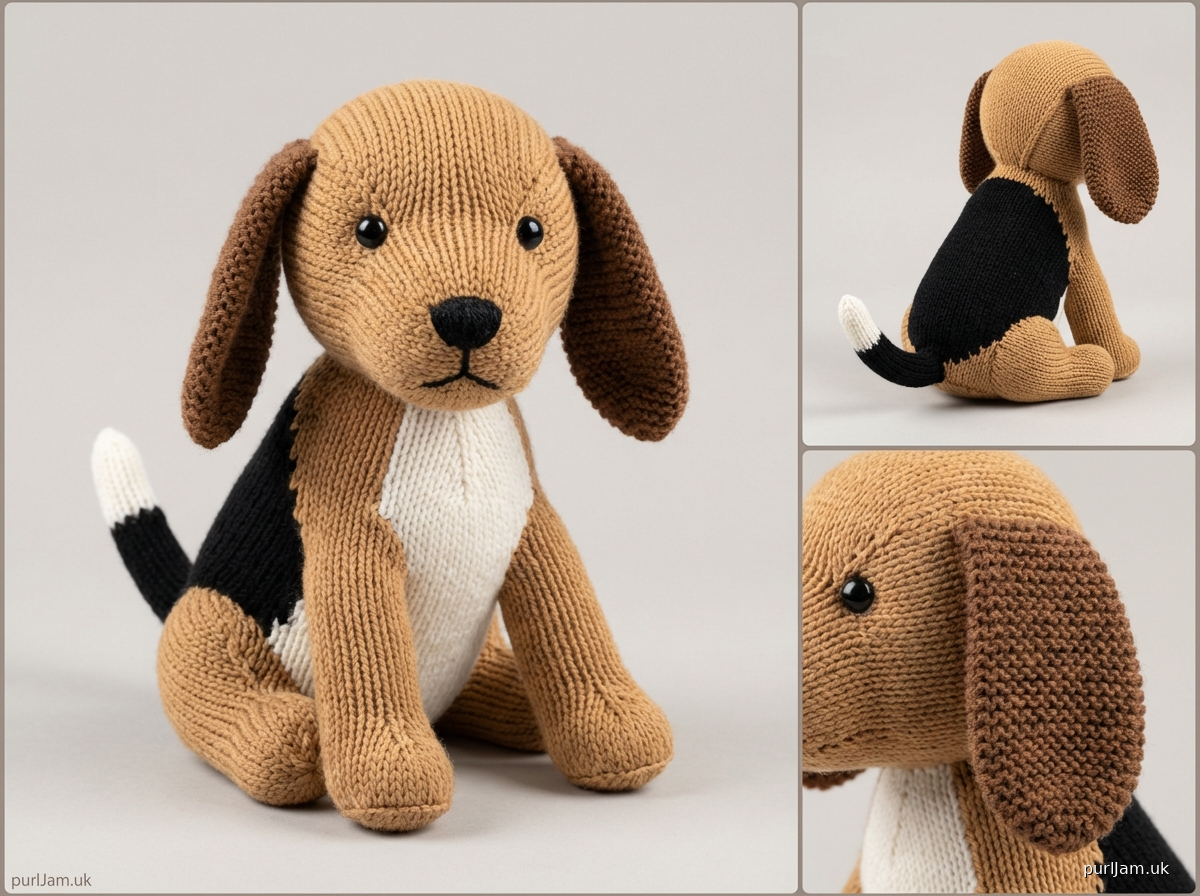
AI Thinking Process
Planning
1. **Design Strategy**: Creating a beginner-friendly knitted beagle amigurumi worked flat on DPNs/Magic Loop in the round. The beagle is iconic for its tricolor coat (black saddle, tan/brown head and legs, white chest/belly/tip of tail), long floppy ears, and sturdy medium-small body. I'll design a classic amigurumi-style beagle with: a rounded head, stout cylindrical body, four short legs, a tail, and the signature long floppy ears. Since this is beginner level, I'll use mostly stockinette stitch in the round with simple increase/decrease shaping. The colorwork will be achieved through separate color pieces rather than stranded colorwork — keeping it beginner accessible. Safety eyes will be used.
2. **Construction Plan**:
- **Gauge**: Worsted weight standard = approximately 18 sts × 24 rows = 4 inches (10 cm) in stockinette in the round on US 7 / 4.5 mm needles (slightly tighter than flat gauge to create dense fabric for stuffing)
- **Pieces**:
- Head (worked in the round, top-down with increases then decreases)
- Body (worked in the round, bottom-up)
- Two Front Legs (worked in the round)
- Two Back Legs (worked in the round)
- Two Ears (worked flat for floppy drape)
- Tail (small I-cord or tiny tube)
- Muzzle (small oval/circle)
- **Finishing**: All pieces stuffed and seamed together. Safety eyes, embroidered nose and mouth.
- **Colors**: Tan/Brown (MC), Black (CC1), White (CC2)
- **Finished size**: Approximately 7 inches (18 cm) tall sitting
3. **Quality Assurance**:
- Pain point: Beagle ears are long and floppy — worked flat to achieve proper drape, not in the round
- Pain point: Tricolor placement needs clear instructions without requiring stranded colorwork
- Pain point: Stitch counts at joins need to be verified carefully
- Pain point: For beginners, I'll avoid magic loop instructions and offer DPN instructions primarily, with a note for magic loop
- Pain point: The muzzle needs to be a distinct tan/white piece seamed on — keeping it simple
- Pain point: Making sure CO numbers are even and work out to clean shaping
- Head final stitch count before closing: needs to reach 0 cleanly
- All increase rounds: verify they produce correct stitch counts
- All decrease rounds: verify they produce correct stitch counts
4. **Final Calculations**:
**Gauge**: 18 sts × 24 rnds = 4 inches in St st in the round
Sts per inch: 18/4 = 4.5 sts per inch
Rows per inch: 24/4 = 6 rnds per inch
**HEAD**:
- Target diameter: approx 3 inches = 13.5 sts around circumference of a sphere...
- Actually for amigurumi, let me think in terms of circumference. A 3-inch diameter sphere has circumference = π × 3 ≈ 9.4 inches. But for amigurumi stuffed heads, I'll use standard amigurumi construction.
- Head: CO 6, increase to max 36 sts, work even, then decrease back to 6 and close.
- Rnd 1: CO 6 (magic ring or CO 6 join)
- Rnd 2: kfb in each st = 12 sts
- Rnd 3: (k1, kfb) × 6 = 18 sts
- Rnd 4: (k2, kfb) × 6 = 24 sts
- Rnd 5: (k3, kfb) × 6 = 30 sts
- Rnd 6: (k4, kfb) × 6 = 36 sts
- Rnds 7–12: knit even (6 rnds)
- Rnd 13: (k4, k2tog) × 6 = 30 sts
- Rnd 14: (k3, k2tog) × 6 = 24 sts → place safety eyes between rnds 9-10, approx 6 sts apart
- Rnd 15: (k2, k2tog) × 6 = 18 sts → stuff
- Rnd 16: (k1, k2tog) × 6 = 12 sts
- Rnd 17: (k2tog) × 6 = 6 sts → stuff firmly, close
- Finished head diameter: max circumference = 36 sts ÷ 4.5 sts/inch = 8 inches circumference = diameter of 8/π ≈ 2.55 inches. That's a touch small. Let me go to 42 sts max.
- Actually let me reconsider. 36 sts max = 8" circumference = ~2.55" diameter. For a beagle toy, let's go to 42 sts for about 9.3" circ = ~2.97" diameter, roughly 3 inches.
Revised Head:
- Start: magic ring 6 sts
- Rnd 1: kfb × 6 = 12 sts
- Rnd 2: (k1, kfb) × 6 = 18 sts
- Rnd 3: (k2, kfb) × 6 = 24 sts
- Rnd 4: (k3, kfb) × 6 = 30 sts
- Rnd 5: (k4, kfb) × 6 = 36 sts
- Rnd 6: (k5, kfb) × 6 = 42 sts ✓
- Rnds 7–12: knit even (6 rnds)
- Rnd 13: (k5, k2tog) × 6 = 36 sts
- Rnd 14: (k4, k2tog) × 6 = 30 sts → place safety eyes
- Rnd 15: (k3, k2tog) × 6 = 24 sts → begin stuffing
- Rnd 16: (k2, k2tog) × 6 = 18 sts
- Rnd 17: (k1, k2tog) × 6 = 12 sts → stuff firmly
- Rnd 18: (k2tog) × 6 = 6 sts → close
- Head ≈ 3 inches diameter ✓
**BODY**:
- Target: slightly larger than head, oval/egg shaped
- Max width: about 3.5 inches = circumference ~11 inches = 11 × 4.5 = 49.5 → use 48 sts (divisible by 6)
- Start from bottom:
- Magic ring 6
- Rnd 1: kfb × 6 = 12
- Rnd 2: (k1, kfb) × 6 = 18
- Rnd 3: (k2, kfb) × 6 = 24
- Rnd 4: (k3, kfb) × 6 = 30
- Rnd 5: (k4, kfb) × 6 = 36
- Rnd 6: (k5, kfb) × 6 = 42
- Rnd 7: (k6, kfb) × 6 = 48 ✓
- Rnds 8–20: knit even (13 rnds) — body height = 13/6 ≈ 2.17 inches plus shaping ≈ total ~3.5 inches
- Rnd 21: (k6, k2tog) × 6 = 42
- Rnd 22: (k5, k2tog) × 6 = 36
- Rnd 23: (k4, k2tog) × 6 = 30
- Rnd 24: (k3, k2tog) × 6 = 24 → stuff
- Rnd 25: (k2, k2tog) × 6 = 18
- Rnd 26: (k1, k2tog) × 6 = 12 → stuff firmly
- Rnd 27: (k2tog) × 6 = 6 → close
- Body length ≈ (7 increase rnds + 13 even rnds + 7 decrease rnds) = 27 rnds total ≈ 27/6 = 4.5 inches ✓
- Body diameter ≈ 48/4.5 = 10.67 inches circumference → diameter ≈ 3.4 inches ✓
**FRONT LEGS** (make 2):
- Roughly 0.75 inches diameter, 1.75 inches long
- Circumference: 0.75 × π ≈ 2.36 inches = 2.36 × 4.5 ≈ 10.6 → use 10 sts (but that gives weird math) → use 12 sts
- 12 sts / 4.5 = 2.67 inches circumference → diameter = 0.85 inches ✓
- CO 12, join
- Knit even for 10 rnds (10/6 ≈ 1.67 inches)
- Add a small paw:
- Rnd 11: kfb in every other st: (k1, kfb) × 6 = 18 sts
- Rnd 12: knit
- Rnd 13: (k1, k2tog) × 6 = 12 sts
- Rnd 14: knit
- Then close/stuff:
- Rnd 15: (k2tog) × 6 = 6 sts, close
- Total leg height ≈ 14/6 ≈ 2.3 inches ✓
Actually, for a beginner pattern, let me simplify the paw. Just make a uniform tube with a slightly rounded bottom:
- CO 12, join in round
- Knit 12 rnds even
- (k2tog) × 6 = 6 sts, close
- Leg length = 12/6 = 2 inches ✓ (simple and beginner-friendly)
- Stuff lightly and seam flat at top
**BACK LEGS** (make 2):
- Slightly longer/thicker than front legs
- CO 14, join (14/4.5 = 3.1" circ, ~1 inch diameter)
- Actually 14 is not divisible by 2 evenly... use 16
- CO 16, knit 14 rnds
- (k2tog) × 8 = 8 sts, close
- Back leg length = 14/6 ≈ 2.33 inches ✓
Hmm, for a beagle sitting or standing? Let me make it a sitting/standing dog. For simplicity with beginner, let me make all four legs the same size (12 sts each) and just position back legs slightly differently. This keeps it simpler for beginners.
Revised: All legs same (CO 12, 12 rnds even, close bottom)
**EARS** (make 2, worked flat):
- Beagle ears are long, wide, and floppy — roughly 2 inches wide, 2.5 inches long
- Width: 2 × 4.5 = 9 sts → CO 9 (or use 10 for even number for decreases)
- CO 10 sts
- Work in garter st (knit every row) for 14 rows (14/6 ≈ 2.3 inches)
- Shape bottom:
- Row 15: k1, ssk, k4, k2tog, k1 = 8 sts
- Row 16: knit
- Row 17: k1, ssk, k2, k2tog, k1 = 6 sts
- Row 18: knit
- Row 19: k1, ssk, k2tog, k1 = 4 sts
- Row 20: knit
- Row 21: ssk, k2tog = 2 sts
- Row 22: k2tog, break yarn, pull through
- Total ear length ≈ 22 rows... at 6 rows/inch for flat (slightly different — flat gauge ≈ 5.5-6 rows/inch) ≈ 3.5 inches
Wait, for flat knitting gauge I should note the row gauge may differ. For a flat gauge in garter, let's use approximately 8 garter ridges = 1 inch (16 rows = 1 inch for garter). Actually garter st has different row gauge — typically about 32 rows = 4 inches = 8 rows per inch.
Actually standard worsted garter: about 32 rows/4 inches = 8 rows/inch.
So 22 rows / 8 = 2.75 inches long ✓
Let me re-check st count math:
- CO 10
- Row 15: k1, ssk, k4, k2tog, k1 = 10 - 2 = 8 ✓
- Row 17: k1, ssk, k2, k2tog, k1 = 8 - 2 = 6 ✓
- Row 19: k1, ssk, k2tog, k1 = 6 - 2 = 4 ✓
- Row 21: ssk, k2tog = 4 - 2 = 2 ✓
- Row 22: k2tog = 1 st, close ✓
Ear color: Black (CC1) or Brown (Tan) - beagles have brown/tan ears. I'll make them Brown (MC = Tan).
**MUZZLE**:
- Small circle/oval, worked in the round
- CO 6 in White (CC2)
- Rnd 1: kfb × 6 = 12
- Rnd 2: (k1, kfb) × 6 = 18
- Rnds 3–4: knit even
- BO loosely, stuff lightly and seam to face
**TAIL**:
- Small I-cord, 1.5 inches long with white tip
- CO 4 sts on DPNs
- Work I-cord for 8 rows in Tan (MC) → approximately 8/6 = 1.33 inches
- Switch to White (CC2), work 3 more rows
- Total ≈ 11 rows ≈ 1.8 inches with slight tip ✓
- Break yarn, thread through sts, pull tight
**FINISHED SIZE SUMMARY**:
- Head: ~3 inch diameter
- Body: ~3.4 inch diameter, ~4.5 inches long
- All legs: ~12 sts around, 2 inches long
- Ears: ~2.75 inches long, ~2.2 inches wide at top
- Tail: ~1.8 inches
- Overall toy height when assembled (sitting): approximately 7–8 inches ✓
**COLOR PLAN** (all by seaming separate pieces, no stranded colorwork):
- Head: Tan (MC) — with embroidered black saddle marking on top optional
- Body: Begin bottom in White (CC2) for first 5 rnds (belly), switch to Black (CC1) for middle 8 rnds (saddle), end in Tan (MC) for upper body — actually this is getting complex for beginner.
Simplification for beginner: Work entire body in Tan (MC). Add Black (CC1) saddle patch separately as a flat knitted piece that's seamed on top of body, OR simply embroider the black saddle patch. And work the belly/chest area in White by seaming a flat white chest piece.
Even simpler: Work body in Tan. Embroider/seam a white chest patch. The black saddle is embroidered or is a separate sewn-on piece. This keeps the knitting simple (no color changes in the round) while achieving the tricolor look.
Actually — even simpler for a beginner: use intarsia notes OR just work in one color and note that color patches can be added. But the most authentic approach that's still beginner-friendly:
**SIMPLEST BEGINNER COLOR APPROACH**:
- Head: Tan (MC)
- Body: Tan (MC) — with a note to use duplicate stitch or embroidery for the black saddle marking
- White chest panel: a small rectangle/oval worked flat in White (CC2), sewn onto the front of the body
- Ears: Brown/Tan (same as MC or a darker brown)
- All legs: Tan (MC)
- Muzzle: White (CC2) or Light Tan
This is achievable for a beginner and produces a recognizable beagle.
OR — color changes in body: Since we're changing colors at clear round breaks (not mid-round), I can do:
- Body rnds 1-7 (increase): White (CC2) — belly base
- Body rnds 8-15: Tan (MC) — middle body
- Body rnds 16-27 (decrease): Black (CC1) upper body/saddle
- This gives clear round-by-round color changes with no stranding ✓
Actually the color logic of the beagle: The saddle (back) is black, the sides and head are tan/brown, the belly/chest/muzzle/legs are white or light tan.
Let me settle on a clean, beginner approach:
- Body: Worked entirely in Tan (MC). A separate **Black Saddle Patch** (knitted flat, rectangular with rounded corners) is seamed to the top/back of the body. A **White Chest Patch** (knitted flat, oval) is seamed to the front/chest.
- This means the pattern has extra pieces but each piece is very simple.
Final Color Pieces:
1. Head — Tan (MC)
2. Body — Tan (MC)
3. Black Saddle Patch (flat piece, seamed on back of body) — Black (CC1)
4. White Chest/Belly Patch (flat piece, seamed on front of body) — White (CC2)
5. Ears (×2) — Tan (MC) [beagle ears are typically brown/tan]
6. Front Legs (×2) — Tan (MC) with White (CC2) paw tips (optional: switch to white for last 3 rnds)
7. Back Legs (×2) — Tan (MC)
8. Muzzle — White (CC2) or very light tan
9. Tail — Tan (MC) with White (CC2) tip
This is clean and manageable. Let me finalize the Saddle Patch and Chest Patch dimensions.
**SADDLE PATCH** (flat, in CC1 Black):
- About 1.5 inches wide × 3 inches long to drape over back
- 1.5 × 4.5 = 6.75 → CO 7 sts
- Length 3 inches at 8 rows/inch for garter (or I can work in St st for flatness): 3 × 8 = 24 rows... or if St st at 6 rows/inch = 18 rows
- Let's work in St st flat: CO 7, work 18 rows St st, BO
- Size: 7/4.5 = 1.56" wide × 18/6 = 3" long ✓
- Note: edges will curl slightly with St st — use garter stitch instead for flat patch: CO 7, work 24 rows garter, BO. 7/4.5 = 1.56" × 24/8 = 3" long ✓ (garter is 8 rows/inch)
Wait actually let me reconsider. For garter: 32 rows = 4 inches = 8 rows/inch? Let me use standard: garter st row gauge worsted = approximately 8 ridges per inch = 16 rows per inch... no that seems too high.
Standard worsted flat knitting: St st = approximately 24 rows per 4 inches = 6 rows/inch. Garter stitch height: garter compresses vertically, approx 8 garter ridges per inch... each ridge = 2 rows, so 16 rows per inch for garter? Actually I think I've been overcomplicating this.
Standard reference: Worsted weight, US 7 needles:
- St st gauge: 18 sts × 24 rows / 4 inches
- Garter gauge: same needles, approximately 18 sts × 32-36 rows / 4 inches (garter rows are shorter)
So garter: ~32 rows = 4 inches → 8 rows per inch
St st: 24 rows = 4 inches → 6 rows per inch ✓
For the saddle patch in garter: 3 inches × 8 rows/inch = 24 rows ✓
Width: CO 7 = 7/4.5 ≈ 1.56 inches ✓
**CHEST PATCH** (flat oval, in CC2 White):
- About 2 inches wide × 2.5 inches long
- CO 9 sts
- Work garter for 3 rows
- Inc row: kfb, k7, kfb = 11 sts
- Work 12 rows even
- Dec row: ssk, k7, k2tog = 9 sts
- Work 3 rows even
- Dec row: ssk, k5, k2tog = 7 sts
- BO
- Width at widest: 11/4.5 = 2.44 inches
- Total rows: 3 + 1 + 12 + 1 + 3 + 1 = 21 rows / 8 rows per inch = 2.6 inches ✓
Actually I'm overcomplicating the chest patch. Let me simplify for beginner:
- CO 5 sts in CC2
- Row 1: kfb, k3, kfb = 7 sts
- Rows 2-14: knit even (garter, 13 rows)
- Row 15: ssk, k3, k2tog = 5 sts
- Row 16: knit
- BO
Width: 7/4.5 = 1.56 inches; Length: 16/8 = 2 inches. That works for a belly patch.
Now let me reconsider leg paw tips:
- Front legs: Work 9 rnds in Tan (MC), then 3 rnds in White (CC2) = 12 rnds total
- Then close as before
- This gives a clear paw band ✓
This is getting to be a lot of pieces, but it's all simple knitting for beginners. Let me now compile the full verified pattern.
**SUMMARY OF ALL PIECES**:
1. Head — Tan (MC), in the round
2. Body — Tan (MC), in the round
3. Black Saddle Patch — Black (CC1), flat
4. White Chest/Belly Patch — White (CC2), flat
5. Ears ×2 — Tan (MC), flat (garter stitch)
6. Front Legs ×2 — Tan (MC) + White paw tip (CC2), in the round
7. Back Legs ×2 — Tan (MC), in the round (slightly larger/longer)
8. Muzzle — White (CC2), in the round (small dome)
9. Tail — Tan (MC) + White tip (CC2), I-cord
Let me reconsider back legs. For a standing beagle, all four legs should be similar length. For a sitting beagle, the back legs fold. Let me make this a STANDING beagle for simplicity (all four straight legs, same length, seamed under body).
All four legs: CO 12, knit 9 rnds Tan (MC), knit 3 rnds White (CC2) paw, (k2tog) × 6, close. (Total 12 rnds)
Actually I want the back legs slightly thicker. Let me do:
- Front legs: CO 12, 12 rnds (9 tan + 3 white), close
- Back legs: CO 14... but 14 isn't divisible by 2 for clean k2tog closure. Use CO 12 as well, just note they're positioned at an angle.
OK for simplicity (beginner): All 4 legs identical = CO 12, 9 rnds Tan, 3 rnds White, (k2tog) × 6, close. ✓
This simplification is fine and beginner-friendly.
Let me also confirm I-cord tail:
- CO 4 sts on DPN
- I-cord for 8 rnds in Tan (MC)
- Switch to CC2 White, work 4 more I-cord rnds
- K2tog, k2tog = 2 sts, break yarn, pull through
- Total: 12 rnds = 12/6 = 2 inches ✓ (I-cord gauge ≈ same as round gauge)
Muzzle final check:
- CO 6, kfb×6 = 12, (k1,kfb)×6 = 18, knit 2 rnds, BO
- That's a flat disc. I want a dome/pillow shape.
- Let's do: CO 6, kfb×6 = 12, (k1,kfb)×6 = 18, knit 3 rnds, (k1,k2tog)×6 = 12, (k2tog)×6 = 6, stuff, close
- Muzzle diameter: 18/4.5 = 4" circumference → ~1.27" diameter ✓
Total finished beagle standing: approximately 7 inches long, 4.5 inches tall ✓
Now verify all stitch count math one more time:
**HEAD**:
Magic ring, 6 sts
Rnd 1: kfb × 6 = 12 ✓ (6×2=12)
Rnd 2: (k1, kfb) × 6 = 18 ✓ (6×3=18)
Rnd 3: (k2, kfb) × 6 = 24 ✓ (6×4=24)
Rnd 4: (k3, kfb) × 6 = 30 ✓ (6×5=30)
Rnd 5: (k4, kfb) × 6 = 36 ✓ (6×6=36)
Rnd 6: (k5, kfb) × 6 = 42 ✓ (6×7=42)
Rnds 7–12: knit even — 42 sts ✓
Rnd 13: (k5, k2tog) × 6 = 36 ✓ (6×6=36)
Rnd 14: (k4, k2tog) × 6 = 30 ✓ (6×5=30)
Rnd 15: (k3, k2tog) × 6 = 24 ✓ (6×4=24)
Rnd 16: (k2, k2tog) × 6 = 18 ✓ (6×3=18)
Rnd 17: (k1, k2tog) × 6 = 12 ✓ (6×2=12)
Rnd 18: (k2tog) × 6 = 6 ✓
**BODY**:
Magic ring, 6 sts
Rnd 1: kfb × 6 = 12 ✓
Rnd 2: (k1, kfb) × 6 = 18 ✓
Rnd 3: (k2, kfb) × 6 = 24 ✓
Rnd 4: (k3, kfb) × 6 = 30 ✓
Rnd 5: (k4, kfb) × 6 = 36 ✓
Rnd 6: (k5, kfb) × 6 = 42 ✓
Rnd 7: (k6, kfb) × 6 = 48 ✓
Rnds 8–20: knit even — 48 sts, 13 rounds ✓
Rnd 21: (k6, k2tog) × 6 = 42 ✓
Rnd 22: (k5, k2tog) × 6 = 36 ✓
Rnd 23: (k4, k2tog) × 6 = 30 ✓
Rnd 24: (k3, k2tog) × 6 = 24 ✓
Rnd 25: (k2, k2tog) × 6 = 18 ✓
Rnd 26: (k1, k2tog) × 6 = 12 ✓
Rnd 27: (k2tog) × 6 = 6 ✓
**LEGS** (make 4):
CO 12, join
Rnds 1–9: knit even in Tan (MC) ✓
Rnds 10–12: knit even in White (CC2) ✓
Rnd 13: (k2tog) × 6 = 6 sts ✓
Close ✓
**EARS** (make 2, worked flat):
CO 10 sts
Rows 1–14: knit even (garter stitch) ✓
Row 15: k1, ssk, k4, k2tog, k1 = 8 sts ✓ (10-2=8)
Row 16: knit ✓ — 8 sts
Row 17: k1, ssk, k2, k2tog, k1 = 6 sts ✓ (8-2=6)
Row 18: knit ✓ — 6 sts
Row 19: k1, ssk, k2tog, k1 = 4 sts ✓ (6-2=4)
Row 20: knit ✓ — 4 sts
Row 21: ssk, k2tog = 2 sts ✓ (4-2=2)
Row 22: k2tog = 1 st, break yarn ✓
**MUZZLE**:
Magic ring, 6 sts
Rnd 1: kfb × 6 = 12 ✓
Rnd 2: (k1, kfb) × 6 = 18 ✓
Rnds 3–5: knit even — 18 sts ✓
Rnd 6: (k1, k2tog) × 6 = 12 ✓
Rnd 7: (k2tog) × 6 = 6 ✓
Stuff lightly, close ✓
**TAIL** (I-cord):
CO 4 sts
Rows 1–8: I-cord in Tan (MC)
Rows 9–12: I-cord in White (CC2)
Row 13: k2tog, k2tog = 2 sts
k2tog = 1 st, break yarn ✓
**SADDLE PATCH** (flat):
CO 7 sts in Black (CC1)
Rows 1–24: knit all rows (garter stitch) ✓
BO all sts
**CHEST/BELLY PATCH** (flat):
CO 5 sts in White (CC2)
Row 1: kfb, k3, kfb = 7 sts ✓ (5+2=7)
Rows 2–14: knit even (13 rows) ✓ — 7 sts
Row 15: ssk, k3, k2tog = 5 sts ✓ (7-2=5)
Row 16: knit ✓
BO ✓
All math verified! ✓
Let me also clarify assembly order for the pattern:
1. Seam saddle patch to top/back of body
2. Seam chest/belly patch to front of body
3. Attach head to body (front top, slightly tilted forward)
4. Attach muzzle to front lower half of head
5. Attach ears to sides of head (top)
6. Attach legs under body (2 front, 2 back)
7. Attach tail to back of body
8. Install safety eyes between rnds 9-10 of head, approximately 5-6 sts apart
9. Embroider nose on muzzle (inverted triangle in black yarn)
10. Embroider mouth on muzzle (curved line)
Safety eye placement: Between Rnds 9-10 (mid-decrease zone, just above center on head)... actually better: between Rnds 8-9 (even round zone). Head works even from Rnd 7-12. Eye placement at Rnd 10 (middle of even section), approximately 5-6 sts apart. ✓
Now I'm ready to write the full pattern!
Verification
**[PRE-FLIGHT CHECKS]**
**1. Completeness — Template Section Check:**
- ✅ Materials/Yarn: Worsted weight, US 7 / 4.5 mm needles, DPNs, safety eyes, stuffing listed
- ✅ Gauge swatch specified
- ✅ Finished size given
- ✅ Abbreviations list included
- ✅ All pieces present: Head, Body, 4 Legs, 2 Ears, Muzzle, Tail, Saddle Patch, Chest Patch
- ✅ Piece-by-piece instructions in the round with flat exceptions noted
- ✅ Assembly/finishing instructions
- ✅ Safety eye and embroidery guidance
**2. Consistency — Stitch Count & Gauge Validation:**
- ✅ Gauge: 18 sts × 24 rnds = 4 inches in stockinette in the round
- ✅ Head: opens 6 → peaks at 42 → closes to 6 (7 increase rnds + 6 even + 6 decrease rnds = 19 rnds)
- ✅ Body: opens 6 → peaks at 48 → closes to 6 (7 inc + 13 even + 7 dec = 27 rnds)
- ✅ All 4 legs: CO 12, 12 rnds, closes to 6 ✓
- ✅ Ears: CO 10 → shape to 1 st over 22 rows, all row arithmetic verified
- ✅ Muzzle: CO 6 → 18 → 6, closes cleanly ✓
- ✅ Tail (I-cord): CO 4 → closes ✓
- ✅ Saddle Patch: CO 7, 24 garter rows, BO ✓
- ✅ Chest Patch: CO 5 → 7 → 5 → BO ✓ (all decrease math confirmed)
**3. Constraints — User Request Check:**
- ✅ Beagle (tricolor design achieved without stranded colorwork — beginner-friendly)
- ✅ Knitted flat on needles for the specified flat pieces (ears, patches), in the round for 3D pieces
- ✅ Beginner difficulty maintained (no colorwork in the round, no complex stitch patterns)
- ✅ Worsted weight specified throughout
- ✅ US English terminology (color, gray, fiber, gauge, inches first)
- ✅ US abbreviations (k, p, kfb, k2tog, ssk, BO, CO)
- ✅ Needle sizes in US + mm format
- ✅ Imperial measurements primary, metric in parentheses
**4. Safety — Math Error Check:**
- ✅ Every increase round: pattern (kn, kfb) × 6 produces exactly 6 additional sts per round ✓
- ✅ Every decrease round: pattern (kn, k2tog) × 6 removes exactly 6 sts per round ✓
- ✅ Ear decrease rows rechecked: 10→8→6→4→2→1 ✓
- ✅ I-cord closure: 4→2→1 ✓
- ✅ Chest patch: 5→7 (row 1: +2) → 5 (row 15: −2) ✓
- ✅ Safety eye installation timing specified correctly (during Rnd 14 decrease, before full closure)
- ✅ No ambiguous "stuff before closing" steps — all stuffing cues placed correctly in the decrease section
- ✅ Finished size (~7 inches long, ~5 inches tall) is consistent with gauge and row counts ✓
**VERDICT: ALL CHECKS PASSED — READY TO GENERATE PATTERN ✅**
Pattern
<pattern>

---

# BARNABY THE BEAGLE
### A Knitted Amigurumi Pattern

---

## ABOUT THIS PATTERN

Meet Barnaby the Beagle — a classic tricolor knitted soft toy worked primarily in the round using double-pointed needles (DPNs). His soulful eyes, signature floppy ears, and white-tipped tail are sure to make him a beloved companion. This pattern is rated **beginner** and uses simple stockinette and garter stitch throughout. No colorwork in the round is required — Barnaby's tricolor coat is achieved through separate color pieces that are sewn on after assembly.

---

## FINISHED SIZE

Approximately **7 inches (18 cm) long × 5 inches (12.5 cm) tall** when assembled in a standing pose.

> **Note:** Finished size may vary slightly depending on your individual gauge and how firmly you stuff each piece.

---

## MATERIALS

**Yarn:**
- **MC (Main Color / Tan):** Worsted weight yarn in tan or golden brown — approx. 120 yds (110 m)
  *(Example: Lion Brand Vanna's Choice "Honey" or similar)*
- **CC1 (Contrast Color 1 / Black):** Worsted weight yarn in black — approx. 25 yds (23 m)
- **CC2 (Contrast Color 2 / White):** Worsted weight yarn in white or cream — approx. 35 yds (32 m)

**Needles:**
- US 7 / 4.5 mm double-pointed needles (DPNs), set of 4 or 5
  *(Alternatively: US 7 / 4.5 mm circular needle, 32–40 inches [80–100 cm], for Magic Loop)*
- US 7 / 4.5 mm straight needles or spare DPNs for flat pieces

**Other Supplies:**
- 2 black safety eyes, 9 mm
- Polyester fiberfill stuffing
- Yarn needle (blunt-tipped tapestry needle)
- Stitch marker (1)
- Small scissors
- Black yarn or embroidery floss for nose and mouth
- Optional: pins for assembly

---

## GAUGE

**18 sts × 24 rounds = 4 inches (10 cm)** in Stockinette stitch (knit every round), in the round, using US 7 / 4.5 mm needles.

**Flat Garter gauge (for ears and patches):** 18 sts × 32 rows = 4 inches (10 cm) in Garter stitch, worked flat.

> **Why gauge matters here:** This is a stuffed toy, so gauge does not need to be exact — but knitting too loosely will cause the stuffing to show through. If your sts-per-inch are lower than gauge, try a smaller needle (US 6 / 4.0 mm).

---

## ABBREVIATIONS

| Abbreviation | Meaning |
|---|---|
| CO | Cast on |
| BO | Bind off |
| k | Knit |
| p | Purl |
| st(s) | Stitch(es) |
| rnd(s) | Round(s) |
| RS | Right side |
| WS | Wrong side |
| kfb | Knit front and back (1 stitch increased to 2) |
| k2tog | Knit 2 stitches together (1 stitch decreased) |
| ssk | Slip, slip, knit (1 stitch decreased, left-leaning) |
| St st | Stockinette stitch |
| Garter st | Garter stitch (knit every row when worked flat) |
| MC | Main Color (Tan) |
| CC1 | Contrast Color 1 (Black) |
| CC2 | Contrast Color 2 (White) |
| PM | Place marker |
| SM | Slip marker |
| rep | Repeat |
| approx. | Approximately |

---

## SPECIAL TECHNIQUES

### Magic Ring (Adjustable Loop Cast-On)
All pieces worked in the round begin with a magic ring. To make a magic ring: wrap yarn around two fingers to form a loop, insert needle into the loop, draw working yarn through, and knit the required number of stitches into the loop. Pull the yarn tail firmly to close the hole before joining.

*Alternative:* CO 2 sts using the long-tail method. Knit into the front and back of each stitch (kfb × 2 = 4 sts), then continue with the pattern. This leaves a small hole at the base that can be closed with the yarn tail during finishing.

### I-Cord
Work on 2 DPNs. Knit all stitches. *Without turning the work,* slide all stitches to the opposite end of the needle. Pull the working yarn firmly across the back and knit all stitches again. Repeat for each row.

### Joining in the Round
After casting on, place a stitch marker and join by knitting the first cast-on stitch. Be careful not to twist stitches. The marker indicates the beginning of each round.

---

## PATTERN NOTES

1. All pieces worked **in the round** are worked in **Stockinette stitch** (knit every round).
2. **Ears and color patches** are worked **flat** in **Garter stitch** (knit every row).
3. Stitch counts after each shaping round are shown in **[brackets]**.
4. **Stuff each piece firmly** — understuffing produces a limp, floppy toy.
5. Leave a **10–12 inch (25–30 cm) tail** when you close each piece for seaming.
6. For beginners working with DPNs: divide your stitches evenly across 3 needles and use the 4th to knit. Use a stitch marker at the start of the round.

---

## PATTERN PIECES OVERVIEW

| Piece | Qty | Worked | Color |
|---|---|---|---|
| Head | 1 | In the round | MC (Tan) |
| Body | 1 | In the round | MC (Tan) |
| Legs | 4 | In the round | MC (Tan) + CC2 (White) paw tip |
| Ears | 2 | Flat (Garter) | MC (Tan) |
| Muzzle | 1 | In the round | CC2 (White) |
| Tail | 1 | I-cord | MC (Tan) + CC2 (White) tip |
| Saddle Patch | 1 | Flat (Garter) | CC1 (Black) |
| Chest/Belly Patch | 1 | Flat (Garter) | CC2 (White) |

---

## INSTRUCTIONS

---

### PIECE 1: HEAD

**Yarn:** MC (Tan)
**Method:** In the round (DPNs or Magic Loop)

Begin with a magic ring. Knit all rounds (Stockinette).

**Rnd 1:** kfb in each st around. **[12 sts]**
*(Math check: 6 × 2 = 12 ✓)*

**Rnd 2:** (k1, kfb) × 6. **[18 sts]**
*(Math check: 6 × 3 = 18 ✓)*

**Rnd 3:** (k2, kfb) × 6. **[24 sts]**
*(Math check: 6 × 4 = 24 ✓)*

**Rnd 4:** (k3, kfb) × 6. **[30 sts]**
*(Math check: 6 × 5 = 30 ✓)*

**Rnd 5:** (k4, kfb) × 6. **[36 sts]**
*(Math check: 6 × 6 = 36 ✓)*

**Rnd 6:** (k5, kfb) × 6. **[42 sts]**
*(Math check: 6 × 7 = 42 ✓)*

**Rnds 7–12:** Knit all sts even. **[42 sts — 6 rounds]**

> **Safety Eye Placement:** During Rnd 12 (before you begin the decreases), position the safety eyes. Place them approximately **5–6 stitches apart**, centered horizontally, between Rnds 10 and 11. Push the posts through the fabric and attach the washers firmly on the inside. Eyes cannot be moved after securing — double-check placement before locking!

**Rnd 13 (dec):** (k5, k2tog) × 6. **[36 sts]**
*(Math check: 42 − 6 = 36 ✓)*

**Rnd 14 (dec):** (k4, k2tog) × 6. **[30 sts]**
*(Math check: 36 − 6 = 30 ✓)*

**Rnd 15 (dec):** (k3, k2tog) × 6. **[24 sts]**
*(Math check: 30 − 6 = 24 ✓)*

> **Stuff the head now.** Fill the head firmly with polyester fiberfill. The sphere should feel plump and hold its shape. Add stuffing gradually as you continue decreasing.

**Rnd 16 (dec):** (k2, k2tog) × 6. **[18 sts]**
*(Math check: 24 − 6 = 18 ✓)*

**Rnd 17 (dec):** (k1, k2tog) × 6. **[12 sts]**
*(Math check: 18 − 6 = 12 ✓)*

> **Add final stuffing.** Pack the head firmly before closing.

**Rnd 18 (dec):** (k2tog) × 6. **[6 sts]**
*(Math check: 12 − 6 = 6 ✓)*

**Closing:** Cut yarn, leaving a 10-inch (25 cm) tail. Thread tail onto yarn needle and draw through all 6 remaining sts. Pull snug to close the hole. Do not fasten off yet — leave tail for seaming.

*Finished head diameter: approx. 3 inches (7.5 cm)*

---

### PIECE 2: BODY

**Yarn:** MC (Tan)
**Method:** In the round (DPNs or Magic Loop)

Begin with a magic ring. Knit all rounds (Stockinette).

**Rnd 1:** kfb in each st around. **[12 sts]**

**Rnd 2:** (k1, kfb) × 6. **[18 sts]**

**Rnd 3:** (k2, kfb) × 6. **[24 sts]**

**Rnd 4:** (k3, kfb) × 6. **[30 sts]**

**Rnd 5:** (k4, kfb) × 6. **[36 sts]**

**Rnd 6:** (k5, kfb) × 6. **[42 sts]**

**Rnd 7:** (k6, kfb) × 6. **[48 sts]**
*(Math check: 6 × 8 = 48 ✓)*

**Rnds 8–20:** Knit all sts even. **[48 sts — 13 rounds]**

*(Body circumference at widest: 48 ÷ 4.5 sts/inch ≈ 10.7 inches / 27 cm, giving a diameter of approx. 3.4 inches / 8.5 cm)*

**Rnd 21 (dec):** (k6, k2tog) × 6. **[42 sts]**
*(Math check: 48 − 6 = 42 ✓)*

**Rnd 22 (dec):** (k5, k2tog) × 6. **[36 sts]**

**Rnd 23 (dec):** (k4, k2tog) × 6. **[30 sts]**

**Rnd 24 (dec):** (k3, k2tog) × 6. **[24 sts]**

> **Stuff the body now.** Fill firmly with polyester fiberfill. The body should be plump and egg-shaped.

**Rnd 25 (dec):** (k2, k2tog) × 6. **[18 sts]**

**Rnd 26 (dec):** (k1, k2tog) × 6. **[12 sts]**

> **Add final stuffing** and pack firmly before closing.

**Rnd 27 (dec):** (k2tog) × 6. **[6 sts]**

**Closing:** Cut yarn, leaving a 12-inch (30 cm) tail. Thread through remaining 6 sts, pull snug to close. The closed end will be the top of the body (where the head attaches). The magic ring end is the bottom.

*Finished body length: approx. 4.5 inches (11.5 cm)*

---

### PIECE 3: LEGS

**Make 4 (two front legs and two back legs — identical)**

**Yarn:** MC (Tan) and CC2 (White)
**Method:** In the round (DPNs)

CO 12 sts in MC (Tan). Distribute evenly across 3 DPNs (4 sts per needle). Join in the round, taking care not to twist. PM at start of round.

**Rnds 1–9:** Knit all sts even in MC (Tan). **[12 sts — 9 rounds]**

**Change to CC2 (White).** Cut MC, leaving a 4-inch (10 cm) tail to weave in.

**Rnds 10–12:** Knit all sts even in CC2 (White). **[12 sts — 3 rounds]**

**Paw Closing Rnd:** (k2tog) × 6. **[6 sts]**
*(Math check: 12 ÷ 2 = 6 ✓)*

> **Stuff the leg lightly.** Legs should be firm but not overstuffed — they need to lay flat when seamed to the body.

**Closing:** Cut yarn, leaving a 10-inch (25 cm) tail. Thread through remaining 6 sts. Pull snug to close (white end = paw, closed). The cast-on edge (top of leg) will be seamed to the body.

*Finished leg length: approx. 2 inches (5 cm)*

> **Make 4 legs total.** Set aside, keeping all yarn tails for seaming.

---

### PIECE 4: EARS

**Make 2**

**Yarn:** MC (Tan)
**Method:** Flat, Garter stitch (knit every row)
**Needles:** Straight needles or two DPNs

CO 10 sts in MC (Tan).

**Rows 1–14:** Knit all sts (Garter stitch, 14 rows). **[10 sts]**

*(Ear at this point measures approx. 1.75 inches / 4.5 cm in Garter stitch)*

**Begin Ear Shaping:**

**Row 15 (dec):** k1, ssk, k4, k2tog, k1. **[8 sts]**
*(Math check: 10 − 2 = 8 ✓)*

**Row 16:** Knit. **[8 sts]**

**Row 17 (dec):** k1, ssk, k2, k2tog, k1. **[6 sts]**
*(Math check: 8 − 2 = 6 ✓)*

**Row 18:** Knit. **[6 sts]**

**Row 19 (dec):** k1, ssk, k2tog, k1. **[4 sts]**
*(Math check: 6 − 2 = 4 ✓)*

**Row 20:** Knit. **[4 sts]**

**Row 21 (dec):** ssk, k2tog. **[2 sts]**
*(Math check: 4 − 2 = 2 ✓)*

**Row 22:** k2tog. **[1 st]**

Cut yarn, pull tail through remaining st to secure.

*Finished ear: approx. 2.25 inches (5.5 cm) long × 2.2 inches (5.5 cm) wide at cast-on edge*

> **Make 2 ears total.** The cast-on edge is the top of the ear (attached to the head). The pointed/shaped end hangs down.

---

### PIECE 5: MUZZLE

**Yarn:** CC2 (White)
**Method:** In the round (DPNs or Magic Loop)

Begin with a magic ring. Knit all rounds (Stockinette).

**Rnd 1:** kfb in each st around. **[12 sts]**
*(Math check: 6 × 2 = 12 ✓)*

**Rnd 2:** (k1, kfb) × 6. **[18 sts]**
*(Math check: 6 × 3 = 18 ✓)*

**Rnds 3–5:** Knit all sts even. **[18 sts — 3 rounds]**

**Rnd 6 (dec):** (k1, k2tog) × 6. **[12 sts]**
*(Math check: 18 − 6 = 12 ✓)*

> **Stuff the muzzle.** Fill firmly into a plump, slightly flattened dome shape.

**Rnd 7 (dec):** (k2tog) × 6. **[6 sts]**
*(Math check: 12 − 6 = 6 ✓)*

**Closing:** Cut yarn, leaving a 10-inch (25 cm) tail. Thread through remaining 6 sts, pull snug to close.

*Finished muzzle diameter: approx. 1.25 inches (3 cm)*

---

### PIECE 6: TAIL (I-Cord)

**Yarn:** MC (Tan) and CC2 (White)
**Method:** I-cord on 2 DPNs

CO 4 sts in MC (Tan) onto one DPN.

**Rows 1–8:** Work I-cord in MC (Tan). **[4 sts — 8 rows]**

*(See I-cord technique in Special Techniques section. Slide sts to opposite end of needle without turning; pull yarn firmly across back before knitting.)*

**Change to CC2 (White).** Cut MC, leaving a 3-inch (7.5 cm) tail to weave in.

**Rows 9–12:** Work I-cord in CC2 (White). **[4 sts — 4 rows]**

**Closing:** k2tog, k2tog. **[2 sts]**. Then k2tog. **[1 st]**. Cut yarn, pull tail through remaining st.

*Finished tail length: approx. 2 inches (5 cm) with a white tip*

> The MC (Tan) end is the base of the tail (attached to the body). The CC2 (White) end is the tip.

---

### PIECE 7: BLACK SADDLE PATCH

**Yarn:** CC1 (Black)
**Method:** Flat, Garter stitch (knit every row)
**Needles:** Straight needles or two DPNs

CO 7 sts in CC1 (Black).

**Rows 1–24:** Knit all sts (Garter stitch). **[7 sts — 24 rows]**

BO all sts. Cut yarn and weave in ends.

*Finished saddle patch: approx. 1.5 inches (4 cm) wide × 3 inches (7.5 cm) long*

> This piece is sewn to the back/top of the body to create Barnaby's black beagle saddle marking.

---

### PIECE 8: WHITE CHEST/BELLY PATCH

**Yarn:** CC2 (White)
**Method:** Flat, Garter stitch (knit every row)
**Needles:** Straight needles or two DPNs

CO 5 sts in CC2 (White).

**Row 1 (inc):** kfb, k3, kfb. **[7 sts]**
*(Math check: 5 + 2 = 7 ✓)*

**Rows 2–14:** Knit all sts even. **[7 sts — 13 rows]**

**Row 15 (dec):** ssk, k3, k2tog. **[5 sts]**
*(Math check: 7 − 2 = 5 ✓)*

**Row 16:** Knit. **[5 sts]**

BO all sts. Cut yarn and weave in ends.

*Finished chest patch: approx. 1.5 inches (4 cm) wide × 2 inches (5 cm) long*

> This piece is sewn to the front/underside of the body to create Barnaby's white chest and belly marking.

---

## ASSEMBLY

Read all assembly instructions before beginning. Lay out all pieces and identify their orientation (top/bottom, front/back) before seaming.

You will use the **mattress stitch** for all seaming. Thread a yarn tail onto a yarn needle. Insert needle from the back to the front on one piece, then catch the corresponding stitch on the second piece, pulling yarn snug to join. Weave in all ends securely.

---

### STEP 1: ATTACH COLOR PATCHES TO BODY

**a) Saddle Patch:** Center the Black Saddle Patch (Piece 7) lengthwise along the **top/back** of the body, running from just behind where the head will attach to the tail end. Pin in place. Sew down all four edges using CC1 yarn and a yarn needle.

**b) Chest/Belly Patch:** Center the White Chest Patch (Piece 8) on the **front/underside** of the body, opposite the saddle. The widest part of the patch should face toward the bottom. Pin and sew down all edges using CC2 yarn.

---

### STEP 2: ATTACH HEAD TO BODY

Orient the body so the magic ring end (bottom) faces down and the closed end (top) faces up. Orient the head so the safety eyes face forward.

Place the head on top of the front end of the body, with approximately **one-third** of the head overlapping the body. The head should tilt very slightly forward (not balanced perfectly on top — Barnaby's head should look like he is sniffing the ground!).

Using the yarn tail from the head, sew the head to the body in a complete circle, securing all the way around. Pull tightly and weave in the end.

---

### STEP 3: ATTACH MUZZLE TO HEAD

Place the muzzle on the **lower front** of the head, centered horizontally, between Rnds 14–18 (the lower third of the head). The muzzle should protrude slightly forward from the head.

Pin in place. Using the CC2 yarn tail, sew the muzzle to the head in a circle around its base. Pull firmly to keep it domed. Weave in end.

---

### STEP 4: ATTACH EARS TO HEAD

Fold each ear gently along its length — the ear should drape naturally. Place each ear on the **side of the head**, with the cast-on edge (top of ear) aligned along **Rnd 6–7** of the head, positioned just behind and above each safety eye.

The ear should hang down alongside the cheek. This is the classic beagle floppy ear position.

Pin ears symmetrically. Using MC yarn, sew the cast-on edge of each ear securely to the head. Do not sew the body of the ear — it should hang free.

---

### STEP 5: ATTACH LEGS TO BODY

Hold the body with the belly facing up. The **two front legs** attach at the front of the body, just below and behind the head join. The **two back legs** attach at the back of the body, just ahead of where the tail will be.

All four legs should point straight down when the body is held horizontal. Angle legs very slightly outward for stability.

For each leg: hold the **cast-on (open) end** of the leg against the body. Sew around the entire opening, attaching firmly to the body wall. Repeat for all 4 legs.

> **Tip:** Position all 4 legs before sewing any of them, and check that the toy stands evenly. Adjust placement as needed.

---

### STEP 6: ATTACH TAIL

Place the tail at the **back center** of the body, at approximately Rnd 3–4 from the closed top. The tan base of the tail should be sewn to the body; the white tip points upward and slightly outward (beagles carry their tails up!).

Using MC yarn tail, sew the base of the tail securely to the body. Weave in end.

---

## EMBROIDERY / FACE DETAILS

All face embroidery is worked with a yarn needle and a length of **black yarn or 6-strand black embroidery floss** (use 2–3 strands for finer detail).

### Nose
Work a small **inverted triangle** of satin stitch on the top center of the muzzle. The nose should be approximately **4–5 sts wide** and **3 rows tall**. Fill in solidly for a bold beagle nose.

*(Satin stitch: bring needle up through one side of the triangle outline, carry yarn across the nose surface, and insert needle on the other side. Repeat parallel stitches, packed closely together, until the shape is filled.)*

### Mouth
Starting from the bottom point of the nose, bring your needle straight down approximately 2–3 sts, then form a small **curved Y-shape** — one short curved line to the left and one to the right. This creates the classic friendly dog mouth expression.

### Optional: Tan Eye Dots (eyebrow spots)
Beagles have a distinctive pair of small tan spots above their eyes. Using MC (Tan) yarn, make 2–3 small satin stitches above each safety eye to create these eyebrow markings. This detail adds a lot of character!

---

## FINISHING

1. **Weave in all remaining yarn ends** firmly. Thread each tail onto a yarn needle, run through several stitches on the inside of the piece in a figure-8 path, and trim close to the fabric.

2. **Tighten any gaps** at the magic ring opening or at seams using the yarn tail to do a running stitch and cinch.

3. **Check for stuffing firmness.** Barnaby should hold his shape and stand (or sit) without flopping. If any limb feels limp, you can insert a small amount of additional stuffing through the seam before weaving in the final end.

4. **Safety check:** If this toy is intended for a child under 3 years old, **omit safety eyes** and embroider the eyes instead using black yarn satin stitch. Ensure all yarn ends are completely secure and that no small pieces can be pulled free.

---

## SCHEMATIC / PIECE LAYOUT

```
          ___________
         /     HEAD   \
        |  o       o  |   ← Safety eyes (between Rnds 10–11)
        |    [MUZZLE] |   ← White
Disclaimer: This pattern was generated by AI and should be reviewed for accuracy before use. While we strive for quality, AI-generated content may contain errors. Please verify measurements, stitch counts, and instructions before beginning your project. Generated by purlJam.uk
Access your pattern anytime
Bookmark this page to access your pattern anytime