Type
Crochet
Difficulty
intermediate
Category
shawl
AI Thinking Process
Planning
Verification
Pattern
Cerulean Jay Shawl
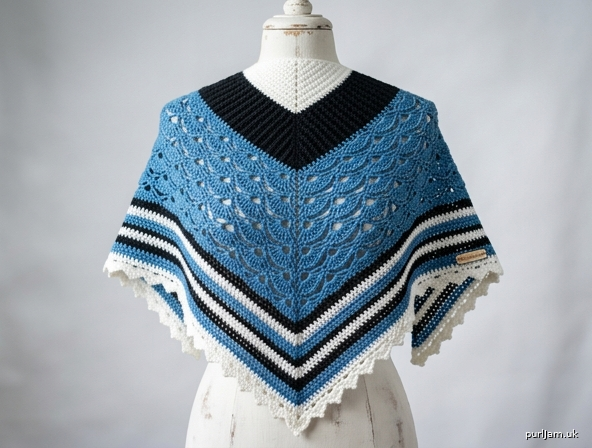
An advanced triangular shawl worked from the center top, inspired by the plumage of the blue jay (Cyanocitta cristata): a compact white crown, a dense black bib, a spreading field of cerulean feather lace, barred “primaries,” and a white picot-shell edge.
Skill level: Advanced
Finished Measurements
One size, after wet blocking.
- Wingspan (tip to tip along the neck edge): 62 inches (157.5 cm)
- Depth (nape to center point): 31 inches (78.5 cm)
The lace is highly block-dependent. Size is adjustable: each additional 4-row Jay Feather repeat in MC adds about 2¼ inches (5.5 cm) of depth.
Materials
Yarn: Worsted weight (category 4), wool or wool-blend strongly preferred for blocking memory.
- MC (Cerulean / jay blue): 650 yards (595 m)
- CC1 (White): 220 yards (201 m)
- CC2 (Black): 180 yards (165 m)
Sample yardage assumes a wool or wool/silk worsted of about 200 yards (183 m) per 100 g. Acrylic will not hold a lace block as cleanly; if substituting, expect a smaller, less open fabric.
Hook: US I-9 / 5.5 mm, or size needed to obtain gauge.
Notions:
- 1 locking stitch marker (center spine); 2 optional markers for the 3-dc edge groups
- Tapestry needle
- Blocking wires, T-pins, and a surface at least 64 × 34 inches (163 × 86 cm)
- Scissors
Gauge
Blocked, unstretched fabric.
- Solid double crochet: 14 dc and 8 rows = 4 × 4 inches (10 × 10 cm)
- Jay Feather Lace: one 4-row repeat = 2¼ inches (5.5 cm) deep
Gauge is not critical for fit, but it does control drape and yarn use. A denser gauge yields a smaller, stiffer shawl and may exhaust MC before the wing bars.
Abbreviations (US)
- beg: beginning
- BPdc: back post double crochet
- CC: contrasting color
- ch: chain
- dc: double crochet
- FPdc: front post double crochet
- Fsh: center shell — (2 dc, ch 2, 2 dc) in the marked center ch-2 space
- hdc: half double crochet
- MC: main color
- pm: place marker
- rep: repeat
- RS: right side
- sc: single crochet
- sk: skip
- sl st: slip stitch
- sp(s): space(s)
- st(s): stitch(es)
- tch: turning chain
- WS: wrong side
- yo: yarn over
Special Stitches
Picot: Ch 3, sl st in the third ch from the hook.
FPdc: Yo, insert hook from front to back to front around the post of the indicated dc, yo and pull up a loop, (yo and draw through 2 loops) twice.
BPdc: Yo, insert hook from back to front to back around the post of the indicated dc, yo and pull up a loop, (yo and draw through 2 loops) twice.
Center shell (Fsh): (2 dc, ch 2, 2 dc) in the marked ch-2 sp. Move the marker up into the new ch-2 sp every row.
5-dc feather: 5 dc in the same ch-2 sp.
Pattern Notes
- Shawl is worked flat in turned rows from a center-top magic ring. The last row is the long lower V (left tip, center point, right tip). The wingspan/neck edge is formed by the row selvedges.
- Ch 3 at the beginning of a row counts as 1 dc.
- The marked center ch-2 does not count as a stitch. Always work Fsh in it.
- Every row increases at four sites: 3 dc in the first st, 3 dc in the last st, and 2 dc on each side of the center ch-2 (the Fsh). In lace, those increases appear as extra ch-2 sps: +2 ch-2 sps per side, every row.
- Turn at the end of every row.
- Change color in the last yo of the last stitch of the old color. Do not fasten off until the section is complete, except where a later section re-joins a parked color.
- Weave tails as you go for 3–4 stitches; blue jay sections create many ends.
- RS rows are the odd-numbered rows throughout.
Schematic (blocked)
                    nape (Row 1)
                        △
                       /│\
                      / │ \
                     /  │  \          depth 31" (78.5 cm)
                    /   │   \
                   /    │    \
                  /  spine    \
                 /      │      \
        left   /        │        \   right
        tip  /__________│__________\  tip

            wingspan 62" (157.5 cm)
            (measured along the neck/selvedge edge)
Color map from nape to lower edge: White crown → Black bib → Cerulean feathers → Black / White / Blue bars → White primaries + picot border.
Instructions
Section 1 — Snow Crown (CC1)
With CC1, make a magic ring (or ch 4 and sl st in the first ch to form a ring).
Row 1 (RS): Ch 3 (counts as dc here and throughout), 2 dc in ring, ch 2, pm in the ch-2 sp (center spine), 3 dc in ring. Pull ring closed. Turn. (6 dc + 1 ch-2 sp; 3 dc per side ✓)
Row 2 (WS): Ch 3, 2 dc in first dc, dc in next 2 dc, Fsh in marked sp, dc in next 2 dc, 3 dc in last dc (top of tch). Turn. (14 dc; 7 dc per side; 3 + 4 = 7 ✓)
Row 3: Ch 3, 2 dc in first dc, dc in each dc to marked sp, Fsh in marked sp, dc in each dc to last dc, 3 dc in last dc. Turn. (22 dc; 11 dc per side; 7 + 4 = 11 ✓)
Rows 4–8: Repeat Row 3.
Checkpoint, dc per side (formula 4n − 1):
| Row | Dc per side | Check |
|---|---|---|
| 4 | 15 | 11 + 4 = 15 ✓ |
| 5 | 19 | 15 + 4 = 19 ✓ |
| 6 | 23 | 19 + 4 = 23 ✓ |
| 7 | 27 | 23 + 4 = 27 ✓ |
| 8 | 31 | 27 + 4 = 31 ✓ |
After Row 8: 31 dc per side, 62 dc total + center ch-2. Fasten off CC1.
Section 2 — Black Bib (CC2)
Row 9 (RS): Join CC2 with a standing dc in the first dc (or sl st join, ch 3). Work 2 more dc in the same st, dc in each dc to marked sp, Fsh in marked sp, dc in each dc to last dc, 3 dc in last dc. Turn. (35 dc per side; 31 + 4 = 35 ✓)
Row 10: As Row 3. (39 dc per side; 35 + 4 = 39 ✓)
Row 11 (RS, begin post-stitch bib): Ch 3, 2 dc in first dc, FPdc around each of the next 38 dc, Fsh in marked sp, FPdc around each dc to last dc, 3 dc in last dc. Turn. (43 dc per side; 39 + 4 = 43 ✓. Edge 3-dc groups and the 2 dc of each half of the Fsh are always plain dc.)
Row 12: Ch 3, 2 dc in first dc, dc in next 2 dc, FPdc around each FPdc to the 2 dc of the center shell, dc in those 2 dc, Fsh in marked sp, dc in next 2 dc, FPdc around each FPdc to last 3 dc, dc in next 2 dc, 3 dc in last dc. Turn. (47 dc per side; 43 + 4 = 47 ✓)
Row 13: Ch 3, 2 dc in first dc, FPdc around each dc to the 2 dc of the center shell, dc in those 2 dc, Fsh in marked sp, dc in next 2 dc, FPdc around each remaining dc to last dc, 3 dc in last dc. Turn. (51 dc per side; 47 + 4 = 51 ✓)
Row 14: Repeat Row 12. (55 dc per side; 51 + 4 = 55 ✓. Total 110 dc + center ch-2.)
Fasten off CC2.
Section 3 — Cerulean Flight (MC)
Jay Feather Lace begins here. From Row 15 onward, count ch-2 spaces per side (not including the marked center ch-2). The running formula is:
ch-2 sps per side after Row n = 18 + 2(n − 15) (n ≥ 15)
Setup
Row 15 (RS, Setup Mesh): Join MC with a standing dc in the first dc (or sl st join, ch 3). Work 2 more dc in the same st, [ch 2, sk 2 dc, dc in next dc] 18 times, Fsh in marked sp, dc in next dc, [ch 2, sk 2 dc, dc in next dc] 17 times, ch 2, sk 2 dc, 3 dc in last dc. Turn.
Left side uses 1 + (18 × 3) = 55 dc ✓. Right side: 1 + (17 × 3) + 3 = 55 dc ✓. 18 ch-2 sps per side ✓.
Jay Feather Repeat (4 rows)
Work the following 4-row repeat for the remainder of the body. Row 15 counts as Repeat Row 1 of the first repeat. Continue with Repeat Rows 2–4 once (Rows 16–18), then work Repeat Rows 1–4 seven more times (Rows 19–46). That is 8 complete repeats in MC (Rows 15–46).
Repeat Row 1 — Mesh (RS or WS): Ch 3, 2 dc in first dc, ch 2, dc in next ch-2 sp, *ch 2, dc in next ch-2 sp; rep from * to the 2 dc of the center shell, ch 2, dc in next dc, ch 2, Fsh in marked sp, ch 2, dc in next dc, ch 2, dc in next ch-2 sp, *ch 2, dc in next ch-2 sp; rep from * to last 3-dc group, ch 2, 3 dc in last dc. Turn. (+2 ch-2 sps per side ✓)
Repeat Row 2 — Mesh: As Repeat Row 1. (+2 ch-2 sps per side ✓)
Repeat Row 3 — Feathers (always RS in this pattern): Ch 3, 2 dc in first dc, ch 2, *5 dc in next ch-2 sp, sc in next ch-2 sp; rep from * to the 2 dc of the center shell, ch 2, dc in next dc, ch 2, Fsh in marked sp, ch 2, dc in next dc, ch 2, *5 dc in next ch-2 sp, sc in next ch-2 sp; rep from * to last 3-dc group, ch 2, 3 dc in last dc. Turn.
The row always begins with an even number of ch-2 sps per side, so the (5 dc, sc) pairing consumes them exactly. Number of 5-dc feathers per side = (ch-2 sps at the start of this row) ÷ 2.
Repeat Row 4 — Reset Mesh: Work as Repeat Row 1, placing 1 dc in each sc, 1 dc in the center (3rd) dc of each 5-dc feather, and 1 dc in each ch-2 sp that sits at the edges of the feather field, with ch 2 between all of those dc, and with the same edge and center increases as Repeat Row 1. Turn. (+2 ch-2 sps per side ✓)
Do not work into the 2 skipped dc on either side of a feather’s center dc — those two dc are the “barbs” of the feather and should stay free so the shell opens in blocking.
Section 3 checkpoint
After Row 46 (end of 8th repeat): ch-2 sps per side = 18 + 2(46 − 15) = 18 + 62 = 80 ✓.
Feather-row audit inside this section (feathers per side):
| Feather row | Sps at start of row | Feathers per side | Check |
|---|---|---|---|
| 17 | 20 | 10 | 20 ÷ 2 = 10 ✓ |
| 21 | 28 | 14 | 20 + 8 = 28 ✓ |
| 25 | 36 | 18 | 28 + 8 = 36 ✓ |
| 29 | 44 | 22 | 36 + 8 = 44 ✓ |
| 33 | 52 | 26 | 44 + 8 = 52 ✓ |
| 37 | 60 | 30 | 52 + 8 = 60 ✓ |
| 41 | 68 | 34 | 60 + 8 = 68 ✓ |
| 45 | 76 | 38 | 68 + 8 = 76 ✓ |
(Each 4-row repeat adds 8 ch-2 sps per side: 2 sps × 4 rows = 8 ✓.)
Do not fasten off MC; park it if you prefer not to cut, or cut and rejoin for cleaner bars.
Section 4 — Wing Bars (CC2, CC1, MC)
Continue the same 4-row Jay Feather Repeat. Change color at the start of each listed pair. These 12 rows are Repeats 9–11 (Rows 47–58).
| Rows | Repeat rows | Color | What you are making |
|---|---|---|---|
| 47–48 | 1–2, Mesh | CC2 Black | First black bar |
| 49–50 | 3–4, Feather + Reset | CC1 White | White wing patch |
| 51–52 | 1–2, Mesh | MC Blue | Blue field |
| 53–54 | 3–4, Feather + Reset | CC2 Black | Second black bar |
| 55–56 | 1–2, Mesh | CC1 White | Second white patch |
| 57–58 | 3–4, Feather + Reset | MC Blue | Blue field |
Feather-row audit:
| Feather row | Sps at start | Feathers per side | Check |
|---|---|---|---|
| 49 | 84 | 42 | 76 + 8 = 84 ✓ |
| 53 | 92 | 46 | 84 + 8 = 92 ✓ |
| 57 | 100 | 50 | 92 + 8 = 100 ✓ |
After Row 58: ch-2 sps per side = 18 + 2(58 − 15) = 18 + 86 = 104 ✓. Fasten off MC.
Section 5 — White Primaries (CC1)
Join CC1.
Rows 59–62: Work one full Jay Feather Repeat (Repeat Rows 1–4). Feather Row 61: 108 sps at start, 54 feathers per side (108 ÷ 2 = 54 ✓).
Rows 63–64: Work Repeat Rows 1–2 once more (two mesh rows), still in CC1.
After Row 64: ch-2 sps per side = 18 + 2(64 − 15) = 18 + 98 = 116 ✓. Do not fasten off.
Picot-Shell Border (CC1)
Worked across Row 64 only — the long lower V. Do not turn after Row 64; continue with RS facing if Row 64 was a WS row, or turn if needed so the border is worked on the RS. If Row 64 (Repeat Row 2 of a mesh pair beginning at 63) is a WS row, turn so the border is RS.
Border row (RS): Ch 1, sc in first dc, sk remaining 2 dc of the edge group, *sc in next ch-2 sp, (3 dc, picot, 3 dc) in next ch-2 sp; rep from * 58 times (all 116 left-side ch-2 sps consumed: 58 × 2 = 116 ✓), (3 dc, picot, 3 dc, picot, 3 dc) in marked center ch-2 sp (the tail point), *(3 dc, picot, 3 dc) in next ch-2 sp, sc in next ch-2 sp; rep from * 58 times (116 right-side sps ✓), sc in last dc. Fasten off.
The left half begins with sc-then-shell so a shell sits against the center point; the right half begins with shell-then-sc so the center is flanked by shells. Two picots at the center point emphasize the jay’s tail.
Neckband (CC1)
With RS facing and CC1, join with sl st at the right-hand wingtip (the beg-of-row selvedge when RS is facing). Work 1 row of sc evenly along the entire wingspan (across all row-ends and the original magic ring) to the left-hand wingtip.
As a guide, place 2 sc in the side of each dc row. 64 body rows × 2 = 128 sc per selvedge, plus 3 sc across the magic-ring crown: about 259 sc total (128 + 3 + 128 = 259 ✓). Work 3 sc in the two wingtip corners if they look tight. Do not work sc into the picot border.
Fasten off.
Finishing
Weave in all remaining ends on the WS, splitting plies and running each tail along a matching-color row for at least 2 inches (5 cm). Do not cut tails flush until after blocking — wet blocking can pull a short tail out of a lace fabric.
Blocking (required for drape)
The unblocked shawl will look shorter, narrower, and slightly corrugated. The feather shells will not open until they are pinned.
- Soak the shawl for 15–20 minutes in lukewarm water with a small amount of wool wash. Do not agitate.
- Drain. Press (do not wring) in a towel until the shawl is damp, not dripping.
- Lay out to a triangle 62 inches (157.5 cm) across the neck edge and 31 inches (78.5 cm) from nape to point. The nape angle is slightly greater than 90°, so the shawl is a wearable wrap rather than a rigid right triangle.
- Run blocking wires through the neckband sc row and through the outer dc of the picot shells along both lower edges. Pin the wires to the measurements above.
- Pin every picot out individually, especially the two at the center point and the picots nearest each wingtip. Pin the center of each 5-dc feather so the shell opens into a rounded vane.
- Leave until bone dry — overnight at minimum; 24 hours for a heavy worsted wool.
- Unpin. Steam the neckband lightly if it waves, holding the iron above the fabric; do not crush the feathers.
After blocking, the white crown should sit at the nape, the black bib should read as a collar, the blue field should fall down the back, and the barred white-tipped edge should read as flight feathers.
Color Sequence (quick reference)
| Section | Rows | Color | Stitch |
|---|---|---|---|
| Snow Crown | 1–8 | CC1 White | Solid dc |
| Black Bib | 9–10 | CC2 Black | Solid dc |
| Black Bib | 11–14 | CC2 Black | FPdc rib |
| Cerulean Flight | 15–46 | MC Blue | Jay Feather Lace, 8 repeats |
| Wing Bar 1 | 47–48 | CC2 Black | Mesh |
| White Patch 1 | 49–50 | CC1 White | Feather + Reset |
| Blue field | 51–52 | MC Blue | Mesh |
| Wing Bar 2 | 53–54 | CC2 Black | Feather + Reset |
| White Patch 2 | 55–56 | CC1 White | Mesh |
| Blue field | 57–58 | MC Blue | Feather + Reset |
| White Primaries | 59–64 | CC1 White | 1 repeat + 2 mesh |
| Picot border | — | CC1 White | Shells + picots |
| Neckband | — | CC1 White | Sc |
Customizing
- Larger shawl: Work extra full 4-row repeats in MC between Row 46 and the wing bars. Recalculate wing-bar and border counts from the formula 18 + 2(n − 15). Feather rows remain even. Allow about 55 extra yards (50 m) of MC per additional repeat.
- Smaller shawl: Stop MC after Repeat 6 (Row 38; 64 ch-2 sps/side), then begin Section 4. Border pairing still works because the sp count stays even.
- Color: A Steller’s-jay variant uses MC in black-blue and CC1 in charcoal; a gray jay uses MC in pale gray, CC1 in white, CC2 in slate. Keep the darkest color on Rows 11–14 so the bib still reads.
- Yarn: A wool/silk worsted opens the feathers further; a firmly spun wool gives crisper black bars. Do not go down a hook size on the bib unless your FPdc rows flare — post stitches already draw in.
Technical Editor’s Count Summary
- Row n, solid (n ≤ 14): dc per side = 4n − 1.
- Row 8: 31 dc/side ✓. Row 14: 55 dc/side ✓.
- Row 15: 18 ch-2 sps/side ✓.
- Row n, lace (n ≥ 15): ch-2 sps/side = 18 + 2(n − 15).
- Row 46: 80 sps/side ✓. Row 58: 104 ✓. Row 64: 116 ✓.
- Border: 58 picot shells per side + 1 double-picot point (116 ÷ 2 = 58 ✓).
Disclaimer: This pattern was generated by AI and should be reviewed for accuracy before use. While we strive for quality, AI-generated content may contain errors. Please verify measurements, stitch counts, charts, and instructions before beginning your project. Generated by purlJam.uk
Love this pattern?
Save this pattern to your free PurlJam libraryAccess your pattern anytime
Bookmark this page to access your pattern anytime