Type
Crochet
Difficulty
intermediate
Category
shawl
AI Thinking Process
Planning
Verification
Pattern
The Azure Jay Shawl
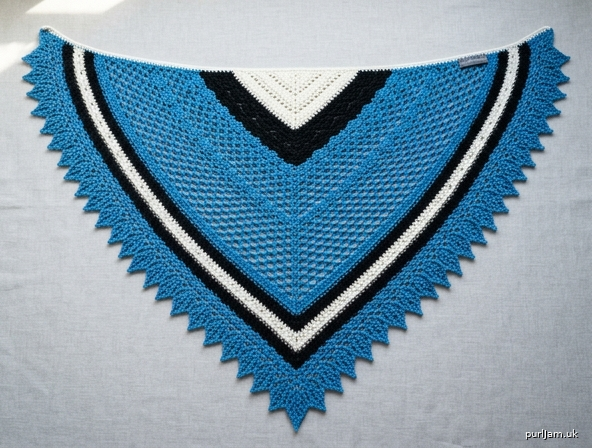
A top-down triangular lace shawl inspired by the plumage of the North American blue jay (Cyanocitta cristata): a white gorget at the neck, a black necklace, a cerulean body, barred flight-feather stripes, and a pointed picot edge like primary feathers. Worked in worsted-weight yarn from the center nape, the fabric is an open two-row lace of V-stitches and shells. Aggressive blocking opens the mesh and gives the shawl its wing-like drape.
Skill level: Advanced
Skills used: Magic ring, V-stitch and shell lace, tracking a marked center spine, clean color changes, mixed-height stitches, picots, even selvedge crochet, wet blocking with wires.
Finished size
One size, after blocking, including edging:
- Wingspan: 64 in (163 cm)
- Depth at center spine: 30 in (76 cm)
To lengthen or shorten, work more or fewer 2-row repeats in the blue body (Rows 17–36), always ending on a shell row before the wing bars. Save 80 yd (73 m) of C for the edging.
Materials
Yarn: Worsted weight (CYC 4), wool or wool-blend strongly recommended so the lace will wet-block. Superwash merino or a wool/nylon sock-worsted both work. Avoid navy; blue jays are vivid cerulean.
| Color | Role | Amount |
|---|---|---|
| A White (ivory or snow) | Gorget, white wing bar, optional neck | 130 yd / 119 m |
| B Black | Necklace and two wing bars | 160 yd / 146 m |
| C Azure (bright jay blue) | Body, outer wing, feather edging | 500 yd / 457 m |
Sample yardage assumes a wool worsted of about 220 yd (201 m) per 100 g. Acrylic will need a larger hook and steam blocking; drape will be stiffer.
Hook: US I-9 / 5.5 mm, or size needed to obtain gauge. For a softer, more open fabric, try US J-10 / 6.0 mm and accept a slightly larger shawl.
Notions:
- 3 stitch markers (1 for the center spine, 2 optional for wing edges)
- Tapestry needle
- Blocking wires and T-pins
- Scissors
Gauge
Blocked, in pattern stitch: 4 shells = 4 in (10 cm) 6 rows (3 V-st rows + 3 shell rows) = 4 in (10 cm)
To swatch: work Rows 1–12, wet-block the small triangle, and measure across the middle of one wing, not at the point. Match gauge for the published size; a denser gauge makes a smaller, heavier shawl.
Abbreviations (US)
| Abb. | Meaning |
|---|---|
| ch | chain |
| sl st | slip stitch |
| sc | single crochet |
| hdc | half double crochet |
| dc | double crochet |
| tr | treble crochet |
| sp(s) | space(s) |
| st(s) | stitch(es) |
| sk | skip |
| PM | place marker |
| SM | stitch marker |
| tch | turning chain |
| RS | right side |
| WS | wrong side |
| beg | beginning |
| rem | remaining |
| rep | repeat |
| yo | yarn over |
Special stitches
V-st (V-stitch): (dc, ch 1, dc) in the same st or sp.
Shell: (2 dc, ch 1, 2 dc) in the same st or sp.
Picot: ch 3, sl st in the 3rd ch from hook.
Feather point: (sc, hdc, dc, picot, dc, hdc, sc) in the indicated ch-sp.
Large feather point: (sc, hdc, dc, tr, picot, tr, dc, hdc, sc) in the indicated ch-sp.
Standing dc: slip knot on hook, yo, insert in indicated st, complete dc as usual. Used at color changes if you prefer not to join with a slip stitch.
Pattern notes
- US crochet terminology throughout.
- Shawl is a triangle worked from the center top (nape) down. Each row is worked across both wings with a marked chain space at the center spine.
- Odd rows (RS) are V-st rows and increase 4 V-sts — one new V-st at each outer edge and two V-sts in the center spine.
- Even rows (WS) are shell rows and do not add motifs. Work one shell in each V-st; shells at the end of an even row always equal the V-st count of the previous row.
- Always work a V-st into the ch-1 space of a shell, and a shell into the ch-1 space of a V-st. Do not work into the dc legs of either motif.
- Ch 4 at the start of a V-st row counts as dc + ch 1 (the first half of the edge V-st).
- Ch 3 at the start of a shell row counts as dc (selvedge).
- Mark the center ch-3 space on Row 1 and move the marker up every row. Losing the spine is the most common error in this construction.
- Change color on the last yarn-over of the last stitch of the old color, then work the turning chain in the new color. Cut yarn at each change; do not carry floats.
- Count V-sts at the end of every odd row until the two-row rhythm is automatic. Counts are given at every color change.
- Right side faces you on V-st rows. The RS is the side with the more defined shells sitting “on top” of the V-sts after blocking.
Shawl
Setup — White gorget (Color A)
With A, make a magic ring.
Row 1 (RS), V-st: Ch 4 (counts as dc + ch 1), dc in ring (first V-st made), ch 3, (dc, ch 1, dc) in ring. Tighten ring. Turn. [2 V-sts, 1 ch-3 spine]. PM in the ch-3 sp.
Row 2 (WS), Shell: Ch 3 (counts as dc here and on every shell row), shell in ch-1 sp of first V-st, ch 1, (dc, ch 3, dc) in marked ch-3 sp, ch 1, shell in ch-1 sp of next V-st, dc in 3rd ch of tch. Turn. [2 shells = previous 2 V-sts ✓]. Move SM to the new ch-3.
Row 3 (RS), V-st: Ch 4 (counts as dc + ch 1 here and on every V-st row), dc in first dc (edge V-st made), ch 1, V-st in ch-1 sp of first shell, ch 1, (V-st, ch 3, V-st) in marked ch-3 sp, ch 1, V-st in ch-1 sp of next shell, ch 1, (dc, ch 1, dc) in tch. Turn. [+4 V-sts → 2 + 4 = 6 V-sts ✓].
Row 4 (WS), Shell: Ch 3, *shell in ch-1 sp of next V-st, ch 1; rep from * to marked ch-3 sp, (dc, ch 3, dc) in marked ch-3 sp, ch 1, *shell in ch-1 sp of next V-st, ch 1; rep from * to last V-st, shell in last V-st, dc in tch. Turn. [6 shells ✓].
The two-row lace is now established.
Repeat instructions (used for the rest of the body)
V-st row (RS, odd rows): Ch 4, dc in first dc, ch 1, *V-st in ch-1 sp of next shell, ch 1; rep from * to marked ch-3 sp, (V-st, ch 3, V-st) in marked ch-3, ch 1, *V-st in ch-1 sp of next shell, ch 1; rep from * to last shell, V-st in last shell, ch 1, (dc, ch 1, dc) in tch. Turn. Each V-st row = previous shell count + 4.
Shell row (WS, even rows): Ch 3, *shell in ch-1 sp of next V-st, ch 1; rep from * to marked ch-3 sp, (dc, ch 3, dc) in marked ch-3, ch 1, *shell in ch-1 sp of next V-st, ch 1; rep from * to last V-st, shell in last V-st, dc in tch. Turn. Each shell row = previous V-st count.
Move the center marker up every row.
Color sequence and motif counts
Continue Rows 3–4 as the repeat, changing color at the start of the listed rows. Motif count is the number of V-sts on an odd row, and the matching number of shells on the even row that follows.
White gorget — Color A, Rows 5–10
Work 3 more full repeats (Rows 5–10).
| Row | Type | Motifs |
|---|---|---|
| 5 | V-st | 10 (6 + 4 ✓) |
| 6 | Shell | 10 |
| 7 | V-st | 14 |
| 8 | Shell | 14 |
| 9 | V-st | 18 |
| 10 | Shell | 18 |
Fasten off A.
Black necklace — Color B, Rows 11–16
Join B with a standing dc in the first dc (or sl st join, ch 3), then complete Row 11 as a V-st row.
| Row | Type | Motifs |
|---|---|---|
| 11 | V-st | 22 (18 + 4 ✓) |
| 12 | Shell | 22 |
| 13 | V-st | 26 |
| 14 | Shell | 26 |
| 15 | V-st | 30 |
| 16 | Shell | 30 |
Fasten off B.
Azure body — Color C, Rows 17–36
Join C as before. Work 10 full repeats (20 rows).
| Row | Type | Motifs |
|---|---|---|
| 17 | V-st | 34 (30 + 4 ✓) |
| 18 | Shell | 34 |
| 19 | V-st | 38 |
| 20 | Shell | 38 |
| 21 | V-st | 42 |
| 22 | Shell | 42 |
| 23 | V-st | 46 |
| 24 | Shell | 46 |
| 25 | V-st | 50 |
| 26 | Shell | 50 |
| 27 | V-st | 54 |
| 28 | Shell | 54 |
| 29 | V-st | 58 |
| 30 | Shell | 58 |
| 31 | V-st | 62 |
| 32 | Shell | 62 |
| 33 | V-st | 66 |
| 34 | Shell | 66 |
| 35 | V-st | 70 |
| 36 | Shell | 70 |
This is the longest section. Count motifs every few RS rows: after Row 25 you should have 50 V-sts; after Row 35, 70 V-sts. Fasten off C.
Wing bars — B, A, B, then a final blue row-pair
The next six rows are the jay’s black–white–black wing bars, worked in the same lace so the stripe sits in the fabric rather than on top of it.
Join B.
- Rows 37–38: V-st 74, shell 74. Fasten off B. Join A.
- Rows 39–40: V-st 78, shell 78. Fasten off A. Join B.
- Rows 41–42: V-st 82, shell 82. Fasten off B. Join C.
- Rows 43–44: V-st 86 (82 + 4 ✓), shell 86.
Do not fasten off C. You should have 86 shells, 43 on each wing, plus the center (dc, ch 3, dc). This is the last body row.
Feather edging (Color C)
Keep C. The edging is worked along Row 44, from left tip through the bottom point to the right tip.
Edging Row 1 (RS), arches: Ch 1, sc in first dc (the selvedge dc), *ch 4, sc in ch-1 sp of next shell; rep from * across all 43 shells of the first wing, ch 4, (sc, ch 6, sc) in marked ch-3 sp, *ch 4, sc in ch-1 sp of next shell; rep from * across all 43 shells of the second wing, ch 4, sc in tch. Turn.
Arch count: 43 ch-4 before the spine + 1 ch-4 into the spine + 1 ch-6 at the spine + 43 ch-4 after the spine + 1 ch-4 to the last sc = 88 ch-4 sps + 1 ch-6 sp = 89 arches ✓.
Edging Row 2 (WS), feather points: Ch 1, *feather point in next ch-4 sp, sl st in next sc; rep from * to the ch-6 sp, large feather point in the ch-6 sp, sl st in next sc, *feather point in next ch-4 sp, sl st in next sc; rep from * to end, sl st in last sc. Fasten off C.
[88 feather points + 1 large center point = 89 points ✓.]
The large point is the tail-tip of the triangle. Pin it out firmly when blocking.
Neck edge
The two selvedges form the top (wingspan) edge that sits at the collar.
With RS facing, join A (or C if you prefer an all-blue collar) at the left front tip, in the same st as the first edging sc.
Neck Row 1: Ch 1, sc evenly along the selvedge toward the magic ring — work 2 sc in each shell-row end and 2 sc in each V-st-row end (44 rows × 2 sc = 88 sc along the first selvedge ✓). Work 3 sc in the magic-ring beginning, then 88 sc down the second selvedge to the right front tip. Do not turn.
Neck Row 2 (optional, recommended): Ch 1, work reverse sc (crab st) in each sc across the neck edge. This raises a firm, slightly rolled collar that holds the shawl on the shoulders.
Fasten off.
Finishing
Weave in all ends on the WS, following the path of the same color where possible. Do not trim tails until after blocking — wet blocking can pull a short tail free.
Blocking (required)
This shawl will not show the lace, the wing shape, or the feather points until it is blocked. Plan on 24 hours of drying time.
Wool / wool-blend (preferred):
- Soak in lukewarm water with a drop of wool wash for 20 minutes. Do not agitate.
- Lift out, support the full weight, and roll in a towel. Press — do not wring — until the shawl is damp, not dripping.
- Lay out a blocking mat or towels. Pin the neck edge in a straight line 64 in (163 cm) long, using blocking wires through the neck sc row if you have them. This is the wingspan.
- Pin the center large feather point 30 in (76 cm) down from the midpoint of the neck edge. That is the depth.
- Pin every remaining feather point out so the two lower sides are straight lines from each front tip to the bottom point. Use a T-pin in each picot.
- Tug the mesh until the V-sts and shells open into even diamonds. The white gorget should sit as a small triangle at the neck, the black necklace as a clear band below it, and the wing bars as three parallel stripes above the points.
- Leave until completely dry. Unpin.
Acrylic: Do not wet-block aggressively. Pin to the same measurements and hover a steam iron 1–2 in (2.5–5 cm) above the fabric. Never let the iron rest on the stitches. Let cool before unpinning.
After blocking, trim remaining ends. The fabric should feel supple, the points sharp, and the shawl should drape in a shallow wing across the back rather than hanging as a stiff triangle.
Schematic (blocked)
     left tip                         right tip
        *———————— nape / wingspan 64 in ————————*
         \         A white gorget              /
          \        B black necklace           /
           \                                 /
            \            C azure            /
             \           body              /
              \                           /
               \   B black               /
                \  A white   wing bars  /
                 \ B black             /
                  \      C             /
                   *  feather points  *
                     depth 30 in
Stitch-count cheat sheet
V-st count on the k-th V-st row (Rows 1, 3, 5, …) = 4k − 2.
| k (V-st row #) | Pattern row | Section | V-sts / shells |
|---|---|---|---|
| 1 | 1 | A | 2 |
| 5 | 9 | A | 18 |
| 8 | 15 | B | 30 |
| 18 | 35 | C | 70 |
| 19 | 37 | B bar | 74 |
| 20 | 39 | A bar | 78 |
| 21 | 41 | B bar | 82 |
| 22 | 43 | C | 86 |
If a V-st row does not match this table, unravel that row and recount shells on the previous WS row before continuing. Do not “ease in” extra motifs; the spine will twist.
Designer notes
Wear the shawl with the white gorget at the back of the neck and the feather points falling down the back, or swing one wingtip forward like a jay’s folded wing. Because the top edge is a firm sc (and optional crab-stitch) band, it stays on the shoulders without a pin; a shawl stick through the two front tips is optional.
The same chart of rows can be worked in a single color if you want a quieter shawl — the feather edging still reads as flight feathers — but the three-color sequence is what makes it a blue jay.
Disclaimer: This pattern was generated by AI and should be reviewed for accuracy before use. While we strive for quality, AI-generated content may contain errors. Please verify measurements, stitch counts, charts, and instructions before beginning your project. Generated by purlJam.uk
Love this pattern?
Save this pattern to your free PurlJam libraryAccess your pattern anytime
Bookmark this page to access your pattern anytime