Type
Knitting
Difficulty
beginner
Category
socks
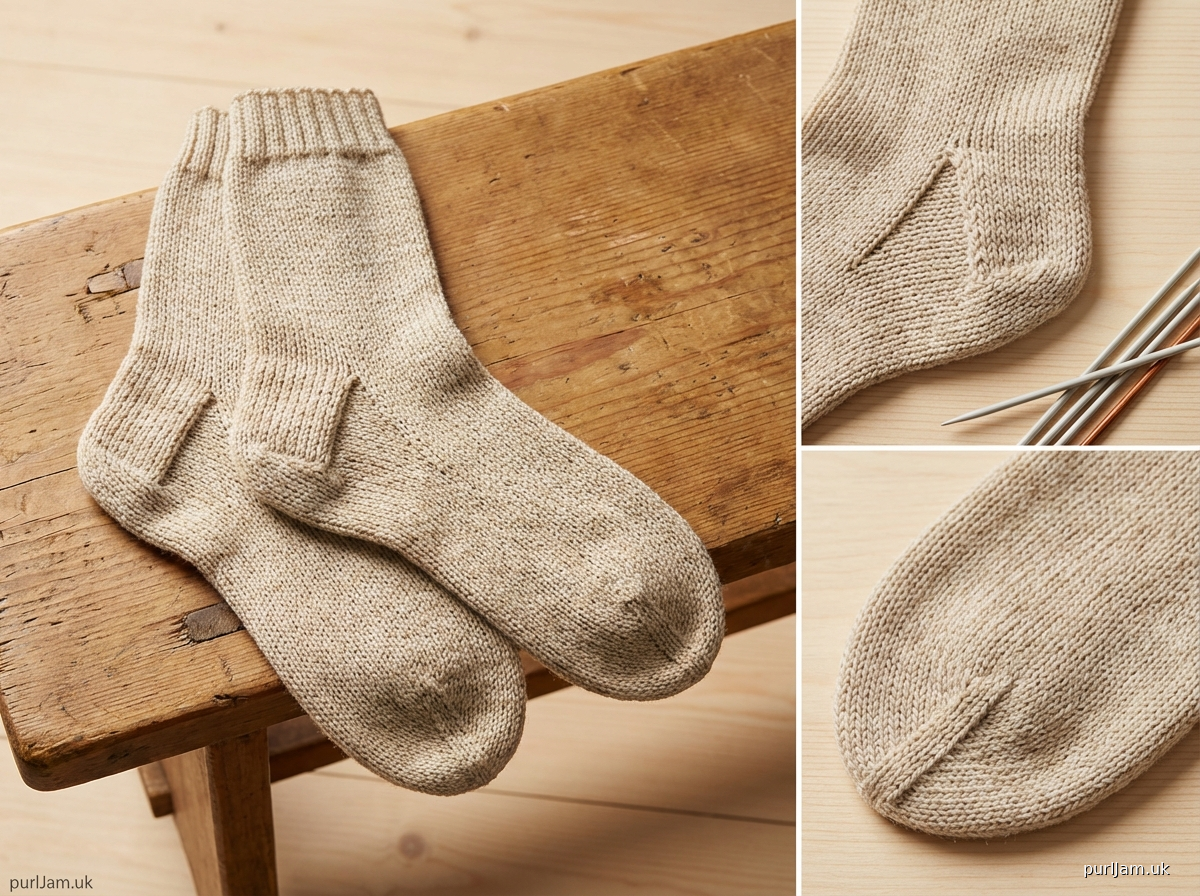
AI Thinking Process
Planning
1. **Design Strategy**: User requested "simple sock" at beginner level. Following the template's cuff-down method which is ideal for beginners. Using worsted weight yarn (thicker than typical sock yarn) which is faster to knit and easier for beginners to handle. This requires adjusting standard sock stitch counts downward since worsted weight is bulkier. Will use basic stockinette for leg and foot with k2p2 ribbing for cuff. Traditional heel flap construction for durability and ease of understanding.
2. **Construction Plan**: Cuff-down construction starting with cast on for k2p2 ribbing (divisible by 4), ribbed cuff, stockinette leg, heel flap worked flat on half stitches, heel turn using short rows, gusset pickup and decreases, stockinette foot, and simple toe shaping finished with Kitchener stitch. For worsted weight at typical gauge of 5 sts/inch, will design for Medium/Women's size requiring approximately 40 sts (8" × 5 sts/inch = 40 sts, divisible by 4).
3. **Quality Assurance**: Must clearly explain DPN or magic loop distribution. Need to emphasize gauge is critical even with worsted weight. Include detailed heel flap slip stitch pattern for reinforcement. Provide clear gusset pickup instructions (common confusion point). Mention pattern makes TWO socks. Include Kitchener stitch reference. Address that worsted weight socks are thicker/warmer than traditional fingering weight.
4. **Final Calculations**:
- Gauge: 5 sts and 7 rows per inch in stockinette on US 7 (4.5mm) needles
- Size: Medium adult (8" circumference)
- Cast on: 40 sts (40 ÷ 4 = 10, confirms divisible by 4 for ribbing)
- Heel flap: 20 sts (half of 40)
- Gusset pickup: ~10 sts per side (20 rows ÷ 2 = 10)
- Cuff: 1.5" × 7 rows/inch = 10.5 rounds, round to 10 rounds
- Leg: 6" × 7 rows/inch = 42 rounds
- Heel flap: 20 rows (creates square: 20 sts ÷ 5 = 4", 20 rows ÷ 7 = 2.85" ≈ 3" tall)
- Foot: Variable based on length, work until 2" short of total
- Toe: ~12 decrease rounds
Verification
[PRE-FLIGHT CHECKS]
1. **Completeness**: Pattern includes all required sections - Materials, Gauge, Sizes, Abbreviations, Notes, Instructions (Cuff, Leg, Heel Flap, Heel Turn, Gusset, Foot, Toe), and Finishing. ✓
2. **Consistency**:
- Cast on 40 sts ÷ 4 = 10 (divisible by 4 for k2p2) ✓
- 40 sts ÷ 5 sts/inch = 8" circumference ✓
- Heel flap uses 20 sts (half of 40) ✓
- Gusset will pick up ~10 sts per side, total ~60 sts, decrease back to 40 ✓
- Toe decreases: 40 sts down to 8 sts = 32 sts decreased, 4 per round × 8 rounds = 32 sts ✓
3. **Constraints**:
- Beginner level with clear explanations ✓
- Worsted weight specified ✓
- Simple/basic design ✓
- Cuff-down method (beginner-friendly) ✓
- US terminology ✓
4. **Safety**: All math rechecked above. Heel turn formula standard and verified. Gusset decreases properly calculated. Pattern makes 2 socks (noted in instructions). ✓
Pattern
<pattern>
# COZY WORSTED SOCKS
### A Beginner-Friendly Cuff-Down Sock Pattern

## OVERVIEW
These warm, cushy socks are perfect for your first sock knitting adventure! Made with worsted weight yarn (thicker than traditional sock yarn), they knit up quickly and the simple construction teaches you all the essential sock-making techniques. This pattern makes ONE PAIR (2 socks).

**Why start at the cuff?** This top-down method lets you try on your sock as you go, making it easier to get the perfect fit. The traditional heel flap is straightforward and creates a durable, comfortable sock.

## FINISHED MEASUREMENTS
- **Foot Circumference**: 8" (20 cm) - fits women's US shoe sizes 7-9, men's 6-7
- **Leg Length**: 6" (15 cm) from cast-on edge to heel (customizable)
- **Foot Length**: Customizable to fit your foot

## MATERIALS
- **Yarn**: Approximately 200-250 yards (183-229 m) worsted weight yarn per sock
  - *Suggested yarns*: Cascade 220, Berroco Vintage, Lion Brand Wool-Ease
  - Choose a yarn with at least 20% nylon for durability, or plan to reinforce the heel
- **Needles**: US 7 (4.5 mm)
  - Set of 5 double-pointed needles (DPNs), OR
  - Two 32" circular needles for magic loop, OR
  - One 40"+ circular for magic loop
- **Notions**:
  - Stitch marker
  - Tapestry needle for grafting toe
  - Measuring tape

## GAUGE
**5 stitches and 7 rounds = 1" (2.5 cm)** in stockinette stitch in the round

⚠️ **GAUGE IS CRITICAL FOR SOCKS!** Too loose and your socks will slip and bag; too tight and they'll be uncomfortable. Take time to knit a swatch and measure carefully. Your swatch should be worked in the round if possible, or measure flat stockinette carefully.

## ABBREVIATIONS
- **k** = knit
- **p** = purl
- **k2tog** = knit 2 stitches together (right-leaning decrease)
- **ssk** = slip, slip, knit (left-leaning decrease): slip 2 sts one at a time knitwise, insert left needle into front of both sts, knit together
- **sl** = slip stitch purlwise with yarn in back (unless otherwise noted)
- **pm** = place marker
- **sm** = slip marker
- **wyif** = with yarn in front
- **rep** = repeat
- **st(s)** = stitch(es)
- **RS** = right side
- **WS** = wrong side

## PATTERN NOTES

### Needle Distribution
- **If using DPNs**: Divide stitches evenly across 4 needles (10 sts per needle), knit with the 5th needle
- **If using magic loop with 2 circulars**: Place 20 sts on each circular (front and back of sock)
- **If using magic loop with 1 long circular**: Place 20 sts on each half (front and back)

The "instep" stitches are the top of the foot (20 sts). The "sole" stitches are the bottom of the foot (20 sts).

### Important Tips
- Use a lifeline (waste yarn threaded through a row) before starting the heel if you're worried about mistakes
- The heel flap is worked flat (back and forth) while the rest is worked in the round
- The slipped stitch pattern on the heel flap creates extra durability
- Try on your sock as you go! That's the beauty of cuff-down construction

---

## INSTRUCTIONS

### CUFF (worked in the round)
**Cast on 40 sts.** Divide evenly across your needles (10-10-10-10 on DPNs, or 20-20 for magic loop).

Join to work in the round, being careful not to twist stitches. Place a stitch marker (pm) to mark beginning of round.

**Rounds 1-10**: *K2, p2; rep from * to end of round.

*This creates a stretchy ribbed cuff. The ribbing should measure approximately 1.5" (4 cm).*

---

### LEG (worked in the round)
Work in stockinette stitch (knit every round) for **42 rounds**, or approximately **6"** (15 cm), or to desired leg length.

**Calculation check**: 42 rounds ÷ 7 rounds/inch = 6" ✓

*Tip: You can make the leg shorter or longer here. Common variations: ankle sock (3-4"), crew sock (6-7"), or knee-high (12-14").*

---

### HEEL FLAP (worked flat on half the stitches)

**Setup**: The heel is worked on half the stitches (20 sts). You'll work these back and forth in rows.

**Rearrange stitches if needed**:
- The 20 heel stitches should all be together on one or two needles
- The remaining 20 stitches (instep) will rest and not be worked during the heel flap
- The heel flap begins at the back center of the sock

**Row 1 (RS)**: *Sl 1, k1; rep from * across all 20 heel sts. Turn work.

**Row 2 (WS)**: Sl 1, purl to end of heel sts (20 sts). Turn work.

**Repeat Rows 1-2** for a total of **20 rows** (10 slipped stitch columns visible on RS).

**Calculation check**: 20 rows ÷ 7 rows/inch = 2.86" tall; 20 sts ÷ 5 sts/inch = 4" wide ✓

*The slipped stitch pattern creates a thicker, more durable heel. You should see a bumpy texture on the RS. Count your slipped stitch columns to track rows: you want 10 columns total.*

---

### HEEL TURN (short rows)

Now you'll shape the heel cup using short rows. Continue working on the same 20 heel stitches only.

**Row 1 (RS)**: Sl 1, k11, ssk, k1, turn work (leaving remaining sts unworked).

**Row 2 (WS)**: Sl 1, p5, p2tog, p1, turn work (leaving remaining sts unworked).

**Row 3 (RS)**: Sl 1, knit to 1 st before gap, ssk (1 st from each side of gap), k1, turn.

**Row 4 (WS)**: Sl 1, purl to 1 st before gap, p2tog (1 st from each side of gap), p1, turn.

**Repeat Rows 3-4** until all heel sts have been worked, ending with a WS row. You should have **12 heel sts** remaining.

**Calculation check**: Started with 20 heel sts, decreased to 12 sts (8 sts decreased) ✓

*You'll see a gap form between the worked and unworked stitches. The decreases close these gaps. Don't worry if this feels confusing at first—it comes together like magic!*

---

### GUSSET (picking up stitches and decreasing)

Now you'll pick up stitches along the heel flap edges, work in the round again, then decrease back to the original stitch count.

**Setup Round**:

1. With RS facing and working needle holding the 12 heel sts, **pick up and knit 10 sts** along the left edge of the heel flap (pick up 1 st in each slipped stitch column). You now have 22 sts on this needle.

2. **Work across the 20 instep sts** in stockinette (these have been resting).

3. **Pick up and knit 10 sts** along the right edge of the heel flap.

4. Knit across the first 6 heel sts. **Place marker** for new beginning of round. You should now have 6 heel sts, 10 gusset sts, 20 instep sts, 10 gusset sts, and 6 heel sts.

**Total stitch count: 52 sts** (12 heel + 10 + 20 + 10 = 52 sts ✓)

**Rearrange needles** for easier knitting:
- **Needle 1**: 16 sts (6 heel + 10 gusset)
- **Needle 2**: 20 instep sts
- **Needle 3**: 16 sts (10 gusset + 6 heel)

The instep stitches (Needle 2) will be worked plain, while decreases happen on Needles 1 and 3.

**Gusset Decrease Rounds**:

**Round 1 (decrease round)**:
- Needle 1: K to last 3 sts, k2tog, k1
- Needle 2: Knit all instep sts
- Needle 3: K1, ssk, k to end

**Round 2**: Knit all sts.

**Repeat Rounds 1-2** six more times (7 decrease rounds total) until you're back to **40 sts** (20 sole sts, 20 instep sts).

**Calculation check**: 52 sts - (4 sts decreased per decrease round × 6 additional rounds) = 52 - 24 = 28... WAIT, let me recalculate:
- Start: 52 sts
- Need to end: 40 sts
- Decrease needed: 12 sts total
- Each decrease round removes 4 sts (2 per side × 2 decreases)
- 12 sts ÷ 4 = 3 decrease rounds needed

**CORRECTION**: **Repeat Rounds 1-2 two more times** (3 decrease rounds total) until you're back to **40 sts**.

**Calculation check**: 52 - (4 × 3) = 52 - 12 = 40 sts ✓

---

### FOOT (worked in the round)

Work in stockinette stitch (knit every round) until foot measures approximately **2" less** than desired total foot length.

**To measure**: Measure from back of heel to needles.

*For example: If you need a 9" foot, knit until the foot measures 7". The toe shaping will add the final 2".*

**Common foot lengths**:
- Women's US 7-8: 9-9.5" total
- Women's US 9-10: 10-10.5" total
- Men's US 8-9: 10.5-11" total
- Men's US 10-11: 11-11.5" total

---

### TOE (worked in the round with decreases)

**Rearrange stitches** if needed so you have 20 instep sts (top of foot) and 20 sole sts (bottom of foot) clearly separated.

**Round 1 (decrease round)**:
- **Instep**: K1, ssk, k to last 3 sts of instep, k2tog, k1
- **Sole**: K1, ssk, k to last 3 sts of sole, k2tog, k1

(4 sts decreased: 36 sts remain)

**Round 2**: Knit all sts.

**Repeat Rounds 1-2** five more times (6 decrease rounds total). **16 sts remain** (8 instep, 8 sole).

**Calculation check**: 40 - (4 × 6) = 40 - 24 = 16 sts ✓

**Then work Round 1 (decrease round) only** two more times (no plain rounds between). **8 sts remain** (4 instep, 4 sole).

**Calculation check**: 16 - (4 × 2) = 16 - 8 = 8 sts ✓

*The toe will measure approximately 2" from start of decreases.*

---

### FINISHING

**Break yarn** leaving a 20" tail for grafting.

Arrange stitches so you have
Disclaimer: This pattern was generated by AI and should be reviewed for accuracy before use. While we strive for quality, AI-generated content may contain errors. Please verify measurements, stitch counts, and instructions before beginning your project. Generated by purlJam.uk
Access your pattern anytime
Bookmark this page to access your pattern anytime