Type
Knitting
Difficulty
beginner
Category
socks
AI Thinking Process
Planning
1. **Design Strategy**: Beginner-friendly worsted weight socks worked cuff-down with traditional heel flap construction. Worsted yarn makes these warm, quick-knit "boot socks" perfect for first-time sock knitters.
2. **Construction Plan**: Cuff-down on DPNs (or magic loop), k2p2 rib cuff → stocking stitch leg → slip-stitch heel flap → short-row heel turn → gusset decreases → stocking stitch foot → wedge toe → Kitchener graft.
3. **Quality Assurance**:
- Worsted tension (5 sts/inch) needs adjusted stitch count vs fingering template
- Gusset pickup count must match heel flap edge stitches
- Heel turn must leave correct stitch count for symmetrical gusset
4. **Final Calculations**:
- Tension: 20 sts × 28 rows = 10 cm in stocking stitch on 4 mm needles
- Women's Medium foot circumference ~20 cm (8")
- Cast on: 40 sts (divisible by 4) → 5 sts/inch × 8" = 40 ✓
- Heel flap: 20 sts × 20 rows
- Heel turn leaves: 12 sts
- Gusset pickup: 10 sts each side
- Total after pickup: 12 + 10 + 20 (instep) + 10 = 52 sts → decrease to 40
- Toe decrease to 20 sts → Kitchener
- Sizes: Small 36 sts, Medium 40 sts, Large 44 sts
Verification
1. **Completeness**: Cuff, leg, heel flap, heel turn, gusset, foot, toe, finishing all included ✓
2. **Consistency**: 40 sts ÷ 20 sts per 10 cm = 20 cm circumference ✓ matches Women's Medium
3. **Constraints**: Worsted weight specified ✓; UK English & metric-first ✓; beginner level ✓; makes a pair ✓
4. **Safety**: Heel flap 20 sts → 20 chain edge sts ÷ 2 = 10 slipped edges to pick up ✓; heel turn math: 20→12 sts verified; gusset 12+10+20+10=52, decrease to 40 ✓; toe 40→20 ✓
Pattern
# Cosy Worsted Cuff-Down Socks
### A Beginner-Friendly Pattern (Makes a Pair)

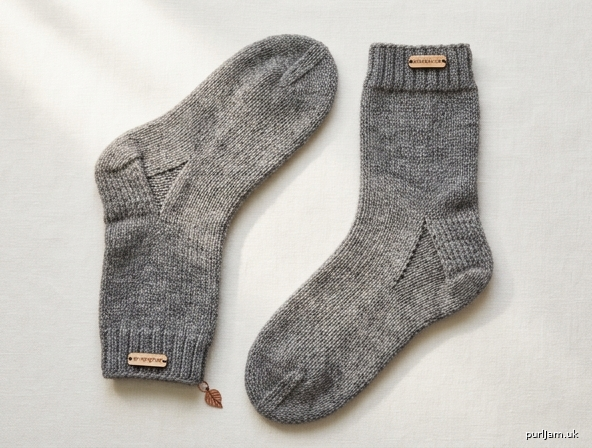
These warm, speedy socks are the perfect introduction to sock knitting. Worked in worsted weight yarn on 4 mm needles, they knit up much faster than traditional fingering-weight socks while teaching you all the classic techniques: ribbed cuff, heel flap, heel turn, gusset, and Kitchener-stitch toe. Wonderful as boot socks, bed socks, or cosy house socks.

---

## Sizes

| Size | Foot Circumference | Sts to Cast On |
|------|-------------------|----------------|
| Small (Child / Women's Small) | 18 cm (7") | 36 sts |
| **Medium (Women's Average)** | **20 cm (8")** | **40 sts** |
| Large (Men's Average) | 22 cm (8¾") | 44 sts |

Instructions are written for **Medium**, with **Small** and **Large** in brackets: M (S, L).

---

## Materials

- **Yarn**: Approx. 200–250 m (220–275 yds) worsted weight wool or wool blend (machine-washable sock yarn recommended). One 100 g ball is usually enough for a pair of Medium socks.
- **Needles**: 4 mm (UK 8 / US 6) — set of 5 double-pointed needles (DPNs), or one long circular for magic loop
- **Notions**: Tapestry / darning needle, stitch marker, scissors

---

## Tension (Gauge)

**20 sts × 28 rows = 10 cm (4") in stocking stitch** worked in the round on 4 mm needles, after gentle blocking.

> ⚠️ **Tension matters for socks!** Too loose and they slip; too tight and they pinch. Knit a small swatch in the round and adjust needle size if needed.

---

## Abbreviations (UK terminology)

- **k** – knit
- **p** – purl
- **st(s)** – stitch(es)
- **k2tog** – knit 2 sts together (right-leaning decrease)
- **ssk** – slip, slip, knit those 2 sts together through back loops (left-leaning decrease)
- **sl1** – slip 1 stitch purlwise
- **wyif** – with yarn in front
- **wyib** – with yarn in back
- **rep** – repeat
- **rnd(s)** – round(s)
- **RS / WS** – right side / wrong side

---

## Construction Overview

You will work each sock from the top down:
**Cuff → Leg → Heel Flap → Heel Turn → Gusset → Foot → Toe → Graft closed.**

### Setting Up Your Needles

**Using DPNs (4 needles holding sts + 1 working):**
Distribute 40 (36, 44) sts evenly: 10 (9, 11) sts per needle. Join in the round, being careful not to twist. Place a marker at the start of the round.

**Using Magic Loop:**
Divide stitches in half: 20 (18, 22) sts on each needle.

---

## CUFF

Cast on **40 (36, 44) sts** loosely. Join to work in the round, taking care not to twist.

**Rnd 1**: *k2, p2*; rep from * to end.
Repeat this round until cuff measures **4 cm (1½")**, approx. 11 rounds.

✅ *Check: total sts ÷ 4 = 10 (9, 11) rib repeats. 40 ÷ 4 = 10 ✓*

---

## LEG

Knit every round (stocking stitch) until leg measures **13 cm (5") from cast-on**, or your preferred length. End ready to begin a new round.

> 💡 *Try the sock on! The leg should reach mid-calf or wherever you like.*

---

## HEEL FLAP

The heel flap is worked back and forth on **half** the stitches. The other half waits on hold for the instep.

**Set up**: Knit the first **20 (18, 22) sts** onto one needle — these are your **heel sts**. Place the remaining **20 (18, 22) instep sts** on a holder or second needle; ignore them for now.

Turn work. You will now work in rows on the heel sts only.

**Row 1 (WS)**: sl1 wyif, p to end.
**Row 2 (RS)**: *sl1 wyib, k1*; rep from * to end.

Repeat Rows 1–2 a total of **10 times** (20 rows worked).

✅ *Check: 20 rows ÷ 2 = 10 slipped edge stitches along each side. You'll pick these up later for the gusset.*

End having just worked Row 1 (a WS purl row). You should now be ready for a RS row.

---

## HEEL TURN (Short Rows)

You'll now shape the cup of the heel using short rows.

**Row 1 (RS)**: k12 (11, 13), ssk, k1, turn. *(leaves sts unworked at end)*
**Row 2 (WS)**: sl1, p5 (5, 5), p2tog, p1, turn.
**Row 3 (RS)**: sl1, k to 1 st before the gap, ssk (closing the gap), k1, turn.
**Row 4 (WS)**: sl1, p to 1 st before the gap, p2tog (closing the gap), p1, turn.

Repeat Rows 3 and 4 until all heel sts have been worked. End with a RS row.

✅ *Check: Medium ends with **12 sts** on the heel needle. (Small: 10 sts; Large: 14 sts.)*

---

## GUSSET

Now you'll rejoin to work in the round and pick up stitches along the heel flap edges.

**Setup round (RS)**:
1. With the needle holding heel sts, **pick up and knit 10 sts** along the right edge of the heel flap (one in each slipped edge st).
2. Knit across the **20 (18, 22) instep sts**.
3. With a new needle, **pick up and knit 10 sts** along the left edge of the heel flap.
4. Knit across the first 6 heel sts. **This is now the new start of round** (centre of heel).

**Total sts on needles**: 52 (46, 56) sts.
✅ *Math check (Medium): 12 heel + 10 + 20 instep + 10 = 52 ✓*

Redistribute so that:
- **Needle 1 (sole, first half)**: 16 sts (6 heel + 10 picked up)
- **Needles 2 & 3 (instep)**: 20 sts
- **Needle 4 (sole, second half)**: 16 sts (10 picked up + 6 heel)

### Gusset Decreases

**Rnd 1 (decrease)**:
- Needle 1: k to last 3 sts, k2tog, k1
- Instep (Ndls 2/3): k all sts
- Needle 4: k1, ssk, k to end

**Rnd 2**: k all sts.

Repeat Rnds 1–2 until you are back to **40 (36, 44) sts** total.
✅ *Check (Medium): 52 − 40 = 12 sts decreased = 6 decrease rounds.*

---

## FOOT

Knit every round in stocking stitch until foot measures **5 cm (2") less than desired finished foot length**, measured from the back of the heel.

> 📏 *Average finished foot lengths: Small 22 cm (8¾"), Medium 24 cm (9½"), Large 26 cm (10¼"). Try on as you go!*

---

## TOE

You'll decrease 4 sts every other round to shape the toe.

**Rnd 1 (decrease)**:
- Needle 1 (sole half 1): k to last 3 sts, k2tog, k1
- Instep: k1, ssk, k to last 3 sts, k2tog, k1
- Needle 4 (sole half 2): k1, ssk, k to end

**Rnd 2**: k all sts.

Repeat Rnds 1–2 until **20 (16, 24) sts** remain, then work Rnd 1 only (no plain rnds) until **16 sts** remain on all sizes.

✅ *Check (Medium): 40 → 20 sts via alternate decreases (5 decrease rounds), then 20 → 16 via consecutive decreases (1 round). Final: 8 sts sole + 8 sts instep ✓*

---

## FINISHING

### Kitchener Stitch (Grafting the Toe)

Cut yarn leaving a **40 cm (16") tail**. Arrange sts so 8 are on a front needle (instep) and 8 are on a back needle (sole), with needles parallel. Thread tail onto a tapestry needle.

**Setup**:
- Front needle: insert tapestry needle **purlwise**, pull through, leave st on.
- Back needle: insert **knitwise**, pull through, leave st on.

**Repeat**:
1. Front: **knitwise**, slip st off. Front: **purlwise**, leave on.
2. Back: **purlwise**, slip st off. Back: **knitwise**, leave on.

Continue until all sts have been worked off. Pull tail through to inside, weave in securely.

> 🎥 *If you're new to Kitchener, search "Kitchener stitch tutorial" — seeing it once makes it click!*

### Weave in Ends & Block

Weave in all yarn ends on the WS. Wet block by soaking in cool water with a little wool wash, gently squeezing out water, and laying flat to dry (or use sock blockers).

---

## 🧦 Make the Second Sock!

Repeat the entire pattern to make a matching sock. **Congratulations — you've made a pair!**

---

## Beginner Tips

- **Ladders between needles?** Give the first stitch on each new needle an extra tug.
- **Heel flap holes?** Pick up one extra stitch in the corner where the flap meets the instep and k2tog it on the next round.
- **Foot too long?** Frog back to before the toe and knit a few more rounds — easy fix with cuff-down construction.
- **Save your tension swatch** to use as a darning patch later!

Enjoy your warm, hand-knit socks. ❤️
Disclaimer: This pattern was generated by AI and should be reviewed for accuracy before use. While we strive for quality, AI-generated content may contain errors. Please verify measurements, stitch counts, and instructions before beginning your project. Generated by purlJam.uk
Access your pattern anytime
Bookmark this page to access your pattern anytime